

Sensitive Teeth and Enamel Erosion: Causes and What Actually Helps
Key Takeaways
- Enamel contains no living cells, so once it is worn away it cannot regrow; toothpastes can help remineralize softened surfaces but no product has shown enamel regrowth in human trials.
- Enamel begins dissolving when the pH at its surface drops below about 5.5, and most sodas, sports drinks and citrus juices sit between pH 2.5 and 3.5.
- Sensitivity that lasts a second or two after a trigger points to exposed dentin, while pain that lingers for minutes or starts on its own suggests pulp inflammation that needs prompt dental care.
- Desensitizing toothpastes containing potassium nitrate, stannous fluoride or arginine have moderate-quality evidence from multiple randomized trials, with relief building over two to four weeks and fading when use stops.
- Brushing within 30 to 60 minutes of acidic food or drink strips mineral from temporarily softened enamel, which is why rinsing with water and waiting is widely recommended.
- A tooth abscess cannot be treated at home; salt water, clove oil and vanilla extract may briefly soothe but the infection requires a dentist to remove its source.
Sensitive teeth usually happen when protective enamel wears thin or gums recede, exposing dentin, the porous layer that carries sensations toward the tooth's nerve. Common causes include acidic foods and drinks, acid reflux, hard brushing, grinding and whitening. Desensitizing toothpastes and professionally applied fluoride have the strongest trial evidence for easing symptoms; enamel that is already lost does not grow back. Persistent, worsening or spontaneous tooth pain needs a dental exam.
The video has nine million views. A woman bites into a lemon wedge, winces theatrically, then holds up a tube of toothpaste that she says will “grow your enamel back in two weeks.” The comments are a mix of hope and skepticism, and the search traffic tells the rest of the story: as of January 2026, questions about sensitive teeth and enamel erosion are climbing faster than almost any other dental topic, driven by a wave of viral remineralizing claims, homemade “enamel pastes” and a renewed debate about fluoride.
Some of that attention is welcome. Dentin hypersensitivity, the clinical name for that electric jolt when cold water or a spoonful of ice cream touches a tooth, is one of the most under-reported complaints in dentistry. Estimates vary widely, but somewhere between roughly one in eight and one in three adults experiences it at some point.
Much of the online advice, though, blurs three very different things: a thinning surface, a receding gum and an infected tooth. They feel similar from the inside. They are not treated the same way, and getting the distinction right is the difference between a quieter tooth and a lost one.
What changed recently in the sensitive teeth conversation
Three threads have braided together to push this topic into the spotlight. The first is a flood of social media content promising that specific toothpaste ingredients, most often hydroxyapatite, can rebuild enamel. Hydroxyapatite is the calcium phosphate mineral that makes up about 96 percent of natural enamel, so the idea sounds plausible. We will look at what the trials actually show later; the short version is that these products can help with surface mineral repair and symptom relief, but no toothpaste has been shown in human trials to regrow enamel that is already gone.
The second thread is scale. The World Health Organization’s most recent global oral health data, published in its 2022 Global Oral Health Status Report and summarized in its current fact sheet, estimates that oral diseases affect about 3.5 billion people worldwide, with untreated tooth decay in permanent teeth alone affecting roughly 2 billion. Erosive tooth wear is not tracked as precisely, but dentists across high-income countries report seeing it more often, particularly in younger adults who drink sparkling water, energy drinks or fruit-based smoothies throughout the day.
The third thread is fluoride. Public conversations about community water fluoridation have intensified, and whatever the policy outcome in any given town, the practical effect has been a spike in people asking how to protect their own enamel. The Centers for Disease Control and Prevention continues to describe fluoride’s mechanism plainly: it helps enamel resist acid and supports remineralization of early damage.
What has not changed is the biology. Enamel contains no living cells, which is why it cannot heal the way skin or bone does. That single fact explains most of what follows.
What is actually happening inside a sensitive tooth?
Picture a tooth as a three-layer structure. On the outside is enamel, the hardest substance in the human body, which has no nerves of its own. Beneath it sits dentin, a bone-like tissue riddled with microscopic channels called dentinal tubules. At the center is the pulp, the soft core of blood vessels and nerve fibers that gives the tooth its sensation.
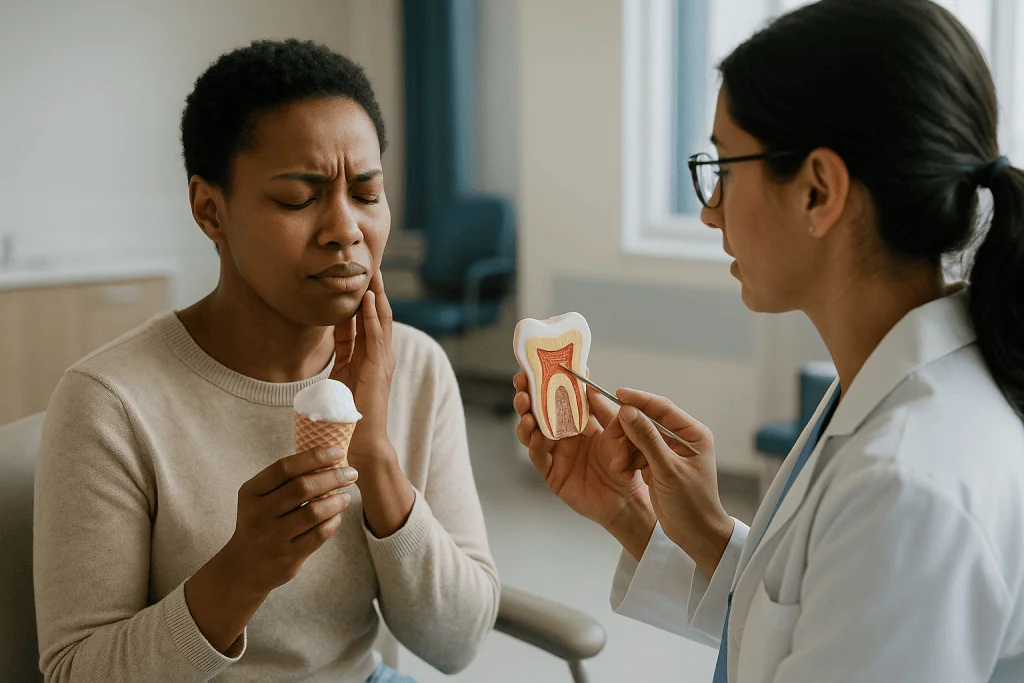
Dentin is where sensitivity lives. Each square millimeter of exposed dentin can contain tens of thousands of tubules, and each tubule is filled with fluid that connects, directly or indirectly, to the nerve endings near the pulp. The leading explanation for sensitivity, called the hydrodynamic theory, holds that anything that shifts this fluid, such as a cold drink that makes it contract or a sugary one that pulls water outward by osmosis, tugs on nerve endings and fires a sharp, brief pain. That is why the pain is typically immediate, intense and short-lived rather than throbbing.
Healthy teeth are protected on two fronts. Above the gumline, enamel seals the dentin. Below it, the gum and a thin layer of cementum on the root do the same job. When either barrier is breached, tubules are open to the mouth, and the tooth becomes a tiny weather station reacting to every change in temperature, sweetness and pressure.
Two practical consequences follow. First, the pain of a genuinely sensitive tooth should stop within seconds of removing the trigger. Pain that lingers for minutes or starts on its own suggests something has reached the pulp itself, which is a different problem. Second, treatments work in one of only two ways: they either block the tubules or quiet the nerve. Everything on the market that has evidence behind it does one of those two things.
Enamel erosion vs. tooth decay: what is the difference?
The two most common enamel problems are routinely confused online, yet they have different causes and different fixes. Tooth decay, or caries, is a bacterial process. Plaque bacteria feed on sugars and produce acid in localized pockets, dissolving enamel from a specific point inward and eventually forming a cavity. It is site-specific, often hidden between teeth or in grooves, and it progresses whether or not you feel it.
Enamel erosion is chemical, not bacterial. It happens when acid from food, drink or the stomach bathes the tooth surface directly and dissolves mineral evenly across broad areas. Enamel begins to lose mineral once the pH at its surface drops below about 5.5. Many sodas, sports drinks and citrus juices sit around pH 2.5 to 3.5. Stomach acid can be lower still. Erosion tends to show up as smooth, shiny, cupped surfaces on the chewing edges of molars, a glassy look to the front teeth, or a yellowish tint as the thinner enamel lets the dentin color show through.
A third process, abrasion, is mechanical wear from a hard toothbrush, gritty paste or habits such as chewing ice. In real mouths these three often overlap: softened enamel after an acidic drink is far more vulnerable to the toothbrush that follows it.
Why does the distinction matter? Decay needs the bacteria and sugar supply addressed, and an established cavity needs a restoration. Erosion needs the acid source found and controlled; no filling fixes a daily habit. The Mayo Clinic’s guidance on cavities and the Cleveland Clinic’s guidance on tooth sensitivity both point to the same first step for either problem: a dental exam to identify which one, or which combination, is actually happening.
What causes enamel erosion in the first place?
Acid has to come from somewhere, and dentists sort the sources into two groups. Extrinsic acids arrive through the mouth. Intrinsic acids come up from the stomach.

Among extrinsic sources, pattern matters more than quantity. One glass of orange juice with breakfast does far less damage than the same volume sipped across a morning, because each sip resets the clock on the half hour or so that saliva needs to buffer the mouth back to a neutral pH. Carbonated water is mildly acidic and generally low risk on its own, but flavored sparkling waters with added citric acid, sour candies, wine, kombucha and energy drinks are in a different league. Some medicines, including chewable vitamin C and certain aspirin forms, are acidic enough to matter when held in the mouth.
Intrinsic acid is the quieter culprit. Gastroesophageal reflux disease, often shortened to GERD, is the condition in which stomach acid regularly flows back into the esophagus and sometimes the mouth. Many people with reflux have no heartburn at all, and a dentist noticing erosion on the inner surfaces of the upper teeth is sometimes the first person to suspect it. Repeated vomiting from any cause, including eating disorders, severe morning sickness or chronic alcohol use, produces a similar pattern.
Dry mouth multiplies every other risk. Saliva is the body’s own remineralizing rinse, supplying calcium and phosphate and neutralizing acid. Hundreds of common medicines reduce saliva flow, as do radiation to the head and neck and conditions such as Sjögren’s syndrome, an autoimmune disorder that attacks moisture-producing glands.
Brushing within minutes of an acid exposure, while the surface is still softened, strips away mineral that saliva might otherwise have rescued. Waiting is a genuinely protective habit.
Why do my teeth suddenly hurt with cold, sweets or a breath of air?
Sudden sensitivity has a short list of usual suspects, and the pattern of the pain narrows it quickly.
If many teeth became sensitive at once, especially after a change in routine, think of something that affected the whole mouth. A new whitening product, a switch to a harder toothbrush or more vigorous technique, a new acidic drink habit, a recent illness with vomiting, or a stressful period that brought on nighttime clenching and grinding (bruxism, the medical term for grinding or clenching teeth, usually during sleep) can all expose dentin broadly. Cold winter air triggering front teeth is a classic sign of early enamel thinning or minor gum recession on those teeth.
If a single tooth is the problem, look for something local. A small crack, often invisible, can open under chewing pressure and let cold reach the dentin. A filling that has worn or chipped at its edge does the same. A cavity that has reached dentin frequently announces itself first as sweet sensitivity, because sugar creates an osmotic pull on tubule fluid. Recent dental work can leave a tooth touchy for days to a few weeks as the pulp settles; this normally eases on its own.
Timing is the most useful clue of all. A tooth that zings for a second or two and then stops is behaving like classic dentin hypersensitivity. A tooth that aches for minutes after cold, or that wakes you at night, or that now hurts with heat as well as cold, is giving signs of pulp inflammation, called pulpitis. That pattern deserves prompt attention rather than a new toothpaste.
MedlinePlus lists cavities, cracked teeth, exposed roots and gum disease as the most common causes of toothache. Sudden sensitivity sits on the same list, just earlier in the story.
Gum recession: the other common reason for sensitive teeth
Enamel gets most of the attention, but a large share of sensitive teeth are sensitive below the gumline, not above it. Tooth roots have no enamel. They are covered by cementum, a thin mineralized layer that is softer than enamel and easily worn away. When the gum pulls back and exposes the root, the dentin beneath is often open to the mouth within months.
Gum recession has several drivers, and they often stack. Periodontal disease, the chronic infection and inflammation of the tissues that anchor teeth, destroys the bone that supports the gum, and the gum follows the bone downward. Overly forceful brushing, especially with a stiff brush and a side-to-side scrubbing motion, abrades gum tissue over years. Some people simply inherit thin gum tissue that recedes more readily. Teeth that are crowded or tilted, orthodontic movement, lip or tongue piercings rubbing against the gum, and clenching habits all contribute.
The giveaway is location. Recession-related sensitivity typically shows up along the gumline of the canine and premolar teeth, where brushing pressure concentrates, and often on one side of the mouth more than the other, matching a right-handed or left-handed brushing habit. Many people notice their teeth look longer, or they can feel a notch where the root meets the crown.
Treatment follows cause. Where gum disease is active, controlling the infection with professional cleaning comes first; desensitizing products are a poor substitute. Where brushing is the issue, changing technique and switching to a soft brush can stop the progression, though it will not restore lost tissue. For severe or cosmetically significant recession, periodontists can perform grafting procedures that cover exposed roots. Evidence from clinical trials supports root coverage for reducing sensitivity in selected cases, but it is surgery, and the decision belongs in a conversation with the treating dentist.
Does teeth whitening cause sensitive teeth?
Yes, often, and usually temporarily. Whitening products rely on hydrogen peroxide or carbamide peroxide, which breaks down into hydrogen peroxide. These molecules are small enough to pass through enamel and dentin and reach the pulp, where they appear to trigger a brief inflammatory response. The result is the sharp, often unprovoked zinger that many people describe during or after a whitening course.
Randomized trials of both in-office and at-home whitening consistently report sensitivity in a substantial minority to a majority of participants, depending on concentration and duration, with symptoms typically peaking during treatment and resolving within a few days of stopping. Several trials have found that using a potassium nitrate desensitizing toothpaste for a week or two before and during whitening reduces the intensity of sensitivity. Evidence quality here is moderate: the studies are small but reasonably consistent.
Whitening does not, in the way the viral videos imply, melt away enamel. Laboratory studies show minimal changes to enamel surface hardness at the concentrations found in regulated products used as directed. The real risks come from misuse: leaving strips on far longer than instructed, using unregulated products of unknown strength, or whitening over existing erosion, recession or untreated decay, where peroxide has an open highway to the pulp.
Charcoal-based and abrasive “whitening” pastes are a different story. They remove surface stain by scouring, and over time a highly abrasive paste can contribute to enamel and cementum wear. They do not lighten the underlying tooth color at all.
If whitening makes a tooth hurt for more than a few seconds at a time, or if the pain continues more than a few days after stopping, that is a sign to pause and have the tooth examined. A dentist can also check for the kinds of damage that whitening should never be done over.
What the evidence actually says about treatments for sensitive teeth
This is where honesty matters most, because the gap between what sells and what has been tested is wide.
Desensitizing toothpastes: moderate-quality evidence from multiple randomized trials. Potassium nitrate works by calming the nerve; it is thought to reduce the nerve’s ability to fire. Stannous fluoride, arginine with calcium carbonate, and calcium sodium phosphosilicate work by plugging the tubules. Systematic reviews of dozens of trials find that all of these outperform ordinary fluoride toothpaste for reducing sensitivity, with differences between them that are modest and inconsistent. Effects build over two to four weeks of twice-daily use and fade when use stops. The trials are generally short, often industry-funded, and measure pain on subjective scales, which is why the grade is moderate rather than strong.
Professionally applied fluoride varnish and bonding agents: moderate evidence. Trials show meaningful short-term reduction in sensitivity when a dentist seals exposed dentin. Durability varies, and repeat application is common.
Hydroxyapatite toothpastes: low to moderate evidence. A handful of randomized trials, several of them small, suggest hydroxyapatite reduces sensitivity about as well as potassium nitrate or fluoride pastes over a few weeks. That is encouraging. It is not evidence of enamel regrowth, and no trial has shown restoration of lost enamel thickness in people.
Lasers: low-quality, mixed evidence. Some trials report benefit, others none, and study designs vary widely.
Behavior change: expert opinion supported by laboratory data. Reducing acid exposure, waiting to brush after acidic meals and using a soft brush have strong mechanistic backing but have rarely been tested in randomized trials, for the simple reason that you cannot blind someone to their own diet.
The honest summary: the best-supported approach combines a desensitizing paste, a professional assessment and a change to whatever is causing the exposure. None of it reverses the damage; all of it can make the tooth comfortable.
Sensitive teeth treatment options at a glance
The table below summarizes the main options people encounter, how they are thought to work and how strong the supporting evidence is. It is a map, not a prescription; which option fits depends on why the dentin is exposed, which only an exam can establish.
| Option | How it is thought to work | Strength of evidence | What to realistically expect |
|---|---|---|---|
| Potassium nitrate toothpaste | Calms nerve response in the pulp | Moderate; many randomized trials | Gradual relief over 2–4 weeks; wears off if stopped |
| Stannous fluoride toothpaste | Blocks dentinal tubules; strengthens enamel | Moderate; many randomized trials | Relief in 2–4 weeks; may cause mild surface staining |
| Arginine or calcium phosphosilicate paste | Deposits a calcium-rich plug in tubules | Moderate; several randomized trials | Comparable to potassium nitrate in most trials |
| Hydroxyapatite toothpaste | Deposits mineral on surface and in tubules | Low to moderate; few, small trials | Symptom relief similar to fluoride pastes; no regrowth |
| In-office fluoride varnish | Seals exposed dentin; supports remineralization | Moderate; several randomized trials | Rapid relief; often needs repeating |
| Dental bonding or sealants | Physically covers exposed dentin | Moderate; small trials | Durable months to years; may need replacement |
| Gum grafting | Covers exposed root with tissue | Moderate for selected cases | Surgical; addresses recession, not enamel loss |
| Laser treatment | Seals tubules or alters nerve response | Low; mixed results | Unpredictable benefit |
| Oil pulling, clove oil, vanilla extract | Various folk mechanisms | Very low; no controlled trials for sensitivity | Temporary numbing at best; no effect on cause |
Two patterns stand out. The options with the most consistent trial support are the least glamorous: a tube of paste and a dentist’s varnish brush. And nothing on the list, including the newest ingredients, has demonstrated regrowth of enamel in human studies. The strongest tool for enamel remains the one that is easiest to overlook: stopping the acid before it arrives.
What could be causing sudden toothache and jaw pain?
When tooth pain arrives with jaw pain, the body is often telling you that the problem has spread beyond a single tooth surface, or that it never started in a tooth at all.
The most common dental explanation is infection. Decay that reaches the pulp causes pulpitis, and if the pulp dies, bacteria can spread through the root tip into the jawbone, forming an abscess, a pocket of pus that produces deep, throbbing pain, tenderness when biting and sometimes swelling of the gum, cheek or jaw. Pain from an abscess frequently radiates to the ear, the temple or along the jaw, so a lower molar infection can feel like a sore jaw joint.
Bruxism is the second frequent cause. People who clench or grind during sleep often wake with aching jaw muscles, a dull headache near the temples and teeth that feel bruised or sensitive to cold. The teeth themselves may show flattened edges or tiny chips.
Temporomandibular joint disorders, problems with the hinge joint just in front of the ear and the muscles that move it, produce jaw pain, clicking and sometimes referred pain into the teeth. A cracked tooth can cause sharp pain on release of a bite that seems to come from the whole side of the face. Sinus infections commonly make upper back teeth ache, because their roots sit just beneath the sinus floor.
Rarely, jaw pain with no dental cause is cardiac. Angina and heart attack can present as pain in the lower jaw, particularly on exertion and particularly in women and older adults. The American Heart Association lists jaw pain among recognized heart attack warning signs. Jaw pain that comes with chest pressure, breathlessness, sweating or nausea is an emergency, not a dental appointment.
The NHS advises seeing a dentist for toothache lasting more than two days, and seeking urgent care for swelling of the face or jaw, fever or difficulty swallowing.
Home remedies for tooth infections and tooth pain: what is honest
Search engines are full of kitchen-cupboard fixes, and the most common questions deserve plain answers.
Can a tooth infection be treated at home? No. An abscess is a bacterial infection inside a space that cannot drain on its own. Rinses do not reach it. Untreated, it can spread to the jaw, the neck and, rarely, the bloodstream. The only effective treatment is removing the source, through root canal treatment or extraction, sometimes with antibiotics prescribed by a dentist or doctor for spreading infection. Home measures can make the wait more bearable; they cannot replace the appointment.
Does salt water help? Warm salt water rinses are recommended by the NHS and others as a soothing measure that can reduce surface irritation and help keep an area clean. Evidence is expert opinion rather than trials. It is safe, cheap and modest in effect.
What about clove oil? Clove’s active compound, eugenol, has genuine numbing and antibacterial properties and has been used in dental materials for over a century. Undiluted oil applied at home can burn gum tissue and, swallowed in quantity, is toxic, particularly to children. Trials of home use for toothache are lacking.
Can vanilla extract help with tooth pain? There are no clinical studies on vanilla for toothache. The folk logic rests on its alcohol content producing a brief numbing sensation and vanillin having mild antioxidant activity in the laboratory. Any effect is fleeting and does nothing for the cause. It is not harmful in small amounts; it is simply not a treatment.
What medication can I take for tooth pain? Over-the-counter pain relievers are widely used to manage toothache while awaiting care, and reviews of randomized trials support their short-term effectiveness for dental pain. Which product is appropriate depends on your other medicines and health conditions, so ask a pharmacist, dentist or physician rather than a video. Pain relief is a bridge to treatment, never a reason to skip it.
Common myths about sensitive teeth and enamel erosion
The viral claims tend to repeat a handful of misunderstandings. Here are the ones that cause the most harm.
“Enamel grows back if you use the right paste.” Enamel has no living cells and cannot regenerate. What toothpaste can do is help redeposit mineral into microscopically softened enamel before it is lost, a process called remineralization. That is valuable and real, but it repairs the surface of what remains; it does not rebuild thickness that has worn away. No product has shown enamel regrowth in human trials.
“Sensitivity means you have a cavity.” Sometimes, but most sensitive teeth are caused by exposed dentin from erosion or recession, not decay. Conversely, many cavities cause no sensitivity at all until they are large. Sensation is an unreliable detector either way.
“Brush harder to remove the stain and the sensitivity.” Force does not remove more plaque; it removes gum and cementum. A soft brush used with gentle, small circular motions cleans as effectively and protects the root surfaces where sensitivity starts.
“Brush right after every meal.” After acidic food or drink, enamel is temporarily softened. Brushing in that window removes mineral that saliva would otherwise restore. Rinsing with water and waiting 30 to 60 minutes is the widely recommended expert approach.
“Sparkling water is as bad as soda.” Plain carbonated water is mildly acidic and has shown minimal erosive effect in laboratory studies. Flavored versions with added citric or malic acid are considerably more erosive, and sugared sodas combine acid with the fuel for decay.
“Lemon water detoxes your body.” There is no evidence for detoxification, and daily lemon water held or sipped slowly is one of the most frequent erosion patterns dentists encounter in otherwise health-conscious patients.
“Oil pulling whitens teeth and heals gums.” Small, low-quality studies suggest a modest reduction in plaque. Nothing supports whitening or reversal of sensitivity.
How do you protect enamel day to day?
Because enamel cannot be rebuilt, protection is where the leverage is. The habits below are supported by a mix of mechanistic data, observational studies and expert consensus; few have been tested in randomized trials, but the underlying chemistry is well established.
Start with the pattern of acid, not its total. Having acidic drinks with meals rather than between them, and finishing them in one sitting rather than sipping for an hour, cuts the number of times the mouth drops below the critical pH. A straw placed toward the back of the mouth reduces contact with the front teeth. Rinsing with plain water afterward, or finishing a meal with a piece of cheese, helps saliva neutralize acid faster; dairy also supplies calcium and phosphate.
Wait before brushing after anything acidic. Half an hour is the common recommendation; an hour is safer. Brush twice daily with a soft brush and a fluoride toothpaste, using light pressure. Electric brushes with pressure sensors can retrain a heavy hand.
Fluoride remains the most thoroughly studied protective ingredient in dentistry. The CDC describes its dual action: it makes enamel more resistant to acid dissolution and promotes remineralization of early lesions. For people with significant erosion or dry mouth, a dentist may recommend higher-strength fluoride products or professionally applied varnish; those decisions belong with the clinician.
Treat the source when it is internal. Reflux that reaches the mouth needs medical evaluation. Frequent vomiting of any cause needs the underlying condition addressed. Dry mouth from medication warrants a conversation with the prescribing doctor about alternatives or saliva substitutes; never stop a prescribed medicine on your own.
Finally, protect against mechanical wear. A custom night guard from a dentist can shield teeth from grinding. Avoid chewing ice and using teeth as tools. The enamel you keep is the enamel you have.
When to see a doctor or dentist about sensitive teeth
Most tooth sensitivity is uncomfortable rather than dangerous, and a few weeks of a desensitizing toothpaste plus gentler habits settles many cases. Some patterns, though, point to a problem that will not wait, and a professional exam is the only way to tell exposed dentin from a dying pulp.
Book a routine dental appointment if sensitivity persists beyond three to four weeks despite a desensitizing paste, if it is clearly worsening, if you can see a notch, chip or dark spot on the affected tooth, or if your gums look like they are receding. A dentist will test the tooth’s response to cold and pressure, check for cracks and decay, examine the gums, and may take X-rays to see what the surface hides. From there the options run from reassurance and a paste recommendation to varnish, bonding, a filling or a referral.
Seek care within a day or two for these signs:
- Pain that lingers for more than a few seconds after a cold or hot trigger is removed
- Pain that starts on its own, especially at night or when lying down
- A tooth that hurts when you bite or release a bite
- Toothache lasting more than two days
- Sensitivity in a tooth that has recently had a filling or crown and is getting worse rather than better
Treat the following as urgent, same-day problems, through an emergency dental service or, if a dentist is unavailable, an urgent care clinic or emergency department:
- Swelling of the face, jaw or neck, or a visible lump on the gum
- Fever alongside toothache
- Difficulty swallowing, breathing or fully opening the mouth
- A bad taste or pus discharge in the mouth
- Jaw pain accompanied by chest pressure, breathlessness, sweating or nausea, which may signal a heart problem rather than a dental one
Any decision about prescription medicines, antibiotics, pain relief or procedures rests with the treating clinician, who can see the whole picture.
Frequently asked questions
What is the most common cause of sensitive teeth?
Exposed dentin is the common thread, usually from either thinning enamel caused by acid erosion or receding gums that uncover the tooth root. Dentin contains thousands of fluid-filled tubules per square millimeter that connect to the nerve, so cold, sweet or air moves that fluid and fires a sharp, brief pain. Hard brushing, grinding and whitening are frequent contributors.
Can enamel erosion be reversed?
Not once enamel is physically lost. Enamel has no living cells, so it cannot regenerate the way skin or bone does. What can be reversed is early softening, through remineralization with saliva, fluoride and calcium phosphate minerals. Protecting the enamel that remains, by controlling acid exposure and waiting to brush after acidic meals, is the only reliable long-term strategy.
How long does it take for desensitizing toothpaste to work?
Most randomized trials show measurable improvement after two to four weeks of twice-daily use, with further gains over eight weeks. The effect depends on continued use and generally fades within weeks of stopping. If a desensitizing paste has not helped at all after a month, the cause may be something a paste cannot address, such as a crack, cavity or active gum disease, and a dental exam is the next step.
Why are my teeth suddenly sensitive to cold?
Sudden cold sensitivity across many teeth often follows a change: a new whitening product, harder brushing, a new acidic drink habit, illness with vomiting or stress-related grinding. Sensitivity in a single tooth more often signals a crack, a worn filling or decay reaching dentin. Cold pain that lingers for minutes rather than seconds suggests pulp inflammation and should be examined promptly.
Does sparkling water cause enamel erosion?
Plain carbonated water is mildly acidic and has shown very little erosive potential in laboratory studies, so it is a reasonable choice for most people. Flavored sparkling waters containing added citric or malic acid are considerably more erosive, and sipping them steadily through the day is the pattern most likely to cause damage. Having them with meals and rinsing with plain water afterward reduces the risk.
What could be causing my sudden toothache and jaw pain together?
The most common dental cause is infection spreading from a tooth into the jawbone as an abscess, which produces throbbing pain that radiates along the jaw or toward the ear. Nighttime clenching and grinding, temporomandibular joint problems, a cracked tooth and sinus infections are other frequent explanations. Jaw pain with chest pressure, breathlessness or sweating can signal a heart attack and needs emergency care.
Are there home remedies for a tooth infection?
No home remedy treats a tooth infection. An abscess sits in an enclosed space that rinses cannot reach, and it can spread to the jaw and neck if left alone. Warm salt water rinses and over-the-counter pain relief recommended by a pharmacist can make the wait more comfortable, but the infection itself requires a dentist to remove its source, through root canal treatment or extraction, sometimes with prescribed antibiotics.
Can vanilla extract help with tooth pain?
There are no clinical studies showing that vanilla extract relieves tooth pain. The folk explanation relies on its alcohol content producing a brief numbing sensation on the gum. Any effect lasts minutes and does nothing for the underlying cause, whether that is exposed dentin, a crack or an infection. It is not harmful in small amounts, but it should not delay a dental appointment.
Does hydroxyapatite toothpaste regrow enamel?
No. Hydroxyapatite is the same calcium phosphate mineral that makes up most of natural enamel, and a few small randomized trials suggest hydroxyapatite toothpaste reduces sensitivity about as well as potassium nitrate or fluoride pastes over several weeks. That is useful for symptoms. No trial in people has shown it restores lost enamel thickness, and claims of regrowth are not supported by the evidence.
When should I see a dentist about sensitive teeth?
See a dentist if sensitivity lasts beyond three to four weeks despite a desensitizing toothpaste, if it is getting worse, or if you notice a chip, notch, dark spot or receding gum. Seek care within a day or two for pain that lingers after a trigger, starts on its own or hurts on biting. Facial swelling, fever or difficulty swallowing are same-day emergencies.
References
- Cleveland Clinic: Teeth Sensitivity
- MedlinePlus: Toothaches
- NHS: Toothache
- World Health Organization: Oral Health Fact Sheet
This article is for general information only and is not a substitute for professional medical advice. Please consult a qualified doctor about your individual situation.

More from the Blog

BPPV: The Most Common Cause of Vertigo and the Maneuver That Fixes It
BPPV (benign paroxysmal positional vertigo) is the most common cause of vertigo. Loose calcium crystals drift into an inner-ear canal and send false motion…

Bad Breath: The Causes Beyond Brushing, From Tonsil Stones to Reflux
Most bad breath, roughly nine in ten cases by dental estimates, begins in the mouth: sulfur-producing bacteria on the back of the tongue, gum…

TMJ Exercises: The Jaw Routine Physiotherapists Use
TMJ exercises are gentle jaw movements physiotherapists teach to relax the chewing muscles, restore smooth opening and retrain jaw posture. Small randomized trials and…

How Often Should You Have an Eye Exam? The Schedule by Age and Risk
Healthy adults without symptoms or risk factors are generally advised to have a baseline comprehensive eye exam at age 40, then one every two…

OTC Hearing Aids and AirPods as Hearing Aids: What Changed and Who Benefits
OTC hearing aids are FDA-regulated devices that adults 18 and older can buy and fit themselves for perceived mild to moderate hearing loss, a…

Cavities in Adults: Why They Still Happen and Whether Early Decay Can Reverse
Cavities still happen in adults because bacteria in plaque turn sugars into acid, and when acid attacks outnumber saliva's repair cycles, enamel loses mineral…