

Snap-In Dentures: How Removable Implant Dentures Work Day to Day
Key Takeaways
- A lower snap-in denture typically needs only two implants, while a palate-free upper usually requires four or more because upper bone is softer and the denture works against gravity.
- The nylon retention inserts are designed to wear out and generally need replacing every six to eighteen months: a normal maintenance item, not a product failure.
- Snap-in dentures should come out every night; sleeping in any denture traps plaque against the gums and raises the risk of inflammation and denture-related fungal irritation.
- Bone must fuse to the implants for roughly three to six months (osseointegration) before the final denture snaps into full function, so plan on a multi-month timeline.
- With enough upper implants, the denture can be made horseshoe-shaped, leaving the palate uncovered, many wearers report noticeably better taste and temperature perception.
- Implants transmit chewing force into the jawbone the way tooth roots once did, which helps preserve bone around them: the shrinkage of an unstimulated ridge is a main reason conventional dentures loosen over the years.
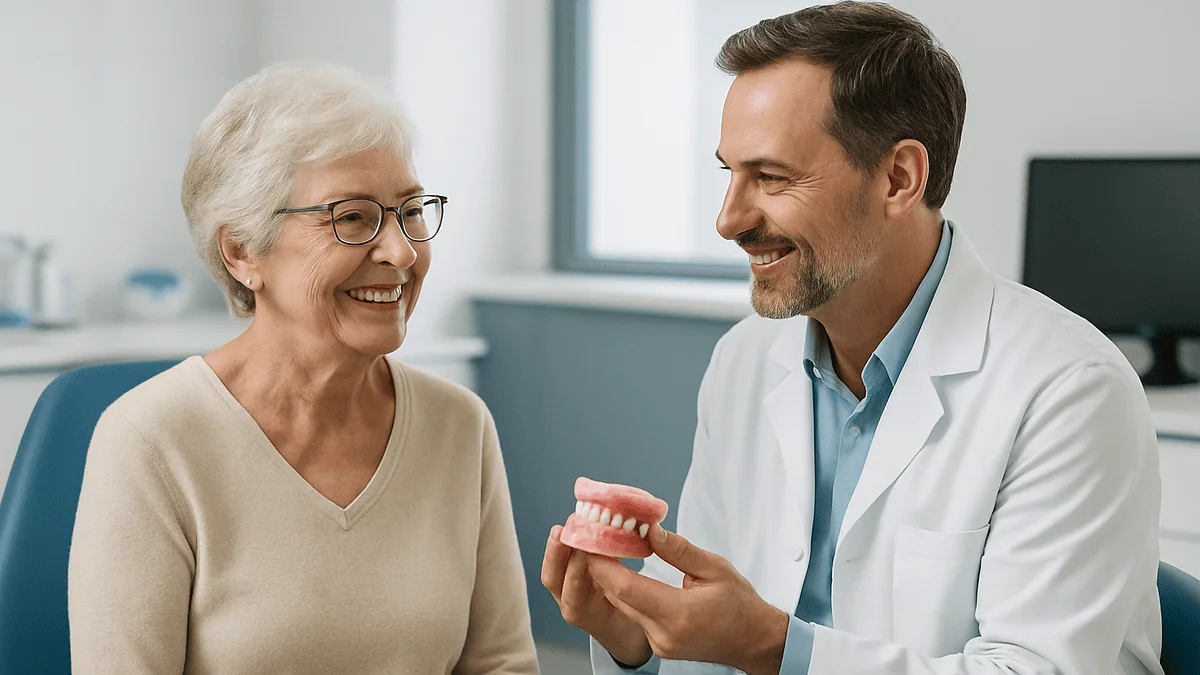
Snap-in dentures are removable overdentures that click onto two to six dental implants instead of resting on the gums alone. Small attachments on the implants lock into housings inside the denture, holding it steady for chewing and speaking, yet it still comes out nightly for cleaning. They generally offer better stability and bite strength than conventional dentures, but cost more and require periodic maintenance.
Watch someone with a loose lower denture eat a BLT. The sandwich gets cut into polite little squares. Chewing happens carefully, on one side, tongue quietly holding the plate in place. A laugh arrives with a hand half-raised to the mouth, just in case. None of this shows up on an X-ray, but it shapes every meal.
That quiet workaround is exactly the problem snap-in dentures were designed to solve. The lower jaw is the classic trouble spot: a conventional lower denture floats on a shrinking, horseshoe-shaped ridge with no suction to help it, which is why prosthodontists have long considered it the least satisfying prosthesis in dentistry.
Add two small implants and a pair of snaps, and the physics change. The plate stops depending on gravity, gum contours, and adhesive paste. This article walks through how that works hour by hour, the clicking on, the eating, the nightly cleaning, along with the honest drawbacks and costs the glossier guides tend to skip.
What exactly is a snap-in denture?
A snap-in denture, dentists usually say implant-retained overdentureis a full denture with small sockets built into its underside. Those sockets click onto attachments mounted on dental implants: titanium posts placed in the jawbone that fuse with it over several months, a process called osseointegration, as described by the Mayo Clinic.
Two details separate it from everything else on the tooth-replacement menu. First, it is removable. You take it out every night, exactly as you would a conventional denture. Second, it is retained by implants but still partly supported by your gums: the implants keep it from lifting or sliding, while the pink acrylic base still rests on the ridge and shares chewing load with the soft tissue.
The typical configuration is modest: two implants for a lower denture, and usually four or more for an upper, because upper bone is softer and the denture fights gravity. A widely cited 2002 consensus of prosthodontic researchers (often called the McGill consensus) went as far as recommending the two-implant lower overdenture, not the conventional denture, as the minimum standard of care for people missing all their lower teeth. That is an unusually strong statement in a field that hedges by habit, and it reflects how consistently studies show better stability, chewing function, and patient satisfaction with the snap-in design on the lower jaw.
What it is not: a fixed bridge. If you have seen ads for teeth that never come out, that is a different, more implant-heavy, more expensive product. The snap-in version is the middle path.
How does the snap mechanism actually work?
The engineering is closer to a jacket snap than to anything high-tech. Each implant carries an abutment: a small connector that pokes just above the gumline. The most common style is a low, dome-shaped stud attachment. Inside the denture sit matching metal housings, each holding a colored nylon insert. Press the denture down, the nylon flexes over the stud, and it seats with a distinct click you can feel and often hear.
Those nylon inserts are the consumable part of the system, and understanding that saves a lot of frustration later:
- They come in different retention strengths, color-coded, so your dentist can tune how firmly the denture grips, snug enough for corn on the cob, loose enough that arthritic hands can still remove it.
- They wear with every insertion and removal. Most people need them swapped roughly every six to eighteen months, a quick chairside job.
- A denture that suddenly feels loose usually needs new inserts, not new implants. The titanium underneath is typically fine.
An alternative design uses a thin metal bar connecting the implants, with clips inside the denture grabbing the bar. Bars can distribute force well but are harder to clean underneath and cost more to make. Some older systems use ball-and-ring attachments on the same principle.
Either way, the mechanical job is identical: resist the lifting and sliding forces that make conventional dentures wander, while still letting you pop the whole thing out at the sink each night. Retention, in other words, not rigidity.
Snap-in vs. traditional vs. fixed: where does this option sit?
Tooth replacement runs on a spectrum from removable-and-affordable to fixed-and-costly. Seeing the three main full-arch options side by side makes the trade-offs concrete.
| Feature | Conventional denture | Snap-in denture | Fixed implant bridge |
|---|---|---|---|
| Implants needed | None | Usually 2 (lower), 4+ (upper) | Usually 4–6 per arch |
| Removable at home | Yes | Yes, nightly | No; dentist removes for servicing |
| Stability while eating | Lowest; relies on suction and ridge shape | Markedly improved; resists lifting and sliding | Highest; functions closest to natural teeth |
| Upper palate coverage | Full palate required for suction | Often reduced or eliminated with enough implants | None |
| Ongoing maintenance | Relines; replacement every 5–10 years | Insert changes, relines, periodic remakes | Professional cleanings, occasional repairs |
| Relative cost | Lowest | Middle | Highest |
The Cleveland Clinic notes that conventional dentures typically need replacement or relining as the jaw ridge changes shape: a reality that also applies, more gently, to snap-in dentures, since their acrylic base still rests on gum tissue.
Where you land on this spectrum is rarely a pure preference question. Bone volume, budget, dexterity, and how much the current denture actually bothers you all push the decision. The snap-in option earns its popularity by fixing the biggest functional complaint, movement, without requiring the implant count or price of a fixed bridge.
Do snap-in dentures cover the roof of your mouth?
Often no, and for many people this is the single most life-changing feature. A conventional upper denture must cover the entire palate, because that broad acrylic plate is what creates the suction seal holding it up. Implants change the retention math. With enough of them (typically four or more in the upper jaw), the denture can be made in an open, horseshoe shape that leaves the roof of the mouth bare.
Why does that matter beyond comfort? The palate is rich in sensory nerve endings that register temperature and texture. While most taste buds live on the tongue, food perception is a team effort, and wearers of full-palate dentures commonly report that hot soup feels lukewarm and flavors seem muted. Uncovering the palate restores that sensory channel. It also helps people with a strong gag reflex, and some notice speech feels more natural without acrylic where the tongue makes certain sounds.
The honest caveats:
- With only two upper implants, most dentists will keep partial or full palatal coverage, because two attachments alone cannot safely retain an upper denture against gravity and sticky food.
- Upper jawbone is less dense than lower, so candidacy for a palate-free design depends on bone volume, sometimes requiring grafting first.
- Lower dentures never cover the palate, so this whole question applies only to the upper arch.
If an open palate is your main motivation, say so at the consultation. It directly affects how many implants get planned, and therefore the price.
A day in the life: morning to lights-out
Here is the rhythm most wearers settle into within a few weeks.
Morning. The denture comes out of its overnight soak. You brush it, soft brush, non-abrasive cleaner, never regular whitening toothpaste, which scratches acrylic, then brush your gums, tongue, and, crucially, the implant abutments themselves. Those little metal studs collect plaque like any tooth. A quick rinse, line the denture up, press down until it clicks. Seated correctly, it should not rock when you push on one side.
Through the day. Mostly, you forget about it, which is the point. No adhesive to reapply, no mid-meal shifting, no keeping crackers on a mental blacklist. Some people carry a travel brush to rinse after meals, since food can still work its way under the base, especially early on.
Evening. Out it comes. Unsnapping takes a firm, even pull, many people rock it gently from one side. Clean the denture, clean the abutments and gums, and let the tissue breathe overnight. The NHS and MedlinePlus both advise removing dentures at night; sleeping in them traps plaque against the gums and raises the risk of inflammation and fungal irritation such as denture-related thrush.
Overnight. The denture rests in water or a cleaning solution, never hot water, which warps acrylic. Total daily time investment: perhaps ten minutes. Less than most skincare routines, with considerably higher stakes.
What can you actually eat with snap-in dentures?
More than with a conventional denture, noticeably more, but not quite everything, and it helps to understand why. Natural teeth are anchored by ligaments loaded with pressure sensors, delivering strong, finely controlled bite force. A conventional denture transmits chewing force through soft gum tissue, which is why long-term wearers often quietly drop apples, steak, and crusty bread from their diets. Research on chewing efficiency consistently finds conventional denture wearers manage only a fraction of the bite force of people with natural teeth.
Snap-in dentures sit in between. The implants stop the plate from lifting and sliding, so you can bite into food, an apple, a sandwich, rather than only chewing what a knife pre-processed. Studies comparing two-implant lower overdentures with conventional lower dentures generally report better chewing function and higher patient satisfaction, particularly with firmer foods.
Realistic expectations for the table:
- Comfortable for most wearers: raw vegetables, most meats, corn on the cob, crusty bread, nuts in moderation.
- Still demanding technique: very chewy or sticky items, caramel, taffy, tough jerky, which can tug at the attachments.
- Worth a habit change: chewing on both sides at once, which balances forces and keeps the denture seated.
Speech tends to improve too, especially with an open-palate upper design, though there is usually a one- to two-week adjustment period where certain sounds feel unfamiliar. Nobody promises a return to a 25-year-old’s bite. The fair comparison is to the denture you have now, and against that benchmark, the difference at dinner is usually what wearers mention first.
What are the disadvantages of snap-in dentures?
Every honest guide owes you this section, so here it is without the softening.
Surgery is required. Implant placement is a genuine minor surgical procedure with the risks Mayo Clinic lists for any implant work: infection, nerve injury, sinus involvement in the upper jaw, and occasional implant failure. Most placements are uneventful, but “minor” does not mean “nothing.”
It is still a removable denture. If your goal is to never take teeth out again, this option will disappoint you. The nightly removal ritual stays. Some people find that psychologically fine; others find it defeats the purpose.
Maintenance is perpetual. Nylon inserts wear out every six to eighteen months. The acrylic base needs relining every few years as the ridge remodels. Attachments can loosen. None of these are emergencies, but each is an appointment and a bill.
The timeline is long. From first surgery to final snapped-in denture commonly takes three to six months or more, because bone must fuse to the implants before they can bear full load. People with thin bone may need grafting first, adding months.
Cleaning demands rise, not fall. Plaque around implant abutments can cause peri-implant inflammation, and in worse cases bone loss around the implant. Skipping hygiene threatens the very posts holding everything together.
Cost. Several times the price of a conventional denture, with limited insurance help, enough to deserve its own section, next.
None of these are reasons to rule the option out. They are reasons to walk in with accurate expectations.
What does a snap-in denture really cost, and why is every quote different?
There is no trustworthy single “average,” and any article giving you one number is simplifying past the point of usefulness. In the United States, quotes for a snap-in denture on one arch commonly land somewhere in the several-thousand to low-five-figure range, often roughly $6,000 to $20,000 or more, but that spread exists because the product itself varies enormously. Treat those figures as orientation, not a promise; only a written treatment plan is real.
What actually moves the number:
- Implant count. Two lower implants versus four to six uppers is the single biggest variable. Each implant adds surgical and component costs.
- Bone grafting. If the jaw has shrunk, common after years in conventional dentures, grafts or sinus procedures may be needed first.
- Attachment system. Individual stud attachments cost less than a milled bar.
- Denture quality. Materials and lab craftsmanship vary as much as they do in eyewear or furniture.
- Geography and provider. Regional fees and specialist versus general-dentist pricing differ substantially.
On coverage: traditional Medicare provides little routine dental coverage, and dental insurance plans that do contribute often cap annual benefits at levels well below the total cost. Dental schools sometimes offer supervised treatment at reduced fees, and phasing treatment, implants first, denture conversion later, can spread expenses.
One budgeting habit worth adopting: ask for the ten-year cost, not the day-one cost. Insert replacements, relines, and an eventual denture remake belong in the math. A quote that looks cheap because it omits maintenance is not actually cheap.
How the process unfolds, from consultation to that first click
The journey typically spans three to nine months, and knowing the stages keeps the wait from feeling like drift.
Planning. A 3D cone-beam scan maps bone height, width, and the position of nerves and sinuses. This scan decides nearly everything: how many implants fit, where, and whether grafting comes first.
Placement surgery. Usually done under local anesthesia, sometimes with sedation. The dentist or surgeon opens the gum, prepares a precise channel in the bone, and seats each titanium post. Most people describe recovery as a few days of soreness managed with cold compresses and soft food, frequently milder than they feared.
Healing and osseointegration. Here is where patience earns its keep. As the Mayo Clinic explains, bone must grow onto the implant surface over a period of months, commonly three to six, before the posts can take full chewing load. During this stretch you usually wear a temporary or modified denture, so you are not toothless in public.
Attachment and delivery. Once integration is confirmed, the abutments go on, and either your existing denture is retrofitted with housings or a new denture is made. Then comes the appointment people remember: the first firm press, the click, and a denture that does not move when they shake their head.
Fine-tuning. Expect a follow-up or two for sore spots and retention adjustments. A well-fitted overdenture should feel secure but not require wrestling to remove.
Why implants matter: the bone story nobody explains at the counter
Here is the mechanism that, in my view, matters more than any comfort feature, because it explains why conventional dentures get worse over time and why implants interrupt that slide.
Jawbone is living tissue that maintains itself in response to load. Tooth roots transmit chewing forces deep into the bone thousands of times a day, and the bone responds by staying dense and tall. Remove the teeth and that signal stops. The body, ever economical, begins resorbing the now-unstimulated ridge. The shrinkage is fastest in the first year after extraction and continues for life; long-term denture wearers can lose a striking share of their original ridge height. It is why a denture fitted five years ago rocks today, why relines become routine, and why the lower face of longtime denture wearers can appear shortened and folded.
Conventional dentures do not stop this process, pressing on the gum surface is not the same signal as force through the bone, and may even accelerate resorption in some areas.
Implants change the equation because they do what roots did: transmit chewing force into the bone. The bone immediately around integrated implants receives functional stimulation and tends to be preserved, which the Cleveland Clinic counts among implants’ key long-term advantages. To be precise about what the evidence shows: preservation is strongest right around the implants themselves, not across the whole ridge, and a snap-in denture still loads gum tissue elsewhere. But two implants in a shrinking lower jaw are not just retention hardware. They are an argument with time, and a reasonably persuasive one.
Cleaning and maintenance: the part people consistently underestimate
The most common misconception about implants goes like this: titanium cannot decay, therefore hygiene matters less. The truth runs opposite. Implants cannot get cavities, but the gum and bone around them can absolutely become inflamed: a condition called peri-implant mucositis, which can progress to peri-implantitis, where bone around the implant is lost. Let that go far enough and the implant fails. The hardware is only as durable as the tissue holding it.
The daily protocol, drawn from standard denture guidance at MedlinePlus and the Cleveland Clinic, plus implant-specific additions:
- Brush the denture daily with a soft brush and non-abrasive cleaner; ordinary toothpaste scratches acrylic and creates plaque-friendly grooves.
- Brush the abutments and surrounding gums morning and night: a small interdental brush reaches around the studs well.
- Soak the denture overnight in water or a denture solution; never hot water.
- Rinse everything after meals when practical, especially during the first months.
Then the scheduled upkeep. Nylon inserts wear out, expect replacements roughly every six to eighteen months, a fast chairside swap. The acrylic base needs periodic relining as the ridge slowly remodels under it. Twice-yearly dental visits let your dentist check attachment torque, tissue health, and bone levels on X-rays. And the denture itself, like any denture, eventually earns replacement, typically on a five-to-ten-year horizon.
Budget the time and the money for all of it. A snap-in denture is not a purchase; it is a maintained system, closer to owning a car than buying a chair.
Who is a good candidate, and who probably isn't
The best candidates share a profile: missing all teeth in an arch (or headed there), frustrated by a loose conventional denture, with enough jawbone to hold implants and the general health to heal from minor surgery. Age by itself is not a barrier, implants are routinely placed in people in their seventies and eighties, and healing capacity matters far more than the birthday.
Factors that complicate candidacy, per Mayo Clinic and Cleveland Clinic guidance on implant surgery:
- Uncontrolled diabetes, which impairs healing and raises infection risk. Well-managed diabetes is generally compatible with implants.
- Smoking, one of the strongest predictors of implant failure, because it restricts blood flow to healing bone and gum. Many surgeons ask patients to quit or pause around surgery.
- Significant bone loss, which does not rule implants out but may require grafting, added time, cost, and healing.
- Certain medications and treatments affecting bone metabolism, and prior head-and-neck radiation, which call for careful case-by-case planning with your medical team.
- Heavy tooth grinding, which can overload attachments and accelerate wear.
One underrated fit question: dexterity. Snapping the denture in and out takes a firm, controlled motion, and cleaning around abutments takes fine motor work. For someone with severe arthritis or a caregiver-managed routine, attachment strength can be tuned lighter, worth raising explicitly at the consultation rather than discovering at home.
And a candid word for people happy with their current conventional denture: contentment is a legitimate clinical finding. Nobody needs implants to satisfy a trend.
Are snap-in dentures worth it? An honest weighing
For the right person, the evidence says yes, with an asterisk about which jaw we are talking about.
The strongest case is the lower jaw. Conventional lower dentures are the chronic underperformer of prosthetic dentistry: no suction seal, a shrinking ridge, a tongue constantly nudging the plate. This is precisely where the research on two-implant overdentures shows the most consistent gains in stability, chewing ability, and patient satisfaction, and why that 2002 prosthodontic consensus singled out the lower two-implant overdenture as the minimum standard worth aiming for. If a loose lower denture is quietly editing your diet and your willingness to laugh in public, the cost-benefit math tilts heavily toward the snaps.
The upper jaw is a closer call. Well-made conventional upper dentures often achieve decent suction, so the functional leap is smaller, unless the palate coverage itself is the complaint. For people who gag on the plate, or grieve the muted taste of food, a palate-free implant-retained upper can justify its higher implant count on quality-of-life grounds alone.
Where the answer turns to “probably not”: someone satisfied with their current denture, someone unable or unwilling to maintain implant hygiene, or someone for whom the cost would create real financial strain. There are also people for whom removability is the dealbreaker: they wanted fixed teeth and will resent the nightly ritual no matter how well it works.
Worth it, then, is not a property of the product. It is a match between the product’s real strengths, stability, bone stimulation, an open palate, and your specific frustrations.
When to call your dentist, or your doctor
Most snap-in denture problems are minor and fixable, but a few deserve a prompt call rather than watchful waiting.
Contact your dentist soon if:
- An implant or abutment feels loose or moves when touched, integrated implants should feel rock-solid, and mobility is never a wait-and-see finding.
- Gums around an abutment are red, swollen, tender, or bleed when you clean them; early peri-implant inflammation is very manageable, and late peri-implantitis is not.
- The denture suddenly stops snapping firmly or rocks in ways it did not before, often just worn inserts, but occasionally a sign of a shifting fit that needs relining.
- A sore spot under the denture persists beyond a few days despite leaving the denture out more.
- Any mouth sore or ulcer lasts longer than about three weeks: NHS guidance flags persistent sores for professional evaluation regardless of cause.
Seek same-day care if:
- You develop fever, spreading facial swelling, or worsening pain after implant surgery, possible signs of infection that should not wait for a routine slot.
- You have significant bleeding that does not settle with steady pressure.
- Numbness or tingling in the lip, chin, or tongue appears or persists after lower-jaw surgery, which can signal nerve involvement and is most treatable when caught early.
A useful rule of thumb: pain, looseness, and swelling are information, not inconvenience. The system has few parts, and every one of them talks when something is wrong. Listen early, and most problems stay small.
Frequently asked questions
What are the disadvantages of snap-in dentures?
The main drawbacks are surgery, cost, and ongoing maintenance. Implant placement carries small risks of infection, nerve injury, or implant failure, and healing takes months. The nylon inserts wear out every six to eighteen months, the acrylic base needs periodic relining, and hygiene around the abutments must be meticulous to prevent gum and bone inflammation. Finally, the denture still comes out nightly, people hoping for permanently fixed teeth may find that disappointing.
What is the average cost of a snap-in denture?
There is no reliable single average because designs vary so much, but US quotes for one arch commonly fall between several thousand and twenty thousand dollars or more. The biggest cost drivers are the number of implants, whether bone grafting is needed, the attachment system, denture quality, and local fees. Dental insurance often covers only a fraction, and traditional Medicare covers little routine dental care, so a written itemized treatment plan is the only figure worth trusting.
Are snap-in dentures worth it?
For people frustrated by a loose lower denture, the evidence strongly suggests yes: studies consistently show better stability, chewing function, and satisfaction with two-implant lower overdentures, and a 2002 prosthodontic consensus called them the minimum standard for the toothless lower jaw. The case for the upper arch is more individual, strongest for people who gag on or dislike full palate coverage. Those happy with their current denture gain less.
Do snap-in dentures cover the roof of your mouth?
Often not, which is a major advantage of the design. With enough upper implants, usually four or more, the denture can be shaped like an open horseshoe, leaving the palate uncovered. That typically improves taste and temperature perception and helps people with a strong gag reflex. With only two upper implants, most dentists keep some palate coverage for retention. Lower dentures never involve the palate at all.
How many implants do snap-in dentures need?
Two implants is the standard minimum for a lower snap-in denture, and it works well because the lower jawbone is dense. The upper jaw usually needs four or more, since its bone is softer and the denture must resist gravity. More implants generally mean better stability and the option of an open palate, but also higher cost and more surgery, so the number is tailored to your bone and goals.
Can you sleep with snap-in dentures in?
Dentists advise against it. Removing the denture nightly lets gum tissue recover from daytime pressure and prevents plaque from sitting against the gums and abutments for hours, which raises the risk of inflammation and fungal irritation such as denture-related thrush. Guidance from the NHS and MedlinePlus recommends overnight removal for all dentures. Store it in water or a denture solution, never hot water, which can warp the acrylic.
How long do snap-in dentures last?
Think of it as three lifespans. The implants themselves can last decades with good hygiene. The denture, like any denture, typically needs relining every few years and replacement roughly every five to ten years as materials wear and the ridge changes. The nylon retention inserts wear fastest, usually needing replacement every six to eighteen months. Regular dental checkups keep all three layers on schedule and catch problems early.
Does getting snap-in dentures hurt?
Most people report less discomfort than they expected. Implant placement is done under local anesthesia, often with sedation available, so the procedure itself should not hurt. Afterward, a few days of soreness, minor swelling, and a soft-food diet are typical, similar to a tooth extraction. Once healed, the denture itself should not cause pain, persistent sore spots signal a fit problem your dentist can adjust, not something to endure.
What foods should you avoid with snap-in dentures?
Very sticky and extremely chewy foods are the main troublemakers, caramel, taffy, and tough jerky can tug at the attachments and dislodge the denture. Most everything else returns to the menu: raw vegetables, meats, crusty bread, even corn on the cob are manageable for most wearers once adjusted. Chewing on both sides simultaneously helps keep the denture balanced and seated. Overall, the diet is far less restricted than with conventional dentures.
Can an existing denture be converted to snap-in?
Sometimes, yes. If your current denture is in good condition and fits well, a dentist can often retrofit it by embedding attachment housings into its underside after your implants heal, which lowers the total cost. However, older, worn, or poorly fitting dentures usually are not worth converting, and a purpose-made overdenture with reinforcement built in tends to hold up better long term. Your dentist can assess the existing denture during implant planning.
References
- Cleveland Clinic: Dentures
- Cleveland Clinic: Dental Implants
- MedlinePlus: Dentures
- NHS: Dentures (false teeth)
This article is for general information only and is not a substitute for professional medical advice. Please consult a qualified doctor about your individual situation.

More from the Blog

All On 6 Recovery Timeline: Swelling, Soft Diet and When the Temporary Bridge Is Swapped
All on 6 recovery usually unfolds in stages: facial swelling and bruising peak within the first two to three days and settle over one…
Who Benefits Most From Dental Robotics? Tight Spaces, Full-Arch Cases and Limited Bone
Dental robotics most often helps when the margin for error is thin: a single narrow gap between healthy teeth, a full-arch case where several…

How Inlays and Onlays Are Placed: Shaping, Impressions, Lab Fabrication and Bonding Explained
An inlay onlay procedure usually takes two visits. First, the dentist numbs the tooth, removes decay or an old filling, and shapes the cavity…
Imaging in Implantology: How Panoramic X-Rays and 3D Scans Guide Implant Position and Depth
Implantology imaging combines two-dimensional dental X-rays, most often a panoramic film, with a three-dimensional cone beam CT (CBCT) scan when the clinician needs to…

Why Jaw Growth Decides When Implantology Can Place an Implant in a Younger Patient
Dental implants for teenagers are usually postponed until the jaw has stopped growing, because an implant fuses to bone and cannot move with the…
How Mini Implants Are Placed: Flapless Insertion, Same-Day Denture Fitting and What to Expect
A mini implant procedure places one or more narrow titanium posts into the jawbone, usually through a small pierce in the gum rather than…