

Teeth Whitening Myths: Enamel Damage, Baking Soda and Other Claims Dentists Correct
Key Takeaways
- Tooth color comes mostly from dentin, the naturally yellow layer beneath translucent enamel, so healthy teeth are rarely pure white and darken gradually with age.
- Peroxide whitening oxidizes stain molecules inside the tooth rather than removing enamel, and laboratory changes to enamel surfaces are generally small and reversed by saliva.
- Baking soda and charcoal only polish surface stains because they contain no oxidizing agent; pushed too hard, they wear enamel and expose yellower dentin.
- Acidic remedies such as lemon juice and vinegar erode enamel below a pH of about 5.5, and acid is the one household whitening method that causes real, lasting damage.
- Temporary sensitivity and gum irritation are the two evidence-backed downsides of whitening, and both usually settle within days once treatment stops.
- Results last from a few months to around three years according to the NHS, so whitening is maintenance with periodic touch-ups, never a one-time permanent fix.
Most teeth whitening myths collapse under evidence. Dentist-supervised peroxide whitening does not dissolve or thin healthy enamel; it oxidizes stain molecules inside the tooth. Baking soda only scrubs surface stains, and acidic or gritty home remedies can wear enamel. Temporary sensitivity is common and usually settles within days. Results fade over months to a few years, so whitening is maintenance, not a one-time fix.
The photograph arrives on a Sunday evening. Someone has zoomed in on their own smile at a family dinner and noticed that their teeth look a shade of buttered toast next to a cousin’s. By Monday there is a tube of baking soda on the bathroom counter, a half-squeezed lemon beside it, and a browser history full of contradictory advice.
That scene plays out in a lot of households, and it is where most teeth whitening myths take root. One post insists whitening strips strip your enamel. Another swears charcoal powder pulled a decade of coffee off a friend’s teeth in a weekend. A third claims yellow teeth are simply genetic and nothing will shift them.
None of those claims survives a look at how enamel is built and what bleaching agents actually do. This explainer walks through the chemistry, the real downsides, and the questions worth asking before anyone puts anything on their teeth.
Why teeth are not naturally paper-white
Start with a small anatomy lesson, because most whitening confusion begins here. A tooth has two visible layers. Enamel, the outer shell, is the hardest tissue in the body and is nearly translucent, like frosted glass. Beneath it sits dentin, a softer, porous, naturally yellow layer that makes up most of the tooth. What you see as tooth color is dentin’s warmth glowing through a thin enamel window.
That explains why nobody is born with the flat white of a bathroom tile. Baby teeth look whiter because their enamel is more opaque and their dentin thinner. Adult teeth run through a range of creamy, greyish and yellowish shades, and all of them are healthy. Dentists actually use shade guides with more than a dozen natural tones to describe teeth.
With age, enamel wears thinner while dentin thickens and darkens, so teeth gradually look more yellow even in a person who brushes faithfully. MedlinePlus lists this normal age change alongside other causes of discoloration, including coffee, tea, red wine, tobacco, certain antibiotics taken in childhood, excess fluoride during tooth development, and injury to a tooth.
Dentists split stains into two families. Extrinsic stains sit on the enamel surface or in the sticky film covering it; think of tea tannins clinging to a mug. Intrinsic stains live inside the dentin or deep in the enamel structure. That distinction matters more than any product label, because scrubbing can remove the first kind and only bleaching can reach the second. Many myths come from applying the logic of one to the other.
How teeth whitening actually works
Nearly every effective whitening product, whether a dentist applies it or you wear it in a tray at home, relies on the same chemistry: a peroxide compound, usually hydrogen peroxide or carbamide peroxide, which breaks down into hydrogen peroxide on contact with saliva. Peroxide is an oxidizing agent, meaning it donates oxygen molecules that break up larger colored compounds into smaller, paler ones.
Enamel is porous at a microscopic level. Peroxide molecules pass through those pores into the dentin, where the yellowing pigments live, and chemically unpick them. The tooth structure is not being scraped, dissolved or painted. The stain molecules themselves are changed so they reflect light differently.
Two things govern how much lightening happens: concentration and contact time. Dentist-supervised gels are stronger and worn for shorter periods; take-home trays use gentler gels worn longer. In the United Kingdom, the NHS notes that whitening kits sold over the counter cannot legally contain more than 0.1% hydrogen peroxide, while products supplied by a registered dentist may go up to 6%. Regulations differ by country, and the point here is not the numbers themselves but the principle: professional products are stronger, which is exactly why they are supervised.
A dentist-led course usually begins with an examination and, for home trays, an impression of your teeth so a custom mouthguard holds the gel where it belongs and away from the gums. The NHS describes the home phase as regular applications over a period of a few weeks. In-office sessions compress that timeline but often still need a follow-up visit.
Understanding this mechanism is the single most useful tool against teeth whitening myths. If a remedy contains no oxidizing agent, it cannot change the color inside the tooth. Whatever it claims, it is polishing, not whitening.
Teeth whitening myths about enamel damage: what the evidence shows
The claim that whitening “strips” or “thins” enamel is the most persistent myth in this field, and it is understandable. Anything that produces a visible change feels as if it must have removed something. The chemistry says otherwise.
Peroxide oxidizes organic pigment. It does not dissolve the mineral lattice of enamel, which is mostly calcium phosphate crystals. Studies looking at enamel surfaces before and after peroxide whitening under a microscope sometimes report minor, temporary changes in surface texture or mineral content, and those changes are generally restored by saliva, which constantly bathes teeth in calcium and phosphate. Cleveland Clinic’s overview of whitening describes the procedure as safe for enamel when products are used as directed and under a dentist’s guidance.
Where does real enamel damage come from? Usually from three sources that have nothing to do with peroxide:
- Acid. Lemon juice, vinegar, some sodas and repeated vomiting soften and erode enamel.
- Abrasion. Hard-bristled brushes, aggressive scrubbing and gritty powders wear enamel over years.
- Grinding. Clenching at night can flatten and chip teeth.
Several of those are actively promoted online as whitening “hacks,” which is how the enamel myth gets its energy: people damage enamel with a remedy, then blame whitening in general.
None of this means whitening is consequence-free. The real, evidence-backed downsides are transient sensitivity and gum irritation, which we cover later. Overuse is also a genuine concern. A person who bleaches far more often than advised can end up with chalky, over-whitened teeth and persistent sensitivity, and the NHS warns that misusing home kits or having whitening done by untrained people raises the risk of burns and other harm. The enamel is not dissolving; the problem is that an effective tool is being used without anyone checking how the mouth is coping.
Does baking soda whiten teeth?
Baking soda has a real, modest role in oral care, which is why this myth is half true and therefore hard to kill. Sodium bicarbonate is a mild abrasive with a fine particle size, and it is alkaline, so it briefly neutralizes acids in the mouth. Many commercial toothpastes include it for exactly those reasons.
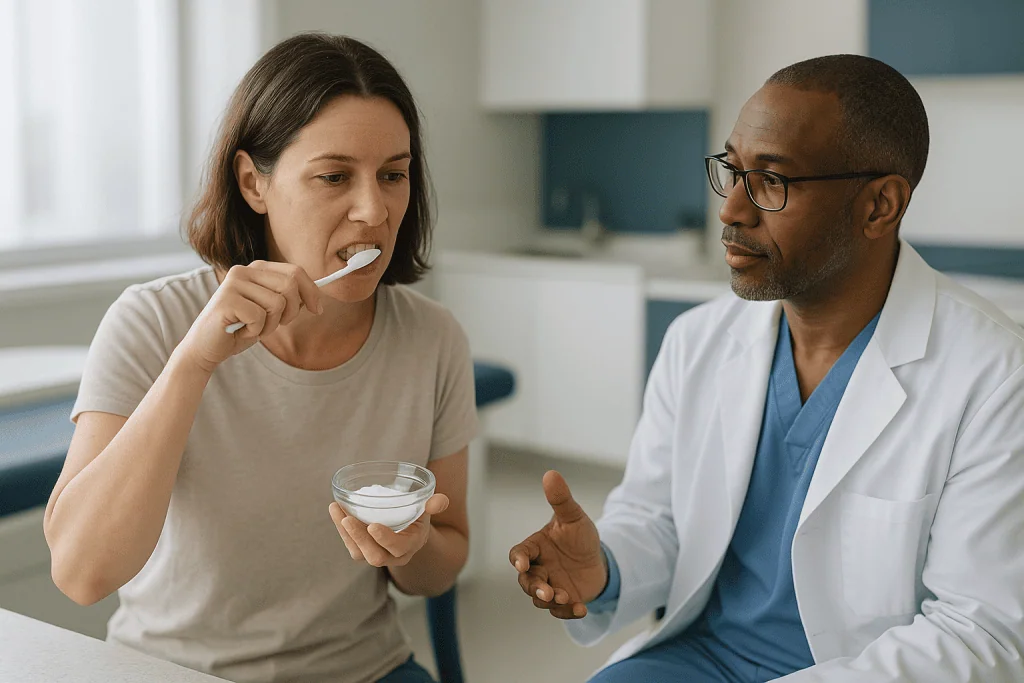
Used gently, it can lift some extrinsic stains, the coffee and tea film sitting on the enamel surface. Teeth may look brighter after a week, and that is not imaginary. What baking soda cannot do is change the color of dentin. It contains no oxidizing agent, so a tooth that is yellow from within, whether from age, childhood antibiotic exposure or genetics, will look almost exactly the same after months of scrubbing.
The trouble starts when the surface stains are gone and the user keeps going, pressing harder and brushing longer in search of a result that surface polishing was never going to deliver. That is when a mild abrasive becomes a wearing agent. Enamel that thins at the neck of the tooth exposes dentin, which is yellower, so the very habit meant to whiten can make teeth look darker and feel sensitive.
A related myth pairs baking soda with lemon juice or hydrogen peroxide from the medicine cabinet as a “dentist-strength” paste. The lemon adds acid to an abrasive, a combination most likely to soften and then scrape enamel. Household peroxide is not formulated to sit against gum tissue and can cause chemical irritation. Mayo Clinic’s guidance on whitening toothpaste makes the general point that products with mild abrasives work on surface stains only; anything deeper needs bleaching agents applied appropriately.
The honest summary: baking soda can polish, within limits, and usually does no harm inside a fluoride toothpaste. As a standalone whitening strategy, it hits a ceiling fast, and pushing past that ceiling costs enamel.
Lemon juice, charcoal, strawberries and oil pulling: does natural mean gentle?
Kitchen whitening has a long folk history, and the ingredients share one appeal: they feel safer than anything in a foil pouch. The evidence does not divide neatly along natural and synthetic lines.
Lemon juice and apple cider vinegar are acids. Enamel begins to demineralize below a pH of about 5.5, and citrus juice sits well under that. Repeated exposure etches the surface, which can briefly look whiter because a rough, dehydrated surface scatters light, then leaves teeth duller, thinner and more sensitive. Dentists see the results as smooth, cupped erosion on the biting surfaces.
Strawberry paste is usually lemon in disguise: mashed fruit with baking soda. The fruit contributes malic acid, the soda contributes grit, and the pairing is the acid-plus-abrasive combination described above.
Activated charcoal powders are abrasive and have not been shown in good-quality trials to whiten intrinsic tooth color. They may remove some surface stain in the same way any polishing agent does. Some charcoal products lack fluoride, and dark particles can lodge in gum margins, fillings and cracks, leaving grey lines that are harder to clean than the original stain.
Oil pulling, swishing coconut or sesame oil for several minutes, has been studied mostly for plaque and gum measures, with small, mixed results. No credible mechanism exists by which oil could oxidize pigment, so whitening claims remain unproven. It is not dangerous if the oil is spat out rather than swallowed, but it does not replace brushing.
Turmeric paste is popular online and, ironically, is one of the strongest food stains known. Whatever brightening effect people describe comes from the brushing motion rather than the spice.
The pattern is consistent. Remedies that seem to work are polishing away surface film, an effect a soft brush and fluoride toothpaste achieve with less risk. Remedies that feel powerful are usually acidic, and acid is the one thing that genuinely damages enamel.
Can yellow teeth actually be whitened?
Yes, in most cases, but how much depends entirely on why the teeth are yellow. This is where a dentist’s examination earns its place, because two people with identical-looking teeth can respond completely differently to the same gel.
Age-related yellowing and diet stains respond best. These teeth have healthy enamel over dentin that has darkened gradually, and peroxide reaches that pigment reliably. Grey or bluish discoloration, often linked to tetracycline-class antibiotics taken while teeth were forming, responds slowly and unevenly, sometimes leaving horizontal bands. Brown or white mottling from excess fluoride during childhood, called fluorosis, may lighten but the contrast between patches can persist. A single dark tooth after an injury or root canal treatment usually needs whitening from inside the tooth, a separate procedure.
| Cause of discoloration | Where the color sits | Typical response to peroxide whitening | What often works instead |
|---|---|---|---|
| Coffee, tea, wine, tobacco | Surface (extrinsic) | Good; often improved by cleaning alone | Professional cleaning, polishing toothpaste |
| Natural aging | Dentin (intrinsic) | Generally good | Whitening, with periodic touch-ups |
| Childhood antibiotic staining | Deep dentin | Slow, partial, may band | Longer supervised courses, bonding or veneers |
| Fluorosis | Enamel structure | Variable; patches may remain | Microabrasion, resin infiltration, bonding |
| Single tooth after injury | Inside the tooth | Poor with external gel | Internal whitening, crown |
| Crowns, veneers, fillings | Restorative material | None | Replacement to match new shade |
That last row surprises people most. Whitening gel has no effect on porcelain or composite resin. A person with a front filling who whitens the surrounding teeth can end up with one visibly darker patch, which is why dentists often plan whitening before replacing visible restorations.
The answer to “can yellow teeth be whitened” is therefore not a yes or no but a diagnosis. Teeth that are yellow from wear and time are the easiest case there is.
Whitening toothpaste, strips and LED lights: what each can and cannot do
Three product types dominate shelves and social media, and their marketing blurs into one promise. Their mechanisms are quite different.
Whitening toothpaste works mostly by polishing. Mayo Clinic explains that these pastes contain mild abrasives and sometimes chemical agents that lift surface stains, and that noticeable brightening, when it happens, tends to take around 2–6 weeks of twice-daily use. Because they do not bleach dentin, the ceiling is your tooth’s natural shade. Some formulas include a small amount of peroxide, but contact time during a two-minute brush is short. The main value is preventing new surface stain from settling, which makes them a reasonable maintenance choice after whitening rather than a whitening method on their own.
Whitening strips are thin plastic films coated with peroxide gel, worn for a set period daily. They do bleach, because they contain an oxidizing agent held against the tooth. Their limitations are fit and reach: strips lie flat, so they can miss curved surfaces and the spaces between teeth, occasionally producing lighter centers and darker edges, and they can slide onto the gums and irritate them.
LED and blue light devices are where the evidence is weakest relative to the marketing. The light does not whiten anything by itself. Some in-office systems use light or heat to speed the breakdown of peroxide, and studies comparing gel with light to the same gel without light generally find little or no lasting difference in shade, with some reporting more sensitivity when heat is involved. Home LED kits pair a low-power light with a peroxide gel; the gel is doing the work.
A practical way to judge any product: ask what the active ingredient is. If it is peroxide, expect real but gradual bleaching plus possible sensitivity. If it is an abrasive, expect polishing only. If it is a light, a spice or an oil, expect very little beyond the effect of brushing.
Is there a downside to teeth whitening?
Two downsides are well documented, and a few more deserve a mention. Neither of the big two is permanent in most people, but pretending they do not exist is its own kind of myth.
Tooth sensitivity is the most common. Peroxide travels through enamel into dentin, and dentin contains microscopic tubules that lead toward the nerve. During and shortly after whitening, cold air, cold drinks or even breathing in can produce sharp, brief zings. Cleveland Clinic notes that this sensitivity is usually temporary and typically settles within a few days of finishing treatment. People who already have receding gums, exposed root surfaces or worn enamel tend to feel it more.
Gum irritation is the second. Peroxide that touches soft tissue can cause whitish, blanched patches and soreness. With a well-fitted custom tray, contact is minimal; with ill-fitting strips or generic trays, gel migrates onto the gums. The NHS specifically warns about gum blistering and burns when kits are misused or when whitening is carried out by someone without dental training.
Less common issues include uneven results when restorations or banded stains are present, a temporary chalky appearance immediately after in-office sessions that settles as the teeth rehydrate, and, with heavy overuse, a translucent or greyish look at the tooth edges.
Whitening is also not a treatment for anything. Decay, cracked teeth, gum disease and dark spots that are actually cavities need attention first, and gel applied over an unfilled cavity can reach the nerve and cause considerable pain. That is the strongest argument for the examination that precedes supervised whitening: it is less about the whitening and more about ruling out the problems that make whitening a bad idea for now.
So the honest answer is that there is a downside, it is usually short-lived, and it is far more likely to be serious when nobody has looked in the mouth first.
Who whitening is usually for, and who is usually asked to wait
Whitening suits a fairly specific person: an adult with healthy gums, no untreated decay, teeth that are yellow rather than grey, few or no visible restorations on the front teeth, and realistic expectations. That describes a lot of people, which is why the procedure is so common.
Several groups are routinely asked to hold off or to have a conversation first.
- Children and young teenagers. Their teeth have larger pulp chambers and thinner, more porous enamel, so sensitivity risk is higher. Many dentists prefer to wait until permanent teeth are fully developed and often revisit the question in the later teenage years.
- People who are pregnant or breastfeeding. Peroxide whitening has not been well studied in pregnancy, and Cleveland Clinic lists pregnancy among reasons to postpone. Most dentists advise waiting simply because the benefit is cosmetic and the safety data are thin.
- Anyone with active gum disease, untreated cavities, cracked teeth or exposed roots. These need treatment first because gel reaching inflamed tissue or open dentin can be very painful.
- People with many crowns, veneers or front fillings. Whitening will create a mismatch; planning is needed.
- People with peroxide allergy or a history of severe sensitivity that has not been managed.
- People expecting a specific shade. Whitening lightens a tooth’s existing color; it does not swap it for a different one.
There is also a softer category: people whose teeth look dull mainly because of surface stain and tartar. A professional cleaning alone can lift several shades, and some dentists suggest trying that first before deciding whether bleaching adds anything.
None of these are absolute bans. They are reasons the treating team takes a closer look and, sometimes, suggests a different sequence. That sequencing, clean first, treat first, whiten later, is one of the most valuable things a dental examination provides.
What the following days and weeks usually look like
Whitening has a timeline, and knowing it in advance prevents both panic and disappointment.
Immediately after an in-office session, teeth often look dramatically white, sometimes with faint chalky patches. Much of that is dehydration; the gel and the isolation used during treatment dry the enamel, which makes it more opaque. Over the next day or two, saliva rehydrates the teeth and the shade settles slightly darker than the first look in the mirror. Expect this, and judge the result after a few days rather than immediately.
Sensitivity, if it appears, usually peaks in the first 24 to 48 hours and eases over the following days. Cleveland Clinic describes it as generally temporary. Many dentists suggest a toothpaste designed for sensitive teeth during a course, and a dentist may also recommend spacing applications differently if zings are strong. Those adjustments are decisions for the treating team, not a reason to abandon good brushing.
For home-tray courses, change is gradual. The NHS describes regular application over a few weeks, and most people notice lightening within the first week, with continued change through the course. Because bleaching reopens enamel pores temporarily, dentists often ask patients to limit strongly colored food and drink during and for a short period after treatment. Think of enamel in that window as a freshly cleaned white shirt at a spaghetti dinner.
Beyond the first month, the question becomes maintenance. The NHS notes that results can last from a few months to up to about three years, with shorter durations for people who smoke or consume a lot of coffee, tea and red wine. Periodic touch-ups, usually far briefer than the original course, are the norm rather than a sign anything went wrong.
A course that produces no change at all after several weeks is worth discussing with the dentist. It often points to intrinsic staining that needs a different approach, or to a product that is not reaching the teeth as intended.
Is teeth whitening safe over the long run, and is it permanent?
Two myths run in opposite directions here. One says whitening is a one-time fix. The other says it quietly ruins teeth over years. The evidence sits between them.
Whitening is not permanent because the causes of discoloration do not stop. Dentin keeps aging. Coffee keeps being drunk. New pigment accumulates in the same pores the peroxide just cleared. That is why the NHS frames longevity as a range running from a few months to a few years rather than a fixed result. Anyone who was promised a permanent change was sold a myth.
Long-term safety of supervised whitening, meanwhile, is reasonably well established for the pattern most dentists recommend: an initial course followed by occasional touch-ups, with a dentist checking the mouth periodically. Enamel mineral changes seen in laboratory studies tend to be small and reversible. Nerve damage is rare and usually linked to gel reaching an already compromised tooth. Cleveland Clinic and the NHS both describe whitening as safe when it is done or supervised by a dentist and the products are used as directed.
The long-run risk that does show up is behavioral. Repeated, unsupervised whitening in pursuit of an ever-brighter shade can leave teeth chronically sensitive and give edges a glassy, translucent look. The habit sometimes drifts toward a distorted sense of what teeth should look like, with people describing healthy, naturally cream-colored teeth as “yellow.” A dentist who says a tooth is already at the light end of the natural range is giving useful information, not an excuse.
Is teeth whitening safe, then? Under supervision, with sensible intervals and healthy teeth to begin with, the mainstream view is yes. The safety comes from the conditions around the gel as much as from the gel itself.
What people often get wrong: more teeth whitening myths that refuse to die
A few claims come up so often in searches that they deserve direct answers.
“Some ethnic groups just have whiter teeth.” Questions like how people in one country keep their teeth so white circulate widely. Tooth shade varies from person to person, not by ethnicity, and much of what looks like whiter teeth in photographs is contrast: teeth appear brighter against darker skin tones or a warmer lip color, and lighting and phone filters do the rest. Traditional practices sometimes credited with whitening, such as chewing fibrous twigs or oil pulling, may reduce plaque but have not been shown to bleach teeth. Enamel chemistry is the same everywhere.
“Follow the 2 2 2 rule and your teeth will stay white.” The rule, brush twice a day for two minutes and see a dentist twice a year, is a decent memory aid but not a whitening method. The NHS does recommend brushing for about two minutes twice daily with fluoride toothpaste. Check-up frequency, though, is individual; some people are seen more often, others less, based on their risk. Brushing prevents surface stain and disease. It does not lighten dentin.
“Whitening works on crowns and veneers.” It does not. Restorative materials do not respond to peroxide, which is why sequencing matters.
“Stronger and longer is better.” Peroxide has diminishing returns. Beyond a point, longer contact adds sensitivity, not shade.
“Whitening weakens teeth so they chip.” Chipping comes from grinding, biting hard objects and existing cracks. Whitening does not soften enamel’s mineral structure.
“If the gums turn white, it is working.” White patches on gums are a chemical burn from gel contact, not a sign of success. They usually heal within days but signal that the tray or strip fit needs attention.
“Whitening replaces a cleaning.” Bleaching does nothing to tartar or plaque. A cleaning often does more for a dull smile than people expect, and it is where most dentists start.
Questions to ask your care team
A good whitening conversation is mostly about the mouth, not the gel. Bring these questions, and pay attention to how thoroughly they are answered.
- What is causing my discoloration, and does it sit on the surface or inside the tooth?
- Would a professional cleaning alone change the shade noticeably?
- Do I have any decay, cracks, gum recession or exposed roots that should be treated before whitening?
- Which of my visible fillings, crowns or veneers will not change color, and how would we handle a mismatch?
- Given my tooth type, what degree of change is realistic, and what shade am I already?
- Which approach do you suggest for me, in-office, custom trays or a combination, and why?
- How long is a typical course for someone with my kind of staining, and what does a touch-up schedule usually look like?
- What should I do if I get sensitivity, and when would you want me to stop and call?
- Is there any reason, including pregnancy, medications or a health condition, that you would prefer I wait?
- What is the plan if the result is uneven or the teeth do not respond?
Notice what is not on this list: which brand of gel is used, or whether a light is included. Those are the details marketing focuses on and the ones that matter least to outcome. A team that spends the first half of the appointment examining, photographing and taking a shade reading before mentioning any product is following the sequence the evidence supports.
It is also fair to ask who will be performing the procedure and what their training is. In many countries, applying whitening products of dentist-level strength is restricted to registered dental professionals, and the NHS is explicit that whitening by untrained providers carries real risk. If the answers are vague, or the pressure is toward booking today, that itself is useful information.
When to call your doctor or dentist
Most whitening side effects are mild and fade on their own. A handful of signs mean the treating team should hear from you promptly rather than waiting for the next scheduled visit.
- Sharp, lingering tooth pain that lasts more than a few seconds after a cold trigger, or pain that wakes you at night. Brief zings are expected; persistent, throbbing pain is not and can indicate the nerve is inflamed or that gel has reached decay.
- Sensitivity that is getting worse rather than better several days after finishing a course.
- Gum tissue that is white, blistered, bleeding or peeling, especially if it has not improved within a couple of days of stopping.
- Swelling of the gums, face or jaw, or a bad taste that will not go away, which can point to infection unrelated to the whitening itself but uncovered by it.
- A tooth that has turned noticeably darker than its neighbors, or a single tooth that has become tender to tap, which may indicate a problem inside the tooth.
- Burning, swelling or hives on the lips or in the mouth, which could indicate an allergic reaction to a product ingredient.
- Any tooth that chips, cracks or feels loose during the course, regardless of whether whitening caused it.
Difficulty breathing or swallowing after using any oral product is an emergency and warrants immediate emergency care, not a dental appointment.
Between those extremes sits a common gray zone: teeth that feel tender, gums that look a little pink, results that seem uneven. None of these needs urgent attention, but all of them are worth mentioning at the follow-up, because small adjustments to how and when gel is applied are the treating team’s call and can make the rest of the course far more comfortable. The decision to continue, pause or change approach always sits with them, informed by what they see in the mouth rather than what a product label promises.
Frequently asked questions
Does whitening damage enamel?
Dentist-supervised peroxide whitening does not dissolve or thin healthy enamel. The gel oxidizes pigment molecules inside the tooth rather than removing mineral. Studies sometimes show small surface changes right after bleaching, which saliva restores. The real enamel threats are acids such as lemon juice, aggressive scrubbing with gritty powders, and grinding. Whitening can cause temporary sensitivity, but that is a nerve response, not structural damage.
Does baking soda whiten teeth?
Baking soda can lift some surface stains from coffee, tea or tobacco because it is a mild abrasive, so teeth may look slightly brighter. It cannot change the color of dentin, the inner layer responsible for most yellowing, because it contains no bleaching agent. Once surface film is gone, further scrubbing adds nothing except gradual enamel wear. Inside a fluoride toothpaste it is generally fine; as a standalone whitening method it has a low ceiling.
Can yellow teeth actually be whitened?
In most cases, yes. Teeth that are yellow from aging or from diet stains respond best to peroxide whitening because the pigment sits in dentin where the gel can reach it. Grey discoloration from childhood antibiotics, mottling from fluorosis and a single dark tooth after injury respond more slowly or need different approaches. Crowns, veneers and fillings do not change color at all, which is why a dental examination comes before any product.
Is there a downside to teeth whitening?
Yes, two main ones. Temporary tooth sensitivity to cold is common during and shortly after treatment and usually eases within a few days. Gum irritation, including white patches or soreness, can occur when gel contacts soft tissue, which is more likely with ill-fitting strips or trays. Results are not permanent and need touch-ups. Serious problems are rare and mostly linked to whitening over untreated decay, cracks or gum disease.
Is teeth whitening safe?
Mainstream dental sources including the NHS and Cleveland Clinic describe whitening as safe when a dentist examines the mouth first and either performs or supervises the treatment using products as directed. Risks rise with unsupervised use, very frequent bleaching, or whitening carried out by people without dental training, where burns to gums have been reported. Pregnant people, children and anyone with active dental disease are usually asked to wait.
How long does teeth whitening last?
The NHS describes results lasting from a few months to up to about three years. The range is wide because the causes of discoloration continue: dentin keeps aging and coffee, tea, red wine and tobacco keep depositing pigment. People who consume a lot of staining drinks or who smoke usually see fading sooner. Periodic touch-ups, typically much shorter than the first course, are normal and expected rather than a sign of failure.
What is the 2 2 2 rule for teeth?
It is a memory aid: brush twice a day for two minutes and see a dentist twice a year. The brushing part matches NHS advice of about two minutes twice daily with fluoride toothpaste. Check-up frequency is actually individual, with dentists setting intervals based on a person’s risk of decay and gum disease. The rule supports oral health and helps prevent surface stain, but brushing does not lighten the tooth’s natural color.
How do people in some countries keep their teeth so white?
Tooth shade varies between individuals, not between ethnic groups, and enamel chemistry is identical worldwide. Much of what looks like whiter teeth in photographs is contrast against skin and lip tones, plus lighting and filters. Traditional habits sometimes credited with whitening, such as chewing fibrous twigs or oil pulling, may reduce plaque but have not been shown to bleach teeth. Diet, tobacco use and access to dental cleaning matter far more than geography.
Do LED lights make whitening work better?
The light itself does not whiten. Any real change comes from the peroxide gel it is paired with. Some in-office systems use light or heat to speed up peroxide breakdown, but studies comparing the same gel with and without light generally find little or no lasting difference in final shade, and heat can add sensitivity. Home LED kits are essentially peroxide gel with a low-power light; judge them by the gel’s contents, not the glow.
Can charcoal or oil pulling whiten teeth?
Neither has good-quality evidence for whitening the tooth’s internal color. Activated charcoal is abrasive and may remove some surface stain, but it can wear enamel, lacks fluoride in many products, and its dark particles can lodge in gum margins and cracks. Oil pulling has been studied mainly for plaque and gum measures with small, mixed results, and there is no plausible mechanism for oil to bleach pigment. Both fall into the polishing-or-nothing category.
This article is for general information only and is not a substitute for professional medical advice. Please consult a qualified doctor about your individual situation.

More from the Blog
Questions to Ask Before Teeth Veneers: Enamel Removal, Repairs and Future Replacement
Before veneers, ask how much enamel will be removed (a thin layer, often around half a millimeter, that never grows back), whether porcelain or…
How Long Does Wisdom Teeth Removal Take? In the Chair and in Recovery
Wisdom teeth removal usually takes 20 to 60 minutes of actual surgery. A single, fully erupted tooth can come out in a few minutes,…
Does Everyone Have Wisdom Teeth? The Evolution Happening in Your Jaw
No. While most adults develop four wisdom teeth, research suggests that between 5% and 37% of people, depending on ancestry, never form one or…

After Gum Recession Treatment: Normal Tenderness vs Bleeding or Swelling to Report
After gum recession treatment, a dull ache, mild puffiness, slight oozing in the first day and a pale or whitish look to the graft…

Preparing for Restorative Dental Treatment: Medications, Diabetes and Past Anesthesia
Preparing for restorative dental treatment such as fillings, crowns, root canal work or implants mostly means sharing information: a complete list of your medicines…

What You Can and Cannot Eat with Braces: Safe Foods, Risky Foods and Practical Swaps
With braces, avoid foods that are hard, sticky, chewy or need biting into: whole apples, corn on the cob, popcorn, nuts, hard candy, caramel,…