

The Day of Eye Laser Treatment: Check-In, Numbing Drops, Minutes Under the Laser, Home

Key Takeaways
- The laser itself typically fires for well under a minute per eye, and the entire procedure for both eyes usually takes less than 30 minutes according to the Mayo Clinic.
- Anesthetic eye drops block pain but not pressure, so a firm pushing sensation during the suction step is expected and lasts seconds.
- Contact lenses reshape the cornea, which is why surgeons ask for a switch to glasses for at least a few weeks before the day and re-measure the cornea on arrival.
- The Mayo Clinic puts full corneal healing and vision stabilization at about two to three months, even though many people see clearly within a day or two.
- Dry eye is the most common after-effect because flap creation cuts corneal nerves that trigger tear production; symptoms commonly last several months as they regrow.
- Laser surgery does nothing to prevent presbyopia, cataracts, glaucoma or retinal disease, so routine eye examinations remain necessary afterward.
Eye laser surgery day usually follows a predictable arc: a check-in and final measurements, anesthetic eye drops so you feel pressure but not sharp pain, roughly a minute or less of laser time per eye within a procedure that typically lasts under 30 minutes for both eyes, then a ride home with someone else driving. Most people rest with eyes closed that afternoon and return for a check within a day or two.
The night before, she laid out her glasses on the kitchen counter the way some people lay out a suit for an interview. Eleven years of wearing them, and by tomorrow afternoon they might be optional. What she could not picture was the middle part: the chair, the light, the few seconds when someone would be doing something to her open eye while she lay perfectly still.
That gap in the imagination is what makes eye laser surgery day feel bigger than it is. The procedure itself is brief. The waiting, the drops, the ride home and the strange first evening with your eyes shut are what fill the hours, and almost nobody explains those parts in the detail that calms a nervous mind.
So this is that explanation: what happens from the moment you sign in to the moment you climb into bed, what you will feel, what you will not feel, and which parts genuinely matter for how your eyes heal.
What actually happens on eye laser surgery day, start to finish
Think of eye laser surgery day as four short chapters of very different lengths. The first is administrative and clinical: signing in, confirming your identity and consent, and repeating a few of the measurements taken at your earlier consultation. The second is preparation, when anesthetic drops go in and you are positioned under the laser. The third, the part everyone fixates on, is the shortest. The fourth is the slow, quiet afternoon at home.
The Mayo Clinic notes that the surgery itself usually takes less than 30 minutes for both eyes, and you are awake for the whole of it. There is no general anesthetic, no operating theater gown and mask in the dramatic sense, and no overnight stay. The NHS describes laser eye surgery as a day procedure: you arrive, you have it done, you go home the same day, with someone else driving.
Refractive laser surgery, to give it its formal name, reshapes the cornea, the clear front window of the eye, so that light focuses more accurately on the retina at the back. A few micrometers of tissue are removed with an excimer laser, a cool ultraviolet laser that vaporizes tissue without heating the surrounding cornea. That is the whole mechanism. Everything else on the day, the drops, the eyelid holder, the flashing light you are asked to stare at, exists to keep you comfortable and your eye still while that reshaping happens.
It helps to know the order in advance because the day has a rhythm that does not feel like a hospital rhythm. Long pauses, then a burst of activity measured in seconds, then a long pause again. People who expect that pattern tend to describe the day as anticlimactic, which is exactly the right outcome.
Why the morning starts with a checklist, not a laser
Most people arrive expecting to be whisked to the laser. Instead, they meet a clipboard. The first hour on eye laser surgery day is deliberately slow, and the slowness is a safety feature.

Staff will confirm which eye or eyes are being treated and what the planned correction is. Your cornea may be mapped again with corneal topography, a device that photographs the surface curvature of the eye in fine detail, to make sure nothing has shifted since your consultation. The Mayo Clinic explains that contact lenses temporarily change the shape of the cornea, which is why surgeons ask people to switch to glasses full time for at least a few weeks before surgery; the day-of measurements verify that the cornea has settled back to its natural shape.
You will be asked to arrive with no eye makeup, no perfume or scented lotion, and comfortable clothes. Lotions and fragrances can contaminate the sterile field or interfere with the laser sensors. You will usually be asked to eat a light meal beforehand, because fasting is not needed for a procedure done under drops alone, and low blood sugar makes people shaky.
Some surgeons offer a mild oral sedative to take the edge off anxiety. Whether that is appropriate for you is a decision for the treating team, not something to arrange yourself. If it is offered, it is another reason you cannot drive home.
Then comes the pause. You may wait 20 to 40 minutes while drops take effect and the laser is calibrated. Bring something to listen to. Reading is difficult once the numbing drops are in, and this is the stretch when nerves do their loudest work.
How numbing drops work, and what you will still feel
The anesthetic drops used for laser eye surgery are topical anesthetics, medicines that block the sodium channels in nerve endings on the surface of the eye so that pain signals cannot be sent. They act within a minute or two and typically last around 15 to 30 minutes, which is comfortably longer than the procedure itself. The effect is confined to the surface of the eye; you will still see, still blink until the lid holder goes in, and still be fully aware.
Here is the honest part. Numbing drops remove sharp pain, but they do not remove sensation altogether. MedlinePlus and the Mayo Clinic both describe a feeling of pressure during the step when a suction ring holds the eye still. People variously call it a firm push, a dull ache or the feeling of a thumb resting on a closed eyelid. It lasts seconds. Vision often dims or goes briefly dark under the suction ring, which is expected and passes when the ring is released.
You may also notice a faint smell during the laser pulses, sometimes described as similar to a burnt hair. It is the odor of tissue being vaporized in microscopic amounts, and it does not mean anything is burning in the way the word suggests.
Once the drops wear off, usually within the first hour after surgery, the surface of the eye becomes sensitive. This is when the gritty, watery, burning feeling described in the Mayo Clinic recovery guidance begins. It is not a sign that the anesthetic failed; it is the ordinary response of a healing corneal surface, and it is the reason the first afternoon is spent with eyes closed.
Minutes under the laser: how LASIK, PRK and SMILE differ from the chair
The three common techniques share the same excimer or femtosecond laser technology but differ in how the surgeon reaches the tissue to be reshaped. From your point of view in the chair, the differences are mostly about a few extra seconds and how the days afterward feel.
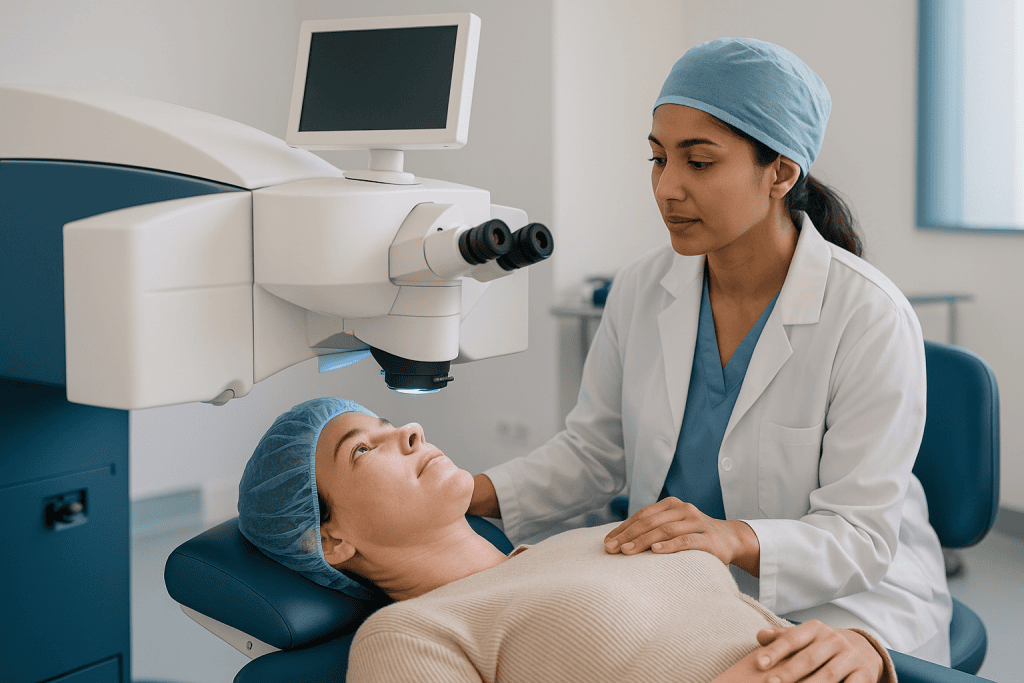
LASIK creates a thin hinged flap in the outer cornea, folds it aside, reshapes the tissue beneath, then lays the flap back where it seals without stitches. PRK, or photorefractive keratectomy, removes the very outer layer of surface cells entirely and reshapes the exposed tissue; those cells regrow over several days. SMILE, small incision lenticule extraction, uses a femtosecond laser to carve a lens-shaped disc inside the cornea, which the surgeon removes through a tiny opening.
| What you notice | LASIK | PRK | SMILE |
|---|---|---|---|
| Suction or pressure step | Yes, during flap creation | No suction ring | Yes, during lenticule creation |
| Laser time per eye | Typically under a minute | Typically under a minute | Typically under a minute |
| Bandage contact lens afterward | Usually not | Usually yes, for several days | Usually not |
| First days | Blurry then often clearer within a day or two | More discomfort; vision clears over about a week | Similar to LASIK, mild grittiness |
| Who it may suit | Most common option | Thinner corneas, some occupations | Selected myopia cases |
The Mayo Clinic and Cleveland Clinic describe the actual laser exposure as lasting seconds rather than minutes; the rest of the time in the chair is positioning and checking. Which technique is right for a given cornea depends on its thickness, shape and the correction needed, and that judgment belongs to the surgeon who has measured it.
Is laser eye surgery very painful? What the evidence says
Short answer: the procedure is not usually described as painful, but the first evening is not usually described as comfortable either. Both halves of that sentence matter.
During surgery, anesthetic drops keep the corneal surface numb. The Mayo Clinic notes that people generally feel pressure rather than pain, and MedlinePlus describes the experience as mildly uncomfortable at most. People who have had it tend to say the anticipation was worse than the sensation. The eyelid holder, a small spring device that stops you from blinking, feels odd rather than sore. You cannot accidentally blink during the laser, and the tracking system pauses if your eye moves beyond a set range, which removes the fear many people carry into the room.
After the drops wear off, the picture changes for a few hours. The Mayo Clinic lists itching, burning, a gritty sensation and watering as common in the hours after LASIK, and describes the discomfort as mild for most people. Light sensitivity is frequent, which is why you leave wearing dark glasses. With PRK, because the surface layer has been removed rather than folded aside, the NHS and Cleveland Clinic describe more pronounced discomfort for the first few days while those cells regrow.
Pain relief, when needed, is usually managed with the drops and simple measures your team prescribes; anything stronger is a conversation for the prescribing clinician rather than something to plan yourself. What the guidance repeatedly emphasizes is that severe or worsening pain is not typical and should be reported, a point covered in the red-flag section below. Discomfort that settles as the evening goes on is expected. Pain that climbs is not.
Who eye laser surgery day is usually for, and who is asked to wait
Not everyone who wants laser correction reaches eye laser surgery day, and being asked to wait is far more common than being told never. The screening process exists because a laser cannot fix a moving target.
The NHS advises that candidates should generally be over 18, and preferably older, with a prescription that has been stable for at least two years. Prescriptions tend to drift through the late teens and early twenties, and reshaping a cornea for a correction that is still changing wastes tissue and results in a later regression. Surgeons look for a modest degree of nearsightedness, farsightedness or astigmatism within the range the technology treats well, a cornea thick enough to leave a safe margin after reshaping, and eyes free of active disease.
The Mayo Clinic lists situations where surgeons commonly advise against or postpone treatment: keratoconus or a family history of it (a condition where the cornea progressively thins and bulges), significant dry eye, uncontrolled autoimmune or connective tissue disease that impairs healing, uncontrolled diabetes, pregnancy or breastfeeding because hormone changes alter the cornea and prescription, and certain medicines that affect wound healing. Large pupils and very high prescriptions raise the likelihood of glare and halos and may steer a surgeon toward a different technique or away from laser altogether.
Alternatives exist for those asked to wait or declined: continuing with glasses or contact lenses, or lens-based surgery such as an implantable lens or refractive lens exchange, which the NHS describes as more usual for people over 50 or with higher prescriptions. Which path is sensible is a clinical judgment for your ophthalmologist, weighed against your own priorities, not something a general article can settle.
The first hours at home: eyes closed, phone down
You will leave with dark glasses, sometimes with clear plastic shields taped over your eyes, and with instructions that sound almost quaint: go home, close your eyes, and stay that way for several hours. This is not ceremony. The corneal surface heals fastest when the eyelids are shut and the tear film is undisturbed, and the flap or surface cells are at their most delicate in the first hours.
Vision on the drive home is usually foggy, as though looking through a steamed bathroom mirror. The Mayo Clinic describes blurriness and haziness in the immediate hours as expected. Light bothers most people, so sunglasses go on even indoors if the room is bright. The gritty, watery phase peaks in this window and begins to ease by bedtime for most people.
Two rules dominate the afternoon. First, do not rub your eyes. A LASIK flap has no stitches; it is held in place by the natural suction of the cornea while the edges seal, and rubbing in the first hours is the most likely way to displace it. Second, use the prescribed drops on the schedule your team gave you, no more and no less. Antibiotic drops reduce infection risk while the surface is open; anti-inflammatory drops calm swelling; lubricating drops ease the grittiness. Their timing has been set by the prescribing clinician and is not something to improvise.
Screens are not forbidden, but they are unkind. Reading and screen use reduce blink rate and dry the eye, so a podcast or audiobook is the better companion. Many people simply sleep, which is the ideal. If you wake with the eye stuck slightly shut with dried tears, that is common; a lubricating drop, not a finger, is the way to open it.
What to expect the day after LASIK eye surgery
The morning after is when the story usually turns. Many people wake, glance at a clock across the room, and realize they can read it. The Cleveland Clinic and Mayo Clinic both note that vision is often noticeably clearer within a day, although it is rarely at its final sharpness. Expect some fluctuation through the day, a slight haze around lights, and eyes that still feel a little scratchy or dry.
The day-after visit is a standard part of the pathway. The Mayo Clinic describes a follow-up appointment one to two days after surgery, during which the surgeon checks that the flap is well positioned, looks for signs of infection or inflammation, measures vision, and reviews how the eyes are healing. This is also when driving is typically discussed. Most guidance advises against driving until a clinician has confirmed that vision meets the legal standard, which for many people happens at this visit, but the decision is individual.
Showering is generally fine from the first day as long as water, soap and shampoo are kept out of the eyes; tilting the head back and keeping the eyes closed does the job. Eye makeup, however, usually stays in the drawer for at least a week, and anything applied near the lash line for longer, because it is a common source of contamination.
Light desk work often resumes within a day or two if the eyes feel comfortable, though frequent screen breaks and lubricating drops make the difference between a productive day and a sore one. PRK follows a slower script: the day after can be the most uncomfortable, the bandage contact lens stays in place, and vision typically clears over roughly a week rather than overnight.
LASIK recovery time: how many days should you rest after laser eye surgery?
The phrase LASIK recovery time hides three different clocks, and mixing them up is where most disappointment comes from.
The first clock is comfort. For most people after LASIK, the burning and grittiness ease substantially within 24 to 48 hours. The NHS advises that people may need to take a few days off work, and many people plan two to three days of genuine rest, longer for PRK where the surface cells take several days to regrow.
The second clock is activity. The Mayo Clinic recommends avoiding strenuous contact sports for at least a few weeks after surgery, and waiting a few weeks before swimming pools, hot tubs and open water, because of infection risk and the chance of a knock to the eye. Gentle walking is fine from the next day. Sweat running into the eyes during a hard workout is unpleasant and is best avoided in the first week or so.
The third clock is vision. The Mayo Clinic states that it takes about two to three months after surgery for the eye to heal fully and vision to stabilize. Along the way, most people notice night glare and halos that fade over weeks, and dry eye symptoms that the Mayo Clinic describes as commonly lasting several months while the corneal nerves regrow.
The follow-up schedule tracks these clocks: a check at one to two days, then typically at around a week, a month and a few months, though your surgeon sets the exact intervals. Each visit is a chance to ask whether you can loosen a restriction, rather than guessing.
A practical framing: rest hard for two or three days, be careful for two or three weeks, and be patient for two or three months. Those ranges are typical, not promised, and your team may adjust them.
Do you get 20/20 vision after laser eye surgery?
Many people do, but 20/20 is a benchmark, not a guarantee, and the more useful question is what the realistic range of outcomes looks like.
The Mayo Clinic describes the goal of LASIK as reducing dependence on glasses or contact lenses and notes that most people achieve good vision for everyday activities without correction; it also notes that some people still need glasses for driving at night or for reading as they age. The NHS makes the same point more bluntly: laser surgery can reduce or remove the need for glasses, but it does not prevent the normal age-related change called presbyopia, where the lens inside the eye stiffens and reading becomes harder after the mid-forties. Someone treated at 28 for nearsightedness will very likely need reading glasses in their fifties regardless.
Outcomes depend heavily on the starting prescription. Higher corrections carry a greater chance of undercorrection or overcorrection, and a small number of people need an enhancement, a second procedure to fine-tune the result, usually considered only after vision has stabilized months later. Whether an enhancement is possible depends on how much corneal tissue remains, which is one reason surgeons preserve a safety margin on the day.
Quality of vision matters as much as the number on the chart. Some people who measure 20/20 still notice halos around headlights or slight ghosting of letters for weeks; the Mayo Clinic lists these as common early effects that usually diminish. A minority experience persistent visual symptoms.
The honest takeaway: the realistic aim is vision that lets you live most of your day without correction. Your surgeon can give you a personalized estimate based on your measurements, and that estimate is the one that counts.
Risks worth understanding before you sit in the chair
Consent forms list complications in a rush of small print. On eye laser surgery day it is worth having already digested the handful that genuinely matter, in plain terms.
Dry eye is the most common. The Mayo Clinic explains that LASIK temporarily reduces tear production because the corneal nerves that trigger tearing are cut during flap creation; symptoms commonly persist for several months while nerves regrow, and a small number of people have longer-lasting dryness. Glare, halos and double vision at night are frequent early on and usually fade over weeks; they are more likely with higher corrections and large pupils.
Undercorrection, overcorrection and induced astigmatism happen when the laser removes slightly too little or too much tissue, or removes it unevenly. Regression, where the eye drifts partway back toward its original prescription, is more common after treatment of high farsightedness.
Flap problems are specific to LASIK. The flap can wrinkle, shift or grow abnormal cells beneath it, particularly if the eye is rubbed or knocked in the early weeks. Infection is uncommon because of antibiotic drops but is serious when it occurs, which is why the red-flag signs later in this article matter.
The rare, severe complication is corneal ectasia, a progressive thinning and bulging of the cornea after surgery, which is why thorough screening of corneal thickness and shape before the day is not optional. The NHS notes that serious complications resulting in permanent vision loss are rare. Rare is not zero, and a clear-eyed conversation about your personal risk profile is part of good care, not a sign of cold feet.
What people often get wrong about eye laser surgery day
Myths cluster around this procedure partly because it happens so fast that nobody has time to observe it properly. A few deserve correcting.
The first is that you must keep your eye perfectly still or the laser will cut in the wrong place. Modern excimer lasers use eye-tracking systems that follow tiny movements many times per second and pause if the eye moves beyond a set limit. The Cleveland Clinic and Mayo Clinic both describe being asked to look at a fixation light, but normal micro-movements are expected and accounted for. You cannot ruin the result by blinking, because the lid holder prevents it.
The second is that the laser is hot and burns the eye. The excimer laser is a cool ultraviolet laser that breaks molecular bonds at the surface rather than heating tissue. The smell people notice is real, but it is not the smell of heat damage.
The third is that clear vision the next morning means healing is done. As covered above, the Mayo Clinic puts full stabilization at around two to three months. Early clarity is encouraging; it is not the finish line, and the restrictions on rubbing, swimming and contact sports still apply.
The fourth is that laser surgery prevents future eye problems. It reshapes the cornea; it does nothing to the retina, the optic nerve or the lens. Glaucoma, cataracts, macular degeneration and presbyopia arrive on their own schedules regardless. Regular eye examinations remain as necessary afterward as before, and a surgically reshaped cornea should be mentioned at any future eye pressure check because it can alter the reading.
The fifth is that pain on the day is the main risk. It is not. The risks that matter play out over weeks and months, and they are managed by following the drop schedule and attending every follow-up.
Questions to ask your care team before the day
The consultation is the time for these; on eye laser surgery day itself you will be too preoccupied, and the drops will make reading a list difficult. Write down the answers.
- Which technique are you recommending for my corneas, and what about my measurements led you to that choice over the alternatives?
- How much corneal tissue will remain after treatment, and does that leave room for an enhancement if one is ever needed?
- Based on my prescription and pupil size, how likely am I to notice night glare or halos, and for how long?
- Do I have any signs of dry eye now, and how would that change my expected recovery?
- What exactly should I do and not do in the first 24 hours, the first week and the first month?
- Which drops will I be using, what is each one for, and who do I contact if I am unsure whether a symptom is normal?
- When is my first follow-up, how many visits are planned, and who do I call outside clinic hours?
- What symptoms should make me call immediately rather than wait for the next appointment?
- If my vision is not what we hoped after it stabilizes, what are the options?
- Is there anything in my medical history, medicines or occupation that changes the risks for me?
Notice that none of these asks for reassurance. They ask for specifics, and a good surgeon will welcome them. The answers form the private version of this article, tailored to your eyes, and they are the ones to trust when the two disagree.
One more habit worth adopting: bring the person who will drive you home to the consultation if you can. They will hear the instructions with clearer eyes than you will on the day.
When to call your doctor
Most of the sensations after laser eye surgery are uncomfortable but expected: grittiness, watering, light sensitivity, hazy vision and mild aching in the first day, with dry eye and night halos persisting for weeks. The signs below are different. The Mayo Clinic, MedlinePlus and the NHS all advise contacting your surgeon or seeking urgent eye care without waiting for the scheduled follow-up if they appear.
- Pain that is severe, or that worsens rather than eases through the first evening and next day, especially after LASIK where significant pain is not typical.
- A sudden drop in vision, or vision that was clearing and then becomes markedly worse.
- Increasing redness, thick or colored discharge, or a lid that swells and becomes hot, which can indicate infection.
- A sensation that something has shifted after a knock, a rub or a splash, or a new persistent feeling of a foreign body under the lid, which can signal a displaced or wrinkled flap.
- Flashes of light, a shower of new floaters, or a curtain or shadow across part of your vision, which are warning signs for the retina and need same-day assessment regardless of the surgery.
- Light sensitivity so intense that you cannot open the eye at all beyond the first day.
When in doubt, call. Clinics that perform laser surgery expect these calls and would far rather check an eye that turns out to be fine than miss one that is not. Keep the out-of-hours contact number your team gave you somewhere you can find it without your glasses, on your phone and in large print on the fridge. If you cannot reach the surgical team and symptoms are severe, an emergency department or urgent eye service can examine you. Every decision about treatment after such a call rests with the clinicians who examine your eye, not with a list on a page.
Frequently asked questions
How many days should I rest after laser eye surgery?
Plan on two to three days of genuine rest for LASIK and a little longer for PRK, then a few weeks of caution. The NHS notes people may need a few days off work, and the Mayo Clinic advises avoiding swimming, hot tubs and contact sports for at least a few weeks. Your surgeon sets the exact timeline for your eyes and can loosen restrictions at each follow-up visit.
Do you get 20/20 vision after laser eye surgery?
Many people do, but it is a benchmark rather than a guarantee. The Mayo Clinic describes the realistic goal as good everyday vision without glasses or contacts, with some people still needing correction for night driving or, later in life, reading. Higher starting prescriptions carry more chance of under- or overcorrection. Your surgeon can give you a personalized estimate based on your own measurements.
Is laser eye surgery very painful?
The procedure itself is not usually painful because anesthetic drops numb the surface of the eye; most people report pressure rather than pain. Once the drops wear off, the Mayo Clinic describes itching, burning, grittiness and watering for the first hours, generally mild and easing by the next day. PRK causes more discomfort for several days. Severe or worsening pain is not typical and should be reported promptly.
What should I expect the day after LASIK eye surgery?
Expect clearer vision than the previous evening, some fluctuation and haze, mild dryness or grittiness, and a scheduled check with your surgeon. The Mayo Clinic describes a follow-up one to two days after surgery to confirm the flap is in place and check for infection. Driving is usually discussed at that visit once vision has been measured, and light desk work often resumes soon after.
What to expect day of LASIK: how long am I actually there?
Plan on a couple of hours in total even though the procedure takes under 30 minutes. Check-in, consent confirmation, repeat corneal measurements, waiting for anesthetic drops and laser calibration, the procedure, and a brief post-procedure check all add up. The laser exposure itself is measured in seconds per eye. You cannot drive home, so arrange a companion or transport in advance.
Can I drive home after laser eye surgery?
No. Vision is hazy for hours afterward, light sensitivity is common, and if a sedative was offered it further rules out driving. Someone else must take you home. Most guidance advises against driving until a clinician confirms that your vision meets the legal standard, which for many people happens at the day-after visit, though the timing is individual and set by your surgeon.
Will I need someone to stay with me afterward?
It is strongly advisable for the first evening. You will be asked to keep your eyes closed for several hours, vision is blurry, and using drops on schedule is easier with help. A companion can also watch for red-flag signs such as worsening pain or a sudden change in vision and make the call to the clinic if needed. Most people are self-sufficient by the next morning.
How long does LASIK recovery time take for night vision?
Glare, halos and starbursts around lights are common in the early weeks and usually diminish as the cornea heals, with the Mayo Clinic placing overall stabilization at about two to three months. People with large pupils or high corrections are more likely to notice them and may take longer. A minority experience persistent night symptoms, which is worth discussing with your surgeon beforehand.
Why does the surgeon check my eyes again on the day?
Because corneas change shape. Contact lenses mold the surface, tear film varies, and even the time of day affects measurements slightly. Repeating corneal topography and confirming the planned correction on the day ensures the laser is programmed for the cornea as it is now, not as it was weeks ago. The Mayo Clinic notes this is why glasses are worn full time beforehand.
Does laser eye surgery stop me needing reading glasses later?
No. Laser surgery reshapes the cornea to correct nearsightedness, farsightedness or astigmatism, but it does not alter the lens inside the eye. The NHS explains that presbyopia, the age-related stiffening of that lens, still develops from the mid-forties onward, so most people eventually need reading glasses regardless. Some surgeons discuss monovision or lens-based options for this, a decision for your treating team.
References
- NHS: Laser eye surgery and lens surgery
- MedlinePlus: LASIK eye surgery
- Cleveland Clinic: LASIK Eye Surgery
This article is for general information only and is not a substitute for professional medical advice. Please consult a qualified doctor about your individual situation.

More from the Blog

Who Is a Poor Match for Multifocal Lenses? Retina, Cornea and Personality Factors
People are usually a poor match for multifocal lenses when the eye has a condition that limits contrast or sharp focus, such as macular…

Scleral Lenses vs Intracorneal Rings for Keratoconus: What Each Does for Vision and Comfort
Scleral lenses and intracorneal ring segments treat keratoconus differently. Scleral lenses are large, removable contact lenses that vault over the irregular cornea and rest…
Getting Ready for Glaucoma Surgery: Blood Thinners, Current Drops and the Morning Routine
Preparing for glaucoma surgery mostly means sorting out medicines with your care team in advance: keep using your prescribed eye drops unless told otherwise,…

Why Is Cross-Linking Discussed Early for Teenagers With Keratoconus? Timing and Follow-Up
Cross-linking is discussed early for teenagers with keratoconus because the cornea tends to steepen fastest during adolescence, and the procedure is designed to stiffen…

Preparing for Femto LASIK: Contact Lens Breaks, Corneal Mapping and Makeup Rules
Femto LASIK preparation usually means pausing contact lenses for a period set by your surgeon, commonly about two weeks for soft lenses and longer…

Diabetic Retinopathy Stage by Stage: How Retinal Damage Advances and When Treatment Begins
Diabetic retinopathy is graded in four stages: mild, moderate and severe nonproliferative retinopathy, in which small retinal blood vessels leak and close, followed by…