

The First Neurological Rehabilitation Assessment: What the Team Measures and Why It Sets Goals

Key Takeaways
- The first neurological rehabilitation assessment measures function (movement, thinking, swallowing, daily tasks) rather than re-diagnosing the disease, and its scores are a baseline, not a verdict.
- The classic neurological examination has seven components: mental status, cranial nerves, motor, sensory, reflexes, coordination, and gait and balance.
- Standardized scales such as the Berg Balance Scale (0–56), Functional Independence Measure (18–126) and NIH Stroke Scale (0–42) let the team see change that a mirror cannot.
- Teams organize goals using the WHO ICF framework, working backward from a life role such as work or family to the specific impairments that block it.
- Mayo Clinic notes stroke rehabilitation commonly starts within 24 to 48 hours, while the AHA guideline cautions against high-intensity mobilization in the first 24 hours after stroke.
- Swallow screening before eating, skin inspection and lying-and-standing blood pressure are part of the first assessment because complications, not lack of effort, most often stall recovery.
A neurological rehabilitation assessment is the structured first evaluation a rehabilitation team makes after a stroke, brain or spinal cord injury, or a progressive condition such as multiple sclerosis or Parkinson's disease. Therapists, nurses and doctors measure strength, sensation, balance, walking, arm use, swallowing, thinking, mood and daily-living skills, usually with standardized scales. Those baseline numbers become the starting point for goals the person and team set together.
Nine days after her stroke, a retired schoolteacher sat on the edge of a plinth while a physiotherapist asked her to reach for a plastic cup, hold it, and put it down on a taped line. She managed it, slowly, with her shoulder hitched up toward her ear. The therapist wrote something down. Then an occupational therapist asked her to button a cardigan, and a speech and language therapist asked her to swallow a teaspoon of yogurt while a hand rested lightly on her throat.
By lunchtime she had been asked her date of birth four times and wondered, out loud, whether anyone talked to each other. They did. Every question and every cup was part of one neurological rehabilitation assessment, and by the end of the week the answers had turned into three written goals with her name at the top.
This is what that first assessment measures, why it takes so long, and how the numbers become a plan.
What a neurological rehabilitation assessment actually is (and what it is not)
A neurological rehabilitation assessment is a structured evaluation of what a nervous-system condition has changed about the way a person moves, feels, thinks, communicates and gets through an ordinary day. It is carried out by a rehabilitation team rather than by a single clinician, and its purpose is to plan therapy, not to name a disease.
That distinction matters. By the time someone reaches a rehabilitation ward or outpatient clinic, the diagnosis is usually already made: stroke, traumatic brain injury, spinal cord injury, multiple sclerosis, Parkinson’s disease, Guillain-Barré syndrome, or one of many others. The neurologist’s examination answered the question “what is wrong?” The rehabilitation assessment answers a different question: “what can this person do today, what do they want to do again, and what stands in the way?”
The tools overlap. A rehabilitation physician will still test reflexes and cranial nerves, and MedlinePlus describes rehabilitation itself as care that helps people regain, keep or improve abilities needed for daily life. But the emphasis shifts from lesion to function. A therapist is less interested in which artery was blocked than in whether the person can stand from a chair without using their hands, and how many seconds that takes.
The assessment also establishes a baseline. Every measurement taken in the first days is repeated later, sometimes weekly, so that change can be seen rather than guessed at. A balance score that rises, a walking speed that improves, a swallowing test that allows a return to normal texture food: each is evidence that the plan is working or needs to change.
One more thing it is not. It is not a test you can fail, and it is not a judgment of effort. A low score on the first day is simply a description of where the starting line sits.
Who is on the neurological rehabilitation team, and why so many people ask the same questions
The repeated questions that frustrated our schoolteacher are not poor communication. Each profession is listening for something different in the same answer.
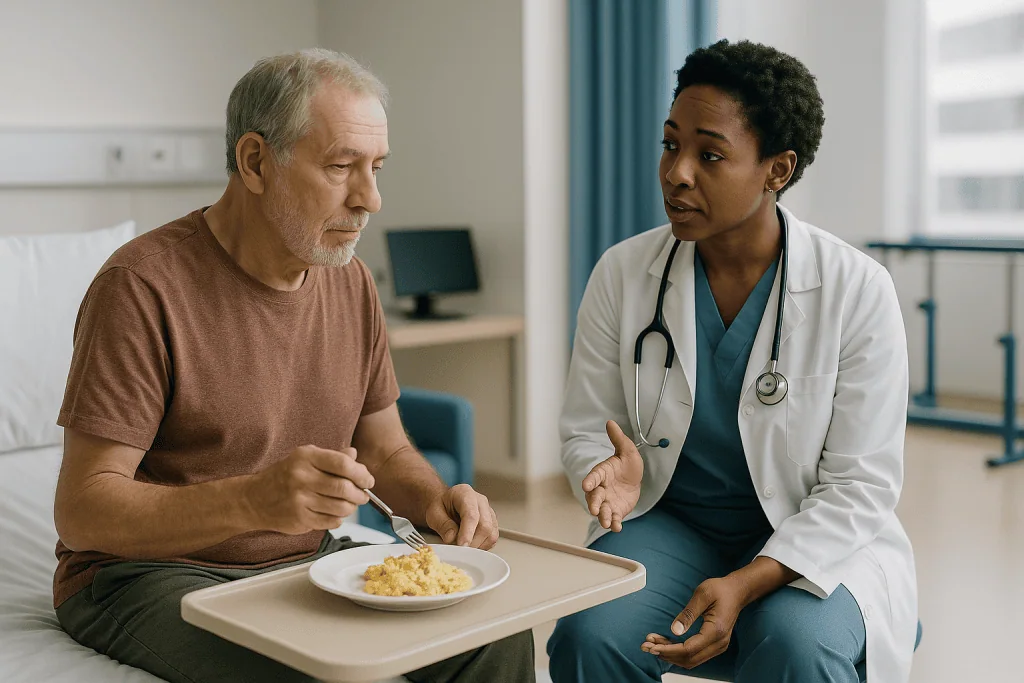
The rehabilitation physician (a physiatrist in US usage, a rehabilitation medicine consultant in the UK) leads the medical side: reviewing the diagnosis, medicines, blood pressure, pain, spasticity and complications, and deciding whether the person is medically stable enough for active therapy. A neurologist may remain involved for the underlying condition.
The physiotherapist (physical therapist) measures movement: strength, muscle tone, balance, transfers, walking and the risk of falls. The occupational therapist measures how that movement translates into tasks: washing, dressing, cooking, handling money, using a phone, and the thinking skills such tasks demand. The speech and language therapist assesses speech, language comprehension, voice and swallowing. A neuropsychologist tests memory, attention, reasoning and mood in more depth. Rehabilitation nurses observe around the clock: bladder and bowel function, skin, sleep, how a person manages at 3 a.m. when no therapist is watching. A dietitian, social worker and psychologist often join, and in spinal cord injury and brain injury units an orthotist and rehabilitation engineer may too.
The American Heart Association’s stroke rehabilitation guideline recommends that this care be delivered by an organized, coordinated interprofessional team, and that the plan be developed jointly with the patient and family. So when the nurse asks your date of birth after the therapist already did, one is checking orientation and memory, the other is checking identity before a medicine. Same words, different data.
Family members and carers are part of the team as well. Their description of what the person could do before the illness is one of the most important measurements the team never takes with an instrument.
What actually happens during the first neurological rehabilitation assessment
Expect it to be spread across two or three days rather than a single appointment, particularly on an inpatient unit. Fatigue is itself a neurological symptom, and a tired brain produces scores that do not reflect real ability.
The medical review comes first. The rehabilitation physician reads the acute hospital notes and scans, reviews the medicine list, checks blood pressure lying and standing, examines the heart and lungs, looks at the skin over bony points, and performs a focused neurological examination. The point is safety: therapy that involves standing and exertion needs a stable heart rhythm, controlled blood pressure and no unrecognized fracture or clot.
Next comes a long conversation. Someone will ask about home: stairs, who lives there, the bathroom layout, work, driving, hobbies, what a good week looked like before. This is not small talk. Goals cannot be written without it.
Then the hands-on measurements begin, usually in a therapy gym. A physiotherapist will watch you roll, sit up, sit at the edge of the bed, stand, step and, if safe, walk, often timing each element. Muscle strength is graded joint by joint. Tone is assessed by moving a limb passively at different speeds. Sensation is checked with light touch, a pin, a tuning fork and by asking you to say where a toe has been placed with your eyes shut.
An occupational therapist may watch you make a hot drink or get dressed, noting not only what your arm does but whether you notice objects on one side, plan the steps in order and remember the kettle is on. The speech and language therapist assesses communication and, where there is any concern, swallowing.
Finally the team meets, without you at first, to pool findings. Then they meet with you. That second meeting is where measurements become goals.
What are the 7 components of a neurological examination?
The classic bedside neurological examination, as described by Johns Hopkins Medicine and Cleveland Clinic, is built from seven parts. The rehabilitation physician runs through all of them, and each therapist then expands the parts most relevant to their work.
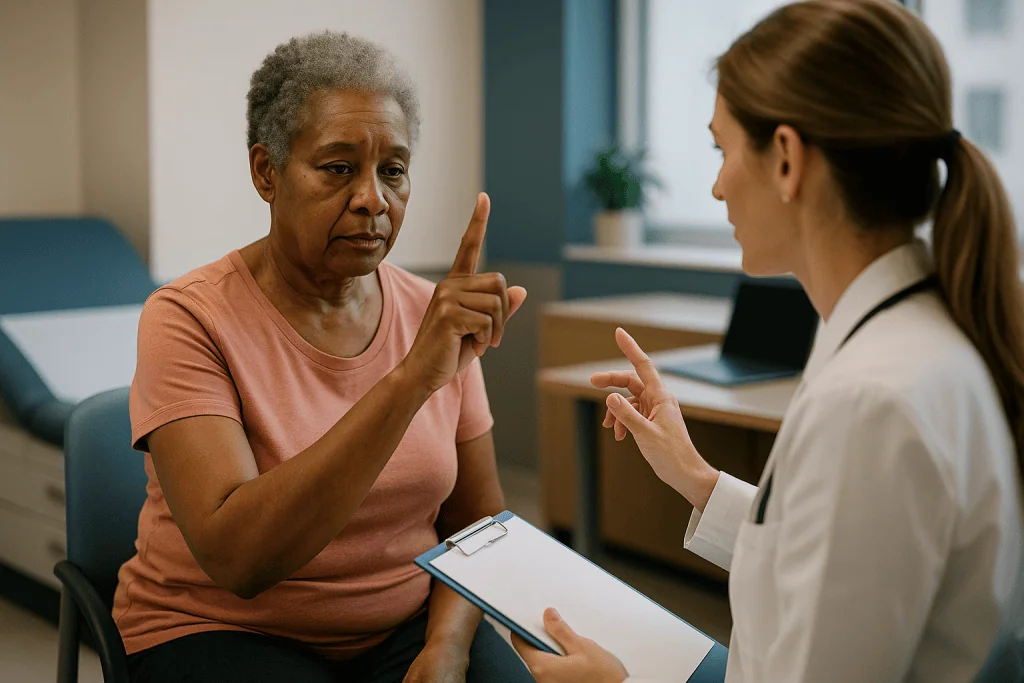
- Mental status. Alertness, orientation to person, place and time, attention, memory, language and insight. A simple conversation reveals a great deal before any formal test.
- Cranial nerves. The twelve paired nerves serving the head: vision and eye movements, facial sensation and movement, hearing, swallowing, tongue and shoulder movement. Facial droop and double vision live here.
- Motor function. Muscle bulk, tone (the resting tension in a muscle) and strength, tested joint by joint and compared side to side.
- Sensory function. Light touch, pinprick, temperature, vibration and joint position sense (knowing where a limb is without looking).
- Reflexes. The tendon taps at knee, ankle, elbow and wrist, plus responses such as the plantar reflex, which tell the examiner whether the problem lies in the brain and spinal cord or in the nerves and muscles.
- Coordination. Finger-to-nose, heel-to-shin, rapid alternating movements. Clumsiness here points toward the cerebellum, the part of the brain that smooths movement.
- Gait and balance. Standing, walking, turning, walking on heels and toes, and standing with feet together and eyes closed.
In rehabilitation, the seventh component becomes a discipline in its own right. Gait and balance are measured with a stopwatch and standardized tasks rather than by eye, because a few seconds’ change in walking speed can be the difference between crossing a road safely and not.
People sometimes search for this list expecting to test themselves at home. Resist that. Reflexes and tone are interpreted in context, and an isolated finding without the other six parts means very little.
What are some examples of neurological assessments? Neuro rehab assessment tools explained
Beyond the physical examination, the team relies on standardized scales: scored tests performed the same way by every clinician, so results can be compared across time and between hospitals. Here are the ones patients most often encounter. Ranges are the published scoring ranges of each instrument, not targets.
| Scale | What it measures | How it is scored | Who usually performs it |
|---|---|---|---|
| NIH Stroke Scale (NIHSS) | Severity of stroke deficits: consciousness, gaze, vision, face, limbs, sensation, language, neglect | 0–42, higher is more severe | Physician or nurse |
| Glasgow Coma Scale | Level of consciousness after brain injury | 3–15, higher is more alert | Physician or nurse |
| Functional Independence Measure (FIM) | Help needed for 18 daily tasks, from eating to stairs to memory | 18–126, higher is more independent | Whole team |
| Barthel Index | Independence in 10 basic activities of daily living | 0–100, higher is more independent | Nurse or occupational therapist |
| Berg Balance Scale | Balance in 14 sitting and standing tasks | 0–56, higher is better balance | Physiotherapist |
| Timed Up and Go / 10-meter walk | Mobility and walking speed | Seconds | Physiotherapist |
| Fugl-Meyer Assessment | Arm and leg recovery after stroke | Motor section 0–100 | Physiotherapist or occupational therapist |
| Modified Ashworth Scale | Spasticity (velocity-dependent muscle stiffness) | 0–4 per muscle group | Physician or therapist |
| Montreal Cognitive Assessment (MoCA) | Screening of attention, memory, language, visuospatial skill | 0–30, higher is better | Occupational therapist or psychologist |
Other conditions bring their own instruments: the Expanded Disability Status Scale in multiple sclerosis, the Unified Parkinson’s Disease Rating Scale, and the ASIA impairment scale for the level and completeness of a spinal cord injury.
None of these numbers predicts an individual’s future on its own. What they do is make change visible. A person who cannot see week-to-week progress in the mirror can often see it in a Berg score climbing from the twenties to the forties.
Why the team measures function, not just the diagnosis: the WHO framework behind it
Two people can have the same stroke on the same scan and need completely different rehabilitation. A concert pianist and a long-distance truck driver with identical weakness of the right hand have different problems, because the problem is not the weakness alone; it is what the weakness prevents.
Rehabilitation teams organize their thinking around the World Health Organization’s International Classification of Functioning, Disability and Health, usually shortened to the ICF. It divides the impact of a health condition into three layers. Body structure and function is the impairment itself: weak grip, reduced sensation, slowed thinking. Activity is the task that impairment affects: buttoning a shirt, walking to the mailbox, following a recipe. Participation is the life role the activity serves: working, parenting, worshipping, playing in a band.
Around all three sit environmental factors (stairs, a supportive spouse, a rural address far from transport) and personal factors (age, education, temperament, what the person values).
The first neurological rehabilitation assessment deliberately collects data at every layer. Grip strength in kilograms is body function. The buttoning test is activity. “I want to get back to the church choir” is participation. A goal written only at the impairment level (“increase grip strength”) is technically measurable but often meaningless to the person living with it. A goal written at the participation level (“sing with the choir at Easter”) is what people actually work for, and the team works backward from it to decide which impairments to treat first.
This is also why the assessment asks about your home, your job and your habits in such detail. The environment is not background. A step at the front door is, in ICF terms, part of the disability, and sometimes the fastest fix is a ramp rather than three more weeks of stair practice.
Cognition, mood and communication: the measurements people do not expect
Most people arriving for rehabilitation expect to be asked to walk. Fewer expect to be asked to draw a clock, repeat a list of words, or describe a picture of a picnic. These tasks often feel more exposing than the physical ones, and they matter at least as much.
After stroke and brain injury, changes in attention, memory, planning and insight are common and frequently invisible to the person who has them. An occupational therapist watching someone make a sandwich is assessing sequencing (doing steps in the right order), safety awareness and something called neglect: a failure to notice one side of space, so that food is eaten only from the right half of the plate. Neglect is a strong reason a team may hesitate about early discharge or driving, because a person who does not perceive the left side of the road cannot compensate for it.
The speech and language therapist separates several problems that families lump together. Aphasia is a disorder of language itself, understanding or producing words. Dysarthria is slurred speech from weak or uncoordinated mouth muscles while language is intact. Apraxia of speech is difficulty planning the movements for words. Each needs a different approach, and each is measured with structured tasks: naming, repetition, following multi-step commands, reading and writing.
Mood is measured too. Depression and anxiety after neurological illness are common enough that the AHA guideline recommends structured screening rather than waiting for someone to mention it. Screening questionnaires are brief, and a positive result is a prompt for a fuller conversation with the treating team, not a diagnosis on its own.
Fatigue is asked about explicitly, because it shapes how much therapy a person can absorb and when in the day it should be scheduled.
Swallowing, bladder, skin and pain: the medical checks that shape the plan
The least glamorous parts of the first assessment prevent the complications that most often derail recovery.
Swallowing. Weakness of the throat muscles, called dysphagia, lets food or liquid slip toward the lungs. The speech and language therapist watches the person swallow different textures, feels the larynx rise, listens for a wet voice or cough afterward, and may recommend an instrumental study using X-ray video or a thin camera. The AHA guideline recommends a swallow screen before anything is given by mouth after stroke, and the result decides diet texture, fluid thickness and whether a feeding tube is needed while function recovers.
Bladder and bowel. Nurses record how often the bladder empties and whether it empties completely, often with a bedside ultrasound scan. Retention raises infection risk; urgency raises fall risk when someone hurries to the toilet at night. Bowel routines are established early because constipation worsens spasticity and confusion.
Skin. Reduced sensation and mobility make pressure injuries a real threat, and every bony point is inspected and a risk score recorded. The mattress and seating prescribed on day one are, in a real sense, part of the rehabilitation plan.
Pain. Shoulder pain on the weak side, neuropathic pain (burning or electric pain from damaged nerve pathways) and headache are each asked about, scored and tracked. Where a medicine is part of the approach, the rehabilitation physician chooses it according to the mechanism of the pain and reviews it as therapy progresses; that judgment rests with the prescribing clinician.
Blood clots and blood pressure. Immobile legs are checked for swelling and tenderness, and blood pressure is measured sitting and standing before upright therapy begins, since a sharp drop on standing is common after spinal cord injury and prolonged bed rest.
How measurements become goals: rehabilitation goal setting after stroke and brain injury
A goal in rehabilitation is not “get better.” It is a specific, observable achievement with a date attached, written in the person’s own words where possible, and agreed rather than assigned.
Most teams use a SMART structure: Specific, Measurable, Achievable, Relevant, Time-bound. The baseline measurements supply the “measurable” part. If the first assessment records that someone needs two people to transfer from bed to chair, a two-week goal might be to transfer with one person and a sliding board. The Berg score, the Timed Up and Go, the FIM item for transfers: each gives a number the team can re-measure to see whether the goal has been met.
Goals come in layers. Long-term goals describe discharge or the end of an episode of care: “walk indoors with a stick and manage the three steps into my house.” Short-term goals are the rungs on the ladder, usually reviewed weekly. Behind both sit the participation goals from the ICF conversation, the choir or the grandchildren, which keep the ladder pointing somewhere worth going.
Some units also use a formal method called goal attainment scaling, where each goal is written with five possible outcomes from “much worse than expected” to “much better than expected,” so that partial progress is recognized instead of being recorded as failure.
Honest goal setting sometimes means the team gently proposes a smaller step than the person hoped for. That is not pessimism. Unrealistic goals produce discouragement and, worse, unsafe attempts. Realistic goals met on time produce the momentum recovery runs on. Both the AHA guideline and NHS stroke recovery guidance describe goal setting as something done with the patient and family, and a goal you did not agree to is one you are entitled to question.
Who is usually offered rehabilitation now, and who is usually asked to wait
The first assessment also answers a practical question: is active rehabilitation the right thing today, and in which setting?
Most people are offered it early. Mayo Clinic notes that stroke rehabilitation commonly begins within 24 to 48 hours of the stroke, while the person is still on the acute ward, and the AHA guideline recommends that people who can participate be transferred to an inpatient rehabilitation unit rather than a lower-intensity setting where one is available. Those with milder deficits who are safe at home may be assessed for early supported discharge, with the same team measurements repeated in an outpatient clinic or the person’s own kitchen.
A smaller group is asked to wait, and the reasons are medical, not motivational.
- Unstable blood pressure, heart rhythm or breathing that makes exertion unsafe.
- A newly diagnosed clot in the leg, an untreated fracture, or an acute infection.
- Very early after a large stroke or brain bleed, where the guideline cautions against high-intensity mobilization in the first 24 hours.
- Reduced consciousness so profound that the person cannot yet take part in therapy, in which case the assessment continues daily and positioning, skin and joint protection begin immediately.
Progressive conditions such as multiple sclerosis or Parkinson’s disease follow a different rhythm. Here the assessment is often prompted by a change: a relapse, more falls, new difficulty with speech. The team measures the new baseline and sets goals for maintaining function, adapting the home or learning a compensatory technique, and the person may return for reassessment at intervals rather than staying on a unit.
Whatever the decision, it belongs to the treating team in conversation with the patient. “Wait” almost always means “wait for this to be treated first,” and the reassessment date should be written down.
What happens in neurological rehabilitation over the following days and weeks
Once goals are set, the assessment does not end. It becomes a rhythm.
On an inpatient unit, most weekdays contain scheduled therapy sessions with physiotherapy, occupational therapy and, where needed, speech and language therapy, interleaved with rest because fatigue limits learning. Nurses continue the assessment between sessions, coaching the person to use the techniques from the gym while washing and dressing. The AHA guideline emphasizes that this practice needs to be repetitive and task-specific: the brain relearns reaching by reaching for real objects, not by exercising a muscle in isolation.
Weekly, or sometimes twice weekly, the team meets to review each goal against fresh measurements. Berg scores, walking times, FIM items and swallow status are re-recorded. Goals met are replaced; goals missed prompt a question about why. Was the goal too ambitious, has a new problem appeared (a urinary infection, low mood, a painful shoulder), or does the approach need to change? Families are usually invited to a review meeting where the discharge plan takes shape.
Home visits are a form of assessment too. An occupational therapist may measure door widths and step heights and watch the person move through their own rooms, because a bathroom is a harder test than a therapy gym.
How long all this lasts varies enormously with the condition and the person. NHS guidance on stroke recovery describes recovery continuing for months, and sometimes longer, with the fastest gains typically early. The point of repeated measurement is that nobody has to rely on impression; the numbers say whether progress is continuing, slowing or has reached a plateau, and each of those has a different next step, from more intensive therapy to a planned pause to community follow-up.
What people often get wrong about the first neurological rehabilitation assessment
“A low score means they have given up on me.” A first-day score is a description, not a verdict. Teams expect early scores to be low; that is why the baseline is taken at all. Nobody is graded on day one.
“If I try my hardest during the test, my goals will be set higher.” Effort is welcome, but pushing through pain or hiding a wobble produces measurements that do not match real ability, which leads to goals that are unsafe. The most useful thing you can do during assessment is show the team what a normal day looks like, including the bad bits.
“The therapist and the doctor disagreed, so someone is wrong.” A neurologist describing weakness in a limb and a therapist describing what that limb can do in a kitchen are reporting different layers of the same picture. Both are correct.
“The scan shows how much I will recover.” Imaging shows structure. Function depends on many other things, including which pathways are spared, other health conditions, mood, sleep and practice. Teams measure function directly because the scan cannot.
“Rehabilitation is only for stroke.” The same assessment approach serves brain injury, spinal cord injury, multiple sclerosis, Parkinson’s disease, peripheral nerve disorders and recovery after neurosurgery.
“Once I am walking, the assessment is finished.” Thinking, mood, fatigue and community participation are often the last things to be addressed and the first to be forgotten, and they carry weight in whether people return to work or driving.
“A new treatment I read about should be in my plan.” Some emerging approaches are promising; many have thin or mixed evidence. Ask the team what the evidence actually shows for your condition, and expect an honest “we don’t know yet” where that is the truth.
Questions to ask your care team after the assessment
The goal-setting meeting is the moment to ask, and a written list helps when fatigue or aphasia makes conversation hard. A family member can ask on your behalf.
- Which measurements did you take, and what did they show about where I am starting from?
- What are my short-term goals for the next one to two weeks, and how will you know if they have been met?
- What long-term goal are we aiming for by discharge, and how does it connect to what I told you matters to me?
- Which of my problems are you treating first, and why that order?
- Is there anything in the assessment that worries you: swallowing, falls, skin, mood, neglect?
- How much therapy will I get each day, and what should I be practicing between sessions?
- Are there medicines in my plan for tone, pain, mood or bladder? What is each one for, what are the expected effects, and who reviews them?
- What should my family be doing, and what should they leave to the team?
- When is the next review, and will I get a copy of the updated goals?
- What will discharge look like: home, outpatient, community team? Who will I contact if something changes?
- Can I drive, return to work or travel, and who decides?
- If progress slows, what are the options, and how will we decide together?
Write down the answers, or ask for them in writing. Ask for jargon to be translated; a team that says “your tone is 2 on the Ashworth” should be able to say “your calf muscle catches and stiffens when moved quickly, which is why your foot drags.” Good teams welcome these questions. The plan is yours, and understanding it is part of carrying it out.
When to call your doctor: red-flag signs during and after rehabilitation
Rehabilitation is a setting where new symptoms can be mistaken for tiredness or a bad day. Some should never be waited out.
Call emergency services immediately if you or someone you are caring for develops any of the stroke warning signs described by the CDC and the NHS: sudden drooping of one side of the face, sudden weakness or numbness in an arm or leg, sudden slurred or confused speech, sudden loss of vision or double vision, sudden severe headache unlike any before, or sudden loss of balance with dizziness. These apply even to someone already recovering from a stroke; a second event is possible and is treated as an emergency in the same way.
Also seek urgent medical attention for a sudden drop in alertness or new confusion, a seizure, a high fever with stiff neck, new chest pain or breathlessness, or a swollen, painful calf, which can signal a blood clot in the leg.
Contact the rehabilitation or treating team the same day if you notice choking or coughing during meals, a wet-sounding voice after swallowing, or a chest infection; new or worsening pain; a rapid increase in stiffness or spasms; a fall, even without obvious injury; new bladder retention or burning when passing urine; redness or a blister over a bony point that does not fade within a short while after pressure is removed; or a marked change in mood, including thoughts of not wanting to live. Low mood after neurological illness is common and treatable, and the team wants to know.
Finally, if measured progress stops or reverses over more than a few days, tell the team rather than assuming that is simply how recovery goes. Reversal often has a treatable cause, and the whole point of the baseline numbers is to catch it early.
Frequently asked questions
What are the common symptoms of neurological disorders that lead to a rehabilitation referral?
Weakness or paralysis of a limb or one side of the body, numbness or altered sensation, poor balance and falls, slurred speech or difficulty finding words, trouble swallowing, double vision, tremor or stiffness, and changes in memory, attention or mood are the most frequent. Any of these that limits daily activities after a diagnosed neurological condition can prompt a rehabilitation assessment. The referral itself comes from the treating clinician, who judges whether the person is medically ready.
What are the 5 symptoms neurologists say never to ignore?
Sudden weakness or numbness on one side of the body, sudden confusion or trouble speaking, sudden loss of vision in one or both eyes, sudden severe headache with no known cause, and sudden dizziness or loss of balance are the five the CDC lists as stroke warning signs that need an emergency call. A first seizure, rapidly progressive weakness and new loss of bladder control with back pain are also treated as urgent by most neurologists.
How long does a neurological rehabilitation assessment take?
On an inpatient unit it is usually spread over two to three days, because each profession assesses separately and fatigue distorts results if everything is crammed into one session. An outpatient assessment may be a single longer appointment with follow-up sessions. The initial goal-setting meeting typically follows once the team has pooled its findings, and the assessment then continues as weekly re-measurement throughout the rehabilitation episode.
What is the functional independence measure explained simply?
The Functional Independence Measure, or FIM, rates how much help a person needs with 18 everyday tasks, from eating, grooming and dressing to walking, stairs, communication and memory. Each item is scored from complete dependence to full independence, giving a total between 18 and 126. Teams use it at admission and discharge to show how much a person’s need for assistance has changed, which is different from measuring strength or a scan finding.
Which neuro rehab assessment tools will a physiotherapist use for balance and walking?
The Berg Balance Scale, which scores 14 sitting and standing tasks out of 56, is the most widely used balance measure. Walking is usually timed over a fixed distance, such as a 10-meter walk, and the Timed Up and Go records how many seconds it takes to stand, walk a short distance, turn and sit down. These are repeated at intervals so progress, or a plateau, is visible in numbers rather than impression.
Can a family member be present during the assessment?
In most services, yes, and teams often encourage it. Families supply the pre-illness baseline: what the person could do, how they lived, what they cared about. They also learn safe handling and the techniques the person will practice at home. Some parts, such as cognitive testing or a mood screen, may be done privately so that answers are the person’s own. Ask the team which sessions are open.
Is the assessment different for multiple sclerosis or Parkinson's disease than for stroke?
The structure is the same, but the timing and goals differ. Stroke and injury assessments establish a baseline after a single event and expect improvement. In progressive conditions, the assessment is often triggered by a change and uses condition-specific scales, such as the Expanded Disability Status Scale or the Unified Parkinson’s Disease Rating Scale. Goals may focus on maintaining function, preventing falls and adapting tasks, with planned reassessment over time.
What happens if my scores go down between reviews?
The team looks for a cause before changing the plan. Falling scores often reflect a new problem such as a urinary infection, dehydration, pain, poor sleep, low mood or a change in medicine, and many of these are treatable. Less commonly they signal a new neurological event, which is why sudden deterioration is treated urgently. Tell the team as soon as you notice a change rather than waiting for the next scheduled review.
What should I bring to a first rehabilitation assessment?
Bring glasses, hearing aids, dentures, any splints or walking aids you already use, comfortable clothes and supportive shoes, a current medicine list, and, if possible, someone who knows your daily routine. Photographs or measurements of steps, the bathroom and the bedroom help the occupational therapist plan. A short written note of what you most want to be able to do again is the single most useful item, because goals are built from it.
Does the rehabilitation physician replace my neurologist?
No. The neurologist continues to manage the underlying condition, including diagnosis, disease-modifying treatment and any recurrence. The rehabilitation physician manages the medical side of recovery: spasticity, pain, bladder, mood, complications and fitness for therapy, and coordinates the team. The two usually communicate, and any change to medicines prescribed by either remains a decision for that prescribing clinician in discussion with you.
References
- Neurological Exam (Cleveland Clinic)
- International Classification of Functioning, Disability and Health (WHO)
- Stroke Signs and Symptoms (CDC)
This article is for general information only and is not a substitute for professional medical advice. Please consult a qualified doctor about your individual situation.

More from the Blog
How a Prosthetic Limb Is Designed and Fitted: Casting, Gait Analysis and Adjustments
The prosthetic fitting process usually begins once the surgical wound has healed and swelling has settled. A prosthetist captures the shape of the residual…

How Do You Get Used to a Prosthesis? Wearing Schedules, Skin Checks and Early Training
Getting used to a prosthetic leg is gradual and supervised. Most rehabilitation programs begin with short wearing sessions of an hour or two, a…
Walking, Cycling, Massage, Chiropractic: What Helps Sciatica
Yes, walking is generally good for sciatica. Gentle, regular movement keeps the spine and hips mobile, eases muscle guarding, and is recommended by national…

What a Neurological Rehabilitation Program Includes: Movement, Speech, Swallowing and Thinking
A neurological rehabilitation program is coordinated therapy for people whose brain, spinal cord or nerves have been injured by stroke, trauma, multiple sclerosis, Parkinson's…

How Much Does Physical Therapy Cost? Session Pricing Explained
A single private physical therapy session typically costs EUR 30–130 in our guide range for international patients, compared with roughly GBP 45–120 at private…

What Recovery Usually Looks Like After Stroke Rehabilitation: Honest Expectations by Stage
Stroke rehabilitation results vary widely, but most measurable change happens in the first three months, when the brain's natural recovery is fastest and therapy…