

TMJ Splint Therapy: How a Night Guard Is Made, Fitted and Adjusted Over Time
Key Takeaways
- A stabilization splint is designed to be reversible: your bite should be exactly the same when you take it out, and any lasting bite change is a reason to stop and see your dentist.
- The fitting visit uses colored marking paper to find and grind away high spots until every lower tooth touches the acrylic evenly, and this balancing is repeated at each review because the jaw settles into a new position as muscles relax.
- A Cochrane systematic review found insufficient evidence for or against stabilization splints compared with other active treatments, so honest expectations are modest relief and reliable tooth protection rather than guaranteed pain resolution.
- Around-the-clock wear of any hard appliance, and long-term use of partial-coverage or repositioning designs, are the situations most associated with tooth drift and bite change.
- Boil-and-bite guards cannot be balanced for even contact and are usually soft, which may increase clenching in some people; they protect enamel to a degree but are not equivalent to a custom adjusted splint.
- Jaw pain that appears with chest pressure, breathlessness or sweating is a possible heart attack warning sign and needs emergency evaluation, not a splint adjustment.
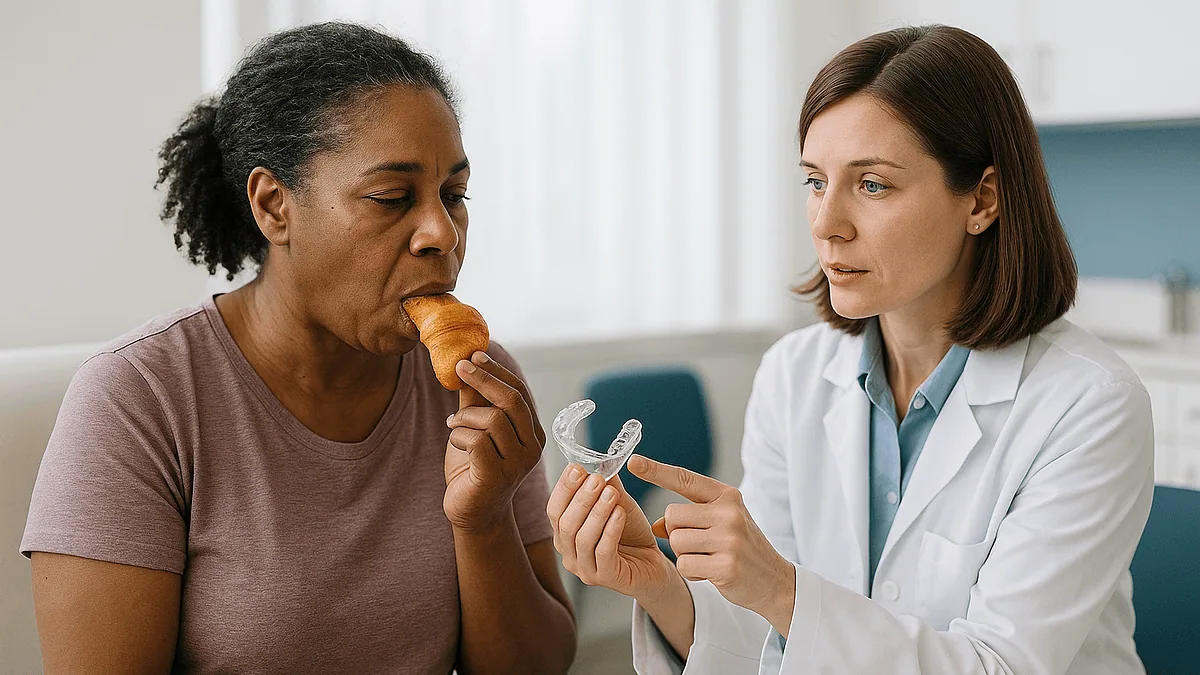
TMJ splint therapy uses a custom-made oral appliance, usually a hard acrylic night guard, to reduce jaw muscle strain and protect the teeth in people with temporomandibular disorders. The dentist takes impressions or a digital scan, a lab fabricates the splint, and the fit and bite contacts are refined over several visits. Evidence for pain relief is modest and mixed, so splints are one reversible option among several, chosen with your treating dentist.
The clicking starts somewhere around the third bite of a bagel. By the end of the workday there is a dull ache in front of one ear, and in the morning the molars feel as if they have been clamped in a vise all night. Someone in this position often ends up in a dental chair hearing a phrase they have never encountered: we could try a splint.
It sounds oddly orthopedic for a mouth. Yet TMJ splint therapy is one of the oldest and most widely used approaches to jaw pain, and also one of the most misunderstood. Patients picture a football mouthguard. Clinicians picture a precisely balanced acrylic plate that will be filed, polished and re-checked more than once.
This explainer walks through how that appliance is actually designed, why the fitting takes more than one visit, what honest research says about whether it helps, and which signs mean you should stop and call your dentist rather than push through.
What is TMJ splint therapy, in plain language?
The temporomandibular joint, or TMJ, is the hinge just in front of each ear that connects the lower jaw to the skull. Problems affecting that joint and the chewing muscles around it are grouped under the term temporomandibular disorders (TMD). The National Institute of Dental and Craniofacial Research estimates that TMD affects roughly 5 to 12 percent of people, with women affected more often than men.
TMJ splint therapy means wearing a removable appliance, made to fit over the upper or lower teeth, for a defined period under a dentist’s supervision. In everyday language people call these devices night guards, bite guards, occlusal splints or orthotics. The word occlusal simply refers to the surfaces of the teeth that meet when you close.
What distinguishes a splint from a drugstore mouthguard is intent. A sports guard is a cushion against impact. A therapeutic splint is engineered to change how the teeth meet while it is in place, so that the jaw muscles can settle into a more relaxed position and the teeth are shielded from the wear of nighttime clenching or grinding, which dentists call bruxism.
Two features matter most. First, the appliance should be reversible: when you take it out, your bite is unchanged. The NIDCR specifically cautions against treatments that permanently alter the bite, and a well-designed splint does not. Second, it should be adjustable. The first version out of the lab is a starting point, not a finished product, and the fine-tuning visits are where much of the clinical work happens.
Splint therapy sits within a broader conservative approach recommended by the NIDCR, Mayo Clinic and the NHS: heat or ice, softer foods, stress management, jaw exercises and, where a clinician judges it appropriate, short-term medicines. The splint is rarely meant to carry the whole load.
How does a TMJ splint actually work?
Here is the uncomfortable truth clinicians will share if you ask directly: nobody is entirely sure. The Mayo Clinic notes that many people with jaw pain seem to benefit from a soft or firm device over the teeth, but that the reasons these devices help are not well understood. Several plausible mechanisms are usually described together.
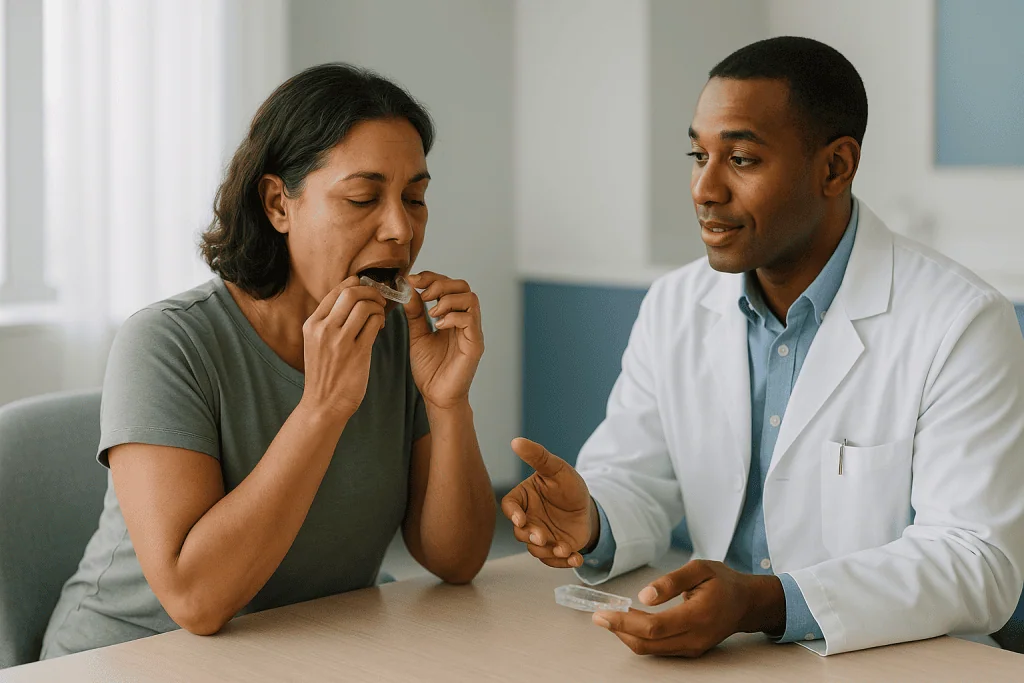
Muscle unloading. A splint places a smooth acrylic layer between the upper and lower teeth. Because the surface is flat and even, no single tooth catches or guides the jaw sideways. The elevator muscles that close the jaw can find a resting position without bracing against a high spot, and clenching forces are spread across the whole arch rather than concentrated on a few teeth.
Joint space. Adding a few millimeters of thickness between the teeth slightly separates the ball of the jaw (the condyle) from the socket. Some clinicians believe this eases pressure on the small cartilage disc that cushions the joint, though imaging studies have not proven that this is the reason people feel better.
Tooth protection. This part is not controversial. If you grind at night, you will wear acrylic instead of enamel. The NHS lists a mouthguard as a standard way to protect teeth from bruxism damage, whatever its effect on pain.
Awareness and habit change. A foreign object in the mouth is a constant reminder. Many people notice they are clenching during the day only after a splint has taught them what an unclenched jaw feels like. Researchers have also pointed out that the attention, reassurance and structured follow-up that come with splint therapy contribute to improvement, sometimes as much as the plastic itself.
None of these mechanisms requires the splint to move the jaw into a new permanent position. When a device is designed to do that, it has crossed from a stabilization splint into a repositioning appliance, which is a different tool with different risks.
Types of TMJ splints: stabilization, repositioning and soft guards
The word splint covers several designs that behave quite differently in the mouth. Knowing which one your dentist is proposing changes the questions worth asking.
| Type | Material and fit | Main purpose | Typical use |
|---|---|---|---|
| Stabilization (flat-plane) splint | Hard acrylic, full arch, custom-made from impressions or a scan | Even tooth contact, muscle relaxation, enamel protection; does not change the bite | Most common first-line appliance for muscle-related TMD and bruxism, usually worn at night |
| Anterior repositioning splint | Hard acrylic with a ramp that holds the lower jaw slightly forward | Attempts to recapture a displaced disc or reduce painful clicking | Selected cases of disc displacement; generally short-term and closely monitored because it can alter the bite |
| Soft (vacuum-formed) guard | Flexible plastic, custom or boil-and-bite | Cushions teeth from grinding | Tooth protection; some clinicians avoid soft guards in TMD because chewing on a soft surface may increase clenching in some people |
| Partial-coverage or anterior bite plate | Hard acrylic covering only the front teeth | Rapid muscle deprogramming | Short diagnostic or emergency use only; long-term wear risks tooth movement |
The stabilization splint is the design most people mean when they say night guard for TMJ, and it is the one with the most research behind it. Its defining characteristic is that every opposing tooth touches the acrylic at the same time when you close, with smooth, shallow guidance when you slide side to side. Achieving that even contact is the entire point of the adjustment visits described later.
Repositioning splints and partial-coverage plates can shift teeth or change how the jaw closes if worn too long. That is precisely why the NIDCR advises that if a splint causes or increases pain or affects your bite, you should stop wearing it and see your clinician. Ask which type you are being fitted for, and why.
Who is TMJ splint therapy usually for, and who is asked to wait?
Dentists tend to reach for a stabilization splint when the picture points toward muscle-driven pain: tenderness in the chewing muscles, morning jaw fatigue, worn or chipped enamel, a partner who hears grinding at night, headaches that sit in the temples. The Cleveland Clinic and Mayo Clinic both describe splints as a conservative, reversible option in this setting, meaning something that can be tried and abandoned without lasting change.

People with painful joint clicking or a jaw that occasionally locks may also be offered an appliance, though the choice of design becomes more nuanced and the follow-up closer. Those with confirmed nighttime bruxism are often fitted primarily to protect teeth, dental work and implants, with any pain relief treated as a welcome bonus rather than the goal.
Several groups are commonly asked to wait or to consider something else first:
- Anyone without a diagnosis. Ear infections, dental abscesses, sinus disease, salivary gland problems and certain nerve conditions can all mimic TMD. A splint on an undiagnosed toothache delays the treatment that would actually help.
- People in active orthodontic treatment. Teeth that are being moved cannot hold a splint that fits, and the splint may interfere with the planned movement.
- Those with extensive untreated decay or loose teeth. Impressions and daily insertion can aggravate fragile teeth; stabilizing the mouth usually comes first.
- Patients whose pain has just begun. The NIDCR notes that most TMJ problems are temporary and settle with simple self-care. Many clinicians hold off on fabricating an appliance until symptoms have persisted despite basic measures.
Age itself is not a barrier, but children and teenagers whose jaws are still growing are usually managed with closer supervision and shorter review intervals, because a rigid appliance can influence a developing bite. In every case the decision to make a splint, and which kind, rests with the treating dentist after an examination.
How a night guard is made: impressions, scans and the lab
A custom splint begins with a precise copy of your teeth. There are two ways to get one, and you may encounter either.
The traditional route is an impression: a horseshoe-shaped tray filled with a soft, putty-like material is pressed over the teeth for a minute or two until it sets into a rubbery mold. Both arches are usually recorded, because the lab needs to know how the opposing teeth will meet the splint. The sensation is cool and slightly claustrophobic; breathing through the nose and leaning forward helps people who gag easily.
The digital route uses an intraoral scanner, a wand about the size of an electric toothbrush that photographs thousands of tiny frames and stitches them into a three-dimensional model on screen. No putty, and the file can be sent to the lab within minutes. Both methods produce clinically acceptable results; the choice usually reflects what the practice has invested in rather than what your jaw needs.
Next comes the bite registration. The dentist records how your jaw closes, often with the joint guided into a relaxed, unstrained position rather than the habitual bite you slam into when chewing. A thin wafer of wax or fast-setting silicone captures this relationship. For a stabilization splint this step is arguably the most skill-dependent moment of the whole process, because it determines where the acrylic will be built.
At the lab, a technician mounts the models on an articulator, a hinged device that mimics jaw movement, and builds the splint in hard acrylic, either by hand-layering and curing it or by milling it from a solid puck using the digital design. The surface is shaped so that every opposing tooth contacts evenly, then polished until smooth. The finished piece is a few millimeters thick, roughly the height of two stacked coins, and returns to the dentist for the fitting visit.
The fitting appointment: what actually happens in the chair
Fitting a splint is less like collecting a pair of glasses and more like tuning an instrument. Expect the visit to involve a fair amount of taking the appliance in and out.
The dentist first seats the splint and checks retention, the snugness with which it grips the teeth. It should click into place with firm finger pressure and stay put when you open wide or talk, but come out without a struggle. Tight spots inside the appliance are located with a marking paste or thin pressure-indicating film and relieved with a small handpiece. Too loose, and the splint rattles or drops at night; too tight, and the teeth ache in the morning.
Then comes the part that takes the longest: occlusal adjustment. You are asked to close on a strip of colored marking paper, and the dots left on the acrylic show exactly where each lower tooth lands. The goal for a stabilization splint is a pattern of small, evenly distributed marks across the whole arch, with no single heavy contact. High spots are ground down, the paper is reapplied, and the cycle repeats. You will also slide your jaw forward and sideways so the dentist can smooth the guiding surfaces, which should let the jaw glide without catching.
Finally the dentist polishes any roughened areas, shows you how to insert and remove the splint using both hands, and demonstrates cleaning. Most people receive practical advice along these lines:
- Brush the splint with a soft brush and cool water or mild soap; hot water can warp acrylic.
- Store it dry in a ventilated case, out of reach of pets, who find the smell irresistible.
- Bring it to every dental visit, since fillings, crowns and even ordinary wear change how it seats.
A review appointment is typically booked before you leave, because the bite you demonstrate on a tense weekday afternoon is not the bite your jaw settles into after a week of wear.
The first nights: what the following days and weeks usually look like
The first night with a new splint is rarely restful. The appliance feels enormous, saliva production spikes, and many people wake at some point to find they have pulled it out in their sleep. This is normal, and dentists usually suggest wearing it for a while in the evening before bed so the mouth acclimates.
Over the first days a predictable pattern tends to unfold. Speech, if you wear the splint while awake, sounds slightly slurred until the tongue learns to work around the acrylic. Some people notice tenderness in a few teeth on waking, which often signals a spot that needs relief at the review visit. Others describe an odd sensation for a few minutes after removal, when the teeth do not quite seem to meet as usual; this fades quickly as the muscles reset and is different from a lasting bite change.
The muscle-relaxation effect, when it comes, is usually gradual rather than dramatic. The NIDCR emphasizes that TMD symptoms often fluctuate and that most problems improve over time with conservative care, so it is genuinely difficult, even for the clinician, to separate the splint’s contribution from the natural ebb and flow of the condition. Keeping a brief note of morning stiffness, headache and clicking helps both of you judge the trend honestly at follow-up.
Two things should not happen. Pain that clearly increases after the splint is introduced, or a sense that the teeth no longer fit together properly when the appliance is out, are signals to stop wearing it and contact the dentist rather than persevere. The NIDCR gives exactly this advice.
During this period the rest of the conservative program continues: softer foods on bad days, moist heat over tender muscles, gentle stretching exercises if prescribed, and attention to daytime clenching, which the splint alone does not address. Think of the appliance as one player on a small team rather than the whole strategy.
How is a TMJ splint adjusted over time?
Adjustment is not a sign that something went wrong. It is the mechanism by which a lab-made object becomes a therapeutic one, and the reason a splint fitted once and never seen again often underperforms.
At each review the dentist repeats the marking-paper check. The pattern almost always shifts between visits. As the chewing muscles relax, the jaw tends to settle into a slightly different closing position, so contacts that were even at delivery become uneven. New heavy spots are relieved; areas that have lost contact may be built up with fresh acrylic. Wear facets, the shiny flattened patches where grinding has polished the surface, are examined for what they reveal about the direction and force of nighttime movement.
Several practical changes are common across the life of a splint:
- Relining the inside surface if a new filling or crown alters how the appliance seats.
- Re-polishing rough patches that irritate the tongue or cheek.
- Modifying thickness if the initial vertical opening proves too much or too little to tolerate.
- Replacement when acrylic has worn thin, cracked, or become discolored and porous despite cleaning.
Review frequency varies with the design and the stability of symptoms. Repositioning splints and any appliance worn in the daytime demand closer monitoring, because they carry a real risk of tooth movement or bite change. A stabilization splint used at night by someone whose symptoms are settling can usually move to longer intervals, with checks folded into routine dental visits. The schedule is a clinical judgment, not a fixed rule, and your dentist should be able to explain the reasoning behind yours.
One caution deserves emphasis. A splint should never be filed, heated or reshaped at home. Acrylic that has been thinned in the wrong place can crack under grinding force, and an uneven surface can create the very muscle strain the appliance was meant to relieve.
How long should you wear a TMJ splint?
People searching for how long to wear a TMJ splint are usually asking two different questions at once: how many hours per day, and for how many months in total. The evidence supports clear principles for the first and honest uncertainty about the second.
Hours per day. For a stabilization splint, the standard prescription is nighttime wear, because that is when bruxism does its damage and when the wearer cannot consciously relax the jaw. Daytime wear is sometimes added for short stretches during a painful flare, but continuous around-the-clock use of any hard appliance is generally discouraged. Teeth that are covered all day and night lose their normal contact with each other, and over time that can allow them to drift. The NIDCR’s warning that a splint which changes your bite should be discontinued applies most sharply here.
Total duration. There is no guideline stating a fixed number of weeks or months. The NIDCR describes most TMJ problems as temporary and advises the simplest, least invasive care that works. In practice, many dentists reassess at intervals and consider tapering nighttime wear once pain and stiffness have settled, while continuing to protect the teeth if grinding persists. Someone with heavy, lifelong bruxism may reasonably wear a night guard indefinitely for enamel protection, not because the appliance is still treating pain but because the alternative is worn-down teeth.
Signals that the wearing schedule needs revisiting include: pain that has plateaued without improvement after a fair trial, new tooth sensitivity, difficulty getting the teeth to meet after removing the appliance, or a splint that no longer seats after dental work. Each of these is a conversation for the review visit, and decisions about continuing, pausing or stopping belong with the dentist who examined you rather than with a general rule read online.
Does TMJ splint therapy work? What the evidence actually shows
The most searched question deserves the least varnished answer. Stabilization splints have been studied for decades, and the results are consistently modest and inconsistently positive.
A Cochrane systematic review that examined randomized trials of stabilization splints for TMD pain found insufficient evidence either for or against their use compared with other active treatments or with no treatment, and it called for larger, better-designed studies. That conclusion still frames the field: many trials show that people wearing a splint improve, but so do many people wearing a placebo appliance or receiving education and exercises alone.
Why is the signal so hard to detect? Several reasons recur in the literature and in the NIDCR’s guidance:
- TMD tends to fluctuate and often improves on its own, which flatters any treatment given during a flare.
- Pain is measured by self-report, and the ritual of a custom device, careful fitting and repeated attention has a real effect regardless of the acrylic.
- Trials mix patients with muscle pain, joint pain and disc problems, who may respond very differently.
- Follow-up is frequently short, so long-term benefit or harm is poorly characterized.
What can be said with reasonable confidence is narrower but still useful. A well-made hard splint protects enamel and dental work from grinding forces; that is a mechanical fact rather than a research finding. It is reversible when designed and monitored correctly. And in the hands of a clinician who adjusts it properly, it appears at least as helpful as other conservative options for many people, without being clearly superior to them.
What cannot honestly be claimed is a percentage of patients who will get better, a guarantee of pain relief, or superiority over exercise and self-care. Anyone quoting a success rate should be asked which guideline or review it comes from. The Mayo Clinic’s plain statement that these devices seem to help many people, for reasons that remain unclear, is about as far as the evidence currently allows.
TMJ splint side effects and risks to know about
Splints are among the safer interventions in dentistry, yet the phrase TMJ splint side effects returns thousands of searches for good reason. Most problems are minor and fixable; a few are not, and they cluster around specific designs and patterns of overuse.
Common and usually temporary
- Excess saliva, dry lips or a mild gag reflex during the first nights.
- Tooth tenderness on waking, typically pointing to a high spot that needs adjustment.
- Sore cheeks or tongue from a rough edge.
- Altered speech if the appliance is worn while awake.
- Bad odor or discoloration if the splint is not cleaned and dried properly; acrylic is slightly porous and will harbor bacteria.
Less common but important
- Bite change. The most significant risk. Partial-coverage plates and repositioning splints worn for extended periods, or any splint worn around the clock, can allow teeth to move or the jaw to adopt a new closing position that then feels wrong without the appliance. The NIDCR advises stopping any splint that affects your bite and seeking review.
- Increased pain. A poorly balanced surface can provoke rather than relieve muscle strain. Pain that worsens after starting a splint is a reason to pause, not push through.
- Tooth decay under the appliance. If teeth are not cleaned before insertion, the splint traps plaque against enamel overnight.
- Dependency on the sensation. Some long-term wearers feel unable to sleep without the appliance; this is a habit rather than a physical harm, but it complicates tapering.
- Airway concerns. A bulky lower appliance can, in some people, shift the tongue or jaw backward. Anyone with known or suspected sleep apnea should raise it before fabrication so the design can account for it.
The safeguard against nearly all of these is the same: a full-coverage, hard, reversible design worn as prescribed and reviewed regularly. Cheap shortcuts, whether a boil-and-bite guard or a splint fitted once and forgotten, are where the avoidable risks concentrate.
Night guard vs TMJ splint: alternatives and what pairs with it
The night guard vs TMJ splint debate is partly a language problem. Dentists use the terms loosely, and what matters is design: full coverage, hard acrylic, custom-made and adjusted, versus soft, generic and unmonitored. Over-the-counter boil-and-bite guards fall into the second category. They will protect enamel to a degree, but they cannot be balanced for even contact, some people clench harder on a soft surface, and they can shift teeth if they fit unevenly. Most clinicians treat them as a stopgap at best.
Splints also sit alongside a range of other conservative options, and guidelines from the NIDCR, NHS and Mayo Clinic consistently recommend trying the least invasive measures first.
Self-care. Softer foods during flares, avoiding gum and wide yawns, moist heat or ice over tender muscles, and deliberate attention to keeping the teeth slightly apart during the day. The NIDCR lists these as first steps for most people.
Physical therapy and exercises. Gentle stretching, posture work and controlled opening exercises, often taught by a dentist or physical therapist, have research support comparable to splints in many trials.
Stress and sleep management. Because clenching is closely tied to stress and disturbed sleep, cognitive behavioral techniques and relaxation training are frequently recommended in parallel.
Medicines. Short courses of over-the-counter anti-inflammatory pain relievers are commonly used; in selected cases clinicians may consider muscle relaxants or, for chronic pain, low-dose tricyclic antidepressants, which act on pain processing rather than mood. Each carries its own trade-offs and is a decision for the prescribing clinician.
Injections and procedures. Botulinum toxin injections into the chewing muscles, joint lavage and, rarely, surgery are reserved for cases that have not responded to conservative care. The NIDCR describes surgery as a last resort and notes that it is irreversible.
In most treatment plans the splint is combined with several of the above rather than substituting for them.
What people often get wrong about night guards for TMJ
Misconceptions about splints travel fast, partly because the appliance is simple to picture and partly because marketing fills the gaps that evidence leaves open. A few corrections are worth making plainly.
Myth: a night guard fixes the joint. A stabilization splint does not repair cartilage, reposition a disc or reverse arthritis. It changes the forces acting on the joint and muscles while it is worn. Any lasting improvement reflects the muscles settling and the condition’s natural course, not a structural repair.
Myth: thicker is better. Bulk does not equal effectiveness. Excess thickness strains the muscles that open the mouth, is harder to tolerate and can be more likely to be spat out in sleep. The right vertical dimension is the least that achieves even contact.
Myth: if it helps at night, wear it all day. This is where the real harm hides. Teeth kept apart around the clock can drift, and the bite can change. Daytime wear, if used, should be limited and supervised.
Myth: a drugstore guard is basically the same thing. A boil-and-bite guard cannot be balanced, is usually soft, and is worn without anyone checking the bite. It protects enamel somewhat and may do little else.
Myth: clicking must be stopped. Painless clicking is common and often needs no treatment. Chasing a noise with aggressive repositioning appliances can create problems where none existed.
Myth: once made, a splint is finished. The adjustment visits are the treatment. A splint fitted once and never reviewed is a mouthguard, not therapy.
Myth: a splint proves you have TMJ. An appliance is not a diagnostic test. Feeling better in a splint does not confirm the diagnosis, and feeling no better does not rule it out.
The thread running through all of these is the same: the splint is a modest, reversible tool whose value depends on correct design and supervision, not a device with powers of its own.
Questions to ask your care team before starting TMJ splint therapy
A good consultation about a splint should leave you able to answer most of the following. If several remain unclear, ask before the impressions are taken.
- What is my diagnosis, specifically? Muscle pain, joint pain, disc displacement and bruxism call for different designs and different expectations.
- Which type of splint are you recommending, and why that one? A stabilization splint and a repositioning splint are not interchangeable.
- Upper or lower arch, and what determined that choice?
- How many hours a day should I wear it, and is daytime wear ever expected?
- How often will you check and adjust it, and what happens at those visits?
- How will we decide together whether it is helping? Agreeing on markers up front, such as morning stiffness or headache frequency, makes later conversations more honest.
- What would make you tell me to stop wearing it? The answer should include pain that increases and any change to how my teeth meet.
- What else should I be doing alongside the splint? Exercises, heat, daytime habit awareness and stress management usually belong in the plan.
- Could this appliance affect my sleep breathing? Particularly relevant if you snore heavily or have been told you may have sleep apnea.
- How long will this splint realistically last before it needs replacing, and what does replacement involve?
- If planned dental work is coming up, how will that affect the fit?
- What are the alternatives if I decide against a splint, or if it does not help?
You are also entitled to ask about whether the practice has a written estimate for the appliance and its follow-up, and how the appliance is coded for any insurance purposes; those are administrative questions the office staff handle and fall outside the clinical scope of this article. None of these questions should be met with irritation. Splint therapy is a partnership over months, and a clinician who explains the reasoning at the outset is more likely to keep adjusting thoughtfully later.
When to call your doctor
Most difficulties with a splint are minor and can wait for the next scheduled review. A handful of situations should prompt a call to your dentist or physician promptly rather than at the next routine visit.
Contact your dentist soon if:
- Pain in the jaw, face or teeth is clearly worse since you began wearing the splint.
- Your teeth no longer seem to meet properly when the appliance is out, and the feeling lasts beyond a few minutes.
- Individual teeth have become newly loose, sensitive or painful to bite on.
- The splint has cracked, warped or no longer seats firmly, since a poorly fitting appliance can do more harm than none.
- You notice ulcers, persistent soreness or bleeding of the gums where the splint sits.
- You wake gasping, snoring far more than usual, or feel unrefreshed in a way that began with the appliance.
Seek urgent medical attention if:
- Your jaw locks open or closed and you cannot free it.
- There is sudden facial swelling, fever, or severe pain suggesting an infection or abscess.
- Jaw pain arrives together with chest pressure, shortness of breath, sweating or pain spreading to the arm or neck. Jaw pain can be a symptom of a heart attack, and the American Heart Association lists it among the warning signs; do not attribute it to your TMJ without being evaluated.
- You develop numbness or weakness of the face, difficulty speaking, or vision changes.
The guiding principle from the NIDCR is simple: a splint that increases pain or alters your bite should be removed and reviewed, not tolerated. Between visits, keep the appliance clean, bring it to every appointment, and mention any change in symptoms even if it seems unrelated. Every decision about continuing, modifying or ending splint therapy remains with the team that examined you and knows your history, and they would far rather hear from you early than discover a problem months later.
Frequently asked questions
Does TMJ splint therapy work?
It helps many people modestly, but the research does not show it to be clearly better than other conservative treatments. A Cochrane review of randomized trials found insufficient evidence for or against stabilization splints, partly because TMD often improves on its own and because attention and follow-up contribute to relief. What a well-made hard splint reliably does is protect teeth from grinding and give the jaw muscles an even surface to rest against.
How much does TMJ splint therapy typically cost?
This article does not publish prices, because the amount varies widely with the type of appliance, the laboratory used, the number of adjustment visits included and the region. Practices will usually provide a written estimate before impressions are taken, and it is reasonable to ask whether follow-up adjustments and any relining are included or billed separately. Treat any price quoted online as unreliable for your own situation.
How long is it recommended to wear a TMJ splint?
Stabilization splints are usually prescribed for nighttime wear, with daytime use limited and supervised because continuous wear can allow teeth to drift. There is no guideline fixing a total number of months; dentists reassess at intervals and may taper wear once pain settles, while continuing to protect teeth if grinding persists. The NIDCR describes most TMJ problems as temporary, so duration is decided case by case with your dentist.
Does insurance cover TMJ splints?
Coverage varies considerably. Some dental plans include occlusal appliances, some exclude them, and some medical plans treat TMD as a medical condition with separate rules. Because the same appliance can be coded in different ways, it is worth asking the practice to request pre-authorization in writing before fabrication. The administrative staff, rather than the dentist, are usually the right people to walk you through your specific plan’s terms.
What is the difference between a night guard and a TMJ splint?
In everyday use the terms overlap, but clinically the distinction is design and supervision. A therapeutic stabilization splint is hard, covers the full arch, is custom-made and is repeatedly adjusted so all teeth contact evenly. A generic night guard, especially a soft boil-and-bite one, cushions teeth but cannot be balanced and is not monitored. Both may protect enamel; only the adjusted splint is intended to influence muscle strain.
Can a TMJ splint change my bite permanently?
A correctly designed full-coverage stabilization splint worn at night should not. The risk rises with partial-coverage bite plates, anterior repositioning splints and any appliance worn around the clock for extended periods, because teeth kept apart can move. The NIDCR advises stopping any splint that affects your bite or increases pain and seeking review. If your teeth feel as though they no longer meet properly after removal, tell your dentist promptly.
What are the common TMJ splint side effects?
Early effects are usually mild and temporary: extra saliva, a gag reflex, sore teeth on waking that point to a high spot, and slurred speech if worn awake. Less common but more important are increased pain, bite change, decay under a poorly cleaned appliance and, in some people, worsened snoring or breathing at night. Most are prevented by a hard full-coverage design, good hygiene and regular adjustment visits.
Should I wear my TMJ splint during the day?
Usually not on a continuous basis. Nighttime wear targets grinding and clenching you cannot consciously control, while daytime clenching is better addressed by awareness and habit change. Some dentists add short daytime periods during a painful flare, but around-the-clock use of a hard appliance is the situation most associated with tooth movement. Follow the specific schedule your dentist gives and raise any wish to extend it at a review visit.
How do I clean and store a night guard for TMJ?
Brush the appliance with a soft toothbrush and cool water or mild soap after each use, avoiding hot water and abrasive toothpaste, which can warp or scratch acrylic. Let it dry in a ventilated case rather than sealing it wet, and keep it away from pets. Clean your own teeth before inserting it so plaque is not trapped overnight, and bring the splint to every dental appointment so its fit can be checked.
What if my TMJ splint makes the pain worse?
Stop wearing it and contact your dentist rather than trying to push through. Increased pain most often means the surface is not evenly balanced or the thickness is wrong, both of which can be corrected at an adjustment visit. Occasionally it indicates that a different design, or a different approach altogether, is needed. The NIDCR specifically advises discontinuing a splint that causes or increases pain.
References
- National Institute of Dental and Craniofacial Research (NIH): TMD (Temporomandibular Disorders)
- NHS: Teeth grinding (bruxism)
- Cleveland Clinic: Temporomandibular Joint (TMJ) Disorders
- MedlinePlus: Temporomandibular Joint Dysfunction
This article is for general information only and is not a substitute for professional medical advice. Please consult a qualified doctor about your individual situation.

More from the Blog

Who Needs Scaling and Root Planing (SRP)? Pocket Depths That Call for a Deep Cleaning
Scaling and root planing is usually recommended for people whose gum pockets measure 4 millimeters or deeper, especially when the gums bleed on probing,…

Is Composite Bonding Right for Chips, Gaps or Uneven Edges? Who Suits It
Composite bonding suits adults with healthy gums, sound enamel and small cosmetic flaws: minor chips, narrow gaps between front teeth, slightly uneven or worn…

Who Needs a Space Maintainer? When an Early Lost Baby Tooth Calls for One
A space maintainer is usually considered when a child loses a baby tooth well before the permanent tooth beneath it is ready to come…
Orthodontic Warning Signs: Broken Wires, Loose Brackets and Pain That Is Not Normal
Orthodontic problems to report include a broken or protruding archwire, a bracket or band that has come loose, a cracked or lost aligner, swelling…

What MRI and CT Reveal About TMJ: The Disc, Arthritis and Joint Damage
MRI is the preferred way to see the soft tissues of the temporomandibular joint, especially whether the cartilage disc sits on top of the…

What Porcelain Veneers Can Change and What Still Depends on Your Gums: Realistic Results
Porcelain veneers are thin ceramic shells bonded to the front of teeth. They can reliably change color, small chips, minor spacing and the shape…