

Traveling for a Smile Makeover: How Many Visits to Plan and What to Arrange First

Key Takeaways
- Porcelain veneers and crowns are typically a two- to three-appointment process because a laboratory fabricates the final restorations between visits.
- Dental implants are placed in stages, and Mayo Clinic describes a healing period of several months while bone fuses to the post before the final tooth is attached.
- Temporary veneers and crowns are held with weak cement by design, which is why they can loosen or fall off during the weeks before final bonding.
- The CDC advises obtaining complete records after medical travel, including the brand and details of any device such as an implant, because components differ by manufacturer.
- There is no universal two-year check-up rule; the NHS sets recall intervals between three months and two years based on an individual's risk of dental disease.
- Long flights raise blood clot risk after surgery, so the CDC's advice to move every hour or two, stay hydrated and limit alcohol applies after longer dental procedures too.
A smile makeover combines several dental procedures, so the number of visits depends on what is planned. Veneers and crowns usually need two to three appointments spaced by laboratory time, while implants typically require separate surgical and restorative stages months apart. Before any travel, arrange a full examination, current X-rays, a written treatment plan, and a dentist near home who agrees to handle follow-up care.
She had already saved the photographs. A neighbor’s new front teeth, a cousin’s wedding smile, a screenshot of a dental office in a city she had never visited. The hard part, she told her hygienist, was not choosing the teeth. It was the calendar: how many days off work, how many flights, and whether her fiancé would need to come along for the second trip, or the third.
That question lands in dental offices every week. People weighing traveling for smile makeover treatment often assume it is one long appointment. In reality a smile makeover is a bundle of separate procedures, each with its own healing biology and laboratory timeline, and the logistics change depending on which ones you need.
What follows is not a travel guide. It is a plain explanation of what each procedure actually involves, why some of them cannot be rushed, and what a careful patient arranges before booking anything at all.
What is a smile makeover, and what actually happens in the chair?
“Smile makeover” is a marketing phrase, not a clinical diagnosis. Dentists use it loosely to describe a planned combination of treatments that change how the front teeth look and function together. The usual ingredients are whitening, bonding, veneers, crowns, gum reshaping, orthodontic alignment and, when teeth are missing, implants or bridges.
A few definitions help. A veneer is a thin shell of porcelain or composite resin bonded to the front surface of a tooth. A crown is a cap that covers the whole visible tooth. A dental implant is a titanium or ceramic post placed in the jawbone to hold a replacement tooth. Bonding is tooth-colored resin sculpted directly onto the tooth and hardened with a light.
The sequence matters more than people expect. Gum health is assessed first, because cementing porcelain onto inflamed tissue invites failure. Teeth are then examined for decay, cracks and old fillings. Only after that does the cosmetic planning begin, often with a diagnostic wax-up: a model of the proposed result made on a plaster or digital copy of your mouth so you can see the shape before any enamel is removed.
For veneers and crowns, the dentist reshapes the teeth, takes an impression or digital scan, fits temporary restorations, and sends the case to a laboratory. The final pieces are tried in, adjusted for bite and color, and bonded at a later visit. Cleveland Clinic describes this as a multi-appointment process rather than a single sitting, which is exactly why travel complicates it.
Implants follow a different clock entirely. According to Mayo Clinic, the implant surgery is staged, and the bone must heal and fuse to the post (a process called osseointegration) over several months before the final tooth is attached. No airline schedule changes that biology.
Why traveling for a smile makeover changes the visit count
At home, a three-appointment veneer case is an inconvenience of three afternoons. Across a border, those same three appointments become three trips, or one very long stay with a stretch of waiting in a hotel room. The procedures do not change. The friction does.
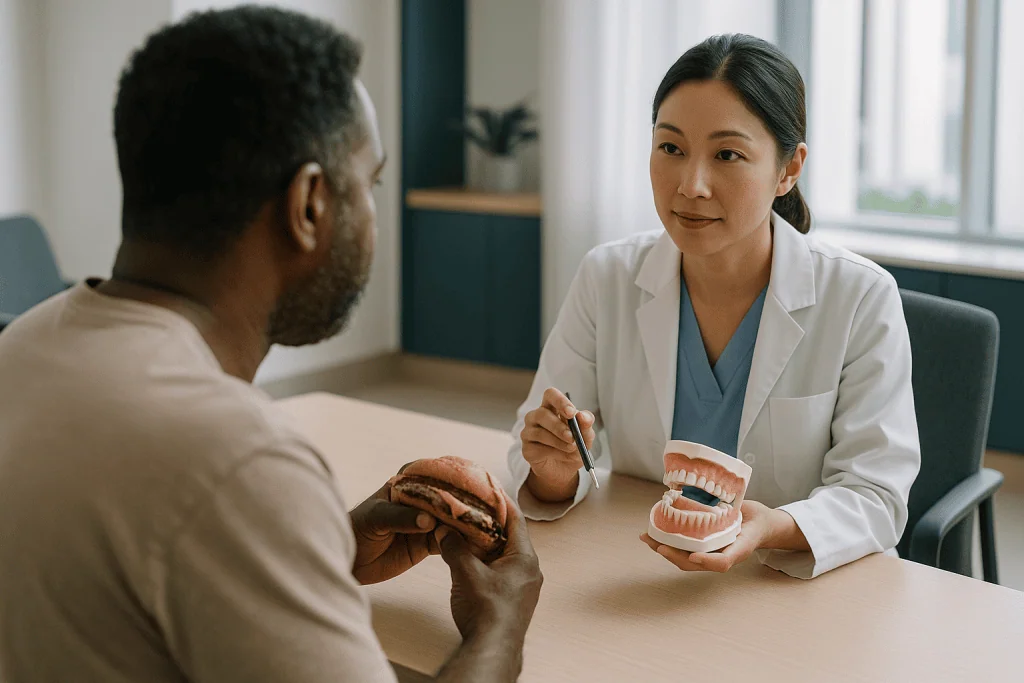
Three things stretch the timeline. The first is laboratory time. Porcelain veneers and crowns are usually made by a technician, and even offices with in-house milling often need a day or more for layering, staining and glazing. The second is tissue healing. Gum contouring, extractions and implant placement each need time before the next step is safe. The third is adjustment. A crown that feels high on the bite at week two, or a veneer edge that catches the lip, is a ten-minute fix for a local patient and a logistical problem for a traveler.
The CDC’s travel health guidance on medical tourism makes a point that applies directly here: complications and the need for follow-up care are common reasons medical travel becomes complicated, and patients should arrange continuity of care before leaving. Dentistry is no exception. A bite that is slightly off can wear opposing teeth or stress a jaw joint for months if nobody is checking it.
There is also a compressed-schedule effect. When a traveler can only stay ten days, there is pressure to shorten the gap between tooth preparation and final bonding, or to combine procedures that would normally be separated. Shortening is sometimes clinically reasonable; it is also sometimes a compromise that nobody says out loud. Asking “what would you do differently if I lived around the corner?” is a fair and revealing question.
None of this means anyone should or should not travel. It means the visit count is a clinical fact to be planned around, not a detail to discover afterward.
Smile makeover abroad visits: how many appointments each procedure usually takes
The honest answer to “how many visits” is “it depends on the recipe.” The table below summarizes typical appointment patterns described by mainstream sources. Treat the numbers as ranges, not promises; your own plan may differ for sound clinical reasons.
| Procedure | Typical appointments | Minimum gap between stages | Why the gap exists |
|---|---|---|---|
| Professional whitening | 1–2 | Days | Sensitivity settles; shade stabilizes |
| Composite bonding | 1 | None | Done directly on the tooth |
| Porcelain veneers | 2–3 | Lab fabrication, often 1–2 weeks | Technician makes the shells; temporaries worn meanwhile |
| Crowns or bridges | 2–3 | Lab fabrication | Fit, bite and color checked before final cementing |
| Gum reshaping | 1, plus review | Weeks before veneers | Tissue must heal and settle to its final position |
| Dental implants | Several, across stages | Months | Bone must fuse to the implant before loading |
| Orthodontic alignment | Many, over months | Weeks between adjustments | Teeth move slowly and need monitoring |
Cleveland Clinic’s overview of dental veneers describes a consultation, a preparation visit and a bonding visit as the usual pattern. Mayo Clinic explains that implant treatment is performed in stages with healing time between them and that the whole process can take many months.
Two practical consequences follow. If your plan includes implants, assume at least two separate windows of time regardless of geography. If it includes only bonding or whitening, the visit count is genuinely small, and the question becomes whether traveling at all makes sense for a procedure any local dentist performs routinely.
Who is a smile makeover usually for, and who is usually asked to wait?
Cosmetic dentistry is elective, which means the healthiest candidates are people whose mouths are already stable. Dentists generally look for controlled gum disease, no active decay, a comfortable bite and realistic expectations about what porcelain can and cannot do.

Several groups are commonly asked to pause or to treat something else first:
- People with untreated gum disease. Bleeding, receding or inflamed gums change shape as they heal, which ruins the margins of veneers placed too early.
- People who grind or clench heavily. Porcelain is strong in compression and brittle under shear; a night guard and a plan for the habit usually come first.
- Smokers and vapers, particularly for implants. Nicotine narrows blood vessels and slows healing, and Mayo Clinic lists smoking among factors that raise implant failure risk.
- People with poorly controlled diabetes or conditions affecting bone healing, who may need medical input before surgical steps.
- Teenagers whose jaws and gum lines are still changing; restorations placed on a moving target rarely age well.
- Anyone in the middle of orthodontic treatment, since final tooth position should be settled before shaping begins.
Pregnancy deserves a specific word. Elective dental work is generally postponed, not because local anesthetic is dangerous, but because long appointments, X-rays and the stress of travel are easier to avoid than to justify.
Being asked to wait is not a rejection. It is the treating team protecting the result. A veneer bonded to a healthy, stable tooth may serve for many years; the same veneer placed over inflamed gums or an unstable bite is being set up to fail, and the person who pays for that failure is the patient, often far from the office that placed it.
What to arrange first before any smile makeover travel
The preparation that matters most happens before a single flight is booked, and most of it happens at home.
Start with a full examination from a dentist you can actually return to. That means a periodontal (gum) assessment, a check for decay and cracks, and current X-rays. Many offices will also take a panoramic X-ray or a cone-beam CT scan, which is a three-dimensional X-ray used to measure bone for implants. These records can be shared with any treating team and spare you repeat radiation.
Then ask for a written treatment plan in plain language. It should list every tooth being treated, what will be done to it, how many appointments are expected, the planned gap between them, and what temporary restorations you will wear in between. If the plan is coming from a distant office, request the same document from them and compare the two. Differences are not necessarily red flags, but unexplained differences are worth a conversation.
Ask what records you will receive afterward. The CDC’s medical tourism guidance recommends obtaining copies of all medical records, including details of materials and devices used. For dentistry that means the brand and lot number of any implant, the type of ceramic, and the cement used. A dentist near home cannot maintain an implant well without knowing which system it is, because screwdrivers and components are not universal.
Arrange follow-up explicitly. Not “I’ll find someone if there’s a problem,” but a named local dentist who has agreed to see you after treatment, knows what was done, and has the records. Some dentists decline to adjust work they did not place; find out before, not after.
Finally, check your medical history for anything that affects healing or sedation, and bring a current medication list to every appointment. The treating team decides what to do with it, but they can only act on what they know.
Is there a traveling dentist? What mobile and visiting dentistry really covers
People searching for a traveling dentist usually mean one of two things, and neither is quite the smile-makeover scenario.
The first is mobile dentistry: dentists who bring portable equipment to nursing homes, schools, rural communities or people who cannot leave home. This is a long-established part of public health dentistry. Mobile teams typically provide examinations, cleanings, fillings, simple extractions and dentures. They do not, as a rule, offer complex cosmetic cases, because laboratory-made porcelain and implant surgery need controlled conditions, imaging and multiple follow-ups.
The second meaning is a visiting specialist, a dentist who holds sessions in another city or country for a few days at a time. This arrangement exists for some specialties and raises a specific question for patients: who is responsible when the specialist has left? A visiting clinician may be excellent, but a veneer that debonds in week three needs someone on site with the records and the materials.
Neither model removes the biology. Implants still need months to integrate. Lab work still needs fabrication time. What changes is where the patient is standing while that time passes.
There is a useful principle buried in this question. Dentistry is a continuity profession. The NHS, in its guidance on dental check-ups, frames care as an ongoing relationship with recall intervals set according to individual risk. A single intensive course of treatment, wherever it happens, is only one chapter. The dentist who sees you every six to twenty-four months afterward is the one who notices a shadow under a crown margin or a slight loosening of an implant abutment before it becomes a problem.
So the practical answer is: yes, traveling and mobile dentists exist, mostly for access and basic care. For an extensive cosmetic plan, the more important figure is the dentist who stays put.
What happens between visits: temporaries, healing and the laboratory
The quiet stretch between appointments is where most travel plans go wrong, because it looks like dead time and is not.
After teeth are prepared for veneers or crowns, you wear temporaries. These are acrylic or composite shells shaped roughly like the final result and held with weaker cement so they can be removed. They protect the prepared tooth from sensitivity and bacteria and keep it from drifting. They are also fragile. Temporaries chip, loosen and occasionally come off entirely, usually at the worst moment. A local patient drops by to have one recemented. A traveler may be left with an exposed, sensitive tooth and no easy fix.
Meanwhile the laboratory is working. A technician builds the porcelain by hand or mills it, then layers, stains and glazes it to match the shade and translucency chosen at the preparation visit. Rushing this stage tends to show in the result: flatter color, less lifelike edges.
For gum reshaping, the tissue needs weeks to settle before anything is bonded above it, because the final gum line determines where the veneer edge should sit. Place porcelain too soon and the margin may end up visible as the gum recedes to its healed position.
Implants are the extreme case. Mayo Clinic describes a healing period of several months after placement while bone grows around the post. During that time the site may carry a temporary tooth, a healing cap or nothing at all. Loading the implant with a permanent crown before integration is complete risks losing it. Some cases allow a temporary crown on the day of surgery, but that decision belongs to the surgeon and depends on bone quality and bite forces, not on the patient’s return flight.
If you remember one thing from this section: temporaries are temporary for a reason, and the gap is part of the treatment.
What the days and weeks after each stage usually look like
Recovery from cosmetic dentistry is mostly mild, but it is not nothing, and it differs by procedure.
After whitening, a day or two of sharp, fleeting sensitivity to cold is common and usually fades. After bonding there is often no recovery at all beyond getting used to new edges with your tongue.
After veneer or crown preparation, expect sensitivity to temperature while wearing temporaries, some tenderness along the gum line, and a slightly odd bite until the finals are placed. Once the permanent restorations are bonded, Cleveland Clinic notes that some sensitivity can persist for a short period and that the dentist will typically check the bite and margins at a follow-up. Many people find speech sounds slightly different for a few days as the lips and tongue adapt.
After gum reshaping, there is soreness for several days and the tissue looks raw before it pinks up. Soft foods and gentle hygiene are the usual advice; the treating team will specify.
After implant placement, Mayo Clinic describes typical experiences of swelling of the gums and face, bruising, minor bleeding and pain at the site for a few days. Stitches may dissolve or need removal. The surgeon usually asks for soft foods while the site heals and schedules a review to confirm healing before the next stage months later.
Across all of these, the pattern is the same: day one to three is the uncomfortable window, week one is settling, and week two is when small adjustments are typically needed. That second week is exactly when many travelers have already flown home. Planning a review with a local dentist for that window, with the records in hand, closes the gap. The treating team should tell you what is normal and what is not; if they have not, ask before you leave the chair.
Flying after dental work: clot risk, cabin pressure and sedation basics
Most routine dental procedures do not, by themselves, make flying dangerous. Still, three issues deserve attention when a long journey follows treatment.
The first is blood clots. A deep vein thrombosis, or DVT, is a clot in a deep vein, usually in the leg, which can travel to the lungs. The CDC’s travel health guidance notes that recent surgery raises clot risk and that long periods of immobility, such as flights over four hours, add to it. Minor dental work is low on that risk scale, but longer surgical sessions, dehydration, and sitting still for hours stack up. The basics apply regardless of destination: walk the aisle every hour or two, flex the calves while seated, drink water, and limit alcohol. Anyone with a personal or family history of clots, or who takes hormonal medication, should raise the question with the treating team before booking.
The second is pressure. Trapped air in a tooth, under a fresh filling or in a sinus near an upper extraction or implant site can ache as cabin pressure changes. This is sometimes called barodontalgia. It is usually brief, but a surgeon who has worked near the sinus may advise waiting before flying, and that advice should win over the airline schedule.
The third is sedation and anesthesia. Nobody should travel alone the same day as intravenous or oral sedation; judgment and balance are impaired longer than people feel. Local anesthetic numbness itself is harmless for flying, though biting a numb lip during an in-flight meal is a classic mistake.
The NHS, in its advice on cosmetic procedures abroad, recommends asking the treating clinician how long to wait before flying home and staying nearby long enough to be seen if a complication appears. Dentistry has no universal number. The right wait is procedure-specific and comes from the person who did the work.
Risks of traveling for a smile makeover, stated plainly
Every dental procedure carries risks wherever it is done. Distance does not create new ones so much as make the ordinary ones harder to manage.
Veneers and crowns can debond, chip or fracture. Teeth prepared for them can become sensitive or, in a minority of cases, develop pulp inflammation that requires root canal treatment. Margins that do not seal perfectly trap plaque and lead to decay underneath, which may not be visible for years. Cleveland Clinic lists sensitivity, chipping and the irreversibility of enamel removal among the recognized drawbacks of veneers.
Implants can fail to integrate, become infected (a condition called peri-implantitis, gum and bone inflammation around an implant), injure a nerve causing numbness of the lip or chin, or perforate the sinus. Mayo Clinic describes these as uncommon but real, and emphasizes that treatment of failed implants takes time.
Travel adds its own layer. The CDC’s medical tourism guidance highlights several: difficulty communicating across languages, variation in infection control and material standards, antibiotic-resistant infections acquired abroad, and the problem of continuity when complications appear after the patient has gone home. It also notes that legal recourse may be limited.
There is a subtler risk that gets little attention: the pressure to accept more treatment than needed. Compressed schedules and large treatment packages can nudge people toward covering healthy teeth that a conservative plan would leave alone. Enamel does not grow back. A second opinion from a dentist with no stake in the plan is one of the cheapest safeguards available, and it works in any direction.
Alternatives exist for most cosmetic goals. Whitening and bonding are reversible or minimally invasive. Orthodontic alignment moves teeth without cutting them. A good treating team will explain why they are proposing porcelain over these options, tooth by tooth.
What people often get wrong about dental work abroad and how many trips it takes
Some myths are harmless. These are not, because each one leads to a planning error.
“It can all be done in one trip.” Whitening and bonding can. Veneers and crowns usually require a laboratory gap. Implants need months. A plan that promises everything in one visit has either excluded the slow procedures or compressed steps that are normally spaced.
“Temporaries are just for looks.” They protect prepared enamel and dentin from bacteria and sensitivity and hold teeth in position. Losing one matters.
“Root canal treatment is the most feared and most painful procedure.” Surveys consistently find root canal treatment near the top of dental fears, yet the NHS describes it as a procedure performed under local anesthetic that should feel no more uncomfortable than a large filling. The pain people remember is usually the toothache before treatment, not the treatment itself.
“Veneers are permanent and maintenance-free.” They are permanent in the sense that enamel is removed and the tooth will always need covering. They are not permanent in the sense of lasting forever; Cleveland Clinic gives a typical lifespan of roughly ten to fifteen years for porcelain before replacement is considered, and that assumes good hygiene and no grinding.
“If something goes wrong, any dentist will fix it.” Many will. Some decline to take responsibility for work they did not place, and implant components vary by manufacturer. Arrange this in advance.
“Travel insurance covers complications.” Standard travel policies commonly exclude elective treatment and its consequences. Read the exclusions.
“A beautiful photo gallery means a safe office.” Photos show selected results on the day of fitting. They say nothing about what the same teeth look like at year five, and nothing about infection control.
The 2 year dentist rule, recall intervals and long-term maintenance
People often ask about a “2 year dentist rule.” It comes from guidance used in some public health systems, including the NHS, where the interval between routine check-ups is set by individual risk and can range from three months for people with active disease to two years for adults with very healthy mouths. There is no universal rule that everyone can wait two years; the point is that the interval should match the mouth.
A mouth full of new porcelain or fresh implants is not a low-risk mouth, at least not at first. Most dentists want to see extensive cosmetic work within a few weeks of completion, again at six months, and then at whatever interval the hygiene, gum health and bite justify. The NHS’s dental check-up guidance notes that the dentist should tell you when the next visit is due based on what they find, rather than defaulting to a fixed schedule.
What maintenance actually involves is unglamorous. Veneer and crown margins are checked for plaque and early decay. The bite is examined for wear on opposing teeth and chips on porcelain edges. Implants are probed gently and X-rayed periodically to watch bone levels, because peri-implantitis is often painless until it is advanced. Night guards, if prescribed, are checked for wear.
Hygiene at home matters more than any product. Twice-daily brushing with fluoride toothpaste, daily cleaning between teeth, and limiting sugary and acidic drinks protect the natural tooth structure under and around every restoration. Porcelain does not decay, but the tooth beneath it does.
This is where traveling for care circles back to the dentist at home. The treating team hands over a result; the local team keeps it. Deciding who that local team is, and confirming they will accept the role, is part of planning, not an afterthought.
Questions to ask your care team before committing
Good teams welcome questions. The list below is written for any dentist proposing extensive cosmetic work, wherever they practice.
- Which of my teeth actually need treatment for health reasons, and which are being treated purely for appearance?
- For each tooth, what is the least invasive option that would meet my goal, and why are you proposing something else?
- How many appointments will this take, how far apart, and what happens to me between them?
- What would you change about this plan if I lived nearby and could come in any time?
- Will I see a wax-up or a trial smile in temporary material before any enamel is removed?
- Who will see me if a temporary comes off or a tooth becomes painful after I leave?
- What records will I receive, including implant brand, components, materials and X-rays?
- What is your policy if a restoration fails within the first year, and how is that handled for someone who lives far away?
- How will my bite be checked after the final restorations are placed, and when?
- Do I need a night guard, and who makes it?
- Which of my medical conditions or medications affect this plan, and have you spoken with my physician if needed?
- How long after each stage do you advise waiting before a long flight?
Write the answers down. A plan that cannot be explained in plain words to the person wearing the teeth is a plan to be cautious about. The decision on every item remains with you and the treating team together, but you cannot make it well without the answers.
When to call your doctor or dentist: red-flag signs after dental treatment
Mild soreness, sensitivity and swelling are expected for a few days after many dental procedures. Some signs are not expected and need prompt attention, wherever you are.
Contact a dentist or doctor the same day for:
- Swelling that is spreading toward the eye, under the jaw or into the neck, or swelling that is increasing after the second or third day rather than easing.
- Fever, chills or feeling generally unwell after treatment.
- Bleeding that does not stop with firm pressure after twenty to thirty minutes.
- Pain that is worsening instead of improving, or that keeps you awake despite the measures your treating team advised.
- Numbness of the lip, chin or tongue that persists beyond the hours expected from local anesthetic.
- A loose or lost temporary or crown, or an implant component that feels mobile.
- A foul taste or discharge from a surgical site.
Seek emergency care immediately, by calling local emergency services, if you have difficulty breathing or swallowing, cannot open your mouth, or have rapidly increasing facial swelling. The NHS warns that a dental abscess spreading into the tissues of the face and neck can become life-threatening, and these are its warning signs.
After a long flight, calf pain, swelling of one leg, sudden chest pain or breathlessness need urgent medical assessment; these can indicate a blood clot.
If you are far from the office that treated you, do not wait to get home. Contact them for guidance and see the nearest available dentist or doctor. Carry your treatment records, including materials and any implant details, so whoever sees you knows what they are looking at. The team that treats you decides what happens next; your job is simply to be seen.
Frequently asked questions
What is a smile makeover?
A smile makeover is a planned combination of dental procedures chosen to change the appearance of the front teeth, such as whitening, bonding, veneers, crowns, gum reshaping, orthodontics or implants. It is not a single treatment or a clinical diagnosis. Dentists usually address gum health and decay first, then plan cosmetic changes, often using a wax-up model so you can preview the shape before any enamel is removed.
How many visits does a smile makeover abroad usually take?
It depends entirely on the procedures involved. Whitening or bonding can be completed in one or two visits. Veneers and crowns typically need two to three appointments with laboratory time between them. Implants require separate surgical and restorative stages months apart. Any plan should state the expected number of visits, the gap between them and what you will wear in between, before you commit.
Can dental work abroad be done in one trip?
Simple procedures can. Veneers, crowns and especially implants usually cannot without compressing steps that are normally spaced for laboratory work or healing. Some offices mill restorations on site to shorten the gap, which can be reasonable for certain cases. Ask the treating team directly what they would do differently if you lived nearby, and whether any step is being shortened to fit your schedule.
Is there such a thing as a traveling dentist?
Yes, in two senses. Mobile dentists bring portable equipment to care homes, schools and remote communities for examinations, cleanings, fillings and dentures. Visiting specialists hold sessions in other cities for short periods. Neither model typically suits an extensive cosmetic plan, which depends on laboratory time, imaging and multiple follow-ups, and the key question for any visiting clinician is who provides care after they leave.
How soon can I fly after dental work?
There is no single answer; it depends on the procedure. Routine fillings, whitening and bonding do not usually restrict flying. After surgery near the sinus, implant placement or sedation, the treating team may advise waiting, and the NHS recommends asking the treating clinician how long to stay before flying home. Recent surgery and long immobile flights both raise clot risk, so moving regularly and hydrating matter.
What is the most feared dental procedure?
Root canal treatment regularly tops surveys of dental fears, although the NHS describes it as a procedure performed under local anesthetic that should feel similar to having a large filling. Much of the dread comes from the severe toothache that precedes treatment rather than the treatment itself. Extractions and implant surgery are also commonly feared, and sedation options exist for anxious patients at the dentist’s discretion.
What is the 2 year dentist rule?
It refers to recall guidance used in systems such as the NHS, where the interval between routine check-ups is tailored to each person’s risk and can range from three months to two years. Two years applies only to adults with very healthy, low-risk mouths. After extensive cosmetic work or implants, dentists usually want to review more often, especially in the first year, and set later intervals based on what they find.
What should I arrange before traveling for dental treatment?
A full examination and current X-rays from a dentist at home, a written treatment plan listing every tooth and every appointment, a comparison with the plan from the treating office, a named local dentist who agrees to provide follow-up, and clarity on what records you will receive afterward, including implant brand and materials. Check travel insurance exclusions and bring a current medication and medical history list to every visit.
What are the risks of traveling for a smile makeover?
The procedural risks are the same anywhere: sensitivity, chipped or debonded veneers, decay under poorly sealed margins, implant failure, infection or nerve injury. Distance makes them harder to manage. The CDC notes added concerns with medical travel, including language barriers, variable infection control, resistant infections and limited follow-up. Compressed schedules can also encourage more treatment than a conservative plan would propose.
How long do veneers last?
Cleveland Clinic gives a typical range of around ten to fifteen years for porcelain veneers before replacement may be considered, with composite veneers generally lasting less time. Lifespan depends on hygiene, gum health, grinding habits and bite forces, and a night guard is often advised for people who clench. Because enamel is removed to place them, veneers commit the tooth to being covered permanently.
References
- Cleveland Clinic: Dental Veneers
- NHS: Cosmetic surgery abroad
- NHS: Root canal treatment
- NHS: Dental abscess
This article is for general information only and is not a substitute for professional medical advice. Please consult a qualified doctor about your individual situation.

More from the Blog

How Long Does a Root Canal Take? Visit by Visit, Tooth by Tooth
Most root canals take 30 to 90 minutes of chair time per visit, and many are finished in a single appointment. Front teeth, with…
Fitting a Space Maintainer: How the Band Is Cemented and How Long the Visit Takes
A space maintainer fitting for a child is usually completed across two short dental visits. At the first, the dentist fits a separator or…

Night Guard for Bruxism: How the Splint Is Made, Fitted and Adjusted at Follow-Ups
A night guard for bruxism is a custom splint, usually hard acrylic, made from an impression or digital scan of your teeth and worn…

Before Committing to an Aesthetic Dentistry Plan: What to Ask the Cosmetic Dentist
Before agreeing to any aesthetic dental plan, ask the cosmetic dentist whether your gums and teeth are healthy enough to treat, how much natural…

Is Gum Disease Contagious or Hereditary, and Does Vaping Cause It?
Gum disease is not contagious in the way a cold is, though the bacteria involved can pass between people through saliva; disease develops only…
Is Sensitivity After a Dental Filling Normal? When a Bite Adjustment Helps
Mild sensitivity to cold, sweets, or pressure is common after a dental filling and usually fades over days to a few weeks as the…