

Types of Dental Implants: Endosteal to Zygomatic: a Complete, Neutral Guide
Key Takeaways
- Endosteal implants, posts placed inside the jawbone, make up the vast majority placed today and show roughly 90–95% survival at ten years in published studies.
- Zygomatic implants run about 35–55 millimeters long, roughly three times standard length, and anchor in the cheekbone to bypass severe upper-jaw bone loss without grafting.
- Mini implants under about 3 millimeters wide are well supported for stabilizing loose lower dentures but show higher failure rates than standard implants under single molar crowns.
- Two implants can support a three-to-four-tooth bridge and four to six can carry an entire arch, so a sound treatment plan often proposes fewer implants than missing teeth.
- Zirconia offers a metal-free, tooth-colored alternative, but titanium carries over five decades of follow-up data while long-term zirconia evidence is still accumulating.
- Smoking, uncontrolled diabetes, and untreated gum disease are the three risk factors that most consistently drag individual implant success below the headline 95% figure.
Dental implants fall into three anatomical types: endosteal implants placed inside the jawbone (the standard used in most cases), subperiosteal implants that rest on top of the bone under the gum, and zygomatic implants anchored in the cheekbone for severe upper-jaw bone loss. Within those, variations include mini implants, titanium or zirconia materials, and single-tooth, bridge, or full-arch configurations.
The word that sends most people to a midnight search tab isn’t “implant.” It’s the one next to it on the treatment planzygomatic, subperiosteal, endostealprinted as casually as a coffee order and explained about as thoroughly.
Here’s the context that estimate probably left out: modern implant dentistry rests on a Swedish accident. In the 1950s, researcher Per-Ingvar Brånemark discovered that living bone fuses to titanium so completely he couldn’t remove a test cylinder from a rabbit’s leg. That fusion, later named osseointegration, is the reason a screw the size of a small wall anchor can hold a molar that bites with well over 100 pounds of force.
Sixty-plus years on, that one discovery has branched into a family of implant types, materials, and configurations, some backed by decades of data, some by a good marketing budget. Sorting one from the other is the whole point of this guide.
What are the three types of dental implants?
Ask where the implant anchors, and the whole category snaps into focus. Every design on the market belongs to one of three anatomical families.
Endosteal implants go inside the jawbone: a threaded post, usually titanium, that bone grows onto over several months. This is the type dentists mean by default; the Cleveland Clinic notes it accounts for the overwhelming majority of implants placed today. Subperiosteal implants sit on top of the bone, beneath the gum: a custom metal frame with posts that poke through to hold teeth. Zygomatic implants skip the upper jaw entirely and anchor in the zygoma, the cheekbone, a route reserved for people whose upper jaw has lost too much bone for conventional posts.
| Type | Where it anchors | Typical use | Status today |
|---|---|---|---|
| Endosteal | Inside the jawbone | Single teeth to full arches | Standard of care; decades of data |
| Subperiosteal | On the bone, under the gum | Severe bone loss when grafts aren’t possible | Rare; seeing a small custom-made revival |
| Zygomatic | Cheekbone | Severe upper-jaw bone loss | Specialist procedure only |
Everything else you’ll hear aboutmini implants, zirconia implants, “same-day teeth”, is a variation in size, material, or timing layered onto one of these three foundations, most often the first.
Endosteal implants: the workhorse inside the jaw
Picture a small threaded post, typically 8 to 16 millimeters long, roughly the length of a shirt button to a thumbtack, turned into a prepared channel in the jawbone. That’s an endosteal implant, and its job is deceptively simple: hold still while bone knits onto its surface.
The classic sequence runs in stages. After placement, the implant heals under or just above the gum for anywhere from a few weeks to six months, depending on bone quality and location. Once integration is confirmed, a connector called an abutment is attached, and the visible tooth, crown, bridge, or denture anchor, goes on top. The Mayo Clinic describes the full process as spanning several months, most of it quiet biological waiting rather than chair time.
Why has this design outlasted every rival? Load-bearing physics. An implant surrounded by bone on all sides distributes chewing force the way a natural root does, which is why published survival figures for endosteal implants commonly land in the 90 to 95 percent range at ten years. No other implant family matches that evidence base, not in volume of studies, not in length of follow-up. When a dentist recommends “an implant” without qualifiers, this is almost certainly what they mean, and for good reason.
Subperiosteal implants: the design that mostly retired
Before bone grafting matured, dentistry had a workaround for jaws too thin to hold a post: don’t go into the bone at all. A subperiosteal implant is a metal framework shaped to saddle the ridge of the jaw, placed under the gum tissue, with small posts emerging through it to support teeth. The bone never grips it the way it grips a threaded implant; the frame essentially rests in place, held by its fit and the overlying gum.
That mechanical difference is also its weakness. Mid-twentieth-century subperiosteal frames loosened, irritated tissue, and failed at rates modern dentistry wouldn’t accept, so the design faded as grafting and endosteal implants improved. The Cleveland Clinic lists it as an option used mainly when a patient can’t have, or chooses not to have, the bone augmentation an endosteal implant would require.
One honest wrinkle: the design is having a small second act. Digital scanning and 3D printing now allow frames milled to fit an individual jaw far more precisely than the hand-cast versions of the past, and some surgeons offer them for extreme bone loss cases. The long-term evidence for these modern versions is still thin compared with conventional implants, which is exactly what you’d want a dentist to tell you before recommending one.
Zygomatic implants: anchoring teeth in the cheekbone
The upper jaw is the harder half of implant dentistry. Its bone is naturally softer than the lower jaw’s, the sinus cavity sits directly above the molar roots, and years of denture wear or gum disease can shrink the ridge until there’s simply nothing left to screw into.
Zygomatic implants answer that problem with audacity. Instead of an 8-to-16-millimeter post, the surgeon places one roughly 35 to 55 millimeters long, about three times standard length, angled up from the mouth to anchor in the dense zygomatic bone of the cheek. Because the cheekbone doesn’t shrink the way a toothless jaw does, the implant finds solid purchase even when the maxilla itself has hollowed out.
The appeal is speed as much as anchorage: this route can spare a patient months of grafting and sinus-lift surgery, and teeth can often be attached quickly. The trade-offs deserve equal billing. Placement runs close to the sinus and, in some techniques, through it; sinus inflammation is a recognized complication, and rescuing a failed zygomatic implant is far more involved than replacing a standard one. Published survival rates in experienced surgical hands are high, but the total body of evidence is smaller and younger than the mountain behind conventional implants. This is specialist territory, an option of consequence, not convenience, and a second opinion before proceeding is entirely reasonable.
Mini dental implants: smaller post, narrower job
A standard implant is usually 3.5 to 5 millimeters across. Mini implants slim that below roughly 3 millimeters, closer to a toothpick than a wall anchor, and typically come as a single piece, post and connector combined, that can often be placed through the gum without lifting a flap of tissue.
The honest case for them is specific. In a lower jaw too narrow for standard posts, several minis can give a loose denture something to snap onto, often with a gentler procedure and a shorter recovery. For patients who mainly want their denture to stop drifting mid-sentence, that can be a meaningful, evidence-supported upgrade.
The honest case against overusing them is just as specific. Less diameter means less surface area for bone to grip and less resistance to the twisting forces of chewing. Studies tracking minis under single crowns, especially in molar positions, where bite forces peak, report higher fracture and failure rates than standard implants in the same roles. A few points worth pressing on if minis are proposed:
- Is the small diameter solving an anatomical problem, or mainly lowering the price of the quote?
- Would a graft plus a standard implant offer better long-term odds?
- What is the plan if a one-piece mini fails, given it can’t be partially replaced the way two-piece systems sometimes can?
Right tool, right job, minis earn their keep as denture stabilizers far more reliably than as molar replacements.
One tooth, several teeth, or a whole arch: configurations explained
A common misconception costs people real money: assuming every missing tooth needs its own implant. Implants are anchors, not one-to-one tooth substitutes, and the configuration matters as much as the implant type.
Single-tooth replacement pairs one implant with one crown. Its quiet advantage over a traditional bridge is what it doesn’t do: the healthy neighboring teeth stay untouched, rather than being ground down to support bridgework, a point both the Mayo Clinic and MedlinePlus flag as a core benefit.
Implant-supported bridges stretch the anchor principle. Two implants can carry a three- or four-tooth span, the way two pillars carry a footbridge, replacing a run of missing teeth without a post at every position.
Full-arch restorations take it further still: four to six implants, placed at engineered angles, supporting an entire upper or lower set of teeth. Various trademarked names market this concept, but the underlying idea is the same, strategic anchor placement in the densest available bone.
The practical takeaway is that a quote proposing fewer implants than missing teeth isn’t corner-cutting; it may be sound engineering. Conversely, an arch supported by too few poorly positioned implants concentrates force dangerously. The number that matters isn’t implants per tooth: it’s whether the anchors match the load, which is a planning question, answered by imaging rather than instinct.
Implant-retained dentures vs. fixed full-arch teeth
Roughly one in six American adults over 65 has lost all of their natural teeth, and for that group the implant conversation usually narrows to two philosophies: removable or fixed.
An implant-retained overdenture is a denture that snaps onto implants, as few as two in the lower jaw, and comes out for cleaning. A widely cited academic consensus has long held that a two-implant overdenture, not a conventional denture, should be considered the minimum standard for a toothless lower jaw, because even that modest anchorage transforms chewing stability. Overdentures cost less than fixed options, are easier to clean and repair, and can restore lost facial support with their acrylic base.
A fixed full-arch bridge stays in permanently, screwed or cemented onto four to six implants. It feels closest to natural teeth, has no removable parts to misplace, and never shifts mid-meal. In exchange, it demands more implants, more money, and more diligent hygiene, cleaning under a fixed bridge takes technique and commitment, and neglect invites gum inflammation around the implants.
Neither is objectively superior. A person with arthritis in their hands may genuinely do better with a removable design they can clean at the sink; someone who dreads the idea of removable teeth may find the fixed option worth every extra step. The right answer lives at the intersection of anatomy, dexterity, budget, and temperament.
Titanium vs. zirconia: does the implant material matter?
Titanium built this field. It’s the material bone was first shown to fuse with, and it carries more than five decades of clinical follow-up: an evidence trail no alternative can match. Modern titanium implants are typically two-piece systems, letting the surgeon fine-tune the angle and design of the visible tooth after the post has healed.
Zirconia, a white ceramic, technically zirconium dioxide, is the challenger, marketed as the “metal-free” or “holistic” option. It has genuine virtues: its pale color can be an aesthetic advantage where thin gums might reveal a dark shadow of metal, and early studies suggest plaque may adhere to it somewhat less readily. For the small number of people with documented metal sensitivities, it offers a real alternative.
What the evidence actually shows, though, deserves plain statement. True titanium allergy appears to be rare, so “metal-free” is solving a problem most patients don’t have. Many zirconia implants are one-piece designs, which limits flexibility in complicated cases, and ceramic’s brittleness makes fracture a specific, if uncommon, failure mode titanium rarely shares. Most importantly, zirconia’s long-term data simply hasn’t had time to accumulate; ten-year results are emerging, fifty-year results don’t exist.
A fair summary: titanium remains the evidence-backed default, zirconia a reasonable choice for specific aesthetic or sensitivity situations, chosen for those reasons, not for wellness-flavored marketing.
Same-day implants: what "teeth in a day" really means
Two different clocks hide inside the phrase “same-day implants,” and conflating them is where expectations go wrong.
The first clock is immediate placement: setting the implant into the socket at the same appointment the failing tooth comes out, rather than waiting months for the site to heal. Done in the right conditions, intact socket walls, healthy surrounding gum, no active infection, research shows outcomes comparable to delayed placement, with the bonus of one less surgery.
The second clock is immediate loading: attaching a visible tooth to the implant right away instead of letting it heal untouched. This is the bolder claim, because it depends entirely on primary stability, how firmly the implant grips bone at the moment of placement, before any biological fusion has occurred. Dense bone and a torque-tested grip can permit it; soft bone cannot, and no amount of patient enthusiasm changes the measurement.
Three honest caveats travel with any same-day plan. The tooth attached on day one is usually a lighter provisional, deliberately kept out of heavy biting, with the final version placed after healing. Candidacy is decided during surgery, not before it: a dentist who guarantees same-day teeth prior to seeing your bone quality is promising something not yet knowable. And full-arch cases tolerate immediate loading better than single molars, because multiple splinted implants share the load.
So what is the best type of dental implant?
The question deserves a straight answer, so here is one: for most people with adequate bone, a standard-diameter titanium endosteal implant is the best-supported choice in all of implant dentistry. It carries the longest follow-up, the largest body of studies, the most refined surgical protocols, and the most predictable repair pathways when something goes wrong. If your anatomy allows it, the burden of proof sits on any alternative.
But notice the hinge in that sentenceif your anatomy allows it. “Best” in implant dentistry is not a leaderboard; it’s a matching exercise. The best implant for a healthy 45-year-old missing one premolar is a poor answer for an 80-year-old with a paper-thin upper jaw, for whom zygomatic anchorage or a graft-first plan might be the difference between fixed teeth and none.
A more useful way to interrogate a treatment plan than asking “which is best”:
- Why this type for my bone, based on my 3D scan, not in general?
- What would the more conventional alternative look like, and what does it cost in time and money?
- How much published, long-term evidence supports this specific approach?
- If this implant fails in year five, what’s the recovery plan?
A clinician with good answers to those four questions is worth more than any particular product. The best implant, ultimately, is the well-planned one.
Why bone grafts and sinus lifts decide which type you get
Jawbone follows a use-it-or-lose-it rule. Tooth roots stimulate the bone around them with every bite; remove the root and the stimulus vanishes. The ridge can lose a substantial share of its width within the first year after extraction, one reason implant consultations so often begin with a conversation about bone rather than teeth.
Grafting is dentistry’s answer, and it’s what keeps most patients in standard-implant territory. A graft, using the patient’s own bone, processed donor or animal-derived material, or synthetic substitutes, rebuilds volume so a conventional endosteal implant can be placed months later. In the upper back jaw, where the sinus floor drops as bone shrinks, a sinus lift gently raises the sinus membrane and packs graft material beneath it to create implant-ready height. The Mayo Clinic notes grafting can add several months to a treatment timeline, but it converts many “impossible” cases into routine ones.
Seen this way, the exotic implant types are largely graft-avoidance strategies. Zygomatic implants bypass the missing upper jaw entirely; modern subperiosteal frames sit atop bone that can’t be rebuilt; short and mini implants squeeze into volume that exists. Each trades the time cost of grafting for a design with a thinner evidence base. That trade is sometimes wise, particularly for older patients or those who can’t undergo multiple surgeries, but it should be presented as a trade, never as a free shortcut.
What are the newest types of dental implants?
Here’s a sentence you won’t find in a promotional brochure: there is no revolutionary new implant type. The endosteal titanium screw that dominates today would be recognizable to a surgeon from the 1980s. What has genuinely changed, and it matters, is everything around the screw.
Surface engineering has been the quiet revolution. Modern implants are roughened, acid-etched, or chemically treated at the microscopic level so bone cells attach faster and more completely than they did to the machined-smooth posts of earlier decades. Faster integration is a real, measurable gain, even if it photographs poorly.
Digital planning and guided surgery may matter even more. Cone-beam CT imaging maps the jaw in three dimensions; software positions the implant virtually, threading it past nerves and sinuses; a printed surgical guide then transfers that plan to the mouth with sub-millimeter precision. Fewer surprises mid-surgery, fewer compromised angles.
3D-printed custom frameworks are reviving the subperiosteal concept for extreme bone loss, and zirconia systems continue to mature as a two-piece option. Both are promising; neither has decades of outcome data yet, say so plainly whenever a clinic leads with “newest.”
A useful consumer heuristic follows from all this: in implant dentistry, “newest” and “best-proven” are usually different products. Ask which category you’re being offered, and why.
How long do implants last, and what do success rates really mean?
The number quoted at consultations, 95 percent or better, is real, but it measures something narrower than most patients assume. Published figures typically report implant survival: whether the post is still integrated in the bone at five or ten years. By that measure, conventional endosteal implants perform remarkably, with ten-year survival commonly reported in the 90 to 95 percent range.
Survival isn’t the same as a maintenance-free lifetime. Three distinctions keep expectations honest:
- The post outlives the parts. Crowns chip, screws loosen, denture attachments wear. The titanium anchor may last decades while the visible tooth on top needs replacement after ten or fifteen years: a normal service item, not a failure.
- Gums can fail even when metal doesn’t. Peri-implantitisinflammation and bone loss around an integrated implant, driven by plaque much like gum disease, affects a meaningful minority of implant patients over time. Reviews vary widely in estimates, but it is common enough that lifelong professional cleanings and honest home care are part of the deal, not optional extras.
- Averages hide risk factors. Smoking, uncontrolled diabetes, and untreated gum disease each drag individual odds well below the headline figure; the Cleveland Clinic flags all three as key failure risks.
So when you hear “95 percent,” translate it as: excellent odds for the anchor, contingent on your health and hygiene, with routine upkeep for everything above the gumline.
What is the average cost of a full-mouth implant?
No single honest number exists, so let’s map the terrain instead. In the United States, a single implant with its abutment and crown is commonly quoted in the low-to-mid four figures all-in. Full-arch fixed teeth on four to six implants typically run well into five figures per arch, meaning a full mouth, both arches, can approach the price of a new car. Implant-retained overdentures usually land meaningfully below fixed bridges, which is a large part of their appeal.
What actually moves the total, in rough order of impact:
- Preparatory surgeryextractions, bone grafts, and sinus lifts are each billed separately and can add substantially before any implant is placed.
- Configurationremovable overdenture versus fixed bridge is often the single biggest fork in the price.
- Materials and lab workthe quality tier of the final teeth varies widely.
- Imaging and planning3D scans and surgical guides add cost and, arguably, earn it back in precision.
- Geography and specialist involvementthe same plan prices differently across regions and provider types.
Two cautions apply everywhere. Dental insurance often covers implants partially or not at all, so verify in writing before committing. And quotes dramatically below local norms deserve scrutiny of what’s excluded, grafting, the final teeth, follow-up visits, because an itemized, all-inclusive written plan is the only quote worth comparing.
When to see a dentist or doctor, before and after implants
Some conversations belong in an exam chair, not a search bar. Before any implant is planned, a thorough evaluation should cover active gum disease (which must be treated first, since implants placed into infection fail early), diabetes control, smoking status, one of the strongest modifiable predictors of implant failure, and any medicines that affect bone healing, including certain treatments for osteoporosis and cancer. Bring your complete medication list; your dental and medical teams may need to coordinate before surgery is scheduled.
After implants are placed, know the difference between normal healing and a warning. Mild soreness, minor swelling, and small amounts of bleeding in the first days are expected. Contact your dental team promptly if you notice:
- Pain that worsens after the first few days instead of easing
- An implant or its attached tooth that feels loose or shifts under pressure
- Persistent bleeding, pus, or gums that stay red and swollen around an implant, even years later, since peri-implantitis is often painless until advanced
- Numbness or tingling in the lip, chin, or tongue that doesn’t fade, which can signal nerve involvement and warrants same-day contact
- Fever, spreading facial swelling, or difficulty swallowing, seek urgent medical care, as these can indicate serious infection
One habit protects the whole investment: keep every scheduled maintenance visit. Implants can’t get cavities, but the gum and bone holding them can absolutely fail, and caught early, that failure is often reversible.
Frequently asked questions
What is the best type of dental implant?
For most people with adequate jawbone, a standard-diameter titanium endosteal implant is the best-supported option, backed by decades of follow-up and survival rates around 90–95% at ten years. “Best” ultimately depends on your anatomy: severe upper-jaw bone loss may make zygomatic implants more appropriate, and thin ridges may suit grafting or, occasionally, mini implants. A 3D scan, not a ranking, determines the right match.
What are the three types of dental implants?
The three anatomical types are endosteal (placed inside the jawbone, the standard used in most cases), subperiosteal (a frame resting on top of the bone beneath the gum, now rarely used), and zygomatic (long implants anchored in the cheekbone for severe upper-jaw bone loss). Options like mini implants, zirconia implants, and full-arch systems are size, material, or configuration variations within these families.
What is the average cost of a full mouth implant?
There is no single average, because full-mouth work spans very different designs. In the US, fixed full-arch teeth on four to six implants typically cost well into five figures per arch, so both arches can total tens of thousands of dollars, while implant-retained removable overdentures usually cost meaningfully less. Extractions, grafting, materials, and geography all shift the total, and dental insurance often covers implants only partially, so request an itemized written quote.
What are the newest types of dental implants?
No fundamentally new implant category has emerged; the advances are refinements around the proven titanium screw. These include engineered surfaces that speed bone attachment, 3D-guided surgical planning for more precise placement, custom 3D-printed subperiosteal frames for extreme bone loss, and maturing two-piece zirconia systems. Each is promising, but none yet matches the decades of outcome data behind conventional endosteal implants, worth remembering when “newest” is used as a selling point.
Are zirconia implants as good as titanium?
Not yet proven to be, though they perform well in shorter-term studies. Titanium carries more than fifty years of clinical evidence; zirconia’s track record spans roughly a decade or two, and ceramic’s brittleness creates a fracture risk titanium rarely shares. Zirconia is a reasonable choice for specific aesthetic situations or documented metal sensitivity, which is rare, but titanium remains the evidence-backed default for most patients.
Do mini dental implants last as long as regular ones?
Evidence suggests they generally don’t match standard implants in heavy-load roles. Their smaller diameter, under about 3 millimeters, means less surface for bone attachment and less resistance to chewing forces, and studies report higher failure and fracture rates when minis support single crowns, especially molars. Their best-supported use is stabilizing lower dentures, where several minis share the load and outcomes are considerably more favorable.
How long do dental implants last?
The implant post itself often lasts decades, with ten-year survival commonly reported at 90–95% for conventional endosteal implants. The parts above the gum are different: crowns, screws, and denture attachments typically need repair or replacement after ten to fifteen years of wear. Long-term success also depends on preventing peri-implantitis, gum and bone inflammation around the implant, through daily hygiene and regular professional cleanings.
Are zygomatic implants safe?
In experienced specialist hands, published survival rates for zygomatic implants are high, but the procedure is more complex than standard implant surgery and carries specific risks, notably sinus inflammation, because the implant path runs near or through the sinus. The overall evidence base is also smaller and younger than for conventional implants. They are a legitimate option for severe upper-jaw bone loss, and a second opinion beforehand is sensible.
Can you get dental implants if you have bone loss?
Very often, yes. Bone grafting can rebuild lost width and height, and a sinus lift can create implant-ready bone in the upper back jaw, though these steps add months to treatment. When grafting isn’t feasible or desired, alternatives include zygomatic implants anchored in the cheekbone, shorter implants, or custom subperiosteal frames. A 3D cone-beam scan is the starting point for determining which route your anatomy supports.
Are same-day dental implants as good as traditional ones?
In carefully selected cases, research shows comparable outcomes, but selection is everything. Immediate placement into a fresh extraction socket works well when the socket walls are intact and infection-free. Attaching teeth the same day additionally requires firm primary stability in dense bone, measured during surgery, and the day-one tooth is usually a lighter provisional. Full arches tolerate immediate loading better than single molars because multiple implants share the biting force.
References
- Cleveland Clinic: Dental Implants
- MedlinePlus: Dental implants (Medical Encyclopedia)
- MedlinePlus: Dental Health
This article is for general information only and is not a substitute for professional medical advice. Please consult a qualified doctor about your individual situation.

More from the Blog

All On 6 Recovery Timeline: Swelling, Soft Diet and When the Temporary Bridge Is Swapped
All on 6 recovery usually unfolds in stages: facial swelling and bruising peak within the first two to three days and settle over one…
Who Benefits Most From Dental Robotics? Tight Spaces, Full-Arch Cases and Limited Bone
Dental robotics most often helps when the margin for error is thin: a single narrow gap between healthy teeth, a full-arch case where several…

How Inlays and Onlays Are Placed: Shaping, Impressions, Lab Fabrication and Bonding Explained
An inlay onlay procedure usually takes two visits. First, the dentist numbs the tooth, removes decay or an old filling, and shapes the cavity…
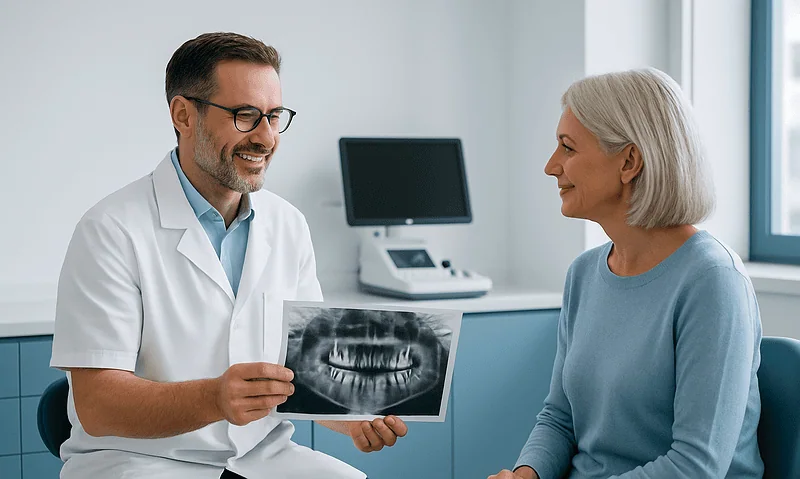
Imaging in Implantology: How Panoramic X-Rays and 3D Scans Guide Implant Position and Depth
Implantology imaging combines two-dimensional dental X-rays, most often a panoramic film, with a three-dimensional cone beam CT (CBCT) scan when the clinician needs to…

Why Jaw Growth Decides When Implantology Can Place an Implant in a Younger Patient
Dental implants for teenagers are usually postponed until the jaw has stopped growing, because an implant fuses to bone and cannot move with the…
How Mini Implants Are Placed: Flapless Insertion, Same-Day Denture Fitting and What to Expect
A mini implant procedure places one or more narrow titanium posts into the jawbone, usually through a small pierce in the gum rather than…