

Weight Changes After Fat Transfer: What Happens to Grafted Fat When Your Body Changes

Key Takeaways
- Grafted fat cells remain living adipocytes that enlarge with weight gain and shrink with weight loss exactly like fat anywhere else in the body.
- Transplanted fat may keep the storage behavior of its donor site, so fat from the abdomen can enlarge or shrink out of step with native tissue around it.
- Weight on the scale in the first one to two weeks is dominated by tumescent and intravenous fluid, swelling and reduced movement, not new fat.
- The NHS places the final result of fat transfer at up to six months, after swelling clears and the share of fat that did not survive is reabsorbed.
- Liposuction removes some fat cells permanently, but remaining cells in the donor area can enlarge with weight gain and surplus fat may be stored in untreated regions.
- Fat necrosis can produce firm lumps or calcifications years later, so anyone having a mammogram should tell the imaging team about prior fat transfer.
Weight gain after fat transfer affects grafted fat the same way it affects fat anywhere else in the body: surviving fat cells enlarge, so the treated area can grow, sometimes unevenly, because transplanted fat keeps the behavior of the site it came from. Weight loss shrinks it. Early postoperative weight is mostly fluid and swelling, not new fat. Surgeons usually advise a stable weight, and your treating team guides every decision.
She stepped on the scale eight days after surgery, saw a number she had not seen in years, and sat down on the edge of the bath. The surgeon had moved fat from her flanks to her breasts, exactly as planned. Nobody had warned her that the scale might jump before anything settled.
That small moment is where most questions about weight gain after fat transfer begin: a number that moves, a body that feels unfamiliar, and a quiet worry that the result is already slipping. Some of that worry is misplaced. Early weight is largely water. Some of it is well founded, because grafted fat is living tissue and lives by the same rules as the fat it left behind.
This explainer walks through what actually happens to transplanted fat when your weight rises, falls, or shifts with pregnancy and age, what the evidence supports, and where honest uncertainty remains.
What actually happens to fat when it is moved from one place to another
Fat transfer, also called fat grafting or lipofilling, is a two-step operation. First, fat is removed from a donor area, commonly the abdomen, flanks or thighs, using liposuction. Liposuction is a suction technique that draws fat out through a thin tube called a cannula. The harvested fat is then processed to separate it from blood, fluid and oil, and reinjected in small threads into the area being enhanced, which may be the breasts, buttocks, face or hands. The NHS describes this sequence and notes that the procedure may need to be repeated to reach the intended effect.
Here is the part that explains almost everything about weight changes. Injected fat has no blood supply at the moment it arrives. Each small parcel must sit close enough to living tissue for new capillaries to grow into it over the following days. Fat placed too thickly, or in a pocket that has been overfilled, is more likely to die and be absorbed. This is why surgeons talk about placing fat in fine layers rather than in a single bolus.
The fat cells that do survive are not scar tissue and they are not inert filler. They are adipocytes, the storage cells that hold the body’s energy reserve, and they remain responsive to insulin, hormones and the energy balance of the person they live in. A grafted adipocyte in the breast still receives the same chemical signals as an adipocyte in the thigh. When the body stores energy, it enlarges. When the body draws on reserves, it shrinks.
Put plainly, fat transfer moves cells; it does not change what those cells are. That single fact is the basis for understanding how the result behaves over years.
Why weight gain after fat transfer changes the result
Adults do not easily gain large numbers of new fat cells. Most weight gain happens because existing cells swell with stored triglyceride, the chemical form in which the body banks surplus calories. Both the Mayo Clinic and the Cleveland Clinic make this point when describing liposuction: the fat cells that remain after suction can grow larger if weight rises. The same logic applies to fat that has been relocated.
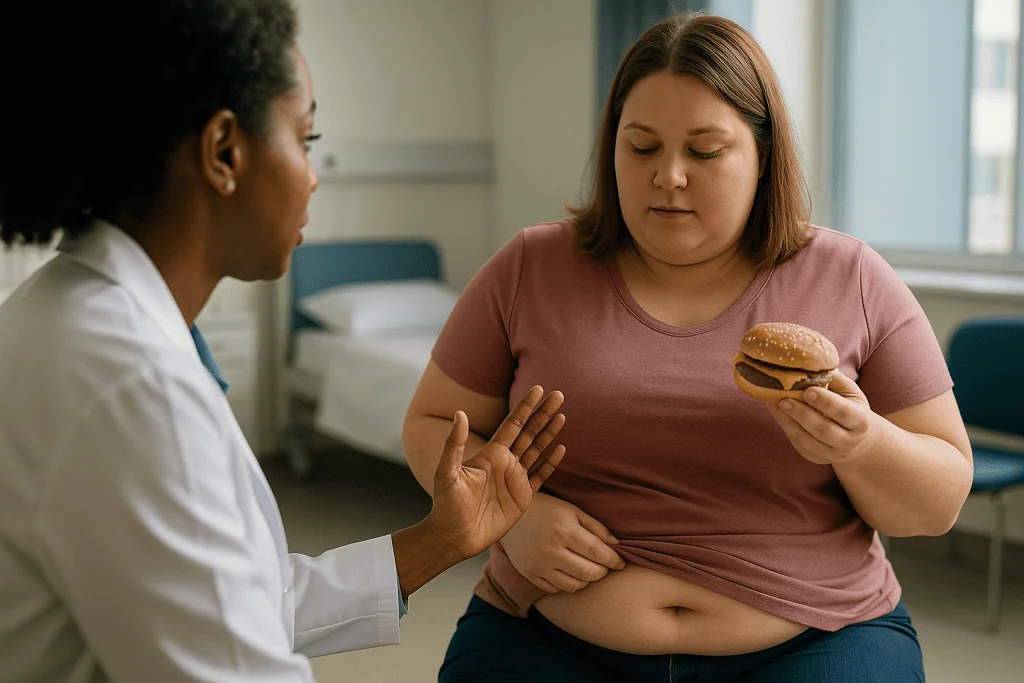
So when the scale climbs months after a fat transfer, the surviving grafted cells expand along with fat elsewhere. The treated breast or buttock may become fuller. That sounds like a bonus, and some people experience it that way, but there are two complications.
The first is proportion. Weight gain is distributed according to your genetics and hormones, and grafted fat can behave as if it were still at its donor site. Fat harvested from the abdomen, an area that in many people enlarges readily with weight gain, may enlarge more enthusiastically than the native tissue around it. The result can be fullness in an unplanned pattern, or a difference between the two sides if graft survival was uneven.
The second is the donor site itself. Liposuction permanently removes a share of the fat cells in that region, so with later weight gain the remaining cells there enlarge, and surplus energy may also be stored in areas that were never treated. The Mayo Clinic notes that fat distribution can change after liposuction for exactly this reason. People sometimes describe new fullness on the upper back, arms or inner knees that they never had before.
None of this is a complication in the medical sense. It is physiology doing what physiology does, which is precisely why surgeons ask about weight stability before agreeing to operate.
Why am I 10 pounds heavier after surgery?
A sudden jump on the scale in the first one to two weeks is one of the most common sources of alarm, and it is almost never fat. Several processes add weight at once.
Liposuction is usually performed with tumescent fluid, a large volume of dilute saline mixed with local anesthetic and a vessel-constricting medicine, injected into the donor area before suction. Not all of it is removed. Some drains over the following days through the small incisions; some is absorbed and later passed in urine. Intravenous fluids given during the operation add more. Then there is swelling, the body’s inflammatory response to tissue injury, which pulls fluid into both the donor and recipient areas. The Cleveland Clinic lists swelling and fluid accumulation among the expected effects of liposuction.
Movement also drops sharply after surgery while bowel transit slows under the influence of anesthesia and pain medicines. Constipation and reduced activity add real but temporary weight. Compression garments, which the NHS and Mayo Clinic describe as a standard part of liposuction aftercare, can mask how much of the change is fluid because the treated areas look flatter than they feel.
None of this means that a ten-pound change should be ignored. If weight rises rapidly alongside shortness of breath, swelling in one calf, or a feeling of pressure in the chest, that pattern needs urgent assessment, because fluid overload and blood clots are serious postoperative risks. In the absence of such symptoms, most surgeons expect early water weight to resolve as swelling settles, a process the Mayo Clinic describes as taking weeks for most of the change and several months for the final contour.
The practical advice many care teams give is simple: put the scale away for the first month and judge progress by how clothes fit and how the tissue feels.
What the first weeks and months usually look like
Recovery from fat transfer runs on two timelines at once, one for the donor area and one for the grafted area, and they do not always move in step.

In the first week, the donor site is usually the louder of the two. Bruising, tenderness and a feeling of tightness are expected after liposuction. The NHS advises that bruising and swelling may take several weeks to fade and that a compression garment is typically worn to support the area. Small amounts of blood-tinged fluid leaking from incision sites in the first day or two are normal.
The grafted area is often swollen enough in the first two to three weeks to look larger than the intended result. This is a known source of disappointment later, because people fall in love with the swollen version. As fluid clears and the grafted fat that did not survive is gradually absorbed, the volume reduces. The NHS states that it can take up to six months for the final result of fat transfer to become clear, and that some of the injected fat is expected to be reabsorbed by the body.
Between roughly weeks three and twelve, the tissue often feels firmer than normal, with small lumps that soften as healing progresses. Not every lump disappears. Some represent fat necrosis, which is the medical term for grafted fat that died and formed a firm nodule or oil cyst. The NHS lists this among the recognized risks of the procedure.
Sensation can be altered for months. Numbness or tingling in either area is common and typically improves, although permanent change is possible.
Weight during this period should ideally stay close to your preoperative baseline, not because small fluctuations ruin the result, but because they muddy the picture when you and your surgeon assess how much fat has taken.
How long does fat transfer last?
The honest answer has two halves, and people deserve both.
The first half: fat that survives the early healing window is permanent in the sense that the cells are now part of your body with their own blood supply. They do not dissolve on a schedule the way injectable fillers made of hyaluronic acid do. The NHS describes surgical fat transfer as a procedure whose results are long-lasting once the surviving fat has settled.
The second half: not all of the fat survives, and the proportion that does varies from person to person and from one operation to the next. Published reviews report a wide range of retention figures, and the spread is wide enough that quoting a single number would be misleading. What the evidence does support is that volume loss occurs mainly in the first few months, that overfilling does not reliably improve the final volume, and that a second session is sometimes planned from the outset. The NHS notes explicitly that more than one procedure may be needed.
After the settling period, the grafted fat is subject to the ordinary forces of time. Skin elasticity declines with age, native breast or buttock tissue changes, and body weight drifts. The graft itself follows your weight. Someone whose weight stays within a narrow range for a decade is likely to see a result that changes slowly and predictably. Someone whose weight swings by a large margin will see the graft swing with it.
So the question “how long does fat transfer last” is really two questions. How much survives? That is decided by month six. How does what survived behave afterward? That is decided, in large part, by the life the body leads.
Weight loss after fat transfer: what shrinks and what does not
Losing weight after fat transfer is the mirror image of gaining it, and it tends to worry people more because it moves the result in the direction they did not want.
When the body runs an energy deficit, it draws triglyceride out of fat cells everywhere. Grafted cells are not exempt. A breast or buttock enhanced with fat will lose some volume during meaningful weight loss, and the amount depends on how much weight is lost, how the person’s body preferentially mobilizes fat, and how much of the graft survived in the first place. The Harvard Health material on body fat describes how fat stores respond to overall energy balance rather than to targeted effort; there is no way to protect one region while reducing another.
There is a subtle point here. Grafted fat may follow the pattern of its origin. Fat harvested from a region that your body tends to shed first could shrink earlier than the native tissue around it. Fat from a stubborn area, such as the outer thighs in many women, may hold on longer. Surgeons sometimes take this into account when choosing a donor site, although the evidence supporting one site over another for durability is limited.
Timing matters too. Weight loss in the first weeks, when grafts are still establishing a blood supply, is thought to be more damaging than weight loss a year later, which is one reason surgeons commonly advise reaching a stable weight before the operation rather than dieting afterward.
What does not shrink is the structural change from liposuction. Fat cells removed from the donor area are gone. The waist contour created by suction persists through weight loss, which is why people sometimes feel the donor site looks better with weight loss while the recipient site looks smaller.
How different body changes affect a fat graft: a summary table
Patterns are easier to see side by side. The table below summarizes what mainstream clinical sources and the physiology of fat tissue suggest about common scenarios. It describes tendencies, not guarantees; individual results vary, and your surgeon’s assessment of your own tissue carries more weight than any general table.
| Body change | Effect on grafted area | Effect on donor area | Typical timing |
|---|---|---|---|
| Early postoperative fluid and swelling | Looks larger than final result | Swollen, bruised, tight | Peaks in the first 1–2 weeks; most settles over weeks, contour final by about 6 months (NHS, Mayo Clinic) |
| Stable weight | Surviving fat remains; changes slowly with age | Contour maintained | Ongoing |
| Modest weight gain | Fullness increases, may be uneven | Remaining cells enlarge; new storage elsewhere possible | Weeks to months after gain |
| Significant weight gain | Marked enlargement, proportion may change | Possible disproportionate fat elsewhere (Mayo Clinic) | Follows weight trend |
| Weight loss | Volume decreases | Contour from liposuction persists | Follows weight trend; early loss thought more harmful |
| Pregnancy and breastfeeding | Breast changes dominated by glandular tissue and hormones | Abdominal skin and fat stretch | Throughout and after pregnancy |
Two observations stand out. First, the only scenario in which the graft reliably holds its intended shape is the one in which weight stays steady, which is why that single piece of advice appears in almost every reputable patient resource. Second, the donor area and recipient area can move in opposite directions during weight change, so judging a result by one region alone gives an incomplete picture.
If your weight has changed substantially since surgery, a review appointment, rather than a mirror, is the right place to assess what has happened.
Who fat transfer is usually for, and who is usually asked to wait
Fat transfer suits a particular kind of goal. It is typically offered to people who want a modest increase in volume, often described in terms of a cup size or a gentle change in contour, and who prefer their own tissue to an implant. It is also used in reconstruction after breast cancer surgery to smooth contour irregularities, and in the face and hands to restore fullness lost with age. MedlinePlus notes that breast enlargement with fat grafting is an option for some people seeking a smaller change than implants typically provide.
Three requirements come up repeatedly in surgical assessment. There must be enough donor fat to harvest; very lean people may not be candidates. Skin at the recipient site must have enough laxity to accept added volume without excessive pressure, since pressure compromises graft survival. And weight should be stable, because a graft placed into a body that is about to change will change with it.
People are commonly asked to wait in several situations. Active weight loss or a planned diet is one; many surgeons prefer that a person has held a steady weight for several months. Smoking is another: nicotine constricts blood vessels and impairs the growth of new capillaries that grafted fat depends on, and the NHS advises stopping smoking before cosmetic surgery to reduce complications. Pregnancy, breastfeeding or plans for either in the near future are usually reasons to defer breast fat transfer, since hormonal changes will reshape the breast regardless. Poorly controlled diabetes, bleeding disorders and certain medicines that affect clotting also need review by the prescribing clinician before any elective procedure.
None of these are judgments. They are attempts to give the graft its best chance, and to avoid operating on a body that is about to move the goalposts.
How to keep fat alive after fat transfer: what the evidence actually supports
The internet is full of advice on “feeding the fat,” and some of it has a basis in physiology while much of it does not. It helps to separate the two.
Graft survival is largely decided in the first days, when each parcel of fat is waiting for capillaries to grow in. During that window, anything that reduces blood flow to the recipient area is a genuine threat. Nicotine in any form is the clearest example, and the NHS’s guidance on cosmetic surgery is unambiguous about stopping before and after any operation. Direct pressure matters as well. Surgeons routinely advise avoiding sitting directly on grafted buttocks for a period after surgery and avoiding tight bras or compression on grafted breasts, because compressed tissue has poorer perfusion. The exact duration is set by your surgeon and depends on the volume placed.
Nutrition supports healing but does not grow fat selectively. Adequate protein, hydration and a diet sufficient in calories give the body what it needs to repair tissue. Deliberately overeating to “nourish the graft” is a myth; surplus calories are stored throughout the body according to your pattern, not routed to the surgical site. Likewise, there is no supplement with evidence that it improves graft take, and the NIH Office of Dietary Supplements consistently finds that supplement claims for surgical outcomes lack supporting trials.
Movement has a more interesting role. Gentle walking from the first day reduces the risk of blood clots, a serious complication after any surgery involving reduced mobility. Strenuous exercise, however, is usually paused in the early weeks, both to protect incisions and because surgeons prefer to avoid energy deficits while grafts establish.
Beyond those basics, the single most useful thing a person can do is hold their weight steady during the first few months. It is unglamorous advice, and it is the advice the evidence supports.
Fat transfer results after 10 years: what is known and what is not
People searching for what happens to fat transfer breast augmentation after ten years are asking a fair question, and the honest reply begins with an admission: long-term follow-up studies spanning a full decade are limited, and most published series report outcomes over months to a few years.
What can be said with reasonable confidence comes from the biology. Grafted fat that survived the first six months is integrated tissue with its own blood supply, so it does not vanish on a timer. A decade later, the volume present is the volume that survived, adjusted by every weight change, pregnancy and hormonal shift in between, and by the normal aging of the surrounding tissue. Breasts change shape with age independently of any procedure; skin thins and ligaments stretch. Grafted fat does not protect against this and may descend with the rest of the tissue.
Two long-term issues deserve attention. The first is fat necrosis, where dead grafted fat forms firm lumps, oil cysts or calcifications. These can persist for years and can appear on mammograms. Radiologists are generally able to distinguish them from suspicious findings, but it is essential that anyone having breast imaging tells the imaging team about previous fat transfer so that films are read in context. The NHS lists lumps from fat necrosis among the recognized risks of the procedure.
The second is the possibility of needing a repeat procedure. Because retention varies, some people choose a second session to add volume, and others decide that the softer, smaller result suits them. Neither path is a failure.
What is not known with certainty is whether grafted fat alters long-term cancer detection or risk in ways beyond imaging artifacts. Current mainstream guidance treats the technique as acceptable with proper imaging follow-up, but anyone with a personal or strong family history of breast cancer should raise this directly with their treating team.
Pregnancy, breastfeeding and menopause after fat transfer
Weight is not the only thing that changes a body, and hormonal transitions can reshape a fat transfer result as much as the scale does.
During pregnancy, breast tissue enlarges because of glandular growth driven by estrogen, progesterone and prolactin, not primarily because of fat. After breastfeeding ends, glandular tissue regresses, and many women notice their breasts are smaller or less full than before pregnancy regardless of any prior surgery. Grafted fat sits in the same tissue, so it rides along through these changes. Pregnancy-related weight gain may enlarge the graft; postpartum weight loss may shrink it; and the stretching and recoil of skin alters the shape of everything inside it. MedlinePlus and the Mayo Clinic both note that pregnancy and breastfeeding can change the appearance of breasts after augmentation, which is why surgeons commonly suggest completing a family before breast enhancement when circumstances allow.
There is no evidence that fat transfer prevents breastfeeding, since the fat is placed in and around existing tissue rather than through the ducts, but anyone planning to breastfeed should discuss this with the surgical team beforehand.
Menopause brings a different pattern. Falling estrogen shifts fat storage toward the abdomen and reduces glandular breast tissue, so breasts often become proportionally more fatty. Harvard Health describes this shift toward abdominal fat in midlife. A fat-enhanced breast may therefore maintain its volume relatively well at menopause while the donor abdomen, with fewer fat cells after liposuction, may store less than it otherwise would, or may redirect storage to untreated regions.
These transitions are not reasons to avoid the procedure, but they are reasons to think about timing, and to accept that a result assessed at six months is a snapshot, not a final photograph.
What people often get wrong about weight gain after fat transfer
Myths cluster around this topic because the procedure sits at the intersection of two things people find confusing: how fat works and how surgery heals. A few corrections are worth making plainly.
“The fat I gain will go to my breasts because that is where the fat was moved.” Not in the way people hope. Surplus energy is distributed according to your genetic pattern. Grafted cells enlarge along with all the others, so some new volume may appear at the recipient site, but the rest goes everywhere it always has. Deliberate overeating is a poor strategy with a predictable cost.
“Liposuction means I can never gain fat in that area again.” The Cleveland Clinic and Mayo Clinic are clear that remaining fat cells can grow larger with weight gain. The treated area has fewer cells, not zero.
“The swelling I see at two weeks is my result.” It is not. The NHS places the final result at up to six months, after swelling clears and non-surviving fat is absorbed. Judging early sets people up for disappointment.
“A lump means something has gone wrong.” Often it means fat necrosis, which is a recognized outcome rather than an error, although any new or growing lump should be examined and may need imaging.
“If I lose weight the graft disappears completely.” Grafted fat shrinks with weight loss; it does not evaporate. The cells remain and will refill if weight returns.
“Fat transfer is risk-free because it uses my own tissue.” Using your own fat removes the risk of implant rupture or capsular contracture, but it does not remove the general risks of surgery, including infection, bleeding, clots, fluid collections, asymmetry and, rarely, fat embolism, all of which the NHS lists.
Each of these myths is a reason to have one more conversation with the surgical team before deciding.
Questions to ask your care team
A good consultation leaves you knowing how your particular body is likely to behave, not just how the procedure works in general. These questions tend to produce useful answers.
- Given my weight history and the donor site you propose, how do you expect the grafted fat to respond if I gain or lose weight later?
- How long would you like my weight to have been stable before surgery, and how will you judge that?
- How much of the injected volume do you expect to survive in someone like me, and what range have you seen in your own practice?
- Are you planning one session or more, and what would prompt a second?
- What should I avoid in the first weeks to protect blood flow to the graft: pressure, garments, exercise, nicotine?
- If I am planning pregnancy or expect menopause within a few years, how might that change the result or the timing you recommend?
- How will fat necrosis or calcifications affect my future mammograms, and what should I tell the imaging team?
- What signs in the first two weeks should make me call you the same day?
- If I am unhappy with volume loss or asymmetry at six months, what options would you consider, and what are their risks?
- What are the alternatives for my goal, including implants or doing nothing, and how do they compare for someone whose weight may change?
Write the answers down. Surgical consultations move quickly, and the detail about donor site behavior or compression timing is exactly the kind that gets lost by the time you are home. If any answer sounds like a guarantee rather than a range, that is a reason to ask again. Reputable surgeons describe tendencies and uncertainties, because that is what the evidence allows.
When to call your doctor
Most of what people notice after fat transfer, including bruising, firmness, temporary numbness and an early jump on the scale, is part of normal healing. Some signs are not, and they should be reported promptly to the surgical team or, if the team cannot be reached, to emergency services.
Contact your surgical team the same day if you notice a fever, spreading redness or warmth around an incision or grafted area, increasing rather than decreasing pain, or thick or foul-smelling discharge. These can indicate infection, which needs assessment and sometimes treatment with antibiotics chosen by the prescribing clinician. Call also if one area becomes suddenly larger, tense and painful, which may suggest bleeding or a fluid collection, or if a lump appears that is enlarging rapidly or changing the overlying skin.
Seek emergency care immediately for shortness of breath, chest pain, coughing up blood, a racing heartbeat, or confusion. These can signal a blood clot that has traveled to the lungs or, rarely after fat transfer, a fat embolism in which fat enters the bloodstream; the NHS lists fat embolism among the serious risks of the procedure. Pain, swelling or warmth in one calf should also be assessed urgently, since it may indicate a clot in the leg. Fainting, severe dizziness or very low urine output despite drinking can indicate dehydration or significant blood loss.
In the longer term, any new breast lump, nipple discharge, skin dimpling or change in breast shape should be examined by a clinician and will usually prompt imaging. Tell the radiology team you have had fat transfer so that findings such as oil cysts and calcifications are interpreted in context.
If you are unsure whether a symptom matters, call. Surgical teams would far rather hear about a normal bruise than miss an early complication, and no article can replace an examination.
Frequently asked questions
Why am I 10 pounds heavier after fat transfer surgery?
Early postoperative weight gain is almost always fluid, not fat. Tumescent fluid injected before liposuction, intravenous fluids given during surgery, inflammatory swelling at both sites, slower bowel transit and reduced activity all add temporary weight. Most of this clears over several weeks as swelling settles. Rapid weight gain with breathlessness, chest pain or one swollen calf needs urgent assessment.
Is it normal to gain 10 pounds after breast augmentation with fat?
A temporary rise of several pounds in the first week or two is common and reflects fluid and swelling rather than true weight gain. It usually resolves without any action. Weight gain that persists for months is different: it means stored fat is increasing throughout the body, and the grafted breast fat will enlarge along with it, sometimes unevenly.
How can I keep fat alive after fat transfer?
Graft survival depends mainly on blood supply in the first days. Avoiding nicotine in any form, avoiding direct pressure on the grafted area for the period your surgeon specifies, walking gently to prevent clots, eating enough to heal and holding a steady weight are the measures supported by physiology and clinical guidance. Overeating or supplements do not improve survival.
What happens to fat transfer breast augmentation after 10 years?
Fat that survived the first six months remains as living tissue, so its volume a decade later reflects every weight change, pregnancy and hormonal shift in between, plus normal aging of breast skin and ligaments. Long-term studies are limited. Fat necrosis lumps and calcifications may persist and can appear on mammograms, so imaging teams should always be told about the procedure.
Does weight loss after fat transfer make the result disappear?
Weight loss shrinks grafted fat but does not remove it. The cells lose stored triglyceride and become smaller, so the treated area loses volume in proportion to overall fat loss. If weight returns, the cells refill. Weight loss in the first weeks, while grafts are still establishing blood supply, is thought to be more damaging than loss much later.
How long does fat transfer last once it has settled?
Surviving grafted fat is permanent in the sense that it has its own blood supply and does not dissolve on a timer like injectable fillers. The NHS describes results as long-lasting once settled, which it places at up to six months. After that, the graft changes with your weight, hormones and age rather than fading on its own.
Will fat gained after fat transfer go to my breasts or buttocks?
Some will, because grafted cells enlarge with all others, but surplus calories are stored according to your genetic pattern across the whole body. There is no mechanism that routes new fat to the surgical site. Deliberately gaining weight to enlarge a result is unreliable and brings general health costs without predictable benefit.
Can fat come back to the liposuction donor area if I gain weight?
Yes, to a degree. Liposuction permanently removes a share of fat cells, but the Cleveland Clinic and Mayo Clinic note that remaining cells can grow larger with weight gain. The area has fewer cells, not none, and surplus fat may also be stored in regions that were never treated, which can change overall proportions.
Should I lose weight before or after fat transfer?
Surgeons generally prefer that weight is stable at the level you intend to maintain before surgery. Dieting afterward, especially in the first weeks, can shrink the graft while it is still establishing blood supply. If weight loss is a goal, most teams suggest reaching and holding a steady weight for several months first, then discussing timing.
Are lumps after fat transfer a sign the fat is dying?
Firmness and small lumps are common during healing and often soften over months. Some persistent lumps represent fat necrosis, where grafted fat died and formed a firm nodule or oil cyst, a recognized outcome listed by the NHS. Any lump that enlarges, becomes painful, changes the skin or appears years later should be examined and may need imaging.
References
This article is for general information only and is not a substitute for professional medical advice. Please consult a qualified doctor about your individual situation.

More from the Blog

Buttock Lift Scars and Daily Life: Placement, Fading and Choosing Clothing While Healing
Buttock lift scars usually run horizontally along the upper edge of the buttocks, just below the waistline, where most underwear or swimwear can cover…

Body Contouring Recovery Milestones: Compression, Tightness and the Return to Daily Life
Body contouring recovery milestones follow a broadly predictable sequence rather than fixed dates. Drains, if used, usually come out within days; a compression garment…

Fat Transfer Recovery Timeline: Healing the Donor Site and the Grafted Area at the Same Time
Fat transfer recovery time runs on two clocks. The liposuction donor site is usually the sorer one, with bruising and swelling that ease over…
HD Liposculpture vs Standard Liposuction: What Sculpting Around Muscle Lines Adds
HD liposculpture is a variant of liposuction in which the surgeon removes fat selectively, in layers, to reveal the outlines of underlying muscles such…
Fat Grafting Complications: Oil Cysts, Lumps and Asymmetry, and How Each Is Managed
Fat grafting complications most often include oil cysts, firm lumps from fat necrosis, uneven volume or asymmetry, bruising, numbness and infection, with fat embolism…

Can Fat Grafting Improve Scars and Contour Defects? When Surgeons Recommend It
Fat grafting can improve some scars and contour defects. A surgeon removes a small amount of a person's own fat by liposuction, processes it,…