

What a Neurological Rehabilitation Program Includes: Movement, Speech, Swallowing and Thinking

Key Takeaways
- A neurological rehabilitation program is coordinated care from physical, occupational, speech-language and cognitive specialists, overseen by a rehabilitation physician, with goals set together with the patient and family.
- Recovery relies on neuroplasticity, the brain's capacity to reorganize connections through repeated, task-specific practice, which is why hundreds of repetitions of a meaningful task matter more than generic exercise.
- Mayo Clinic reports that stroke rehabilitation often starts within 24 to 48 hours of medical stability, with the fastest gains in the first three to four months and continued improvement possible into the first and second year.
- Swallowing is assessed early because dysphagia after stroke or brain injury can allow food or liquid into the lungs, and texture changes are temporary safety measures reviewed as the swallow improves.
- The NHS notes that around a third of people who have a stroke experience aphasia, a language disorder distinct from dysarthria, which is a problem of speech muscles rather than words.
- Cognitive rehabilitation has stronger evidence for strategy training practiced in real settings, such as diaries, alarms and checklists used in the kitchen or shop, than for computer drills done in isolation.
A neurological rehabilitation program is coordinated therapy for people whose brain, spinal cord or nerves have been injured by stroke, trauma, multiple sclerosis, Parkinson's disease or similar conditions. It typically combines physical therapy for movement and balance, occupational therapy for daily tasks, speech-language therapy for communication and swallowing, and cognitive rehabilitation for memory and attention, delivered by a team that sets goals with the patient and family.
Two weeks after a stroke, a retired carpenter stares at a coffee mug on a bedside tray. He knows what it is. He knows what he wants to do with it. His right hand simply does not get the message. In the next room, a young woman recovering from a motorbike crash can lift the mug fine, but cannot remember whether she already drank from it. Both of them have just been told the same thing: you are being referred to a neurological rehabilitation program.
The phrase lands heavily. It sounds like a place, or a verdict. It is neither. It is a plan, built around a person, that tries to teach an injured nervous system to do familiar things in new ways.
This explainer walks through what that plan usually holds, from relearning to stand and swallow safely to rebuilding the quieter skills of attention and word-finding, and where the evidence is clear, cautious or still catching up.
What is a neurological rehabilitation program, in plain terms?
Strip away the jargon and a neurological rehabilitation program is a structured course of therapy for people whose nervous system has been damaged. Neurological means anything involving the brain, spinal cord and the nerves that run out to the body. Rehabilitation means recovering function, or learning to live well when some function does not come back.
The conditions that lead people here are varied but share a thread: the wiring has been disrupted. Stroke is the largest single group. Traumatic brain injury, spinal cord injury, multiple sclerosis, Parkinson’s disease, Guillain-Barré syndrome, brain tumors treated with surgery, and post-infectious encephalitis all bring people to the same door. Johns Hopkins describes the field as care aimed at helping people with nervous-system disease or injury regain function, reduce symptoms and improve well-being.
What makes it a program rather than a series of appointments is coordination. One therapist working on your walking and another on your speech will be reading the same notes, aiming at the same goals and, ideally, meeting weekly to adjust the plan. Goals are set with you, not for you. A goal might be as concrete as pouring a kettle safely or returning to a Thursday choir rehearsal.
People often ask whether this is only for the badly injured. It is not. A program can be intensive and residential, or two sessions a week while you live at home. The intensity is matched to what your body can tolerate and what you are trying to get back. Someone with a mild stroke affecting only fine finger control may need occupational therapy alone; someone with a severe brain injury may need every discipline described below. The label is the same, because the principles are the same.
How neurorehabilitation actually works: neuroplasticity and repetition
The engine underneath every session is neuroplasticity, the brain’s ability to reorganize its connections in response to experience. Neurons that were killed by a stroke or a blow do not regrow in adults in any meaningful number. Surviving neurons, though, can strengthen existing pathways and recruit neighboring regions to take on lost jobs. Mayo Clinic notes that recovery depends on this reorganization and that it is driven by practice.
Practice has to be specific. A therapist will not ask you to squeeze a ball for an hour if your goal is buttoning a shirt; they will hand you a shirt. The technical phrase is task-specific training, and it reflects a consistent finding: the brain learns what it rehearses. Repetition matters as well, and the numbers are larger than most people expect. Rehabilitation research routinely uses hundreds of repetitions of a movement in a single session, far more than happens in ordinary daily life after an injury.
Timing plays a role too. Mayo Clinic reports that after a stroke, rehabilitation commonly begins within 24 to 48 hours once the person is medically stable, and that the most rapid gains usually occur in the first three to four months. That window is not a deadline. The same source records that some people continue improving into the first and second year, and therapists working with spinal cord injury or multiple sclerosis see meaningful change well outside any neat calendar.
There is a quieter mechanism alongside plasticity: compensation. If a hand will not recover grip, a therapist teaches a one-handed technique or fits an adaptive tool. Good programs do both at once, pushing recovery where it is still possible and building workarounds where it is not, and they are honest with you about which is which.
Who is a neurological rehabilitation program usually for, and who is asked to wait?
Referral usually rests on three questions. Is there a measurable loss of function? Is the person medically stable enough to take part? And is there a realistic prospect that therapy will change something that matters to them? A yes to all three opens the door, whatever the age or diagnosis.
Typical candidates include people in the weeks after a stroke with weakness on one side, known as hemiparesis; people with traumatic or acquired brain injury whose memory, planning or behavior has changed; people with new spinal cord injury learning to move, transfer and manage bladder and bowel; people with progressive conditions such as multiple sclerosis or Parkinson’s disease who want to hold onto walking, speech or independence; and people with peripheral nerve conditions such as Guillain-Barré syndrome in the recovery phase.
Some people are asked to wait, and the reasons are usually about safety rather than potential. Unstable blood pressure, an uncontrolled infection, a fresh fracture that cannot yet bear weight, or ongoing seizures may mean intensive therapy is delayed by days or weeks while the medical team settles those problems. Someone who is too drowsy to follow a simple instruction may start with bedside positioning and passive movement rather than a full program, then step up as alertness returns.
A different group is redirected rather than delayed. People with very severe injuries who cannot yet tolerate any activity may be offered a slower-stream or maintenance pathway, with a review date. This can feel like a door closing. In practice it is a triage decision about the right setting at the right time, and it is worth asking the team what would need to change for a full program to become appropriate. The decision, and its revisiting, sits with the treating physicians and therapists.
Who is on the neurorehabilitation team, and what does each person do?
Walk the corridor of a rehabilitation unit and you will pass half a dozen professions before lunch. Each covers a different slice of daily life.
A physiatrist is a physician specializing in physical medicine and rehabilitation; in some countries a neurologist or rehabilitation physician fills the role. This doctor oversees the medical side, manages problems such as spasticity or pain, and chairs the team. Rehabilitation nurses handle round-the-clock care, skin protection, bladder and bowel routines, and reinforce what therapists teach, because a skill practiced only in the gym does not stick.
Physical therapists focus on the large movements: sitting balance, standing, walking, stairs and falls prevention. Occupational therapists work on the tasks that fill a day, from dressing and cooking to using a phone or returning to a job, and they assess the home for hazards. Speech-language pathologists cover both communication and swallowing, two functions that share the same muscles and nerves. Neuropsychologists assess thinking, memory and mood, and design cognitive rehabilitation. Dietitians match food texture and nutrition to swallowing safety and energy needs. Social workers and case managers coordinate discharge, benefits and community services. Orthotists build braces and splints; recreational therapists reintroduce hobbies as therapy.
MedlinePlus lists these roles as the core of stroke rehabilitation, and the same structure applies across neurological conditions. Two people are on the team who do not wear badges: the patient and the family. Team meetings that exclude them produce goals nobody is invested in. Expect to be asked what a good week looked like before the injury; the answer shapes everything that follows.
Movement therapy: relearning to sit, stand, walk and balance
Movement work begins earlier and lower than people imagine. On day one it may be nothing more than learning to roll in bed without help, or sitting on the edge of the mattress for a few minutes while a therapist steadies your trunk. Sitting balance is a prerequisite for almost everything else, which is why so much early attention goes to the core.
From there the sequence runs roughly through transfers, meaning moving safely between bed, chair and toilet; standing with support; stepping; and finally walking with progressively less assistance. Therapists use parallel bars, body-weight-supported treadmills, walking frames and, where available, robotic gait devices. The evidence for these tools is mixed: they allow high repetition safely, which is valuable, but reviews have not shown that high-tech devices reliably outperform equally intensive conventional walking practice. A program that uses them as a means to more steps, rather than as a promise in themselves, is applying the evidence sensibly.
Strength training is now standard. Older fears that resistance work would worsen spasticity, the involuntary muscle tightness that follows brain or spinal cord injury, have not been supported by research. Stretching, positioning and splinting sit alongside it to protect joint range.
For the arm, one well-studied approach is constraint-induced movement therapy, in which the stronger hand is restrained for set periods so the weaker one is forced to work. It suits people who already have some finger movement and can tolerate frustration. Mirror therapy, electrical stimulation to trigger muscles, and mental practice all have supporting studies of varying quality; your therapist should be able to say which they use and why.
Falls are the recurring worry. Balance retraining, home assessment and honest conversation about walking aids reduce risk, though no program can remove it entirely.
Occupational therapy: hands, daily tasks and getting back to your life
Occupational therapy is the most misunderstood part of a neurological rehabilitation program, largely because of its name. It has nothing specifically to do with employment. The occupation in question is whatever occupies your day: washing, dressing, making tea, texting a grandchild, driving, shopping, gardening.
The work starts by breaking a task into steps and finding the one that fails. Buttoning a shirt, for instance, needs shoulder stability, wrist extension, a pincer grip, hand-eye coordination and the sequencing to do the steps in order. A stroke may spare four of those and remove one. The therapist rebuilds the missing link through graded practice, then reassembles the whole task.
When a skill does not return, adaptation steps in. Button hooks, non-slip mats, tap turners, raised toilet seats, one-handed cutting boards and voice-controlled devices are the everyday tools of the trade. None of these is glamorous, and all of them can be the difference between living at home and not. The NHS stroke recovery guidance describes this blend of retraining and equipment as central to regaining independence.
Two problems get special attention. Apraxia is difficulty planning and sequencing movements even though the muscles work; a person may pick up a toothbrush and hold it to their ear. Neglect is a failure to notice one side of space, usually the left after a right-brain stroke, which leads to bumping into doorframes and leaving food on half the plate. Both respond to structured cueing and practice, and both are easy to mistake for confusion or carelessness if nobody explains them.
Toward discharge, occupational therapists usually visit or review the home, recommend changes and, where relevant, begin the long conversation about driving, work and hobbies.
Speech therapy after stroke and brain injury: aphasia, dysarthria and finding words
Losing the ability to say what you mean is, for many people, the most isolating part of a neurological injury. Speech-language pathologists separate the problem into its parts, because the treatments differ.
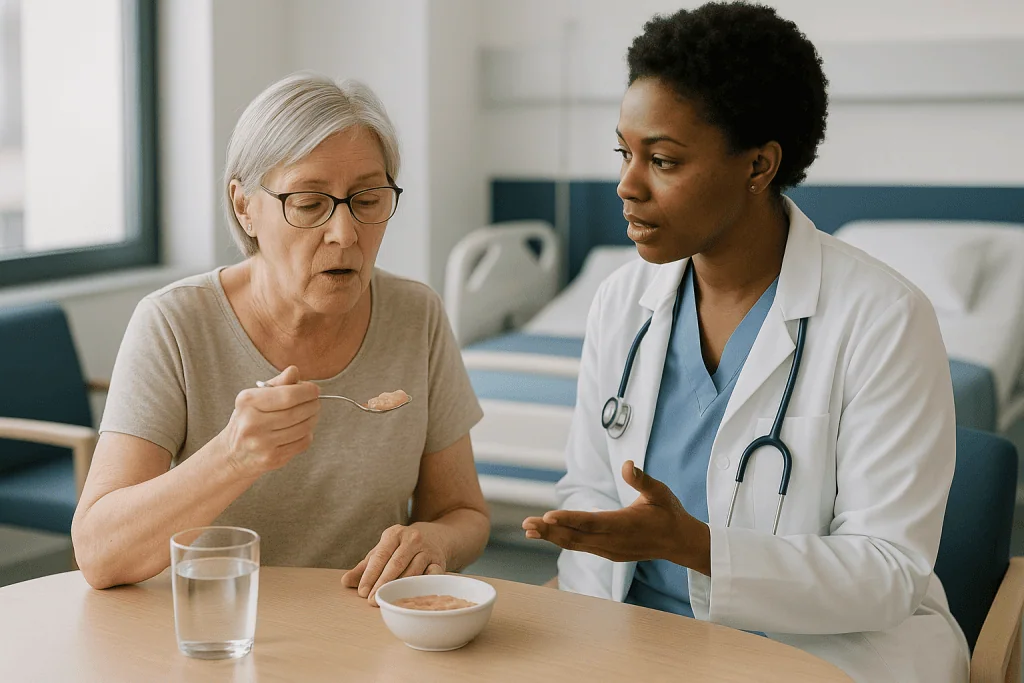
Aphasia is a language disorder: the machinery of speech is intact, but the brain’s ability to find, understand or assemble words is damaged. The NHS notes that around a third of people who have a stroke experience some degree of aphasia. It comes in several patterns. Some people speak fluently but produce the wrong words; some understand well but struggle to get any words out; some have trouble with reading and writing more than speech. Therapy targets the specific breakdown, using picture naming, word-finding strategies, structured conversation practice and, increasingly, software that allows extra practice between sessions.
Dysarthria is different. Here language is intact but the muscles of the lips, tongue, palate and voice box are weak or uncoordinated, so speech comes out slurred, quiet or nasal. Treatment works on breath support, articulation drills, pacing and, when needed, communication boards or speech-generating devices.
Cognitive-communication disorder, common after traumatic brain injury, is a third category: the person speaks clearly and finds words, but loses the thread, interrupts, misreads social cues or cannot organize a story. This overlaps with cognitive rehabilitation and is often treated jointly.
Families are trained too. Slowing down, asking one question at a time, allowing silence, and offering yes-or-no options are not patronizing when done with care; they are evidence-informed ways to keep someone in the conversation. Recovery of language tends to be slower than recovery of walking, and the NHS is clear that improvement can continue for months or years, which is why speech therapy is often the last discipline to sign off.
Swallowing therapy: why dysphagia has its own specialist
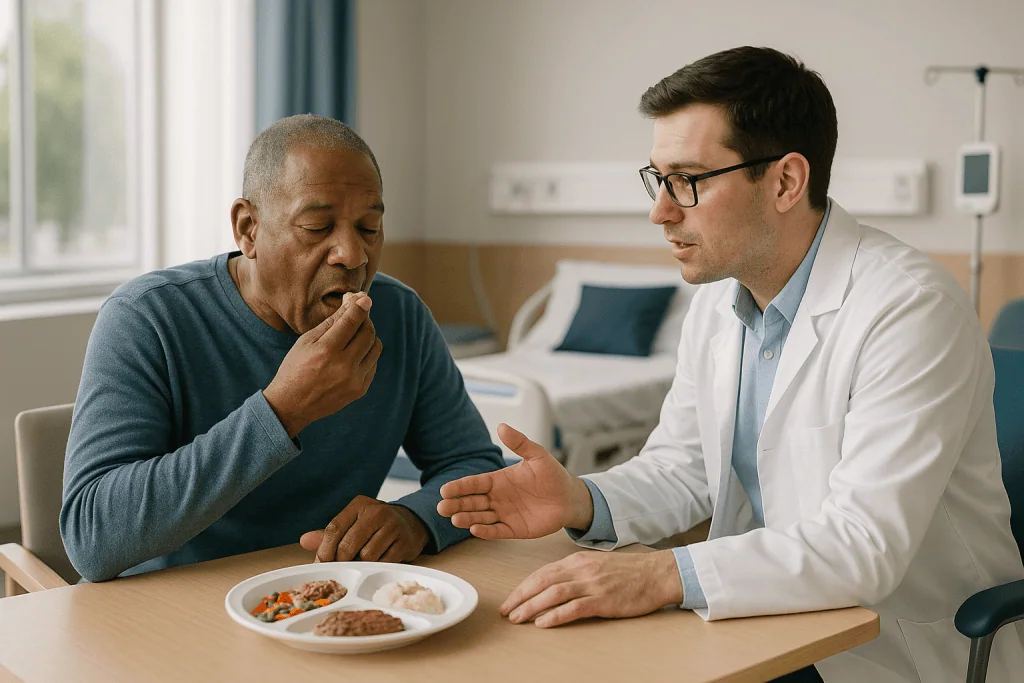
Swallowing rarely makes the list when people imagine rehabilitation, yet it is often the first thing assessed, sometimes within hours of arrival. Dysphagia, the medical term for difficulty swallowing, is common after stroke and brain injury because the same cranial nerves that move the tongue and throat also close the airway during a swallow. When that coordination fails, food or liquid can slip into the lungs, an event called aspiration, which can lead to pneumonia.
The first step is a bedside screen by a nurse or speech-language pathologist, watching the person take sips and small amounts of food. If there is concern, imaging follows. A videofluoroscopic swallow study is an X-ray recording taken while you swallow barium-coated food and drink. A fiberoptic endoscopic evaluation of swallowing, or FEES, passes a thin camera through the nose to watch the throat directly. Both show where the swallow breaks down and which textures are safe.
Treatment has two arms. Compensation changes the food or the posture: thickened fluids, softer textures, a chin-tuck while swallowing, smaller mouthfuls, sitting fully upright. Rehabilitation aims to strengthen and re-coordinate the swallow itself through targeted exercises for the tongue, throat and voice box, and sometimes through electrical stimulation of the throat muscles, an approach with supporting but not yet conclusive evidence.
The NHS dysphagia guidance emphasizes that texture changes are safety measures, not permanent sentences, and are reviewed as the swallow improves. For some people a feeding tube is needed temporarily to maintain nutrition while therapy continues; the decision is a medical one made with the person and family. The dietitian’s role here is to keep calories and protein adequate, because malnutrition slows every other kind of recovery.
Cognitive rehabilitation after brain injury: memory, attention and planning
Thinking problems are the invisible injury. Someone who walks out of the unit unaided may still be unable to follow a recipe, keep track of a conversation in a noisy room or remember an appointment made that morning. Cognitive rehabilitation is the part of the program that addresses these losses, and it is delivered mainly by neuropsychologists and occupational therapists, with speech-language pathologists covering the communication overlap.
Assessment comes first, because the word memory covers many different systems. Attention can be impaired in its sustained form (staying on task), its selective form (filtering distraction) or its divided form (doing two things at once). Memory may fail at encoding, storage or retrieval. Executive function is the umbrella term for planning, starting tasks, switching between them, checking errors and controlling impulses; it lives mainly in the frontal lobes and is frequently damaged in traumatic brain injury.
Treatment follows the same restore-or-compensate logic as physical therapy. Restorative approaches drill attention and processing speed with graded exercises. Compensatory approaches teach external aids and internal strategies: diaries, alarms, checklists, a fixed place for keys, the habit of repeating back what someone has said. Evidence reviews generally find stronger support for strategy training that carries into real life than for computerized drills done in isolation, which is why a good program insists on practicing strategies in the kitchen or the supermarket, not only at a screen.
Insight is a recurring challenge. Some brain injuries reduce a person’s awareness of their own deficits, so they may see no need for the diary they keep forgetting to use. Therapists handle this with structured feedback and small, safe experiences of what goes wrong without the strategy. Fatigue, mood and sleep all worsen cognition, which is why they are treated in parallel rather than left for later.
Where rehab happens: inpatient, outpatient and home programs compared
The same disciplines can be delivered in very different settings, and where you start is usually decided by how much medical supervision you need and how much therapy you can tolerate in a day. Mayo Clinic describes the main options for stroke rehabilitation, and they apply broadly.
| Setting | Who it usually suits | Typical pattern | Trade-offs |
|---|---|---|---|
| Inpatient rehabilitation unit | People needing daily physician oversight and able to take part in several hours of therapy a day | Mayo Clinic reports stays commonly of two to three weeks, with therapy most days | Highest intensity; away from home; discharge planning starts on admission |
| Skilled nursing or subacute unit | People needing nursing care but unable yet to tolerate intensive therapy | Lower daily therapy hours over a longer stay | Gentler pace; may step up to inpatient rehab later |
| Outpatient program | People living at home who can travel to appointments | Sessions one to several times a week, often for months | Practices skills in real life between visits; depends on transport and energy |
| Home-based therapy | People who cannot travel or whose goals are specifically about the home | Therapist visits at home, frequency set by need | Highly relevant practice; fewer specialist facilities |
Most people move through more than one setting, typically from hospital to inpatient unit to outpatient or home therapy. Transitions are the risky points: information gets lost, and momentum can stall while referrals are processed. Ask at each stage who is coordinating the next one, and get a written summary of your current goals and exercises so you can hand it to the next team yourself.
What the first days and weeks of a neurological rehabilitation program usually look like
The first 48 hours are mostly assessment. Each discipline meets you, watches you attempt a set of standard tasks and records a baseline. It can feel repetitive, as five different people ask when your problems started. Those baselines matter later, because progress in neurological recovery is often slow enough to be invisible day to day and only shows on a chart.
By the end of the first week, a team meeting usually produces a written set of goals with rough timeframes. Expect them to be small and concrete. Stand at the sink for two minutes to brush teeth. Say the names of five family members. Swallow puree safely without coughing. These are chosen because each one unlocks something larger.
A typical inpatient day is structured: therapy sessions in the morning and afternoon, rest built in between, meals used as swallowing and hand practice, evenings with family. Mayo Clinic notes that intensity in inpatient units is high, often several hours of active therapy most days, and that fatigue is expected. Nurses reinforce techniques between sessions, so getting dressed at seven in the morning is itself therapy.
Weeks two and three shift toward discharge, even if that seems premature. Occupational therapists assess the home. Equipment is ordered. Family members are shown how to help with transfers and how not to help too much. A discharge summary lists follow-up appointments and home exercises.
After discharge, the pattern loosens. Outpatient therapy may run one to three times a week. Progress continues but in a different rhythm; the NHS stroke guidance describes recovery that is fastest in the first months yet can continue long afterward. Plateaus are common and temporary more often than permanent, though nobody can promise which.
Spasticity, pain, fatigue and mood: the problems that ride alongside
Recovery is rarely just about the deficit that brought you in. Several companions tend to arrive uninvited, and a program that ignores them will underperform.
Spasticity is muscle tightness caused by loss of the brain’s normal braking signal to the spinal cord. It can curl a hand, point a foot or lock an elbow, and it interferes with washing, dressing and walking. Management layers stretching, splinting and positioning with, when needed, medicines. Oral muscle relaxants act on the spinal cord or the muscle itself; focal injections of botulinum toxin block the nerve signal to specific overactive muscles for a period of roughly a few months before wearing off. Whether any of these is appropriate, and in what form, is a decision for the rehabilitation physician, who weighs the benefit against drowsiness and weakness.
Pain has several sources: a shoulder that subluxes because the muscles no longer hold it, nerve pain from damaged sensory pathways, or ordinary musculoskeletal strain from moving differently. Each is treated differently, so describe pain precisely to the team.
Fatigue after neurological injury is not ordinary tiredness. It is a profound, disproportionate exhaustion that is a recognized consequence of the injury itself. Therapists teach pacing, scheduling demanding tasks for the best time of day and protecting sleep.
Mood changes are frequent. Depression and anxiety after stroke and brain injury are well documented, and the NHS stroke recovery guidance encourages people to raise them early. Emotional lability, in which laughter or tears arrive without warning, is a neurological symptom rather than a character change. Psychological support is part of the program, and where medicines are considered, that conversation belongs with the prescribing clinician.
What people often get wrong about neurological rehabilitation
Myths cluster around this field, partly because recovery is unpredictable and partly because hope and fear both distort what people hear.
The first is that recovery stops at six months. It does not. Mayo Clinic and the NHS both describe the steepest gains in the early months, followed by slower change that can continue for a year or more. Progress later is harder won and often depends on continued practice, but the idea of a shutter coming down is not supported.
The second is that therapy is something done to you. In reality the therapist provides the structure and the corrections; the repetitions that rewire the brain happen when you practice, including between sessions. A person doing thirty minutes of guided exercise and nothing else all day is leaving most of the available gain on the table.
The third is the opposite error: that more is always better and that pushing through exhaustion proves commitment. Neurological fatigue is real, and overdoing it can produce days of lost function. Pacing is part of the treatment, not a concession.
The fourth is that walking is the measure of success. Families and patients understandably fixate on it. Yet a safe swallow, the ability to hold a conversation and the capacity to remember a medication routine often matter more for independence and for the risk of readmission.
The fifth is that gadgets do the work. Robots, virtual reality and brain-stimulation devices are under active study, and some show promise, but reviews to date have not shown them to be reliably superior to equally intensive conventional therapy. They are tools for repetition, not shortcuts.
The last is that a plateau means the end. Plateaus are common and often temporary; a change of goal or technique frequently restarts progress.
Questions to ask your care team about a neurological rehabilitation program
Team meetings move fast, and it is easy to leave with more paper than understanding. A short written list, brought to the first review, changes the dynamic. These are the questions experienced patients and families tend to find most useful.
- Which of my problems do you expect to improve with therapy, and which are we planning to work around instead?
- What are my goals for the next two weeks, in plain words, and how will we know if we have reached them?
- How many hours of active therapy will I have each day, and what should I be practicing between sessions?
- Who is coordinating my care, and who do I contact if something changes at the weekend?
- What is my swallowing status, and when will it be reviewed?
- Has my thinking and memory been formally assessed, and what did it show?
- How are you treating my fatigue, pain and mood alongside the physical work?
- What equipment or home changes are you recommending, and who arranges them?
- Where will my rehabilitation continue after this setting, and when does that referral get made?
- What signs would mean I should come back sooner than planned?
- How can my family help without doing too much for me?
- Is there anything about driving, work or alcohol I need to know now rather than later?
Two habits make these questions more effective. Ask for the answer to be written in the discharge summary or your goal sheet, so it survives the handover to the next team. And ask the question again a few weeks later; the honest answer to what will improve often changes as the team learns how you respond, and you are entitled to the updated version.
When to call your doctor during or after neurological rehabilitation
Rehabilitation assumes a stable nervous system that is being trained. Certain changes suggest something else is happening and need a medical assessment, not another therapy session. Contact emergency services immediately for any sudden new weakness, facial droop, difficulty speaking or understanding, sudden loss of vision, a severe abrupt headache, a seizure in someone who has not had one before, or sudden confusion or drowsiness. After a stroke or brain injury these can signal a new stroke, bleeding or swelling, and time matters.
Call your doctor or the rehabilitation team the same day for a fever, a new cough, wet-sounding breathing or coughing during meals, which can indicate aspiration and early pneumonia in someone with swallowing problems; for new pain, swelling or warmth in a calf or thigh, which can indicate a blood clot in people who are less mobile; for burning or foul-smelling urine, fever or new confusion, which often point to a urinary infection; for a fall, particularly with a head strike or new pain; for new pressure areas or skin breaks over the heels, tailbone or hips; and for a marked step backward in function that has no obvious explanation.
Do not wait for a scheduled review if mood drops sharply, if you or a family member notice thoughts of self-harm, or if a caregiver is reaching a point where safe care at home is no longer possible. These are medical and social emergencies in their own right, and rehabilitation teams expect to hear about them.
Finally, if a home exercise causes sharp pain or a clear worsening rather than ordinary effort, stop and ask before continuing. Every decision about changing the program, adjusting medicines or returning to a higher level of care rests with the treating team, and the quickest route there is a phone call.
Frequently asked questions
What is neurorehabilitation and how is it different from ordinary physiotherapy?
Neurorehabilitation is therapy designed specifically for damage to the brain, spinal cord or nerves, whereas general physiotherapy often addresses muscles and joints alone. The difference lies in the target: neurorehabilitation aims to retrain the nervous system through repetitive, task-specific practice and to compensate where function will not return, and it usually involves several disciplines working together rather than a single therapist.
How long does a neurological rehabilitation program last?
There is no fixed length; it depends on the condition, its severity and your goals. Mayo Clinic reports that inpatient stroke rehabilitation stays are commonly two to three weeks, followed by outpatient or home therapy that may continue for months. The NHS notes that recovery can continue for years, so the program is usually stepped down gradually rather than ending on a set date.
Does stroke rehabilitation therapy still help if I start late?
Starting later is not ideal, but it is not pointless. The most rapid recovery typically happens in the first three to four months, according to Mayo Clinic, yet the same source records improvement continuing into the first and second year. People who begin therapy later can still gain function and, importantly, learn compensatory strategies and receive equipment that improves safety and independence.
What does cognitive rehabilitation after brain injury actually involve?
It begins with a formal assessment of attention, memory, processing speed and executive function, then combines restorative exercises with practical strategies. Those strategies include diaries, alarms, checklists, routines for belongings and techniques for following conversations, practiced in real-life settings. Neuropsychologists and occupational therapists usually lead it, and fatigue, sleep and mood are treated alongside because each one worsens thinking.
Why does speech therapy after stroke also cover swallowing?
Speaking and swallowing use the same muscles of the lips, tongue, palate and throat and are controlled by the same cranial nerves, so a speech-language pathologist is trained in both. After a stroke or brain injury, that specialist assesses whether food and drink can be swallowed safely, recommends textures and postures, and prescribes exercises to strengthen the swallow, in addition to working on language and speech clarity.
Will I need to change what I eat during rehabilitation?
Possibly, at least for a time. If a swallowing assessment shows a risk of food or liquid entering the airway, the team may recommend softer textures or thickened fluids and specific swallowing positions. The NHS describes these as safety measures that are reviewed as the swallow improves, not permanent restrictions. A dietitian ensures nutrition stays adequate, since undernutrition slows recovery of every kind.
Can family members take part in a neurological rehabilitation program?
Yes, and most teams actively want them to. Family members are taught how to assist with transfers safely, how to support communication in aphasia, how to reinforce swallowing precautions at meals and how to encourage home practice without taking over. They are also included in goal-setting and discharge planning, because the transition home is the point where most information gets lost.
Are robots, virtual reality and brain stimulation part of standard rehabilitation?
They are used in some programs and are under active research, but the evidence so far has not shown them to be reliably better than equally intensive conventional therapy. Their main proven value is allowing safe, high-repetition practice. A reasonable question for any team is what a device adds beyond more repetitions, and the answer should be specific rather than promotional.
What happens if I hit a plateau in recovery?
Plateaus are common and often temporary. Therapists typically respond by changing the goal, altering the technique, adjusting intensity or checking for a hidden barrier such as fatigue, pain, low mood or an infection. A plateau in one skill does not mean others have stopped improving, and it is worth asking the team directly what they think is driving it and what they plan to try next.
Is medication part of a neurological rehabilitation program?
Sometimes, as a support to therapy rather than a replacement for it. Medicines may be used to reduce spasticity, manage nerve pain, treat depression or control seizures, each working through a different mechanism. Whether any is appropriate, and how it is adjusted over time, is decided by the prescribing physician on the team, who weighs the benefit against side effects such as drowsiness or weakness.
References
- Stroke: Recovery: NHS
- Aphasia: NHS
- Dysphagia (swallowing problems): NHS
- Stroke Rehabilitation: MedlinePlus
This article is for general information only and is not a substitute for professional medical advice. Please consult a qualified doctor about your individual situation.

More from the Blog
How a Prosthetic Limb Is Designed and Fitted: Casting, Gait Analysis and Adjustments
The prosthetic fitting process usually begins once the surgical wound has healed and swelling has settled. A prosthetist captures the shape of the residual…
How Do You Get Used to a Prosthesis? Wearing Schedules, Skin Checks and Early Training
Getting used to a prosthetic leg is gradual and supervised. Most rehabilitation programs begin with short wearing sessions of an hour or two, a…
Walking, Cycling, Massage, Chiropractic: What Helps Sciatica
Yes, walking is generally good for sciatica. Gentle, regular movement keeps the spine and hips mobile, eases muscle guarding, and is recommended by national…

The First Neurological Rehabilitation Assessment: What the Team Measures and Why It Sets Goals
A neurological rehabilitation assessment is the structured first evaluation a rehabilitation team makes after a stroke, brain or spinal cord injury, or a progressive…

How Much Does Physical Therapy Cost? Session Pricing Explained
A single private physical therapy session typically costs EUR 30–130 in our guide range for international patients, compared with roughly GBP 45–120 at private…

What Recovery Usually Looks Like After Stroke Rehabilitation: Honest Expectations by Stage
Stroke rehabilitation results vary widely, but most measurable change happens in the first three months, when the brain's natural recovery is fastest and therapy…