

What an RF Microneedling Session Involves: Numbing, Needle Depth and the Heat You Feel
Key Takeaways
- The numbing cream, not the needling, is usually the longest part of an RF microneedling appointment, at roughly 30 to 60 minutes according to Cleveland Clinic's description of microneedling.
- Numbing cream blunts the needle sensation well but only partly dulls the radiofrequency heat, which is released deeper than most topical anesthetics reach.
- Needle depth is adjusted across the face because skin thickness differs several-fold between the eyelids and the cheeks, and deeper is not automatically better.
- Radiofrequency energy is not absorbed by melanin, which removes one laser-specific risk, but pigment changes from the injury itself remain possible in darker skin.
- Visible improvement comes from collagen remodeling over weeks to months, as Mayo Clinic describes for resurfacing treatments, so results should be judged at three to six months, not at one week.
- Unintended heating of the fat layer at deep settings can cause small dents, making depth judgment on thin-skinned areas the risk most specific to RF microneedling.
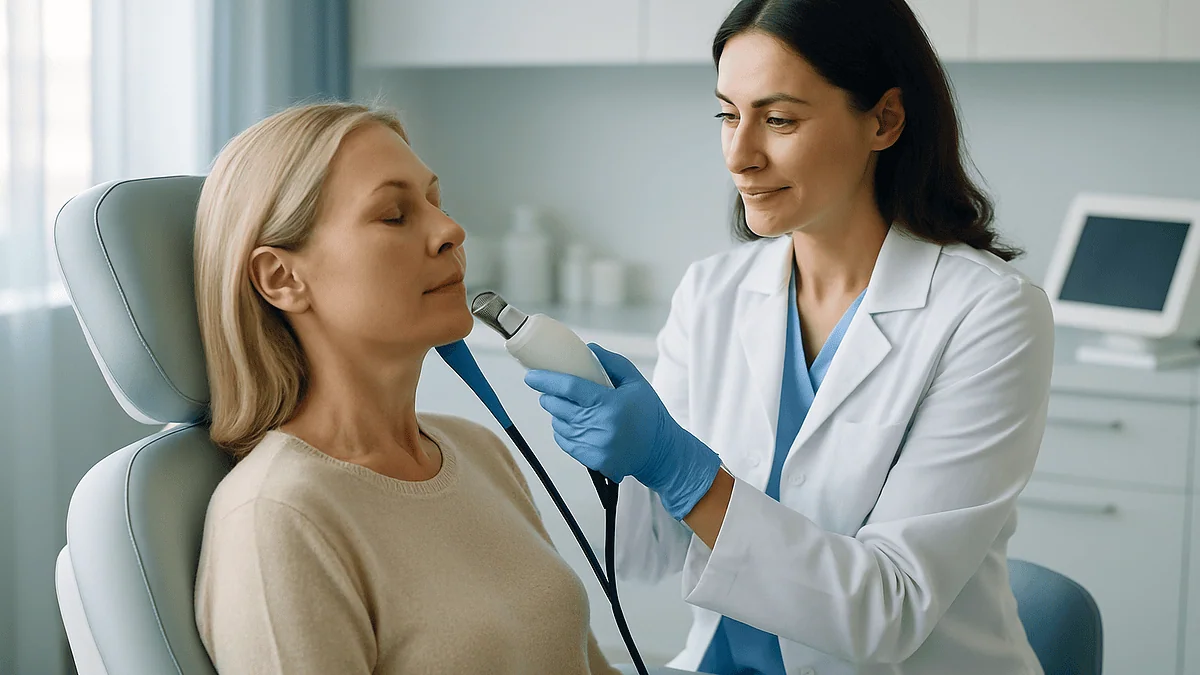
An RF microneedling procedure begins with a topical numbing cream left on for 30 to 60 minutes. A handpiece then pushes insulated needles a set depth into the skin, fractions of a millimeter to a few millimeters, and releases radiofrequency energy that heats the deeper layer. Most people describe pressure and brief warmth, then a day or more of redness. A clinician chooses depth and energy for each area.
The consultation ran long because of one question she kept circling back to: not whether it would help, but what it would actually feel like. She had read that an rf microneedling procedure uses “needles and heat,” and both words did their work on her imagination. The nurse drew a cross-section of skin on the back of a leaflet, marked a line for the needle tip, and said, “This is where the warmth happens. Not on the surface. Down here.”
That little sketch answers more than most marketing pages. RF microneedling is a treatment in which fine needles carry radiofrequency energy into the dermis, the living layer beneath the skin’s surface. The three things patients most want to understand, numbing, depth and heat, are also the three variables a clinician adjusts most carefully.
What follows is a plain account of the appointment from the moment the cream goes on to the weeks afterward, with the evidence laid out honestly, including where it runs thin.
What actually happens during an rf microneedling procedure, step by step
Strip the branding away and the rf microneedling procedure has five stages, and the order rarely changes.
First, the skin is cleansed and any makeup, sunscreen or moisturizer is removed, because residue on the surface can be dragged into the tiny channels the needles make. Second, a topical anesthetic cream is spread over the treatment area and left to work. Third, the clinician calibrates the device: needle depth, energy level and, on many machines, how long each pulse of radiofrequency lasts. Fourth, the handpiece is pressed against the skin in an overlapping grid, one stamp at a time. Each stamp drives a small array of needles into the dermis, delivers a burst of energy, and withdraws. Fifth, a soothing or barrier product is applied and you are given written aftercare.
Radiofrequency, in this context, means an electrical current oscillating fast enough to generate heat in tissue rather than a shock. The dermis is the layer that holds collagen, the protein scaffolding that gives skin its firmness, and elastin, the protein that lets it spring back. Cleveland Clinic describes the underlying logic of microneedling as controlled injury: small wounds trigger the skin’s repair response, and repair includes laying down new collagen. Adding radiofrequency means the injury is thermal as well as mechanical.
Timing varies by area. Cleveland Clinic puts the needling portion of a standard microneedling session at roughly 10 to 20 minutes; larger areas and the extra pulse time of radiofrequency stretch this, so a full-face appointment commonly runs about an hour to 90 minutes once numbing is included. The device does the stamping; the judgment about where to stamp, how deep and how hot belongs to the person holding it.
Why the numbing cream is the longest part of the appointment
Most people are surprised that they spend more time waiting for the numbing cream than being treated. That is by design.
Topical anesthetics work by blocking the nerve signals in the outermost layers of skin. They need time to penetrate, and the thicker skin of the cheeks and jaw takes longer than the thin skin near the eyes. Cleveland Clinic describes numbing time for microneedling in the range of about 30 to 60 minutes; some practices cover the cream with plastic film to hold in warmth and speed absorption. Once the cream is wiped away, the anesthetic effect gradually fades, which is one reason clinicians work efficiently and often treat the most sensitive zones first.
A few things are worth knowing about how the numbing behaves. It dulls the needle sensation far better than it dulls the heat, because the radiofrequency is released deeper than most creams reach. Patients therefore tend to report the procedure as “pressure and warmth” rather than “sharp,” with the warmth strongest over bone, such as the forehead and jawline, where the tissue is thin. The anesthetic does not remove all sensation, and a treatment that felt like nothing at all would usually mean the energy was set very low.
The numbing choice is also a medical decision. Topical anesthetics are medicines, and clinicians ask about allergies, heart rhythm conditions and the total area being treated, because absorption through many tiny channels adds up. Some practices offer additional comfort measures such as cold air or a handheld vibrating device; a few use injected local anesthetic for small, deep scar treatments. Which approach suits you is a conversation with your treating team, not a menu item.
How deep do the needles go, and who decides?
Needle depth is the setting people fixate on, and understandably so. It is also the one that varies most from person to person and even from centimeter to centimeter across a single face.
Skin thickness is not uniform. The eyelid dermis is paper-thin; the cheek and jaw are several times thicker; the neck is thinner again. Cleveland Clinic’s description of microneedling gives a needle range from about half a millimeter to a couple of millimeters for standard devices, and RF systems marketed for deeper scar and laxity work are designed to reach further. The precise figure is a clinical setting, not a promise, and a good clinician changes it repeatedly during one session: shallower near the orbital bone, deeper over a boxcar acne scar on the cheek.
Depth determines what the energy touches. Very shallow passes affect the epidermis, the outermost layer, and the upper dermis, and are used for texture and fine lines. Mid-depth passes reach the collagen-rich dermis where scar remodeling happens. The deepest settings approach the boundary between dermis and the fat layer beneath, which is where the tightening effect is sought and also where the risk of unintended fat heating rises.
Two design details matter here. Many RF microneedling needles are insulated along their shaft and release energy only from the tip, so the heat is concentrated at depth and the surface is relatively spared. Others are non-insulated and heat along their whole length, which affects more of the dermis but places more thermal load on the surface. Neither design is universally better; they suit different goals and skin types.
Ask which depth range your clinician plans for each zone and why. The answer should sound like anatomy, not a fixed number for everyone.
Does RF microneedling hurt? The heat you feel, and why radiofrequency at all
The honest answer to “does rf microneedling hurt” is that the needles are mostly numbed and the heat is mostly not. What you feel is a brief, deep warmth with each stamp, sometimes described as a hot rubber-band snap, fading within seconds.
The heat is the point. Collagen is a triple-helix protein, and when it is warmed past a threshold its structure partially unwinds and contracts. Mayo Clinic’s account of laser resurfacing describes the same principle: controlled thermal injury to the dermis prompts contraction and then stimulates new collagen growth during healing. Radiofrequency achieves this without light, so it is not absorbed by melanin, the pigment that gives skin its color. That is the main reason clinicians consider it for a wider range of skin tones than many ablative lasers, though the evidence base for darker skin is still smaller than for lighter skin and pigment changes remain possible.
Why does the warmth feel stronger in some spots? Bone reflects and concentrates sensation, so the forehead, temples and jaw angle often register more. Thinner skin means the tip sits closer to nerve endings. Higher energy settings, used for scars and laxity, produce more heat than the gentle settings used for texture. Your clinician can pause, adjust or cool an area on request, and should tell you before moving to a more sensitive zone.
Afterward the skin feels sunburned for several hours: warm, tight and tender to touch. Cleveland Clinic notes that redness and irritation after microneedling commonly last a few days, and adding heat tends to make the first evening the warmest. A cool compress and the barrier product you were given are usually all that is advised for comfort; anything beyond that should come from your treating team.
RF microneedling vs microneedling vs laser resurfacing: how they compare
People searching “rf microneedling vs microneedling” usually want to know whether the radiofrequency is worth the added heat, cost and downtime. The comparison below sticks to mechanisms and typical experiences rather than rankings, because the right tool depends on the problem being treated.
| Feature | Standard microneedling | RF microneedling | Fractional laser resurfacing |
|---|---|---|---|
| How it injures the skin | Mechanical channels only | Mechanical channels plus radiofrequency heat at depth | Light energy vaporizes or heats columns of tissue |
| Where the effect is strongest | Upper to mid dermis | Mid to deep dermis, adjustable by needle depth | Surface and upper dermis (deeper with ablative settings) |
| Dependence on skin pigment | None | Minimal; energy is not light-based | Higher; melanin absorbs light |
| Typical downtime described by Cleveland Clinic and Mayo Clinic | Redness for a few days | Redness and swelling for a few days, occasional pinpoint grid marks | Days to two weeks or more for ablative treatments |
| Usual number of sessions | Several, often spaced about a month apart | Fewer sessions at higher energy is common; set by clinician | One to a few, depending on ablative or non-ablative |
| Common target problems | Texture, fine lines, mild scarring | Acne scars, mild to moderate laxity, deeper texture | Sun damage, wrinkles, pigment, scarring |
Two cautions when reading tables like this. First, “deeper” is not automatically “better”; a fine-line concern does not need a deep-dermis treatment. Second, downtime ranges are typical experiences described by mainstream sources, not guarantees, and your own recovery will depend on energy, depth, skin type and how you care for it afterward. The decision about which modality fits your skin and your goals sits with the clinician who examines you.
Does microneedling with RF really work? What the evidence shows
The question deserves a plain answer with its uncertainty intact. Yes, RF microneedling changes the skin in measurable ways, and no, the evidence does not support the transformation language often attached to it.
What is well established is the biology. Cleveland Clinic describes microneedling as a collagen-induction technique: small wounds trigger repair, and repair includes new collagen and elastin. Mayo Clinic describes the same wound-healing response for heat-based resurfacing. Skin biopsies in research settings show thicker, more organized collagen in the months after treatment. On this mechanistic level the therapy is not controversial.
What is less certain is how much visible change an individual will see, how long it lasts, and how it stacks up against alternatives. Much of the published work consists of small studies, often without a comparison group, frequently funded or run by people with a stake in the technology, and relying on before-and-after photographs judged by clinicians rather than blinded observers. The strongest signal is for acne scarring, particularly rolling and boxcar scars, where several controlled studies show improvement in scar grading. For skin laxity the improvements tend to be modest and gradual, and studies rarely follow patients beyond a year.
Realistic expectations, then: acne scars often become shallower and softer rather than disappearing; skin texture and pore appearance frequently improve; jawline and neck tightening is real for some people but subtle, and a surgical lift is a different category of change. The NHS guidance on cosmetic procedures makes a general point that applies here: results vary from person to person and any practitioner should be able to explain the evidence and limits of a treatment before you commit.
Who is RF microneedling usually for, and who is usually asked to wait
Clinicians tend to consider RF microneedling for three broad groups: people with depressed acne scars, people with mild to moderate skin laxity who are not seeking surgery, and people with uneven texture or enlarged-looking pores who want more than a superficial treatment. It is also used on stretch marks and some other scars, though the evidence there is thinner.
Equally useful is knowing who is commonly asked to postpone or choose something else. Cleveland Clinic and Mayo Clinic, describing microneedling and heat-based resurfacing respectively, list circumstances that raise risk:
- An active skin infection, including a cold sore flare, open acne pustules or eczema in the treatment area, because needles can spread infection and heat can worsen inflammation.
- A history of keloids or hypertrophic scars, where the skin overreacts to injury.
- Recent treatment with isotretinoin, an oral acne medicine that slows skin healing; clinicians typically wait a period of months after the course ends, with the exact interval set by the prescribing doctor.
- Pregnancy or breastfeeding, because safety data are lacking rather than because harm is proven.
- Bleeding disorders or blood-thinning medicines, which increase bruising and pinpoint bleeding.
- Implanted electronic devices such as pacemakers, or metal implants near the treatment field, because radiofrequency current can interfere with them.
- A recent tan or sunburn, which raises the chance of pigment changes.
A history of pigment problems after skin injury, known as post-inflammatory hyperpigmentation, is not an absolute barrier but calls for conservative settings and a frank conversation. None of these lists replaces an assessment; the person examining your skin, reviewing your medical history and asking about your goals decides whether now is the right time, later is better, or a different approach fits.
What is the best age for RF skin tightening?
There is no best age, and any answer with a specific number in it is guessing. What matters is the state of the skin, not the date on the birth certificate.
MedlinePlus describes the changes of skin aging in plain terms: the outer layer thins, the number of pigment-containing cells decreases while remaining ones enlarge, connective tissue loses strength and elasticity, and the fat layer beneath shrinks. Collagen production slows gradually from the mid-twenties onward and sun exposure accelerates every part of the process. Two people of the same age can have skin a decade apart in biological terms depending on sun history, smoking, genetics and hormonal changes.
RF microneedling asks the skin to make new collagen. It follows that the treatment works best when there is still a reasonable capacity to respond and a modest amount of laxity to correct. Very early, with no laxity present, there is little to tighten and the benefit is mostly textural. Very late, when laxity is severe and the fat and bone beneath have changed shape, heat-induced tightening cannot compensate for volume loss and structural descent, and clinicians are more likely to discuss surgical or combination approaches.
Acne scarring follows different logic. Scars can be treated at almost any adult age once active acne is controlled, because the goal is remodeling scar tissue rather than reversing laxity.
The more useful questions to bring to a consultation are: what exactly do I want to change, is that change primarily texture, scarring or laxity, and is this the modality most likely to address it? A clinician who answers those honestly will also tell you when a simpler treatment, or none, is the better choice.
Is 2 sessions of RF microneedling enough? How many sessions and how far apart
Two sessions may be enough for one person’s texture goals and not nearly enough for another person’s deep acne scars. The number is set by the problem, the energy used and how the skin responds to the first treatment.
Cleveland Clinic describes a typical course of standard microneedling as several sessions, spaced roughly a month apart, because each round produces a limited amount of new collagen and the effect builds. RF microneedling delivers more energy per session, so protocols commonly use fewer treatments, often three, with intervals of several weeks to allow healing between rounds. That interval is not arbitrary. Collagen remodeling continues for weeks after the visible redness has gone, and treating again before the dermis has recovered adds inflammation without adding benefit.
Several factors push the number up or down:
- Scar depth: deep, tethered scars typically need more sessions than shallow rolling scars.
- Energy and depth chosen: gentle settings for sensitive or darker skin mean more sessions to reach a similar total effect.
- Individual healing: some people produce collagen readily; others respond slowly, and there is no test in advance to know which you are.
- Your tolerance for downtime: some patients prefer several mild treatments over fewer intense ones.
Maintenance is another honest topic. Mayo Clinic notes that skin continues to age after resurfacing, and results from collagen-inducing treatments are not permanent. Some clinics suggest a single refresher treatment yearly or so; the evidence for the ideal interval is limited, and this should be a decision you revisit with your clinician based on how your skin actually looks, not on a schedule sold in advance. Anyone who quotes a fixed number of sessions before examining your skin is guessing.
RF microneedling recovery time: what the following days and weeks usually look like
Recovery has a fairly predictable rhythm, and knowing it in advance removes most of the anxiety. The ranges below are typical experiences described by Cleveland Clinic for microneedling and Mayo Clinic for heat-based resurfacing, not promises for any one person.
The first evening. The skin is red, warm and slightly swollen, much like a moderate sunburn. Pinpoint dots may be visible where the needles entered. Most clinics advise leaving the skin alone: no makeup, no active skincare, no heat from hot showers, saunas or exercise, and no touching beyond gentle cleansing and the barrier product you were given.
Days one to three. Redness fades toward pink. Swelling, if present, is often most noticeable around the eyes on the morning after and settles over a day or two. The surface may feel rough or slightly dry as the tiny channels close, and a faint grid pattern can sometimes be seen up close before it resolves. Mineral sunscreen is usually permitted once the skin is no longer raw, and strict sun protection is emphasized because freshly treated skin darkens easily.
Week one. Fine flaking may occur. Many people return to makeup and normal routines within a few days, though clinicians often ask you to hold off on retinoids, exfoliating acids and vitamin C serums for a period they specify.
Weeks two to twelve and beyond. This is where the actual change happens, invisibly at first. New collagen is laid down and gradually reorganized, so improvements in texture and scar depth emerge over weeks and continue for months. Mayo Clinic describes results from dermal remodeling as gradual, with the fullest effect appearing months after treatment. A photograph at one month therefore tells you very little; three to six months is when clinicians usually assess.
What is the downside of RF microneedling? Side effects and risks in plain language
Every treatment that injures the skin on purpose carries risk, and rf microneedling side effects range from the expected to the rare but serious. Cleveland Clinic and Mayo Clinic list the following for microneedling and heat-based resurfacing; the RF-specific items come from clinical experience with these devices.
Expected and short-lived: redness, warmth, swelling, pinpoint bleeding, mild bruising, dryness and flaking, and temporary sensitivity to skincare products. These are the treatment working, not going wrong.
Less common but recognized:
- Post-inflammatory hyperpigmentation, a darkening of the treated area, more likely in medium to deep skin tones and after sun exposure; it often fades over months but can persist.
- Hypopigmentation, a lightening of the skin, which is rarer and harder to reverse.
- Grid or track marks, small square patterns where stamps overlapped or energy was high; these usually fade but can occasionally linger.
- Reactivation of cold sores in people who carry the herpes simplex virus; clinicians often ask about this history in advance for exactly that reason.
- Infection, including bacterial and, rarely, atypical organisms, particularly if aftercare is poor or devices are not properly sterilized.
- Acne or milia flares in the weeks after treatment.
Rare and serious: burns from excessive energy, scarring including keloids in predisposed people, small dents or hollows from unintended heating of the fat layer at deep settings, and nerve irritation causing temporary numbness or weakness. Fat loss is the risk most specific to deep RF, which is why depth judgment matters so much on thin-skinned areas.
The NHS guidance on cosmetic procedures stresses choosing a properly trained practitioner in a regulated setting and being told about risks before consent. A downside no list captures is disappointment: the treatment can be performed perfectly and still produce less change than hoped. Ask what a realistic result looks like for your specific skin before you begin.
What people often get wrong about the rf microneedling procedure
Myths about this treatment tend to cluster around the three variables in this article’s title, so it is worth correcting them one at a time.
“Deeper is always better.” Depth is chosen to match the target. Treating fine forehead lines at scar-depth settings adds risk to thin skin over bone without adding benefit. Skilled treatment involves constant adjustment, not a single aggressive number.
“It should not hurt at all.” Numbing cream blunts the needles well and the heat only partly. A brief, deep warmth with each stamp is normal. A treatment that produced no sensation whatsoever would usually indicate very low energy.
“Results show up in a week.” What you see in the first week is swelling settling and surface texture smoothing. Collagen remodeling takes weeks to months, as Mayo Clinic describes for resurfacing generally. Judging the outcome early leads to unnecessary extra sessions.
“It is a non-surgical facelift.” The tightening is modest and gradual. Surgical lifting repositions tissue; heat-based treatments encourage the skin to contract slightly and thicken. Comparing the two is comparing different categories of change.
“Radiofrequency means it is safe for every skin tone.” RF is not absorbed by melanin, which reduces one specific risk compared with many lasers. Pigment changes from the injury itself remain possible in darker skin, and conservative settings still matter.
“The device does the work, so the operator does not matter.” The machine delivers what it is set to deliver. Anatomy, depth mapping, energy choice, sterile technique and aftercare instruction are human decisions, and the NHS advice on cosmetic procedures is explicit that training and regulation of the practitioner are central to safety.
“More sessions are always worth it.” Beyond the point where the skin has responded, added sessions add inflammation and cost without a matching gain.
Questions to ask your care team before an RF microneedling procedure
A good consultation should leave you able to describe your own treatment plan in your own words. These questions help get there, and the quality of the answers tells you as much as the content.
- What specific problem are we treating, and is RF microneedling the modality most likely to address it, or is a simpler option comparable?
- What depth range and energy level do you plan for each area of my face or body, and why does that suit my skin thickness and tone?
- Are the needles insulated or non-insulated, and how does that change the surface heat I will experience?
- What numbing approach will you use, how long will it stay on, and what should I tell you about allergies or heart conditions first?
- How many sessions do you anticipate, how far apart, and at what point will we reassess rather than continue on autopilot?
- What does a realistic result look like for someone with my skin, and can you show unretouched photographs taken under the same lighting at a comparable follow-up interval?
- What is your plan if I develop hyperpigmentation, a cold sore flare or a suspected infection, and who do I contact out of hours?
- Which of my current skincare products and medicines should I pause, for how long, and who should I confirm that with if a doctor prescribed them?
- How is the handpiece sterilized or is the needle cartridge single-use?
- What training and registration do you hold for energy-based devices, and is a doctor available on site?
The NHS guidance on cosmetic procedures encourages a cooling-off period between consultation and treatment, and advises against being pressured by time-limited offers. If any answer sounds like a guarantee rather than a range, or dismisses the risks in the previous section, that is useful information too. Bring a written list, take notes, and feel free to seek a second opinion before proceeding.
When to call your doctor after RF microneedling
Redness, warmth, mild swelling and pinpoint dots in the first few days are expected. What follows is a short guide to the signs that fall outside the normal pattern and warrant a call to the treating clinic or your doctor rather than waiting to see.
Contact the clinic promptly if you notice:
- Redness or swelling that is getting worse after the second day instead of settling, or spreading beyond the treated area.
- Increasing pain, throbbing or heat in one zone, particularly with yellow discharge or crusting, which can signal bacterial infection.
- Clusters of small blisters or tingling, burning patches, which may indicate a cold sore reactivation and are treated most effectively early.
- Fever, chills or feeling generally unwell after the treatment.
- Blistering, weeping or skin that looks white or gray in patches, which can indicate a burn.
- New dents, hollows or firm lumps under the skin appearing in the weeks after a deep treatment.
- Persistent grid marks or patches of darkening or lightening that are not fading over the timeline your clinician described.
- Any numbness, weakness or drooping in the treated area that lasts more than a few hours.
- Eye symptoms after treatment near the orbit: pain, vision change or persistent irritation.
Seek urgent medical care if you have rapidly spreading redness with fever, difficulty breathing, facial swelling that affects your airway or swallowing, or signs of an allergic reaction to the numbing cream or aftercare products such as hives and lip or tongue swelling.
Cleveland Clinic and Mayo Clinic both note that complications from microneedling and resurfacing are uncommon when performed correctly, but that early assessment changes the course of the ones that do occur. Keep the clinic’s out-of-hours contact details from your consent paperwork, photograph anything that worries you in good light, and let the treating team make the call about whether it is normal healing or needs attention.
Frequently asked questions
Does microneedling with RF really work?
It produces measurable changes in skin structure, with the strongest evidence for depressed acne scars and more modest, gradual effects on laxity. Cleveland Clinic and Mayo Clinic describe the mechanism as controlled injury prompting new collagen. Many published studies are small and lack blinded comparison groups, so the size of the visible benefit for any individual is uncertain, and realistic expectations are softer scars and improved texture rather than a dramatic transformation.
Does RF microneedling hurt?
Most people describe pressure and a brief deep warmth with each stamp rather than sharp pain, because topical numbing blunts the needles but reaches less far than the radiofrequency heat. Sensation is stronger over bone, such as the forehead and jawline, and at higher energy settings. Afterward the skin feels sunburned for several hours. Your clinician can pause, adjust energy or add cooling on request.
What is the best age for RF skin tightening?
There is no best age; the condition of the skin matters more than the number. MedlinePlus describes collagen production slowing gradually through adulthood and sun exposure accelerating it. The treatment suits mild to moderate laxity in skin that can still respond by making collagen. Severe laxity with volume loss usually needs a different approach, and acne scars can be treated at almost any adult age once active acne is controlled.
Is 2 sessions of RF microneedling enough?
It depends on what is being treated and how your skin responds. Cleveland Clinic describes standard microneedling as a course of several sessions about a month apart; RF delivers more energy per session, so three treatments spaced several weeks apart is a common starting plan. Shallow texture goals may need fewer, deep tethered scars more. The number should be reassessed after each treatment rather than fixed in advance.
What is the downside of RF microneedling?
Expected downsides are a few days of redness, swelling and pinpoint marks. Less common risks listed by Cleveland Clinic and Mayo Clinic for microneedling and heat-based resurfacing include pigment darkening or lightening, grid marks, cold sore reactivation, infection and acne flares. Rare serious risks are burns, scarring and small dents from unintended fat heating at deep settings. Results can also simply be less than hoped.
What is the RF microneedling recovery time?
Redness and warmth typically peak the first evening and fade toward pink over one to three days, with possible swelling around the eyes on the morning after, based on Cleveland Clinic’s description of microneedling recovery. Fine flaking may follow in the first week and many people resume makeup within a few days. The remodeling that produces visible improvement continues for weeks to months, so the final look is assessed at three to six months.
How is RF microneedling different from regular microneedling?
Standard microneedling creates mechanical channels only; RF microneedling adds radiofrequency heat delivered at the needle tip into the dermis. The heat causes existing collagen to contract and adds a thermal stimulus for new collagen, which is why RF is favored for deeper scars and mild laxity. It also carries more heat-related risks, such as grid marks and fat-layer changes, and usually involves fewer but more intense sessions.
How deep do RF microneedling needles go?
Depth is a clinician’s setting that changes across the face. Cleveland Clinic gives a range of roughly half a millimeter to a couple of millimeters for standard microneedling, and RF devices designed for scars and laxity can reach deeper. Thin skin near the eyes is treated shallowly, thicker cheek and jaw skin deeper. Ask your clinician which depth range is planned for each zone and why.
What are common RF microneedling side effects in darker skin?
The main concern is post-inflammatory hyperpigmentation, a darkening of treated areas after injury, which is more likely in medium to deep skin tones and after sun exposure. Radiofrequency is not absorbed by melanin, so it avoids the light-specific burns associated with many lasers, but the needle injury itself can still trigger pigment changes. Conservative energy settings, strict sun protection and a clinician experienced with your skin tone reduce the risk.
Who should not have RF microneedling?
Cleveland Clinic and Mayo Clinic list circumstances that raise risk for microneedling and heat-based resurfacing: active skin infection or cold sores, keloid history, recent isotretinoin treatment, pregnancy or breastfeeding, bleeding disorders or blood thinners, and a fresh tan. Implanted electronic devices such as pacemakers are a specific concern with radiofrequency current. The final decision on suitability rests with the clinician who examines you.
References
- Cleveland Clinic: Microneedling
- Cleveland Clinic: Acne Scars
- NHS: Cosmetic procedures
- MedlinePlus: Aging changes in skin
This article is for general information only and is not a substitute for professional medical advice. Please consult a qualified doctor about your individual situation.

More from the Blog

RF Microneedling Downtime: Redness, Grid Marks and When You Can Wear Makeup Again
RF microneedling downtime is usually short. Redness and mild swelling typically peak in the first 24 hours and fade over one to three days,…

The Best Age for a Facelift: Why Anatomy Matters More Than Birthdays
There is no single best age for a facelift. Most patients are in their 40s through 60s, but surgeons evaluate anatomy, skin laxity, jowls,…

Reconstructive Surgery in Older Adults: How Age, Heart Health and Healing Are Weighed
Reconstructive surgery in older adults is judged on overall health, not birth date. Surgical and anesthesia teams weigh heart and lung function, frailty, medicines,…
Split-Thickness vs Full-Thickness Skin Grafts: How Surgeons Choose the Graft Type
Surgeons choose between a split-thickness and a full-thickness skin graft mainly on wound size, location, and how much the graft may shrink. Split-thickness grafts…

When Can Acne Scar Treatment Begin? Why Active Acne Must Be Controlled First
Acne scar treatment usually begins only after active acne has been controlled for several months, because every new breakout can create a new scar…
Microdermabrasion Downtime: Why Most People Return to Normal Skincare Within Days
Microdermabrasion downtime is usually short: most people have mild redness, tightness, and a sunburn-like feel for about a day, then return to a gentle…