

What Do Non-Invasive Ventilation and Communication Devices Change for Someone With ALS?
Key Takeaways
- In the randomized trial underpinning the Cochrane review, non-invasive ventilation extended median survival by about seven months in people with ALS whose speech and swallowing muscles were not severely affected, alongside sustained quality-of-life gains.
- Bilevel NIV differs from CPAP by delivering a higher pressure on breathing in and a lower one on breathing out, which rests weak muscles; CPAP alone gives little help in ALS.
- Oxygen without pressure support can worsen carbon dioxide retention in ALS, because the underlying problem is muscle weakness rather than diseased lungs.
- Morning headaches, unrefreshing sleep and breathlessness lying flat often signal nighttime under-breathing before daytime lung tests fall, and prompt teams to consider NIV.
- Voice banking must be done while speech is still clear, which is why many teams raise it soon after diagnosis rather than when speech has already changed.
- Eye movements are usually preserved late into ALS, which is why eye-gaze computers can keep a person typing, speaking and directing their own care after hands and voice have weakened.
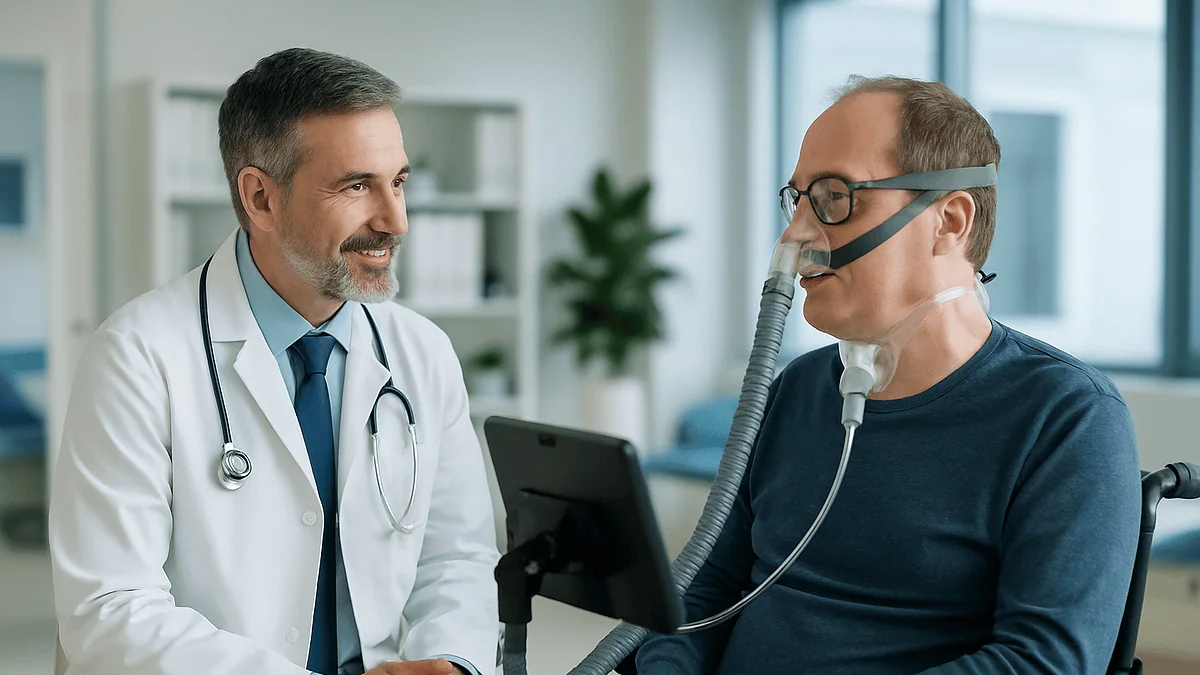
Non-invasive ventilation supports weakened breathing muscles through a mask, usually at night first, and in people with ALS whose speech and swallowing muscles are relatively spared it has been shown in a randomized trial to ease breathlessness, improve sleep and extend life by a median of several months. Communication devices, from letter boards to eye-gaze computers and banked voices, preserve conversation as speech fades. Neither reverses ALS; both change how it is lived.
The first sign is often not the breathing at all. It is the morning headache that lifts by lunchtime, the nap that no longer restores anything, the sentence that runs out of air two words early. Someone with amyotrophic lateral sclerosis, or ALS, a disease in which the nerve cells that drive voluntary muscles slowly die, notices these things months before anyone says the word ventilator.
Then a respiratory therapist sets a small machine on the kitchen table, a mask beside it, and the conversation changes. Not long after, a speech-language pathologist arrives with a tablet that speaks. Two machines, two very different fears: that the mask means the end is near, and that the talking computer means the person is already gone.
Both fears are understandable and, on the evidence, both are largely wrong. Non-invasive ventilation for ALS and communication technology do not stop the disease. What they change is more particular and, for many families, more important: how well a person sleeps, thinks, eats, argues and says goodnight.
Why can't people with ALS breathe? The muscle problem behind the symptom
The lungs in ALS are usually healthy. The trouble sits in the muscles that move them. Breathing depends on the diaphragm, a dome of muscle under the ribs, and on the muscles between the ribs and in the neck and abdomen. All of them take orders from motor neurons, the nerve cells that ALS destroys. As those cells fail, the muscles weaken and waste, exactly as the muscles of a hand or a leg do. The NIH’s National Institute of Neurological Disorders and Stroke describes respiratory failure as the usual final consequence of this weakness, and it is the reason breathing is watched from diagnosis onward.
Weak breathing muscles fail quietly at first. Lying flat is hardest, because the abdominal contents press up against a diaphragm that can no longer push back, so people wake with a start, stack pillows, or drift into a recliner. Sleep is where the problem surfaces. During dreaming sleep the body switches off most muscles except the diaphragm, so a weak diaphragm is left working alone. Carbon dioxide creeps up overnight, and the person wakes with a dull headache, a foggy mind and no sense of having rested.
Cough weakens for the same reason. Clearing mucus takes a fast, forceful squeeze from the abdominal wall and a tight snap of the vocal cords; when either fails, secretions pool and chest infections follow. The NHS lists breathing difficulties, weak cough and chest infections among the problems that motor neurone disease teams monitor, which is why lung function tests, sniff tests and overnight oxygen measurements become routine at clinic visits.
Understanding this matters because it explains the treatment. Nothing about a mask fixes nerve cells. It simply adds pressure from outside to do part of the work the diaphragm can no longer manage.
How non-invasive ventilation for ALS actually works
Non-invasive ventilation, usually shortened to NIV, means a machine pushes air through a mask rather than through a tube placed in the windpipe. The machine most people with ALS use is a bilevel device, often called BiPAP, which delivers two pressures: a higher one as the person breathes in, to expand the chest more fully, and a lower one as they breathe out, so exhaling is not a struggle against the airflow. The difference between those two pressures is what gives the breathing muscles a rest.
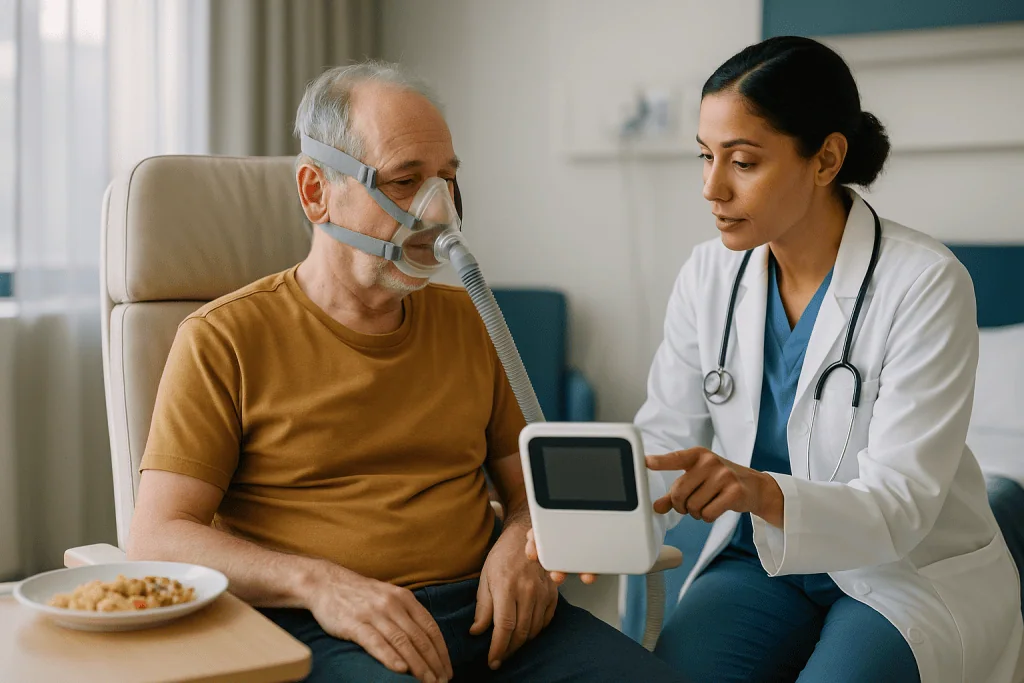
Think of a tired rower. A bilevel machine does not take the oars away; it puts a second, steadier pair of hands on them during each stroke. The person still triggers the breath, and modern devices sense that effort within a fraction of a second. If breathing stops or slows during sleep, most machines can deliver a backup breath on a timer, which is one of the features that separates a true ventilator from the simpler devices sold for snoring.
The mask is where success is decided. Some cover the nose only, some the nose and mouth, and some rest under the nose like a cushioned pillow. The respiratory team fits it, adjusts the straps and often tries two or three shapes before settling. Air leaks around a poorly fitted mask make the machine chase pressure all night and wake the sleeper; a good seal is quiet and almost forgettable.
Humidification is commonly added because a night of pressurised air dries the nose and throat. Settings, humidity and mask type are all adjusted by the clinical team over the first weeks, and they change again as the disease progresses. NIV is a support, calibrated to a moving target, not a single prescription written once.
BiPAP for ALS versus CPAP versus a ventilator: a plain comparison
Families often arrive with a CPAP machine borrowed from a relative with sleep apnea and ask why it is not the same thing. The answer lies in what each device is designed to do, and the table below sets the three main options side by side.
| Device | What it does | Typical role in ALS | Main trade-offs |
|---|---|---|---|
| CPAP | One continuous pressure that holds the airway open | Rarely suitable; it does not assist weak breathing muscles | Can make exhaling harder for someone whose problem is muscle weakness, not airway collapse |
| Bilevel NIV (BiPAP) | Higher pressure on breathing in, lower on breathing out, with optional backup breaths | Standard first-line breathing support, usually starting at night | Needs a mask seal and some ability to manage saliva; less effective when throat muscles are very weak |
| Invasive ventilation via tracheostomy | Air delivered through a surgical opening in the neck, bypassing mouth and throat | Chosen by a minority when NIV can no longer maintain breathing | Round-the-clock care, loss of natural voice, major lifestyle and ethical decisions |
CPAP, or continuous positive airway pressure, is built for a different disease. In sleep apnea the airway collapses and a steady splint of air keeps it open; the breathing muscles are strong. In ALS the airway is usually fine and the muscles are failing, so a single pressure offers little help and can add work on the out-breath. Bilevel machines exist precisely to solve that.
Invasive ventilation, discussed later in this article, is not a stronger version of the mask so much as a different way of living. The Cochrane systematic review of mechanical ventilation in ALS notes that evidence for tracheostomy comes from observational studies only, while NIV has been tested in a randomized trial.
Who is usually offered non-invasive ventilation for ALS, and who is asked to wait
Timing is judged, not fixed. Neurologists and respiratory teams combine three kinds of information: what the person reports, what the breathing tests show, and what the overnight measurements reveal.
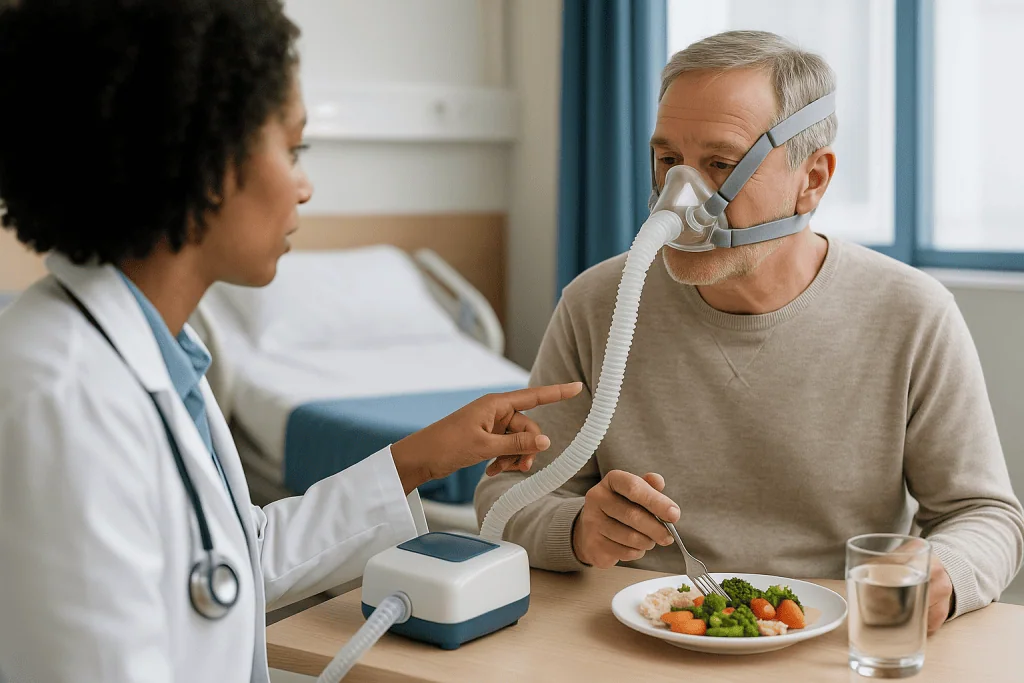
The reported symptoms carry real weight. Waking breathless when lying flat, morning headaches, unrefreshing sleep, daytime sleepiness and a voice that fades by evening are all taken seriously. In the randomized trial that anchors the Cochrane review, people were offered NIV when they had breathlessness lying flat or a raised daytime carbon dioxide level, rather than waiting for a specific lung volume to be reached. Breathing tests in clinic, including forced vital capacity (the largest breath a person can blow out) and a sniff pressure test of diaphragm strength, add a trend line. Overnight oximetry or a home carbon dioxide study can catch nighttime under-breathing before the person is aware of it.
Who is usually asked to wait? Someone whose tests are stable and who sleeps well and wakes clear-headed is generally monitored at each visit rather than started immediately, since a machine used before it is needed tends to be abandoned. People whose bulbar muscles, meaning those of the lips, tongue and throat, are severely weak present a different question. They may still be offered NIV for comfort and sleep, but the Cochrane review reports that the survival benefit seen in the trial was confined to people with normal or moderately impaired bulbar function. Heavy saliva, difficulty closing the mouth and a weak cough all make a mask harder to use and are weighed frankly.
Cognitive change, which affects a proportion of people with ALS, is also considered, because tolerating a mask requires learning and cooperation. None of these factors is a rule. Each is a strand in a discussion that belongs to the person, their family and the treating team.
What the evidence actually shows about breathing support and survival
The honest answer is that the strongest evidence rests on one well-designed but small randomized trial, and it is worth knowing what it did and did not find.
Researchers randomized 41 people with ALS to receive NIV or standard care and followed them until death. Across the whole group, the people using NIV lived a median of 48 days longer. Among those without severe bulbar impairment, the difference was far larger: a median gain of 205 days, roughly seven months, alongside better quality-of-life scores that were maintained for most of the survival period. In the subgroup with severe bulbar weakness, NIV improved sleep-related symptoms but did not extend life. These findings are reported in the trial itself and summarized in the Cochrane review of mechanical ventilation for ALS, which judged the evidence moderate in quality because of the trial’s size.
Those numbers deserve two cautions. Medians describe the middle of a group, not any one person’s future; some people gained much more time, others much less. And the trial predates current machines and current practice, so the true effect today may differ in either direction.
What the evidence does not support is the idea that NIV is only a comfort measure. Improved daytime carbon dioxide, better sleep architecture and less morning headache are physiological effects measured in the trial, not impressions. It equally does not support extravagant claims. Observational studies suggest that people who use the machine for more hours tend to do better, but people who feel better also use machines more, so cause and effect are tangled.
For comparison, the Mayo Clinic notes that riluzole, the first medicine approved for ALS, extends life by a matter of months in trials. Set against that, a mask and a fan-driven pump hold their own as one of the better-supported interventions in this disease.
The first nights and weeks with a mask: what usually happens
Almost nobody loves it on night one. The team knows this, which is why the early weeks are treated as a training period rather than a test to pass or fail.
A typical start is a daytime session, sitting up, with the machine on gentle settings and the mask held rather than strapped. The goal is simply to let the body learn that the pressure arrives when a breath begins and drops when it ends. Once that rhythm feels natural, the mask goes on for a nap, then for the first part of the night. Many people use it for a couple of hours before sleep and take it off; others sleep through with it from the first week. Both patterns are normal.
Common early complaints are predictable. A dry mouth or blocked nose responds to heated humidification. A red mark on the bridge of the nose points to over-tightened straps or the wrong mask shape. Swallowing air causes bloating, which often settles as the team fine-tunes the pressures. A feeling of not being able to exhale usually means the exhalation pressure is set higher than that person needs. Each of these is a phone call to the respiratory team, not a reason to quit.
The NHS describes NIV as something that can significantly improve quality of life for many people with motor neurone disease, and the change often shows within a few weeks: mornings without headache, a clearer head, a longer stretch of sleep before waking. The trial in the Cochrane review measured quality of life at monthly intervals and found gains that persisted. A reasonable expectation is that comfort improves before anything else does, and that the machine gradually stops being an event and becomes furniture.
What changes day to day: sleep, appetite, thinking and energy
Ask people who have settled into NIV what changed and they rarely talk about breathing. They talk about breakfast.
Overnight under-breathing leaves a residue of carbon dioxide that blunts appetite, sours mood and slows thought. When the machine clears it, mornings feel different. People report eating more, which matters enormously in a disease where weight loss is common and tied to faster decline. They describe reading a newspaper again, following a conversation across a dinner table, staying awake through an evening. A partner may notice fewer nighttime wakings, less snoring-like sound and a steadier breathing pattern that lets them sleep too.
Fatigue eases for a mechanical reason. A weak diaphragm working all night arrives at the morning already spent; rested by the machine, it has capacity left for the day. Some people find that a short session in the afternoon extends this effect, and daytime use often grows as the months pass.
Not everything improves. Skin under the mask needs care. Saliva management can become more complicated with a full-face mask. Travel means carrying a device, a battery and a power plan. Intimacy, sleep positions and bedroom routines all shift, and couples often need a frank conversation with the team about what is practical. Anxiety about the machine failing at night is common in the early months and usually fades as its alarms and battery back-up become familiar.
The Mayo Clinic frames the goal of ALS care as maintaining independence and comfort for as long as possible, and NIV fits that frame precisely. It does not add strength to a hand or a leg. It removes a drag on everything else.
How long can an ALS patient live on BiPAP?
This is the question typed into search engines late at night, and it deserves a straight answer: there is no reliable number for an individual, and anyone who offers one is guessing.
What can be said comes from the group data already described. In the randomized trial summarized by the Cochrane review, NIV added a median of about seven months of life for people whose throat and speech muscles were not severely affected, on top of whatever course their disease would otherwise have taken. That underlying course varies widely. The NIH’s NINDS notes that most people live three to five years from symptom onset, while about one in ten live a decade or longer, and a few live considerably beyond that. Where someone sits on that range depends on their age, how quickly weakness has spread, whether bulbar muscles are involved and factors nobody can yet measure.
Two things about the trajectory on NIV are worth understanding. First, the machine does not slow the nerve damage, so muscle weakness continues; over time, hours of use typically increase from nights only, to naps, to most of the day. Second, the point at which NIV can no longer maintain adequate breathing is usually reached gradually, giving time to decide what happens next. That decision, covered in the following section, is the real fork in the road.
It helps to hear how clinicians think about this. They do not count remaining months. They track the trend in breathing tests, the hours of daily use, the frequency of chest infections and the person’s own account of breathlessness, and they revisit goals at each visit. That is the honest replacement for a number: an ongoing conversation, anchored in measurements, with the person’s wishes at its center.
When the mask is no longer enough: tracheostomy and the choices around it
Eventually NIV reaches a limit. The person needs it nearly around the clock, throat weakness makes a mask seal impossible, or secretions cannot be cleared despite cough-assist devices and suction. At that point three broad paths exist, and no guideline says one is correct.
The first is invasive ventilation through a tracheostomy, a surgical opening in the front of the neck into the windpipe, with a tube connected to a ventilator. This bypasses the mouth and throat, so mask problems and much of the secretion difficulty disappear. It also means twenty-four-hour care, frequent suctioning, loss of natural speech unless a speaking valve can be used, and ventilator dependence for the rest of life. The Cochrane review found no randomized trials of tracheostomy in ALS, so its effects on survival and quality of life come from observational reports only. Some people live for years with it; some find the burden on family unacceptable; some change their minds later, which is legally and ethically permitted with palliative support.
The second path is to continue NIV as a comfort measure for as long as it helps, accepting that it will not prevent respiratory failure, alongside medicines and nursing care that ease breathlessness and anxiety. The third, chosen by some, is to stop machine support when it no longer serves their goals, with the same palliative care.
Uptake of tracheostomy varies widely between countries and cultures, which tells you this is a values decision as much as a medical one. The Mayo Clinic and the NHS both emphasize discussing preferences early, ideally while the person can still speak easily, and recording them in an advance care plan. Those documents can be changed at any time. Their purpose is not to lock a choice in but to make sure the person, not a crisis, decides.
Why speech goes, and what ALS communication devices do about it
Speech is breathing with shape. It needs air from the lungs, a vibrating larynx, and fine, fast movements of tongue, lips and jaw. ALS can weaken any or all of these, so voices become quiet, slurred, nasal or slow, sometimes before limbs are much affected and sometimes long after. For about a quarter of people the disease begins in these bulbar muscles; for most others they are reached later. Either way, the NHS lists speech and language therapy and communication aids as standard parts of motor neurone disease care.
Augmentative and alternative communication, usually shortened to AAC, is the umbrella term for every tool that supplements or replaces speech. The range is wider than most people expect. At the simple end sit alphabet boards, yes/no cards and a partner who is taught to ask well-shaped questions. In the middle are speech-generating apps on ordinary tablets, controlled by touch while hands still work, then by a single switch, a head pointer or eye movement as they weaken. At the far end are dedicated eye-gaze computers, which track where the pupils rest on the screen and let a person type, speak, send messages, control lights and browse the internet with their eyes alone.
What these tools change is not merely information exchange. Research on communication in progressive disease consistently links loss of speech with isolation, depression and a sense of being talked over, and clinical teams see the reverse when a working system arrives: arguments resume, jokes land, decisions get made by the person rather than about them. The speech-language pathologist’s job is to match the tool to the current abilities and, crucially, to plan the next step before it is needed, so that no one is left without a voice during the switch.
Voice banking for ALS and eye-gaze technology: how the tools are set up
Voice banking is the recording of a person’s own voice, usually many hundreds of sentences, while speech is still clear, so that a speech-generating device can later speak in something recognizably theirs rather than a generic synthetic voice. The recordings feed software that builds a personalized synthetic voice, and the finished voice is loaded onto whatever device the person uses. Many clinics recommend beginning soon after diagnosis, because the quality depends on recording before slurring starts, and because the process takes hours spread over days or weeks. Message banking is a simpler cousin: recording specific phrases, a child’s nickname, a favorite curse, a habitual greeting, exactly as the person says them.
Eye-gaze systems work by shining a harmless infrared light toward the face and using a camera to locate the reflection on the cornea and the position of the pupil. Software translates where the eyes rest into a cursor position; dwelling on a letter or word for a fraction of a second selects it. Calibration takes a few minutes and is repeated if glasses, lighting or seating change. Eye movements are usually preserved late into ALS, which is why this technology matters so much in this particular disease.
Setup is a team task. Occupational therapists position the screen so the neck is not strained; speech-language pathologists build word-prediction vocabularies around the person’s actual life; family members learn to troubleshoot. Fatigue is real, so most users combine methods, speaking while they can, typing when speech is hard, and falling back on a partner’s questioning when the device is off.
The Mayo Clinic and NHS both describe communication aids as an integral part of multidisciplinary ALS care rather than a last resort. The evidence for their effect on survival is nil; the evidence for their effect on daily life is the sound of someone still saying what they think.
Breathing and talking at the same time: fitting the two technologies together
The mask and the talking computer meet at the face, and that is where practical friction arises.
A full-face mask covers the mouth, which muffles speech and blocks mouth-operated switches. A nasal mask leaves the mouth free but relies on the lips staying closed during sleep, which weak bulbar muscles may not manage. Eye-gaze cameras need a clear view of the eyes, so mask straps that cross the brow or a headgear that shifts the glasses can interfere. Teams solve these puzzles case by case: a nasal pillow mask for daytime NIV sessions during conversation, a fuller mask at night when speaking matters less; a screen mounted at an angle that clears the strap line; a chin strap to help lip closure.
Timing helps too. Many people schedule long conversations, video calls or family visits after a rest period on the machine, when carbon dioxide is lowest and energy highest. Speech itself is a breathing exercise, and someone with a weak diaphragm may find that a session of NIV before a meal or a phone call lengthens the sentences they can manage. Conversely, eating and NIV do not mix, and cough-assist sessions are usually kept separate from communication time so that secretions are cleared first.
There is an emotional dimension the manuals skip. Some people feel that using the device while speaking through a mask makes them look sick in front of visitors, and they hide both. The counterintuitive experience many report is the opposite: visitors relax when the person is comfortable and intelligible, and awkwardness comes from breathlessness and unheard words, not from equipment. The team can help rehearse this. Nothing in the NHS or Mayo Clinic guidance suggests that either technology should be rationed to particular hours; both are used whenever they serve the person.
What people often get wrong about ventilation and ALS
Misunderstandings cluster around a few points, and correcting them early spares needless distress.
The mask means the end is close. It does not. NIV is offered when breathing tests or symptoms show the diaphragm needs help, which for many people is a year or more before the final phase, and the trial evidence summarized by the Cochrane review shows it extends life rather than marking its end. Starting it early enough to learn it comfortably is the whole point.
Oxygen would be simpler. Oxygen tanks are a common request and a common mistake. The problem in ALS is not low oxygen from diseased lungs but poor removal of carbon dioxide by weak muscles. Giving oxygen alone can blunt the drive to breathe and let carbon dioxide rise further. Oxygen is used only in specific circumstances under supervision; the treatment for muscle weakness is pressure support.
A ventilator means a machine breathes for you and you become passive. Bilevel NIV responds to the person’s own breaths. It assists; it does not take over, and people remain in control of when they wear it.
Once you start you cannot stop. Any treatment, including NIV and invasive ventilation, can be declined or withdrawn at the person’s request, with palliative care to prevent distress. Advance care plans record wishes and can be revised at any time.
Losing speech means losing the ability to decide. A person who communicates by eye gaze has the same legal and ethical authority over their care as anyone else. Devices exist precisely so that decisions stay with them.
Communication aids are for later. Voice banking must happen while speech is still clear. Waiting until it is needed usually means the personal voice is lost.
Questions to ask your care team
Clinic appointments are short and the questions that matter most tend to surface on the drive home. Writing them down beforehand, and bringing someone to take notes, helps. The following are drawn from what people with ALS and their families most often wish they had asked.
- Which of my breathing test results are you watching most closely, and what trend would prompt you to suggest starting non-invasive ventilation?
- Do my speech and swallowing muscles affect how much benefit I am likely to get from a mask, and how will you monitor that?
- Who fits and adjusts the mask, and who do I call at night or on a weekend if it leaks, alarms or feels wrong?
- How many hours of use do you hope for at the start, and how will we know if it is helping?
- What is the plan for cough and secretion clearance alongside NIV?
- If NIV eventually cannot keep up, what are my options, and when should we talk about tracheostomy so the decision is mine rather than an emergency’s?
- How do I record my wishes about ventilation in an advance care plan, and how can I change them later?
- When should I start voice banking, and who will help me do it?
- Which communication device suits my current abilities, and what is the next step planned for when my hands or speech change?
- Can the mask and the eye-gaze system be used together, and who will set that up?
- What support exists for my partner or family, who will be doing much of the practical work?
None of these questions has a single right answer, and the Mayo Clinic stresses that ALS care is delivered by a team spanning neurology, respiratory medicine, speech and occupational therapy, dietetics and palliative care. Asking who on that team owns each issue is itself a useful question.
When to call your doctor: red-flag signs in ALS breathing and communication
Breathing problems in ALS usually creep, but they can also jump, and knowing the difference is part of living safely at home.
Contact the ALS or respiratory team promptly, the same day, for any of the following: new or worsening breathlessness while lying down or at rest; a morning headache or confusion that was not there before; a fever, a change in sputum color or a cough that has become weaker or wetter, all of which can signal a chest infection that a weak cough cannot clear; a sudden increase in the hours of NIV needed to feel comfortable; or repeated mask leaks, skin breakdown or alarms that the usual adjustments do not fix.
Seek emergency care immediately if there is severe breathlessness that does not settle with NIV, blue or grey lips or fingertips, drowsiness that cannot be roused, a choking episode that does not clear, or if the machine fails and no backup is available. The MedlinePlus and NINDS summaries of ALS both identify respiratory failure and aspiration pneumonia as the main serious complications, and both respond better to early treatment.
Communication changes warrant a call too. A sudden inability to use a device that worked yesterday, new difficulty controlling saliva, or a swallow that has started to trigger coughing at meals are all reasons for the speech-language pathologist to reassess soon, before a gap in communication or a chest infection opens up.
Every decision about starting, adjusting, continuing or stopping ventilation sits with the person and their treating team. This article describes what the evidence shows; it cannot replace the judgment of clinicians who know the individual case.
Frequently asked questions
What is the most promising treatment for ALS?
No treatment stops or reverses ALS, so the most promising approach is a combination: approved medicines such as riluzole that slow decline modestly, non-invasive ventilation, which has randomized-trial evidence for extending life and improving quality of life in people without severe bulbar weakness, and multidisciplinary care covering nutrition, communication and mobility. Newer drugs, including a gene-targeted therapy for one inherited form, are available for specific groups; a neurologist can explain who they suit.
Why can't people with ALS breathe properly?
Because the muscles that move the lungs, chiefly the diaphragm, weaken as the motor neurons controlling them die. The lungs themselves are usually healthy. Weak muscles cannot pull enough air in or push carbon dioxide out, especially during sleep, when the diaphragm works alone. A weak cough also lets secretions build up, raising the risk of chest infections. Non-invasive ventilation adds pressure from outside to help the weakened muscles.
How long can an ALS patient live on BiPAP?
There is no reliable figure for an individual. Group data from the randomized trial summarized in the Cochrane review show a median gain of about 205 days, roughly seven months, in people without severe bulbar weakness, added to a disease course that itself varies from under two years to more than ten. Progression continues on BiPAP, so hours of use typically increase over time, and the care team tracks breathing tests and symptoms rather than counting months.
What is the average life expectancy for someone with ALS on a ventilator?
It depends on which kind of ventilation and cannot be stated as a single number. With non-invasive ventilation, the trial evidence shows a median extension of months in suitable people. With invasive ventilation through a tracheostomy, some people live for years, but the Cochrane review found only observational studies and no randomized trials, so figures are uncertain and vary with age, care setting and other complications. The treating team can discuss what is realistic for a particular person.
Is BiPAP for ALS the same as a CPAP machine for sleep apnea?
No. CPAP delivers one steady pressure that props open a collapsing airway, which is the problem in sleep apnea. In ALS the airway is normally fine and the muscles are weak, so a bilevel machine is used instead: it raises pressure as the person inhales and lowers it as they exhale, easing the work of each breath, and can add backup breaths if breathing pauses. Using a borrowed CPAP is not a substitute and should be discussed with the respiratory team.
Can someone with ALS breathing problems use oxygen instead of a mask machine?
Usually not on its own. The core problem in ALS is that weak muscles fail to clear carbon dioxide, not that the lungs cannot take up oxygen. Giving oxygen without pressure support can reduce the drive to breathe and allow carbon dioxide to rise further, causing drowsiness or confusion. Oxygen is occasionally added under close monitoring for specific reasons, but pressure support through non-invasive ventilation is the treatment aimed at the actual mechanism.
When should voice banking for ALS begin?
As early as possible after diagnosis, while speech is still clear. Building a personalized synthetic voice requires recording many sentences with good articulation, spread over several sessions, and slurring reduces the quality. Even people whose speech is unaffected at diagnosis are often encouraged to record, since bulbar involvement can arrive later. Message banking, capturing specific phrases in the person’s own voice, is a quicker option that can run alongside.
What ALS communication devices are used when hands and speech both weaken?
Eye-gaze computers become the mainstay. An infrared camera tracks where the eyes rest on the screen, and dwelling on a letter or word selects it, allowing the person to type, speak through a synthetic or banked voice, message, and control home devices. Before that stage, tablets with speech apps operated by touch, a single switch or head movement are common. Speech-language pathologists plan each transition so no one is left without a working system.
Does non-invasive ventilation help if the throat and speech muscles are already very weak?
It can help comfort and sleep, but the evidence for extending life is weaker. In the trial summarized by the Cochrane review, people with severe bulbar impairment had improved sleep-related symptoms on NIV but no survival benefit, partly because mask seal, saliva control and cough clearance are harder. Teams still often offer a trial of NIV in this situation for symptom relief, alongside cough-assist and secretion management, and judge benefit individually.
Can a person with ALS stop using a ventilator once they have started?
Yes. Both non-invasive and invasive ventilation can be declined at the outset or withdrawn later at the person’s request, and clinical teams are experienced in doing this with palliative medicines and support so that distress is prevented. Recording preferences in an advance care plan, ideally while speech is easy, helps ensure the person’s wishes guide events; those documents can be revised at any time as circumstances and views change.
References
- Motor neurone disease: Treatment: NHS
- Amyotrophic Lateral Sclerosis (ALS): NIH National Institute of Neurological Disorders and Stroke
- Amyotrophic Lateral Sclerosis: MedlinePlus
This article is for general information only and is not a substitute for professional medical advice. Please consult a qualified doctor about your individual situation.

More from the Blog

Trigger Assessment Before Migraine Treatment: What Your Neurologist Wants Tracked
A migraine trigger assessment is a structured period, usually several weeks to a few months, of recording attacks alongside sleep, meals, stress, menstrual cycle,…
What to Ask Your Neurologist When an Autonomic Neuropathy Plan Involves Several Specialists
When several specialists share an autonomic neuropathy plan, ask your neurologist who coordinates the whole plan, which symptom each clinician owns, how test results…
Spinal Cord Disorder Follow-Up: Which Bladder, Bowel or Weakness Changes Need an Urgent Call
After a spinal cord disorder, call your care team the same day for any new loss of bladder or bowel control, difficulty passing urine,…

Fetal Surgery or Repair After Birth for Spina Bifida: What Does Each Pathway Involve?
Fetal surgery for spina bifida closes the spinal opening before birth, usually between about 19 and 26 weeks of pregnancy, through an incision in…
Daily Life With ALS: Assistive Devices, Nutrition and Energy Conservation Explained
Daily life with ALS changes gradually as motor neurons weaken muscles, but much of it can be planned for and managed. Assistive devices such…
Why Gamma Knife Results Take Months to Show and How Follow-Up MRI Tracks the Change
Gamma Knife radiosurgery rarely produces visible results right away. The radiation damages the DNA of target cells so they lose the ability to divide,…