

What Does the Robot Change in Robotic Colorectal Surgery? Magnified View and Wristed Tools
Key Takeaways
- The robot has no autonomy: every instrument movement mirrors the surgeon's hands at a console, and the team can undock and continue laparoscopically or open at any point.
- In the ROLARR randomized trial of 471 people with rectal cancer, conversion to open surgery was 8.1 percent with robotic versus 12.2 percent with laparoscopic surgery, a difference that did not reach statistical significance.
- Robotic operations took longer on average than laparoscopic ones in ROLARR, while complication rates, cancer margins and quality of life were similar.
- Smaller scars, less pain and shorter stays are benefits of minimally invasive surgery in general; the robot inherits them rather than adding to them.
- The case for robotic assistance is strongest in a difficult pelvis: low rectal tumors, prior radiotherapy, a narrow male pelvis or higher body weight.
- MedlinePlus describes a typical hospital stay of about 3–7 days after large bowel resection, with heavy lifting usually restricted for several weeks while the abdominal wall regains strength.
In robotic colorectal surgery, the robot does not operate on its own. It gives the surgeon a magnified, three-dimensional view and small wristed instruments that bend and rotate inside the abdomen, which can help in tight spaces such as the pelvis. Trials so far show outcomes broadly similar to standard keyhole surgery, with longer operating times; whether it suits a given person is a decision for the treating team.
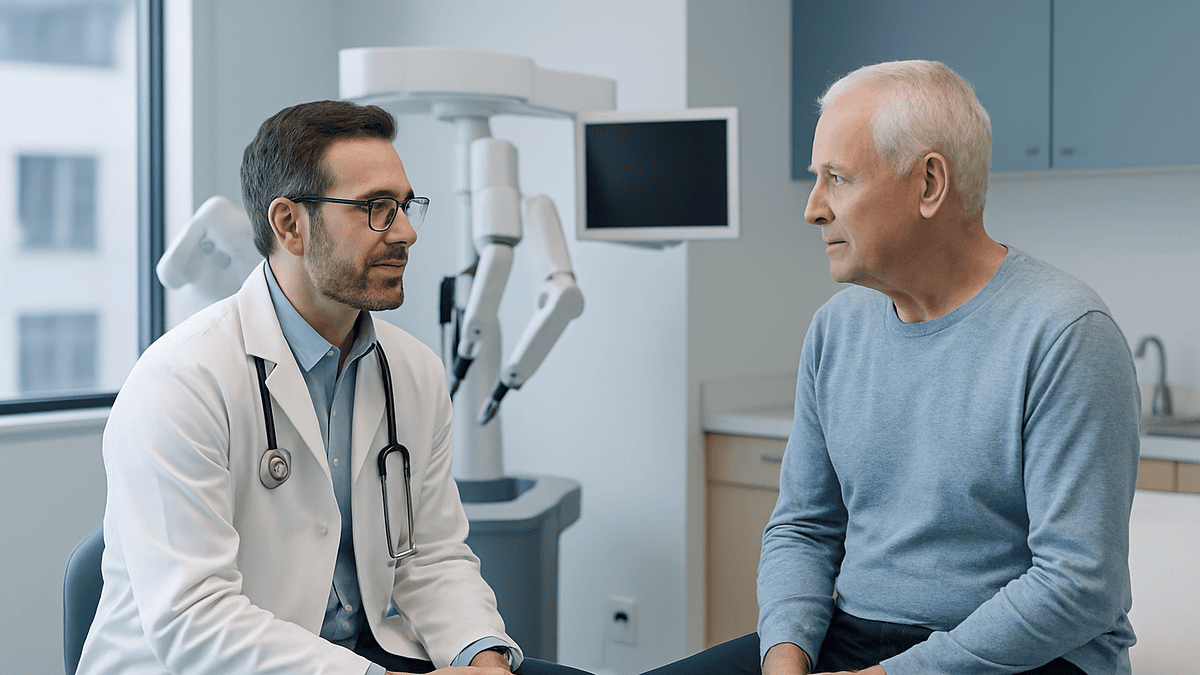
The clinic letter said keyhole surgery. Then, at the appointment, the surgeon drew a quick sketch of a pelvis, tapped the narrow part at the bottom and said, “This is where we would use the robot.” For most people that word lands with a jolt. A machine? Holding the instruments? Near the bowel?
The honest picture is less dramatic and more interesting. Robotic colorectal surgery is keyhole surgery with a different set of hands and a different pair of eyes. The surgeon still makes every move. What changes is how clearly they can see and how far their instruments can bend. Those two shifts are where nearly all the discussed robotic colorectal surgery benefits come from, and they are also where the marketing tends to outrun the evidence.
This explainer walks through what actually happens, what the trials do and do not show, what recovery usually looks like, and the questions worth asking before you sign a consent form.
What actually happens during robotic colorectal surgery?
Start with the room. You are asleep under general anesthetic on the operating table. Beside you stands a cart with three or four slim arms. A few meters away, your surgeon sits at a console, looking into a viewer and moving hand controls. An assistant surgeon and scrub team stay at your side throughout, swapping instruments and holding tissue.
The surgery itself is laparoscopic, meaning it is done through small incisions rather than one long cut. A laparoscope is a thin tube with a camera on the end. The abdomen is gently inflated with carbon dioxide gas so there is room to see and work. Several small ports, each about the width of a fingertip, are placed through the abdominal wall, and the robotic arms are docked to them. Instruments and the camera pass through those ports.
From that point the operation follows the same steps as any bowel resection: the diseased segment of colon or rectum is freed from its attachments, its blood supply is divided, the segment is removed, and the two healthy ends are joined. That join is called an anastomosis, a stitched or stapled connection between two pieces of bowel. If a join is not safe, a stoma may be made, an opening on the abdomen where bowel content passes into a bag, either temporarily or permanently.
Every movement of the robotic arm mirrors the surgeon’s hand at the console. The system does not plan, decide or act independently; Mayo Clinic describes it plainly as a tool that translates the surgeon’s motions into smaller, precise movements of the instruments. If anything goes wrong with the equipment, the team can undock the arms and continue laparoscopically or, if needed, through a conventional open incision. That fallback is planned for in every case.
The magnified 3D view: what the surgeon sees differently
Standard keyhole surgery shows the surgeon a flat, two-dimensional picture on a screen, rather like watching a video of your own hands while trying to thread a needle. Depth has to be inferred from shadows and the way tissue moves. Skilled laparoscopic surgeons become very good at this, but it is a learned compensation.
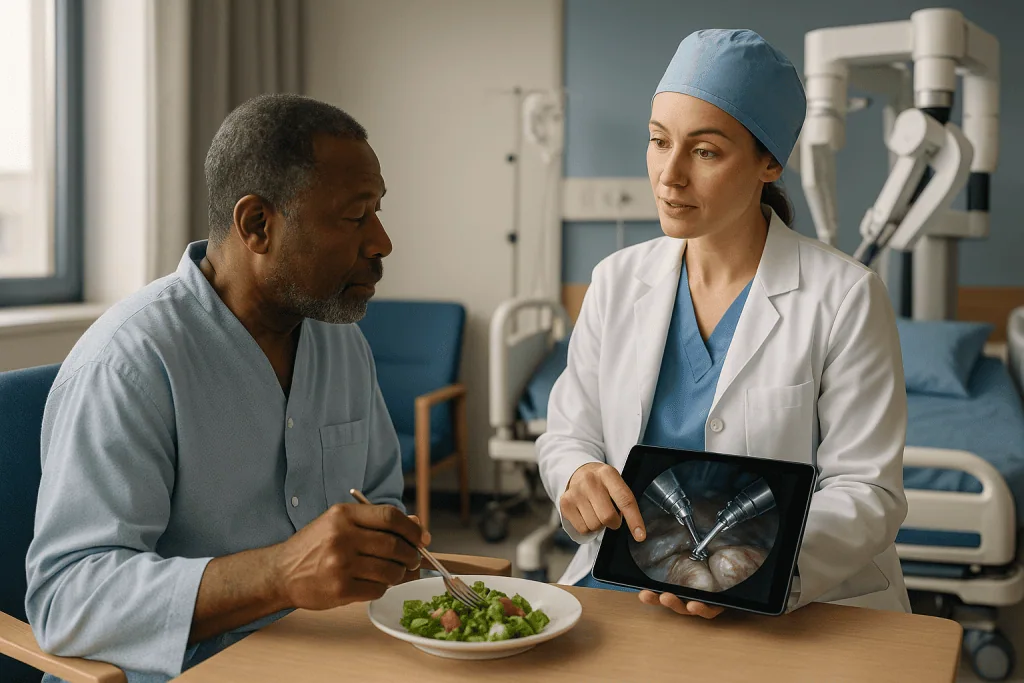
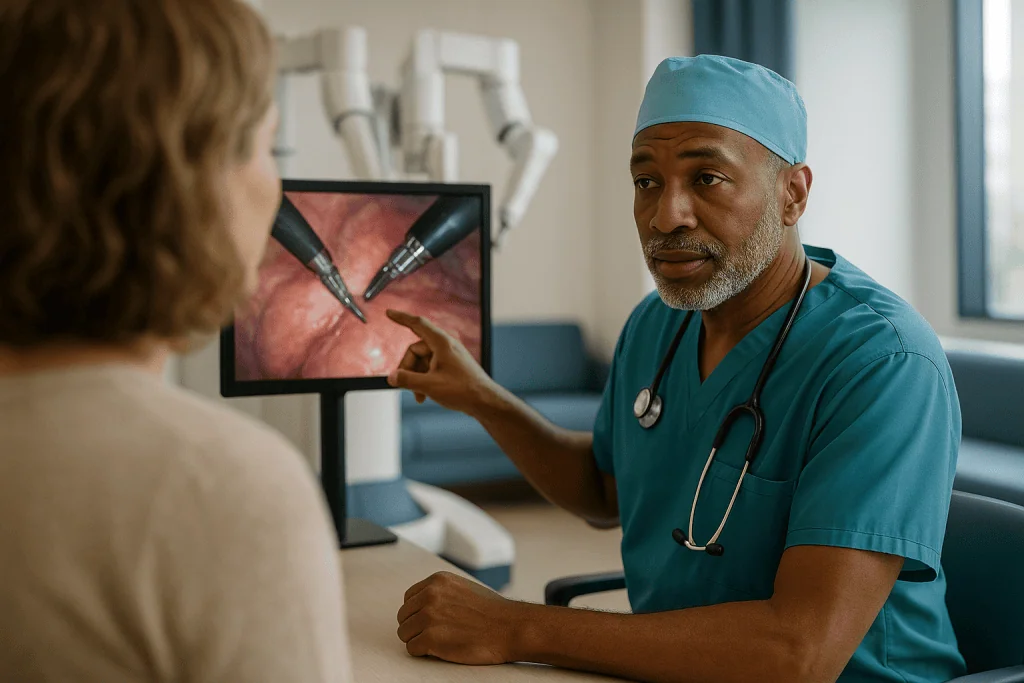
A robotic console offers a stereoscopic view: two cameras feed one image to each eye, so the surgeon perceives depth as they would in open surgery. The image is high definition and magnified several times over, according to Johns Hopkins and Mayo Clinic descriptions of the technology. Small structures that matter enormously in the pelvis, such as the thin nerve fibers that control bladder and sexual function, appear larger and in three dimensions.
Two further features shape the view. The camera is held by a robotic arm rather than a human assistant, so it stays rock steady and moves only when the surgeon wants it to. And the surgeon controls the camera directly from the console, tilting and zooming without asking anyone. In practice this means fewer moments where the picture wobbles or the angle is slightly wrong.
Does better vision translate into better outcomes? That is the crucial question, and the honest answer is that sharper sight is a mechanism, not a guaranteed result. Vision helps the surgeon identify the right plane between the rectum and surrounding tissue, which is what protects nerves and keeps the cancer specimen intact. Whether that advantage shows up in measurable patient outcomes depends on the case, the surgeon’s experience and how difficult the anatomy is. We will come to what the trials show shortly.
Wristed tools: why an instrument that bends matters in the pelvis
Picture reaching into a narrow jar with a long straight spoon. You can move the spoon in and out, side to side and rotate it, but you cannot bend the tip. That is roughly the situation with conventional laparoscopic instruments. They are rigid rods that pivot at the abdominal wall.
Robotic instruments add a wrist. Near the working tip is a small articulated joint that bends and rotates, controlled by the surgeon’s own wrist and fingers at the console. Cleveland Clinic and Johns Hopkins both describe this as the instrument moving with a range that exceeds the human hand. In the deep pelvis, where the rectum sits within a bony ring and the working space narrows to a few centimeters, that ability to angle the tip around a corner is the single feature surgeons most often mention.
The console also filters tremor. Every human hand has a faint natural shake; the system smooths it out before the motion reaches the instrument. Movements can also be scaled, so a large hand motion becomes a smaller instrument motion, which suits fine dissection.
Where does this matter most in colorectal work? Three tasks stand out. Dissecting the rectum away from the pelvic sidewalls while preserving nerves. Placing sutures at awkward angles, for example when reinforcing a join low in the pelvis. And working in a very narrow or deep pelvis, which tends to be harder in men and in people with a higher body weight.
One thing the wrist does not give is touch. Robotic instruments provide little or no tactile feedback, so the surgeon judges tissue tension by sight rather than feel. Experienced robotic surgeons adapt to this, but it is a genuine trade-off, not a footnote, and it is part of why training and case volume matter.
Robotic colorectal surgery benefits: what the evidence actually supports
Any list of robotic colorectal surgery benefits should begin with what is shared with all minimally invasive surgery. Compared with a long open incision, keyhole approaches in general are associated with less postoperative pain, smaller scars and shorter hospital stays; MedlinePlus and Mayo Clinic describe these advantages for laparoscopic bowel resection broadly. The robot inherits them because it is a form of laparoscopy. It does not add to them simply by being robotic.
The specific question, then, is whether robotic assistance improves on standard laparoscopy. The best available randomized evidence in colorectal surgery is the ROLARR trial, published in JAMA and indexed on PubMed, which randomized 471 people with rectal cancer to robotic or conventional laparoscopic resection. Its primary outcome was conversion to open surgery. The robotic group converted in 8.1 percent of cases and the laparoscopic group in 12.2 percent, a difference that did not reach statistical significance. Rates of complications, positive resection margins and quality of life were similar between the two groups.
What that trial does support is a modest, plausible signal that robotic assistance may reduce conversions in the hardest cases, and subgroup analyses hinted at more difference in men and people with obesity, where the pelvis is narrower or deeper. Those were secondary findings and should be read cautiously.
So the evidence-graded summary reads like this. High confidence: robotic surgery is as safe as standard laparoscopy in experienced hands, with equivalent cancer margins and complication rates. Moderate confidence: it may make a difficult pelvic dissection more achievable without converting to open surgery. Low confidence or unproven: claims that it produces better long-term cancer control, better function or faster healing than a well-performed laparoscopic operation. When a website lists those as settled benefits, it is ahead of the data.
Is robotic surgery better for colon cancer?
It helps to separate colon from rectum, because the anatomy changes the answer. The colon sits in the roomier upper abdomen. The rectum lives in the pelvis. Most of the argument for wristed instruments and 3D vision concerns the rectum.
For colon cancer, meaning tumors in the ascending, transverse, descending or sigmoid colon, standard laparoscopy already works well. The operating field is wider, the angles are less extreme and long rigid instruments reach what they need to reach. Trials and registry studies comparing robotic and laparoscopic colectomy have generally found similar complication rates, similar lymph node yields and similar oncological outcomes, with longer operating times for the robotic approach. There is no strong evidence that a robot improves cancer clearance in the colon.
For rectal cancer, particularly tumors low in the rectum, the pelvis is tight and the target is to remove the rectum with its surrounding envelope of fatty tissue intact, a technique called total mesorectal excision. That envelope is where cancer can spread, so keeping it in one piece matters. The ROLARR trial found equivalent margin results between robotic and laparoscopic approaches, which is reassuring in both directions: the robot did not do worse, and it did not do measurably better in a trial population.
The NHS describes surgery as the main treatment for bowel cancer that has not spread, and the choice between open, laparoscopic and robotic approaches is made case by case. Factors that push a team toward the robot include a low rectal tumor, a narrow male pelvis, higher body weight, prior radiotherapy that has stiffened tissues, and a surgeon who performs robotic pelvic surgery regularly. Factors that make it less relevant include a straightforward right-sided colon tumor or an emergency presentation where speed matters. Better, in other words, is a question about the specific operation, not the technology in the abstract.
Robotic vs laparoscopic colorectal surgery: a side-by-side comparison
Numbers help here, provided they are read as typical patterns rather than promises. The table below draws on MedlinePlus, Mayo Clinic and the ROLARR trial, and describes what generally distinguishes the three approaches to removing a segment of colon or rectum.
| Feature | Open surgery | Standard laparoscopic | Robotic-assisted |
|---|---|---|---|
| Incision | One long midline cut | Several small ports plus a short extraction incision | Several small ports plus a short extraction incision |
| Surgeon’s view | Direct, 3D, unmagnified | 2D screen, magnified | 3D console, magnified, surgeon-controlled camera |
| Instrument movement | Full hand and wrist | Rigid rods pivoting at abdominal wall | Wristed tips with tremor filtering |
| Tactile feedback | Full | Partial | Minimal |
| Operating time (ROLARR, rectal cancer) | Not compared | Shorter | Longer on average |
| Conversion to open (ROLARR) | Not applicable | 12.2 percent | 8.1 percent, not statistically different |
| Complications and margins (ROLARR) | Not compared | Similar | Similar |
| Typical hospital stay (MedlinePlus, bowel resection) | Usually longer | About 3–7 days | About 3–7 days |
Two lines deserve emphasis. First, the recovery advantages sit with both minimally invasive columns, not with the robot alone. Second, the robot’s clearest measurable difference in a randomized trial was a lower conversion rate that did not reach significance overall. That is a real but modest finding, and it sits alongside a longer time under anesthetic.
Open surgery remains the right choice in some situations: emergencies with perforation or obstruction, very large tumors, dense scar tissue from previous operations, or when a person cannot safely tolerate the inflated abdomen and steep table positions that keyhole approaches require. Your team weighs all of this against your individual anatomy and health.
What is the downside of robotic surgery?
Every honest explainer needs this section, and the downsides are concrete rather than theoretical.
Longer operations. In ROLARR, robotic procedures took longer on average than laparoscopic ones. Docking the arms, changing instruments and the console workflow all add minutes. Longer anesthesia carries its own small risks, particularly for people with heart or lung conditions.
Loss of touch. The surgeon cannot feel tissue tension through the console. Excessive pull on the bowel or a vessel is judged visually. Experienced robotic surgeons develop strong visual cues, but the learning curve is real, and outcomes in surgical studies are consistently better in centers with higher case volumes.
Position and pressure. Like all laparoscopy, robotic surgery uses gas to inflate the abdomen and often a head-down tilt to move the small bowel out of the pelvis. People with severe heart failure, advanced lung disease or raised pressure in the head may not tolerate this well, and the team may prefer an open approach.
Equipment complexity. Robotic systems occasionally fail or need recalibrating mid-case. Teams rehearse converting to laparoscopy or open surgery for exactly this reason, so it rarely changes the outcome, but it is a reason procedures are performed in centers with the right support.
Same fundamental risks. The robot does not remove the risks that belong to bowel surgery itself: anastomotic leak (a breakdown of the join between bowel ends), bleeding, infection, ileus (a temporary shutdown of bowel movement), injury to nearby organs such as the ureter or bladder, and blood clots in the legs or lungs. MedlinePlus lists these for large bowel resection regardless of technique.
Resource use. Robotic platforms are expensive for health systems to buy and maintain, and that is part of why they are not available everywhere. This article does not discuss costs to patients, but it is fair to say access varies and depends on where you are treated and what your treating team has available.
Who is usually offered robotic colorectal surgery, and who is asked to wait?
Selection is where much of the benefit is actually created. A well-chosen patient and a well-chosen operation matter more than the platform.
People commonly considered for a robotic approach include those with rectal cancer, especially low tumors that sit close to the anal sphincter, where nerve preservation and a precise dissection are hardest. Men with a narrow pelvis and people with a higher body mass index are often mentioned, since the ROLARR subgroup analyses suggested the robot may help most in those groups. People with inflammatory bowel disease who need part or all of the colon removed, or who need a pouch reconstruction after the rectum is removed, are also candidates in many centers, because pelvic dissection in Crohn’s disease and ulcerative colitis can be intricate. Benign conditions such as complicated diverticular disease, rectal prolapse or large polyps that cannot be removed by colonoscopy are sometimes treated robotically as well.
Others are usually steered toward a different approach or asked to wait. Emergencies, such as bowel obstruction or perforation, generally call for the fastest safe operation, which is often open or standard laparoscopic surgery. People with severe heart or lung disease may not tolerate the prolonged head-down position and inflated abdomen. Extensive previous abdominal surgery with dense scar tissue can make port placement risky. Very large tumors invading neighboring organs may need an open operation to remove several structures together.
Waiting can also be deliberate rather than exclusionary. Someone with rectal cancer may first receive chemotherapy or radiotherapy to shrink the tumor, with surgery planned weeks later. Someone with active Crohn’s inflammation may be optimized with medical treatment and nutrition before an elective resection. Someone who smokes or has poorly controlled diabetes may be asked to address those first, because both raise wound and anastomotic complication risks. None of these delays are refusals; they are the team arranging the safest sequence.
How long does it take to recover from a robotic colectomy?
The first thing to know is that the timeline belongs to the bowel, not the robot. Recovery after a robotic colectomy looks much like recovery after any laparoscopic bowel resection, and the reference points below come from MedlinePlus and Mayo Clinic guidance on colectomy rather than from robot-specific promises.
Day of surgery. You wake in recovery with small dressings on the abdomen, a drip in your arm and often a urinary catheter. Pain is usually managed with a combination of medicines chosen by the anesthetic team; the details and any adjustments are theirs to decide. Many teams now follow enhanced recovery protocols, which encourage sitting out of bed and sipping fluids the same day.
Days one to three. Walking short distances several times a day is the single most useful thing you can do. It wakes the bowel, lowers clot risk and clears the lungs. Diet advances from fluids to soft food as the gut starts moving; passing gas is celebrated as a milestone. Bloating, shoulder-tip pain from residual gas and fatigue are common and expected.
Going home. MedlinePlus describes a typical hospital stay of about 3–7 days after large bowel resection, shorter after keyhole approaches and longer if complications occur. Some people leave sooner under enhanced recovery pathways; others need more time. Neither is a failure.
The first two weeks at home. Expect tiredness that lifts gradually, appetite that returns in steps and bowel habit that is looser or more frequent than usual while the shortened colon adapts. Small incisions heal quickly on the surface, but the internal join needs weeks.
Most people return to desk work, driving and light daily activity within a few weeks, though your surgeon sets the specifics. Recovery time is a range, shaped by age, fitness, the extent of resection and whether a stoma was made, not a figure the technology can shorten on its own.
How long does it take to heal completely after robotic surgery?
Surface and depth heal at different speeds, and confusing the two causes most of the frustration people feel around week three.
The skin. Port incisions are small and usually closed with dissolvable stitches or glue. They typically look healed within one to two weeks, though the skin can remain pink and tender for longer, and small lumps under the scar are common as the deeper layers knit.
The abdominal wall. Each port passes through muscle and the tough layer of fascia beneath it. That fascia takes weeks to regain strength. MedlinePlus discharge guidance for large bowel resection advises avoiding heavy lifting and strenuous exercise for roughly the first several weeks, commonly around six, or until your surgeon clears you. Lifting too early is the main cause of incisional hernias, where bowel or fat pushes through a weak point in the wall.
The bowel join. An anastomosis gains most of its strength in the first two weeks, which is why leak, when it happens, usually shows up in that window. Full remodeling of the bowel wall continues quietly for months. You will not feel it, but it is why teams ask you to report fever or new abdominal pain promptly in the early weeks.
Bowel function. After a colectomy the remaining bowel gradually takes over water absorption. Looser or more frequent stools often settle over weeks to a few months. After a low rectal resection, changes in urgency and control can persist longer and sometimes need pelvic floor physiotherapy or dietary adjustment guided by your team.
Energy. Fatigue after major abdominal surgery frequently lasts longer than people expect, often several weeks, and the body is doing invisible repair work throughout. Complete healing, in the sense of feeling entirely like yourself, is best measured in months rather than weeks, and that is true regardless of whether a robot held the instruments.
Stomas, joins and bowel function: what the approach does and does not change
People often ask whether the robot makes a stoma less likely. The truthful answer is that stoma decisions rest on anatomy, blood supply, tumor position and prior radiotherapy far more than on the instruments used.
A temporary stoma, often a loop of small bowel brought to the skin, is frequently made after a very low rectal join to divert stool while the anastomosis heals. That reasoning applies equally to robotic and laparoscopic operations. If your tumor sits low, expect a conversation about a temporary stoma whichever platform is used, and ask when reversal would be considered.
A permanent stoma becomes necessary when the tumor involves the sphincter muscles and a join cannot be made safely. Here, precise pelvic dissection can occasionally let a surgeon preserve a few extra millimeters of rectum, and some surgeons feel wristed instruments help in that specific situation. This is a plausible mechanistic argument rather than a proven outcome, and no randomized trial has shown lower permanent stoma rates with robotic surgery.
Nerve preservation is the other frequently cited functional benefit. The autonomic nerves that control bladder emptying and sexual function run along the pelvic sidewalls, close to the plane of dissection. Magnified 3D vision makes them easier to see. ROLARR measured bladder and sexual function as secondary outcomes and found no significant difference between robotic and laparoscopic groups at the time points studied. That does not rule out a benefit in particular subgroups or in expert hands; it means the benefit has not been demonstrated at trial level.
Bowel function after rectal surgery, sometimes called low anterior resection syndrome, involves urgency, frequency and clustering of bowel movements. Its main drivers are how much rectum is removed and whether radiotherapy was given. No surgical platform has been shown to prevent it. Your team can offer management strategies, and asking about them before surgery is reasonable.
Robotic colorectal surgery benefits in rectal cancer and inflammatory bowel disease
If the benefits are modest on average, where does the technology earn its place? The clearest cases share one feature: a difficult pelvis.
Low rectal cancer after radiotherapy. Radiation stiffens tissue and blurs the natural planes between the rectum and its neighbors. Dissecting in that setting is slow, close work. Surgeons who use the robot regularly describe the wristed tip as allowing them to stay in the correct plane around the curve of the sacrum, where straight instruments must approach at awkward angles. The ROLARR subgroup data pointing toward fewer conversions in men and people with obesity fit this picture, though the trial was not powered to prove it.
Ulcerative colitis requiring pouch surgery. When the colon and rectum are removed for ulcerative colitis, many people have a pouch fashioned from small bowel and joined to the anal canal, allowing them to avoid a permanent stoma. The join is very low and the dissection must spare the nerves and sphincters. Several centers now perform this robotically, and observational reports describe it as feasible with complication rates comparable to laparoscopy. Randomized data are limited, so this remains an area where the evidence is emerging rather than established.
Crohn’s disease with complex pelvic disease. Fistulas and abscesses distort anatomy. Some surgeons report that magnified 3D vision helps them trace tracts and preserve healthy bowel. The same caution applies: these are experience-based observations, not trial results.
Notice what these examples have in common. In each, the case for the robot is strongest exactly where the operation is hardest and the margin for error smallest. For a routine right-sided colectomy in a slim person, the benefits over standard laparoscopy are hard to demonstrate. Choosing the platform to match the difficulty of the case is what experienced teams do, and it is a fair question to ask why the robot is or is not being proposed for you.
What people often get wrong about robotic colorectal surgery
Myth: the robot does the operation. It does not. Nothing moves unless the surgeon moves it, and the system has no autonomy or decision-making function. Mayo Clinic and Cleveland Clinic both describe it as a surgeon-controlled tool. The name is a historical accident that causes real anxiety.
Myth: robotic means less invasive than keyhole. The incisions are the same size and number as in standard laparoscopy, sometimes with one extra port. The reduction in pain and scarring belongs to minimally invasive surgery generally, not to robotic surgery specifically.
Myth: robotic surgery removes cancer more completely. In the ROLARR trial, positive margin rates were similar between robotic and laparoscopic rectal resections. There is no evidence that a robot improves cancer clearance compared with well-performed laparoscopy.
Myth: recovery is faster. Hospital stay and return to activity are governed by the bowel’s healing, the enhanced recovery protocol and the person’s fitness. Trials have not shown a meaningful recovery advantage for robotic over laparoscopic colorectal surgery.
Myth: newer is always safer. Safety depends heavily on the surgeon’s training and the team’s case volume. A high-volume laparoscopic team is a safer choice than a low-volume robotic one.
Myth: the robot means no stoma. Stoma decisions depend on tumor height, blood supply, radiotherapy and sphincter involvement, not on the instruments.
Myth: if the surgeon converts to open, something went wrong. Conversion is a planned safety step taken when the keyhole view or access is not adequate. It is a mark of judgment, not failure.
Myth: robotic surgery is only for cancer. Benign conditions, including inflammatory bowel disease, diverticular disease and prolapse, are treated robotically in many centers.
What is true, and worth repeating, is narrower than the myths but still meaningful: better vision and wristed tools can make the hardest pelvic dissections more achievable without a large incision. That is a genuine advance. It simply needs stating at its real size.
Questions to ask your care team before robotic colorectal surgery
A consultation goes better with a short list in hand. These questions are neutral, and a good team will welcome them.
- Why are you recommending the robotic approach for my particular operation, and what would you do if the robot were not available?
- How many robotic colorectal procedures does the surgical team perform in a typical year, and how many of this specific operation?
- What is the likelihood, in your experience, that my operation would need to convert to laparoscopic or open surgery, and what would prompt that?
- Will I need a stoma? If so, is it expected to be temporary, and when would reversal be considered?
- How will my bladder, bowel and sexual function be monitored afterward, and what support exists if problems arise?
- What does the enhanced recovery pathway look like here: when will I eat, walk and likely go home?
- What are the specific warning signs you want me to call about in the first two weeks?
- How will pain be managed, and who do I contact if it is not controlled at home?
- What activity restrictions apply, and for how long, especially for lifting and driving?
- How long is the operation expected to take, and does the robotic approach add time in my case?
- Are there alternatives, including standard laparoscopy, open surgery or non-surgical options, and how do they compare for me?
- If this is cancer surgery, what other treatments might come before or after, and how does the timing fit together?
Bring someone with you if you can, and ask whether the team can provide written information about the plan. Writing down the answers, particularly to the questions about warning signs and who to call, is worth more than any general article, including this one. Every decision about approach, timing and aftercare sits with the team who know your scans, your history and your priorities.
When to call your doctor after robotic colorectal surgery
The first two to three weeks are when the bowel join is most vulnerable and when complications, if they occur, tend to declare themselves. MedlinePlus and Mayo Clinic guidance on bowel resection agree on the core warning signs. Contact your surgical team, or emergency services if you are very unwell, for any of the following.
- Fever, shaking chills or feeling suddenly and progressively worse.
- New or worsening abdominal pain, especially pain that spreads, becomes constant or makes the abdomen rigid.
- A swollen, tense abdomen with vomiting or an inability to pass gas or stool, which can signal obstruction or ileus.
- Redness, warmth, increasing pain, foul-smelling fluid or pus from any incision, or an incision that opens.
- Heavy bleeding from the rectum, from a stoma or from a wound, or stool that is black and tarry.
- A stoma that turns dark purple or black, or that stops producing output when it previously did.
- Difficulty passing urine, or urine that is cloudy, bloody or painful.
- Pain, swelling or warmth in one calf, or sudden shortness of breath or chest pain, which can indicate a blood clot in the leg or lung and requires emergency care.
- Persistent vomiting or inability to keep fluids down, with signs of dehydration such as dizziness or very dark urine.
- Diarrhea that is severe or prolonged, particularly with a high stoma output.
Trust your instinct. People who have had bowel surgery often describe simply feeling that something is off before a specific symptom emerges, and surgical teams would far rather hear from you early than late. Keep the contact numbers you were given at discharge somewhere visible, and do not wait for a routine appointment if any of the signs above appear. Your treating team makes the assessment; your job is only to make the call.
Frequently asked questions
How long does it take to recover from a robotic colectomy?
Most people spend several days in hospital, typically about 3–7 days according to MedlinePlus guidance on large bowel resection, then feel progressively better over the following few weeks. Light activity and desk work often resume within a few weeks, while heavy lifting is usually restricted for longer. The timeline reflects how the bowel heals rather than the robot, and your surgeon sets the specifics for your case.
What is the downside of robotic surgery for the bowel?
The main downsides are longer operating time, loss of tactile feedback for the surgeon, and dependence on complex equipment and a well-trained team. In the ROLARR trial, robotic rectal operations took longer on average than laparoscopic ones. The underlying risks of bowel surgery, such as anastomotic leak, bleeding, infection and blood clots, are the same with any approach and are not removed by the technology.
Is robotic surgery better for colon cancer?
For cancers in the colon itself, standard laparoscopy generally performs as well, and studies show similar complication and cancer outcomes with longer robotic operating times. The stronger argument for robotic assistance is in rectal cancer, where the pelvis is narrow. Even there, the ROLARR trial found equivalent margins and complications between robotic and laparoscopic surgery. Your team chooses the approach based on tumor position, your anatomy and their experience.
How long does it take to heal completely after robotic surgery?
Skin incisions usually look healed within one to two weeks, but the deeper abdominal wall takes several weeks to regain strength, which is why heavy lifting is restricted. The bowel join gains most of its strength in the first two weeks and continues remodeling for months. Bowel habit and energy commonly take weeks to a few months to settle, and this pattern is similar whether or not a robot was used.
What is the difference between robotic vs laparoscopic colorectal surgery?
Both are keyhole operations through small ports. Laparoscopy uses rigid instruments and a two-dimensional screen; robotic surgery adds a three-dimensional magnified console view, wristed instrument tips that bend inside the body, tremor filtering and a surgeon-controlled camera. Incision size and recovery are broadly similar. The robot’s potential advantage is in tight spaces such as the deep pelvis, at the cost of longer operating time.
Does the robot actually do the surgery?
No. The surgeon sits at a console and controls every movement of the instruments; the system translates those movements into smaller, steadier motions inside the abdomen. Mayo Clinic and Cleveland Clinic describe it as a surgeon-operated tool with no independent action. An assistant and full surgical team remain at the bedside throughout, and the operation can continue laparoscopically or open if the equipment is not suitable.
Does robotic colorectal surgery mean I will avoid a stoma?
Not necessarily. Whether a temporary or permanent stoma is needed depends on how low the tumor sits, whether the sphincter is involved, blood supply to the join and prior radiotherapy. Those factors apply whatever instruments are used. No randomized trial has shown lower stoma rates with robotic surgery. Ask your team directly whether a stoma is likely, whether it would be temporary and when reversal would be considered.
Why does robotic surgery take longer?
Positioning the arms, docking them to the ports, exchanging instruments and the console workflow all add minutes compared with standard laparoscopy. In the ROLARR trial, robotic rectal resections took longer on average than laparoscopic ones. Longer anesthesia carries a small additional risk, which your anesthetic team weighs against the potential benefits of the approach for your particular anatomy and operation.
Can robotic surgery be used for Crohn's disease or ulcerative colitis?
Yes, many centers use robotic assistance for inflammatory bowel disease operations, including removal of the colon and rectum and pouch reconstruction in ulcerative colitis, and complex pelvic resections in Crohn’s disease. Observational reports describe it as feasible with complication rates comparable to laparoscopy, but randomized evidence is limited. Timing is often planned after inflammation, nutrition and medicines have been optimized by the gastroenterology and surgical teams.
What does conversion to open surgery mean, and is it a failure?
Conversion means the surgeon decides mid-operation to switch from keyhole to a larger open incision, usually because the view or access is not safe enough to continue. It is a planned safety step, not an error. In ROLARR, 8.1 percent of robotic and 12.2 percent of laparoscopic rectal cancer operations converted. Recovery after conversion is generally more like open surgery, with a longer hospital stay.
References
- MedlinePlus: Large bowel resection
- Cleveland Clinic: Robotic surgery
- PubMed: Effect of robotic-assisted vs conventional laparoscopic surgery on risk of conversion to open laparotomy among patients undergoing resection for rectal cancer (ROLARR randomized clinical trial)
- NHS: Bowel cancer treatment
This article is for general information only and is not a substitute for professional medical advice. Please consult a qualified doctor about your individual situation.

More from the Blog

Why Might Pain Continue After Gallbladder Removal? Retained Stones and What Comes Next
Pain that persists or returns months after gallbladder removal is usually not caused by the surgery itself. Common explanations include a stone left behind…

Preparing for Hepatopancreatobiliary Surgery: Scans, Blood Thinners and Diabetes Medicines
Preparing for liver, pancreas or bile duct surgery usually involves detailed contrast scans to map the anatomy, blood tests and a fitness assessment, and…

Managing Pain After Hemorrhoidectomy: Sitz Baths, Anesthesia Choices and the First Week
Pain after hemorrhoidectomy is expected because the wounds sit in nerve-rich skin at the anal opening, and it usually peaks in the first two…

Fecal Incontinence Treatment Ladder: Diet and Pelvic Floor Therapy Before Any Surgery
Fecal incontinence treatment options usually follow a stepped ladder. Most people start with diet changes, fiber adjustment, a regular toilet routine and, where needed,…

Fecal Incontinence After Childbirth: Why It Happens and How Pelvic Floor Specialists Help
Fecal incontinence after childbirth usually happens because delivery stretches or tears the anal sphincter muscles or the nerves that control them, most often after…

Bleeding After a Hemorrhoid Procedure: Spotting That Is Expected vs Signs to Report
Light spotting of bright red blood on toilet paper or streaked on stool is common for a few weeks after a hemorrhoid procedure, especially…