

What Happens During a TMS Session: Coil Placement, Pulses and How Long You Are in the Chair

Key Takeaways
- A standard TMS session involves about 20 to 40 minutes of magnetic pulses delivered to the left front of the head while you sit awake in a reclining chair, with no anesthesia and no downtime afterward.
- The first visit is the longest because the clinician must find your motor threshold, the lowest pulse strength that twitches your thumb, and use it to set both the coil position and the treatment intensity.
- Earplugs are mandatory: each pulse produces a loud click, and Mayo Clinic lists hearing problems among the rare risks when ear protection is not used.
- The usual course is one session every weekday for four to six weeks, roughly 20 to 30 sessions in total, with mood questionnaires each week to track change that typically appears gradually.
- Non-removable metal in or near the head, including aneurysm clips, cochlear implants and some stents, is the main reason people are turned away, while seizure history and bipolar disorder call for extra caution rather than automatic exclusion.
- Depression has the strongest evidence base; TMS protocols also have regulatory clearance for OCD, smoking cessation and migraine with aura, but stand-alone anxiety disorders remain an area of limited and less settled research.
During a TMS session you sit awake in a reclining chair while a clinician positions an electromagnetic coil against your scalp, most often over the left front of the head. The coil delivers repeated magnetic pulses that feel like firm tapping, with loud clicks, for roughly 20 to 40 minutes. You then drive or walk out as usual, typically repeating sessions on weekdays for about four to six weeks.
The appointment card says 8:40 a.m., and the thing that worries her most is not the magnet. It is the not knowing: whether she will have to undress, whether it will hurt, whether she can take her morning coffee in with her. She has read that transcranial magnetic stimulation is used when antidepressants have not done enough, and she has read very little about the room itself.
That gap is what this article fills. If you want to know what happens during a TMS session, the honest answer is reassuringly ordinary: a chair, a measuring tape, a coil that rests against your hair, and a series of taps and clicks while a technician sits a few feet away. The details matter, though, because small things, like where the coil sits and whether your earplugs stay in, shape both comfort and safety.
What follows is the walk-through most people wish they had been given before that first morning, drawn from mainstream clinical sources rather than marketing pages.
What happens during a TMS session, step by step
Transcranial magnetic stimulation, or TMS, is a non-invasive procedure that uses a rapidly changing magnetic field to induce small electrical currents in a targeted patch of brain tissue. Nothing is implanted, no anesthesia is given, and the magnetic field is roughly the strength of the one used in an MRI scanner, according to the National Institute of Mental Health.
A routine session follows a steady rhythm. You check in and the technician asks a handful of questions: how you slept, whether anything about your medicines or alcohol intake has changed, whether you have had any new symptoms since yesterday. Those questions are not small talk; sleep deprivation and certain substances lower the seizure threshold, so the team wants to know before the coil goes on.
You then sit in a padded, reclining chair, a little like a dentist’s chair, and put in earplugs. The technician may fit a thin cap marked from your first mapping visit, or simply measure from fixed landmarks on your head, then swings the coil arm into place so the coil rests flush against your scalp. The machine is switched on. Pulses arrive in short trains separated by quiet pauses, and the whole stimulation period for a standard protocol runs about 20 to 40 minutes, with Mayo Clinic describing a typical session as around 40 minutes.
You stay awake the entire time. Most people are asked to keep their head still but can talk during the pauses, watch something on a screen, or simply close their eyes. When the final train ends, the coil lifts away, the technician checks how you feel, and you leave. Mayo Clinic notes that people can usually drive themselves home and return to normal activities straight away.
Before the first pulse: the mapping visit and your motor threshold
The first appointment is longer than the rest, and it is mostly measurement. Its purpose is to find two things: the spot on your head where the coil will sit for every future session, and how strong the pulses need to be for your particular brain.
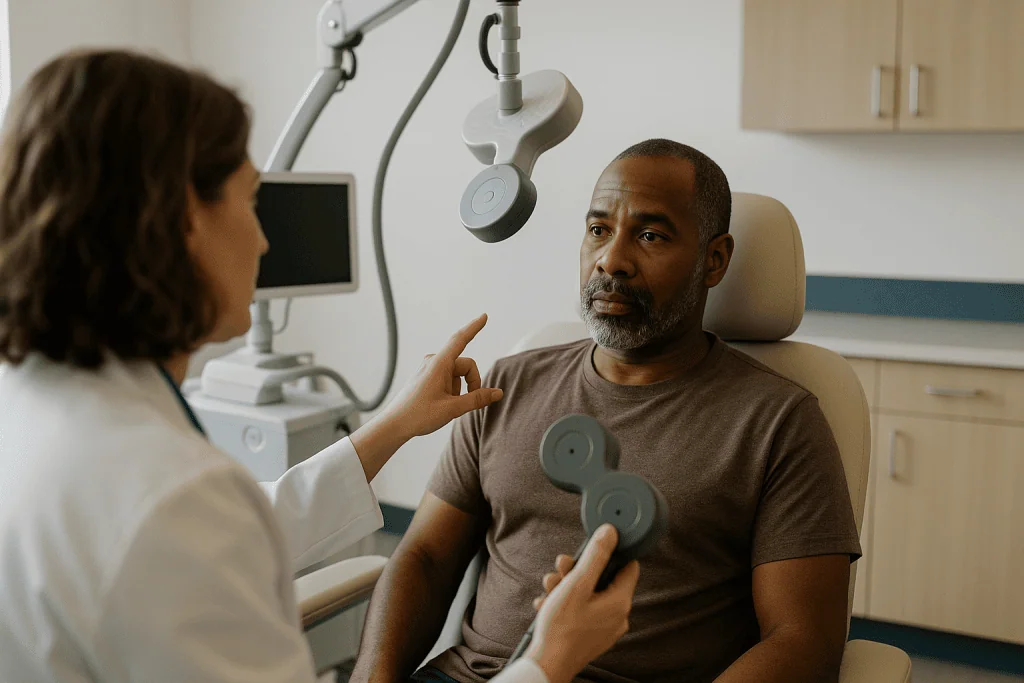
The strength question is answered with something called the motor threshold. In plain language, the motor threshold is the lowest magnetic intensity that makes a muscle in your hand twitch when the coil is held over the part of the brain that controls that hand. The clinician places the coil over the motor cortex, the strip of brain that sends movement commands, and fires single pulses while watching your thumb or fingers. When the thumb flicks about half the time, that intensity becomes your personal reference point. Mayo Clinic describes this as the step that lets the care team identify the right place for the coil and the right amount of magnetic energy for you.
Treatment intensity is then set relative to that threshold, a decision that belongs to the treating psychiatrist and may be adjusted if scalp discomfort is a problem early on. You will not be asked to choose a number, and you should not feel the need to compare yours with anyone else’s; thresholds vary widely between people and even shift a little with sleep and medication.
With the threshold recorded, the clinician measures forward from the motor spot to the treatment target, marks it on a cap or in a navigation system, and photographs or documents the coil position. Some centers use an MRI scan of your head to guide placement, a method called neuronavigation; many rely on standardized scalp measurements. Both are accepted approaches, and your team will explain which one they use and why.
Where does the coil go? TMS coil placement explained
For depression, the usual target is the left dorsolateral prefrontal cortex. That mouthful describes a region behind the upper left forehead, roughly above the outer corner of the left eyebrow and a few finger-widths back, that is involved in mood regulation, attention and decision-making. Imaging studies have repeatedly found reduced activity in this area in people with depression, which is why high-frequency stimulation there became the standard approach described by Mayo Clinic, Cleveland Clinic and the NHS.
The coil itself comes in several shapes. The most common is a figure-of-eight coil, two round loops joined in the middle, which focuses the field under the junction point. A newer design, often called an H-coil, sits inside a padded helmet and reaches somewhat deeper and more broadly; this is the design used in what is marketed as deep TMS. Neither shape is inherently superior for every person, and the choice depends on the protocol your team uses and the condition being treated.
Placement is fussier than it looks. The coil must sit flat against the scalp, because the field falls off sharply with distance; a coil tilted a centimeter away delivers a noticeably weaker stimulus. Hair is fine, hats and clips are not, and the technician will typically ask you to remove earrings or metal hair accessories on that side. A headrest or cushion keeps your head steady so the mark and the coil stay aligned through the whole session.
Not every protocol targets the left side. Some depression protocols use slower, low-frequency pulses over the right prefrontal cortex, and the protocol used for obsessive-compulsive disorder targets a different, more central region. If your coil sits somewhere other than your left forehead, that is not a mistake; ask the technician to explain the target and they will.
What does TMS feel like? Pulses, tapping and the sound
The sensation people describe most often is tapping: a quick, firm knock on the scalp, as if someone were drumming a fingertip in the same spot many times per second. Each train of pulses lasts a few seconds, followed by a pause, and the pattern repeats for the length of the session. People compare it to a woodpecker, a rubber band flicked against the skin, or a small hammer, which gives you a sense of the range. Mild discomfort is common, sharp pain is not expected and should be reported.
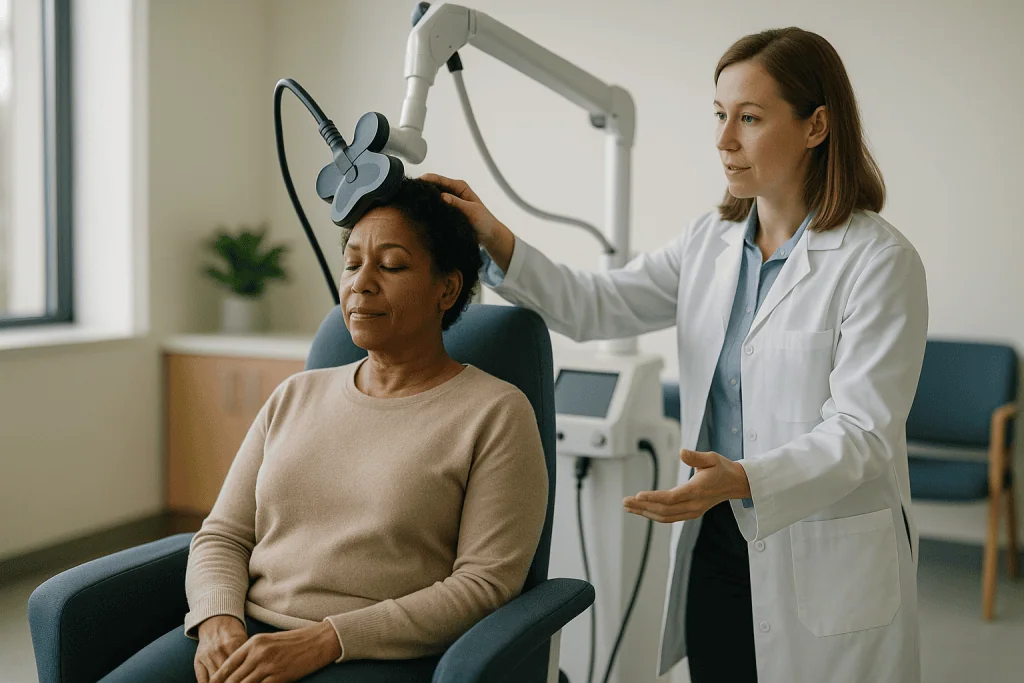
Because the coil sits over the forehead, nearby nerves and muscles pick up the field too. A twitch of the eyebrow, cheek or jaw during each train is normal and listed by Mayo Clinic among the expected effects, along with tingling or spasms of facial muscles. Some people blink involuntarily with each pulse. These movements stop the moment the train ends.
The sound surprises almost everyone. Each pulse makes a sharp click, loud enough that ear protection is required; Mayo Clinic lists hearing problems as a rare risk when earplugs are not used properly. The clicks are mechanical, created by the coil windings flexing as current surges through them, not by anything happening in your head.
You remain fully alert throughout. There is no sedative, no numbness and no loss of time, which is one of the clearest differences from electroconvulsive therapy. Many people find the first two or three sessions the most uncomfortable, partly from the novelty and partly because scalp sensitivity tends to settle; Mayo Clinic notes that side effects generally lessen with additional sessions. If discomfort stays high, the team can make small changes to coil angle or intensity, and that conversation is worth having early rather than enduring in silence.
How long are you in the chair? Session length by visit type
Time in the chair depends on the protocol and on whether it is your first visit. The table below gathers typical ranges described by Mayo Clinic and Cleveland Clinic; your own schedule may sit anywhere within them, and the first appointment is nearly always the longest.
| Visit type | Typical time in the chair | What fills the time |
|---|---|---|
| First mapping visit | Often an hour or more | Consent questions, motor threshold testing, locating and marking the target, a first full or partial treatment |
| Standard repetitive TMS session | About 20–40 minutes of stimulation; appointments are often booked as 30–60 minutes | Brief check-in, coil positioning, pulse trains with pauses, a quick check before leaving |
| Theta-burst session | A few minutes of stimulation | Same setup, but a compressed pulse pattern that Cleveland Clinic describes as much shorter |
| Review visits during the course | Added to a normal session | Mood questionnaires and a conversation with the prescribing clinician |
Theta-burst stimulation deserves a word of explanation. It is a pattern of pulses delivered in rapid bursts that mimics a natural brain rhythm, which allows the stimulation to be compressed into a far shorter window than a conventional protocol. Shorter does not mean weaker in effect; it means a different pattern, and whether you receive it is a protocol decision for your team.
Plan for the appointment, not just the stimulation. Check-in, earplugs, positioning and the end-of-session check add minutes on either side, so blocking roughly an hour on your calendar is realistic even when the pulses themselves take twenty. Over a full course, Harvard Health describes 20 to 30 sessions as typical, which is why the practical question of fitting daily visits around work and family often weighs as heavily as the treatment itself.
Who TMS is usually for, and who is usually asked to wait
In routine practice, TMS is offered mainly to adults with major depression that has not improved enough after at least one adequate trial of antidepressant medicine, a situation often called treatment-resistant depression. That is the group described by Mayo Clinic, the NHS and Harvard Health, and it is the indication with the largest body of evidence. The National Institute of Mental Health notes that regulators have also cleared TMS protocols for obsessive-compulsive disorder, smoking cessation and migraine with aura, each using its own target and pulse pattern.
Some people are asked to wait, and some are advised against TMS altogether, almost always for safety reasons connected to the magnetic field. Mayo Clinic lists metal or implanted medical devices in or near the head as the main concern: aneurysm clips or coils, stents in the neck or brain, cochlear implants, deep brain stimulators, implanted electrodes, bullet fragments and even facial tattoos made with metallic or magnetic-sensitive ink. The field can heat, move or interfere with these. Dental fillings and braces are generally not a problem. Pacemakers and other chest devices are assessed case by case.
A personal or family history of seizures prompts extra caution because the pulses can, rarely, trigger one. People with bipolar disorder are watched closely for a swing into mania, which Mayo Clinic flags as a possible, though uncommon, effect. Pregnancy is a shared decision based on limited data. Active heavy alcohol use, recent withdrawal, or a new medicine that lowers the seizure threshold may lead the team to postpone rather than refuse.
None of these screens happen on the fly. Expect a detailed safety questionnaire and a conversation with a psychiatrist before anything is scheduled, and expect the final call on suitability to rest with that clinician rather than with a brochure or a form.
TMS therapy timeline: what a typical week and full course look like
The most common schedule is one session a day, five weekdays a week, for four to six weeks, a pattern described consistently by Mayo Clinic, the NHS and the National Institute of Mental Health. Some programs then taper, moving to three sessions a week, then one, over a further week or two, while others stop at the end of the acute course. Accelerated protocols that fit several sessions into a single day exist in research settings and some clinics; they are not the norm, and your team will tell you if they are offered.
Week one is about settling in. The mapping visit sets the coil position, scalp sensitivity is at its highest, and headaches after sessions are most likely. Many people describe the strangest part as the sheer repetition rather than anything that happens in the chair.
Weeks two and three are quiet for a lot of people. Mood questionnaires, usually filled out weekly, may barely move, and this is the stretch where doubts creep in. Clinicians generally ask for patience here because changes, when they come, tend to appear gradually rather than overnight.
Weeks four to six are when clinical reviews carry most weight. The prescribing psychiatrist looks at the trend across your rating scales, your own account, and what family or friends have noticed, and decides whether to complete the planned course, extend it, taper, or stop.
Beyond the course, the picture is less tidy. Depression can return months later, and some people are offered maintenance sessions or a repeat course; Harvard Health notes the evidence on long-term durability and maintenance scheduling is still developing. Your antidepressant medicines are usually continued throughout, and any change to them remains a decision for your prescribing clinician, not something TMS replaces.
What not to do during TMS
The list is short and practical, and most of it exists for safety rather than ceremony.
Do not move your head once the coil is set. A shift of a centimeter changes where the field lands, so if you need to cough, scratch or reposition, say so during a pause and the technician will stop and re-check alignment. Do not remove your earplugs until the machine is off; the clicks are loud enough that Mayo Clinic lists hearing damage as a rare risk when protection is skipped.
Do not bring metal or electronics within reach of the coil. Phones, smartwatches, credit cards and hairpins can be damaged or heated by the field, and the technician will ask you to leave them in a tray. Do not wear a hat, headband or hair clip on the treatment side.
Do not hide changes. New medicines, a missed night of sleep, a heavy drinking evening, a new supplement or a recent illness all matter because they can alter seizure risk or scalp sensitivity. Telling the technician is not an admission; it is part of the safety check. Likewise, do not stop, start or change a prescribed medicine on your own during the course; that decision sits with your prescribing clinician, who may want to keep things steady while the TMS effect is being assessed.
Do not skip sessions casually. The treatment works through repetition, and most programs ask you to attend every weekday. One missed day is manageable and usually rescheduled; a scattered attendance pattern makes it hard to judge whether the course is doing anything.
Finally, do not expect to sleep through it. Many centers ask you to stay awake and alert, partly so you can report sensations and partly because alertness is thought to matter for the brain’s response. Reading, quiet conversation during pauses or listening to something through the clinic’s system are all fine.
TMS side effects and what the following days usually feel like
Most of what people feel after a session is local and short-lived. Mayo Clinic lists headache, scalp discomfort at the stimulation site, tingling or twitching of facial muscles, and lightheadedness as the common effects, and notes that they tend to ease shortly after each session and become less frequent as the course goes on. A mild headache in the first week is the single most reported complaint; it usually responds to the kind of simple measures you would use for any tension headache, and your clinician can advise on what is appropriate alongside your other medicines.
Fatigue is mentioned often in patient accounts but less consistently in clinical summaries. Some people feel wiped out after early sessions, others feel nothing of the sort; if tiredness is affecting your day, mention it so the team can consider timing and intensity.
What TMS largely does not do is produce the body-wide effects associated with many antidepressant medicines. Harvard Health points out that because the stimulation is focused on one region of the brain, TMS is not linked to weight change, sexual side effects or stomach upset, and it does not cause the memory disruption associated with electroconvulsive therapy. That is a neutral observation about mechanism, not a reason to alter any prescription.
Serious effects are uncommon but real. A seizure is the one that matters most; Mayo Clinic describes it as rare, and screening for seizure history, sleep deprivation and alcohol use exists to keep it that way. A switch into mania can occur in people with bipolar disorder. Hearing loss has been reported when ear protection was inadequate.
Between sessions, most people simply carry on: work, school, driving, exercise. There is no wound to care for and no downtime, which is one reason the daily commitment is usually the hardest part rather than the recovery.
What are the signs that TMS is working?
The honest answer is that the first signs are small, easy to miss, and frequently noticed by someone else before you notice them yourself. A partner comments that you laughed at something. You realize you cooked dinner instead of ordering in. You slept through the night for the first time in months. These are the kinds of shifts clinicians listen for, because they often precede any change in how you would describe your mood.
Sleep and energy tend to move early. Concentration and the ability to start tasks often follow. The heavy, flat feeling that defines depression for many people is frequently the last thing to lift, which is why someone can be objectively improving on a rating scale while still telling the technician they feel the same.
Those rating scales are the most reliable gauge. Standardized depression questionnaires completed each week give the prescribing clinician a trend line rather than a snapshot, and a steady downward drift across several weeks carries more weight than any single good or bad day. If your program uses them, ask to see your own numbers; watching the line move can be steadying during the quiet middle weeks.
Improvement is rarely linear. A good week followed by a flat one is common and does not mean the treatment has stopped working. Timing varies too; some people describe change in week two, others not until week four or five, and some complete the course without meaningful benefit. Harvard Health is candid that a substantial share of people with treatment-resistant depression respond and a smaller group reach remission, while others do not, and no clinic can predict in advance which group you will be in.
What you should not do is read a lack of early change as failure, or a sudden surge of energy and sleeplessness as success. The second pattern, in particular, is worth reporting the same day, because it can be an early sign of mania rather than recovery.
Is there a downside to TMS?
Yes, and it is worth naming them plainly rather than burying them under reassurance.
The first is time. Twenty to thirty appointments across four to six weeks, each needing travel and an hour of your day, is a genuine burden for anyone with a job, caring responsibilities or a long commute. Harvard Health identifies this daily commitment as one of the main practical drawbacks. Unlike a tablet taken at home, TMS cannot be done remotely or batched into a single visit under standard protocols.
The second is uncertainty of benefit. TMS is offered because antidepressants have not worked well enough, and it does not work for everyone either. Some people finish the course with little change. A course that does help may not hold indefinitely, and the evidence on how best to prevent relapse, whether through maintenance sessions, medicines, psychotherapy or a combination, is still being worked out.
The third is comfort and safety. Scalp discomfort and headache in the early weeks are common enough to make some people stop. The rare but serious risk of a seizure is the reason for the detailed screening, and anyone with non-removable metal in the head may simply be ineligible.
The fourth is scope. Depression has the strongest evidence base. For other conditions the evidence is thinner and protocols are less settled, so claims that TMS treats a long list of problems deserve skepticism.
Alternatives exist and should be part of the conversation: a different antidepressant or an added medicine, structured psychotherapy, electroconvulsive therapy for severe or life-threatening depression, and in some settings esketamine, a nasal medicine related to the anesthetic ketamine. Each has its own trade-offs, and the choice between them is a clinical judgment made with your psychiatrist, not a ranking to be solved online.
Is TMS better for anxiety or depression?
The evidence is clearly stronger for depression. That is where the large trials were done, where the standard left-prefrontal protocol was developed, and where regulators first cleared the treatment; Mayo Clinic, the NHS and the National Institute of Mental Health all describe depression as the primary use. If you are being offered TMS for depression, you are being offered the version with the most supporting data.
Anxiety is more complicated. Many people with depression also have prominent anxiety, and when their depression improves with TMS, anxiety symptoms often ease alongside it. That is a well-recognized pattern, but it is not the same as TMS being a proven treatment for anxiety disorders on their own, such as generalized anxiety disorder, panic disorder or social anxiety. For those conditions, the research consists of smaller studies with varied targets and pulse patterns, and mainstream sources do not list stand-alone anxiety disorders among the established indications. Where it is offered for anxiety alone, it is generally considered off-label or investigational, and your clinician should say so.
Obsessive-compulsive disorder sits in between. The National Institute of Mental Health notes that a specific TMS protocol, using a different coil position and pattern than the depression protocol, has regulatory clearance for OCD. So a person with OCD may be a reasonable candidate, but the session will not look identical to a depression session.
The practical upshot: if someone describes TMS as equally proven for anxiety and depression, they are smoothing over a real difference in the evidence. Ask which diagnosis the treatment is being proposed for, which protocol will be used, and what the evidence looks like for that specific pairing. A careful team will welcome the question.
What people often get wrong about TMS
The first and most persistent confusion is with electroconvulsive therapy. ECT deliberately induces a brief seizure under general anesthesia and is associated with memory effects around the time of treatment. TMS does neither: you are awake, no seizure is intended, and the National Institute of Mental Health describes it as a separate, non-invasive approach. The two share the word brain and almost nothing else about the experience.
A second misconception runs the other way, treating TMS as a gentle wellness gadget with no risks. It is a medical procedure with a screening process for a reason. Seizures are rare but documented, and the hard exclusions around metal in the head are not formalities.
Third, people often expect an immediate effect. Because each session is short and you walk out afterward, it is natural to assume something should feel different that evening. The typical course of change, described by Mayo Clinic and others, unfolds over weeks, and an uneventful first fortnight is normal rather than discouraging.
Fourth, there is a belief that TMS replaces medicine. In most programs antidepressants continue throughout, and any decision to adjust them belongs to the prescribing clinician. TMS is usually added to a plan, not swapped in for one.
Fifth, the phrase MRI-strength magnet alarms some people. The comparison, which the National Institute of Mental Health makes, describes field strength, not danger; MRI scans are performed millions of times a year, and the TMS field is focused on a small area for brief pulses.
Finally, a lot of online material presents TMS as working for almost everything, from chronic pain to memory decline. For most of those uses the evidence is early or mixed. Depression carries the weight of the data, a few other indications have regulatory clearance, and everything beyond that deserves to be described as research rather than routine care.
Questions to ask your care team before you start
A good consultation leaves you knowing not just whether TMS is suitable but exactly what your version of it will look like. These questions tend to surface the details that matter.
- Which diagnosis is this being offered for, and what does the evidence look like for that specific condition?
- Which protocol will I receive: standard high-frequency, low-frequency right-sided, theta-burst or deep TMS, and why that one for me?
- How will you locate the target, by scalp measurement or MRI-guided navigation, and how often will you re-check the position?
- How many sessions are planned, how many days a week, and roughly how long will each appointment take from arrival to leaving?
- What happens if I miss a day because of illness or work?
- How will we judge whether it is working, and at what point would you recommend stopping if it is not?
- What should I do about my current medicines during the course, and who do I contact if I am thinking of changing anything?
- Which side effects should I expect in the first week, and which ones should prompt a same-day call?
- Have I been screened for every implant, device and seizure risk factor, and is there anything in my history you want to double-check?
- If the course helps, what is the plan for maintaining the benefit, and what happens if symptoms return?
- Who will actually be in the room during sessions, and who do I speak to if something feels wrong?
Write the answers down or ask for them in writing. Programs differ in meaningful ways, and the version of TMS you receive is defined by these specifics, not by the general descriptions found online or in this article.
When to call your doctor
Most sessions end with nothing more than a tender spot on the scalp and perhaps a mild headache. A few situations need prompt attention, and the team running your treatment should give you a direct number for exactly this purpose.
Treat the following as emergencies and call emergency services, then inform your TMS team: a seizure or convulsion, during or after a session; loss of consciousness or a collapse; sudden weakness, numbness or slurred speech; and thoughts of harming yourself or ending your life, which should also prompt contact with a crisis line if one is available where you live. These are rare, but they are the reasons screening exists and they are never something to wait on.
Call your treating clinician the same day, before your next session, if you notice: a severe or unusual headache that does not ease with simple measures or that is different from your usual pattern; a change in hearing, ringing in the ears or a feeling of fullness in one ear after a session; a sudden surge in energy with very little need for sleep, racing thoughts, rapid speech or impulsive decisions, which can signal a swing toward mania; new confusion or difficulty finding words; persistent facial pain or twitching that continues long after the session has ended; skin irritation, blistering or a burn-like mark at the coil site; or a marked worsening of mood, hopelessness or agitation.
Also let the team know about anything that changes your safety profile before you sit down: a new prescription, a night without sleep, heavier drinking than usual, a fall or head injury, a fever, or a newly scheduled MRI or surgery that might involve implanted material.
Every one of these judgments, from pausing a session to stopping the course, rests with the clinicians who know your history. Reporting early gives them the chance to make those calls well.
Frequently asked questions
What not to do during TMS?
Do not move your head once the coil is positioned, remove your earplugs, or bring phones, cards or metal accessories near the coil. Avoid hiding changes such as a sleepless night, heavier drinking or a new medicine, since these affect seizure risk. Do not alter prescribed medicines on your own; keep your prescribing clinician in charge of that. Most programs also ask you to stay awake and attend every scheduled weekday session so the effect can be judged fairly.
What are the signs that TMS is working?
Early signs are usually subtle: better sleep, a little more energy, finding it easier to start tasks, or a family member noticing you seem lighter before you feel it yourself. Weekly depression questionnaires give the clearest picture, with a gradual downward trend over several weeks mattering more than any single day. Progress is often uneven and may not appear until the third or fourth week, and some people complete a course without meaningful change.
Is there a downside to TMS?
The main downsides are the time commitment of daily weekday appointments for four to six weeks, the possibility that it will not help or that benefit will fade, early scalp discomfort and headaches, and ineligibility for people with certain metal implants in the head. Seizure is a rare but serious risk that screening aims to minimize. For conditions other than depression the evidence is thinner, so broad claims should be viewed cautiously.
Is TMS better for anxiety or depression?
Depression has far stronger evidence, and it is the condition for which standard TMS protocols were developed and cleared. Anxiety symptoms that accompany depression often improve as the depression does, but stand-alone anxiety disorders are supported mainly by smaller studies with varied methods, and mainstream sources do not list them among established indications. A separate protocol has regulatory clearance for obsessive-compulsive disorder, which sits between the two in terms of evidence.
How long is a TMS session from start to finish?
The stimulation itself typically lasts about 20 to 40 minutes for a standard protocol, with Mayo Clinic describing a usual session as around 40 minutes and Cleveland Clinic allowing 30 to 60 minutes for the appointment. Theta-burst protocols compress stimulation into a few minutes. Check-in, earplugs, coil positioning and a brief check afterward add time on either side, and the first mapping visit often runs an hour or more.
Can I drive home after a TMS session?
Usually yes. TMS does not involve sedation or anesthesia, and Mayo Clinic notes that people can typically drive themselves and return to normal activities immediately after a session. Exceptions exist: if you felt lightheaded, had an unusually strong headache, or experienced anything out of the ordinary during the session, tell the technician and wait until you feel fully steady. Your team may advise differently based on your own history.
Does TMS hurt?
Most people describe firm tapping on the scalp and twitching of the forehead, eyebrow or jaw during each train of pulses, which can be uncomfortable but is not expected to be sharply painful. Scalp sensitivity and headache are most noticeable in the first week and generally ease as sessions continue, according to Mayo Clinic. If discomfort stays high, the team can adjust coil angle or intensity, so report it early rather than tolerating it.
Is TMS the same as electroconvulsive therapy?
No. Electroconvulsive therapy induces a brief, controlled seizure under general anesthesia and is linked to memory effects around treatment. TMS uses focused magnetic pulses while you are awake, does not aim to cause a seizure, and does not require anesthesia or recovery time. The National Institute of Mental Health describes them as distinct brain stimulation therapies with different procedures, risk profiles and typical roles in the treatment of depression.
Do I keep taking my antidepressants during TMS?
In most programs, yes: antidepressants are usually continued throughout the course, and TMS is added to an existing plan rather than replacing it. Any change to your medicines, including stopping or adjusting, should be made only by your prescribing clinician, who may prefer to keep things stable while the TMS effect is assessed. Always tell the TMS team about any new prescription, since some medicines affect seizure risk and therefore safety screening.
What happens if I miss a TMS session?
A single missed day is common and usually just rescheduled, often by extending the course by a day. Programs aim for consistent weekday attendance because the effect builds through repetition, so frequent gaps make it hard to judge whether treatment is helping. If you expect to miss several sessions for travel or illness, let the team know in advance so they can decide whether to adjust the schedule or pause and restart.
References
- Cleveland Clinic: Transcranial Magnetic Stimulation (TMS)
- National Institute of Mental Health: Brain Stimulation Therapies
- NHS: Depression in adults, treatment
This article is for general information only and is not a substitute for professional medical advice. Please consult a qualified doctor about your individual situation.

More from the Blog

Who Is a Candidate for Deep Brain Stimulation in Parkinson Disease? What the Evaluation Tests
A person is usually a candidate for deep brain stimulation (DBS) in Parkinson disease when they have confirmed idiopathic Parkinson disease, still respond clearly…

Daily Life With a Movement Disorder: Rehabilitation, Fall Safety and Caregiver Routines
Living with a movement disorder usually means combining three things: regular rehabilitation with physical, occupational and speech therapists; a home and daily routine arranged…

Broca’s, Wernicke’s and Global Aphasia: How the Type Changes the Therapy Approach
Therapy for aphasia is matched to the pattern of language loss. In Broca's aphasia, understanding is relatively preserved, so therapy drills spoken output, often…

Epilepsy Surgery and Neurostimulation: What Changes When Medication Alone Is Not Enough
Epilepsy surgery is usually considered when seizures continue despite two appropriately chosen and well-tolerated anti-seizure medicines, a situation neurologists call drug-resistant epilepsy. A specialist…

Which Hearing Devices and Vision Aids Help With Deafblindness, and How Are They Fitted?
Hearing devices for deafblindness include hearing aids, cochlear implants, bone-conduction devices, remote-microphone systems and vibrating alerting devices; vision aids include prescribed magnifiers, electronic video…

CBT-I or Sleep Medication for Insomnia: How the Two Approaches Compare Over Time
For chronic insomnia, major guidelines recommend cognitive behavioral therapy for insomnia (CBT-I) as the first treatment because its benefits usually persist after the course…