

When Can You Wash Your Hair After a Brow Lift? Sun, Exercise and Early Wound Care
Key Takeaways
- Scalp incisions seal within days, but the deep attachment of lifted forehead tissue to bone takes weeks, which is why exercise limits outlast stitch removal.
- Stitches or clips after a brow lift are usually removed at around 7–10 days, and many teams allow a first gentle hair wash once the dressing is off and the incisions are checked.
- Forehead numbness removes your warning system, so hot water, hair dryers and sun can injure the skin without pain; test water on your wrist and skip heat styling early on.
- Bruising often migrates down into the eyelids and cheeks around days three to five before it fades, which is normal gravity, not a complication.
- Nicotine narrows the small blood vessels the forehead skin depends on, which is why smoking is linked to delayed healing, wound breakdown and poorer scars.
- Scars continue fading for many months, so sun protection over the forehead and hairline is a year-long habit, not a two-week rule.
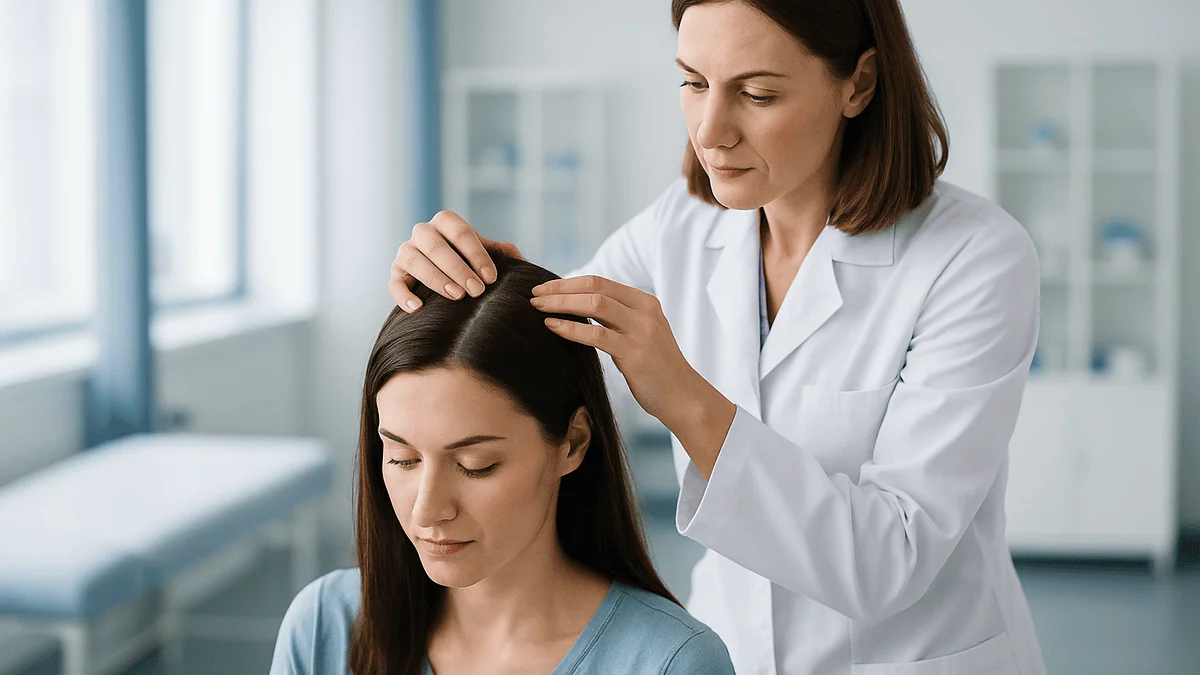
Most people can gently wash their hair within the first few days after a brow lift, once the surgical team has removed or loosened the dressing and confirmed the incisions are sealed. Use lukewarm water, a mild shampoo, fingertips rather than nails, and pat dry. Hair dye, heat styling and vigorous scrubbing wait longer, usually until clips or stitches are out and the scalp has healed.
Three mornings after surgery, a woman stands in her bathroom holding a bottle of shampoo like it is a legal document. Her scalp itches under the dressing, her forehead feels oddly numb, and the one line in her discharge paperwork about hair washing has been read so many times it has stopped making sense. She is not vain. She simply wants to feel like herself again, and clean hair is where that starts.
Brow lift aftercare is full of small, practical questions like this one, and they rarely get the attention that the operation itself does. When can water touch the incisions? Is a hair dryer safe near numb skin? Why does every leaflet warn about the sun when the scars are hidden in the hairline? And how soon can you go back to the gym without undoing the work?
This guide answers those questions with the evidence that exists, says plainly where it runs out, and leaves every date on your calendar to the people who actually saw your incisions.
What brow lift aftercare actually involves in the first 72 hours
The first three days after a brow lift are less about doing things and more about not undoing them. A brow lift (also called a forehead lift) repositions the soft tissue of the forehead so the eyebrows sit higher and the skin between them softens. The incisions are usually hidden in or just behind the hairline, and the first job of aftercare is to protect those incisions while the tissue settles into its new position.
According to Mayo Clinic, surgeons commonly wrap the forehead loosely after the operation to limit swelling, and a small drainage tube is sometimes placed under the skin to carry away fluid for a day or two. Expect the dressing to be checked, changed or removed at an early follow-up visit rather than at home.
Swelling and bruising are the main physical experience of these days, and they often spread downward into the eyelids and cheeks because fluid follows gravity. Keeping the head raised, including during sleep, and using a cool compress as your team directs are the two measures most consistently recommended. Pain is usually described as tightness or pressure rather than sharp pain; your prescribing clinician will decide what, if anything, you need to manage it, and that decision belongs to them.
What you are not doing matters just as much. No bending at the waist, no lifting, no rubbing the forehead, no pressing on the scalp to see how it feels. Cleaning the incision lines is done exactly as instructed, often with nothing more than a clean cotton pad and a little water, and only once the team says to start. If you cannot remember a specific instruction, calling the office is the right move; guessing is not.
How a brow lift works, in plain language
Knowing what happened under the skin makes the aftercare rules feel less arbitrary. Over decades, the muscles that pull the eyebrows down become stronger than the single muscle that raises them, and the connective tissue holding the forehead to the bone loosens. The brows drift lower, the upper eyelids look heavier, and horizontal forehead lines deepen as the brain compensates by lifting the brows constantly.
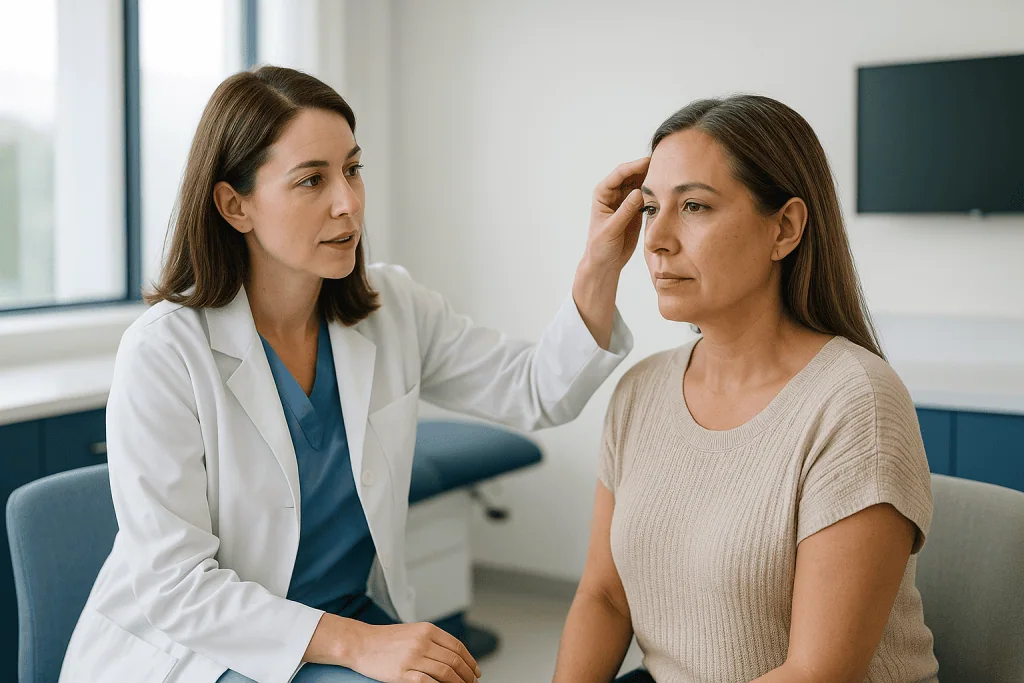
A brow lift releases the forehead tissue from the bone, lifts it to a higher position and fixes it there while the body forms new attachments. Mayo Clinic describes three main approaches. In an endoscopic brow lift, the surgeon makes several short incisions behind the hairline and uses a thin tube with a camera (an endoscope) to see and release the tissue, then secures it with small temporary fixation devices or sutures. In a coronal brow lift, a single longer incision runs from ear to ear across the top of the head. In a hairline brow lift, the incision sits at the junction of forehead skin and hair, which shortens a tall forehead rather than raising the hairline.
Each approach shares one biological reality: the lifted tissue has to glue itself back to bone and surrounding structures, and that process takes weeks. Early movement, pressure or heavy swelling can stretch the healing attachments. That is why your team is cautious about bending, straining and vigorous scalp handling long after the incisions themselves look closed. The skin heals first; the deeper fixation heals more slowly, and nobody can see it from the outside.
Fixation devices, when used, are typically designed to dissolve or be removed at a follow-up visit. Your surgeon will tell you which kind you have, and that detail changes some aftercare steps, such as how firmly the scalp may be touched during washing.
When can you wash your hair after a brow lift?
The honest answer is: when your surgical team says so, and that is usually within the first few days. The timing is not a matter of preference. It depends on when the dressing comes off, whether a drain was placed, whether skin glue or clips were used, and how the incisions look at the first check.
Two principles from general surgical wound guidance explain the logic. MedlinePlus advises keeping a freshly closed surgical wound dry for roughly the first day or two and then showering only once your surgeon has confirmed it is safe. Mayo Clinic adds that for brow lift specifically, stitches or clips are usually removed within about 7–10 days, and your surgeon will tell you when the incisions may get wet. In practice, many teams allow a first gentle wash soon after the dressing is removed, while others ask patients to wait until the clips are out. Both are reasonable; the number on your sheet is the one that counts.
Why not sooner? Water itself is not the enemy. The concern is softening the skin edges before they have sealed, carrying bacteria into an open line, and the mechanical scrubbing that most of us do without thinking. Shampoo residue sitting against a healing incision can also irritate it.
Why not simply wait longer to be safe? Because scalp incisions trap oil, dried blood and ointment, and a scalp that is never cleaned becomes itchy, crusted and more uncomfortable, which makes people scratch. Clean incisions are easier for your team to inspect. Gentle, well-timed washing is part of good brow lift aftercare, not a risk to it.
If your discharge sheet gives a day and your scalp looks or feels different from what was described, call before you wash rather than after.
Shampoo, hair dryers and styling: the practical details nobody writes down
Once washing is allowed, technique matters more than timing. Here is what surgical teams commonly describe, framed as general guidance rather than a substitute for your own instructions.
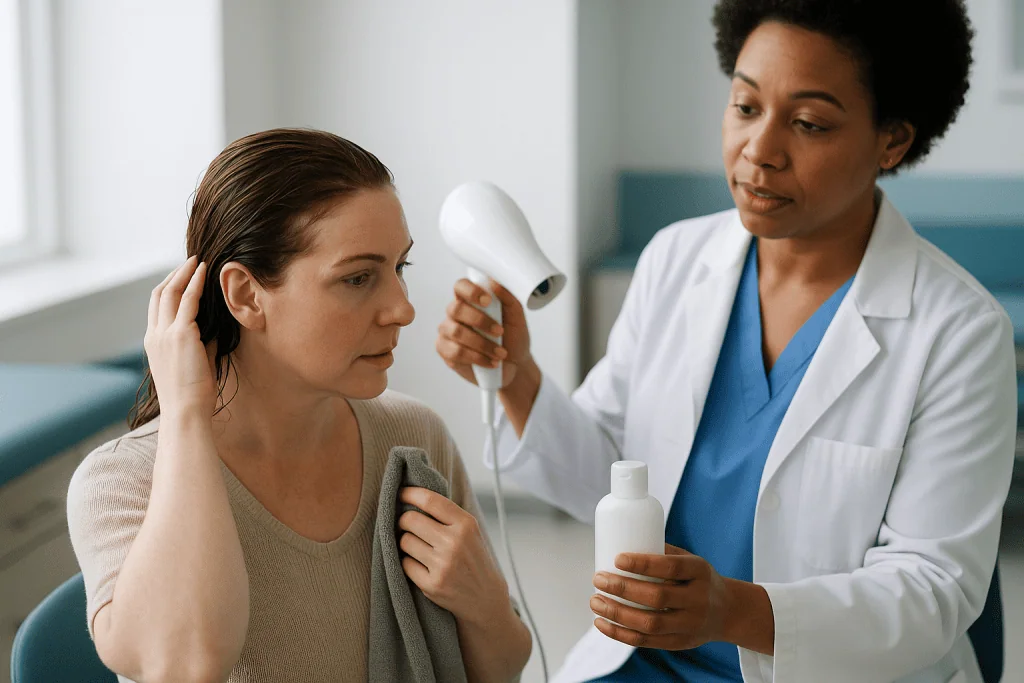
- Use lukewarm water. Freshly lifted forehead skin is often numb, so you cannot rely on it to warn you that water is too hot. Test the temperature on the inside of your wrist.
- Choose a mild, fragrance-free shampoo. Harsh detergents and strong perfumes can sting incision lines and irritate skin that is already inflamed.
- Wash with fingertips, not nails, and let the water do the lifting. Lather around the incisions rather than scrubbing across them.
- Rinse thoroughly. Residue dries into crust and encourages picking.
- Pat the scalp with a clean towel. Do not rub.
Hair dryers deserve a specific warning. MedlinePlus and Mayo Clinic both highlight that numbness is common after brow lift, and heat applied to skin that cannot feel it can cause a burn without pain. If a dryer is used at all, teams usually advise the coolest setting, held well away, and only once the incisions are closed. Letting hair air dry is the simpler choice for the first couple of weeks.
Hair color, bleach, chemical straightening and tight braids or ponytails are a separate category. Dye and bleach are chemical irritants that have no business near a healing wound, and tight styles put traction on exactly the tissue the surgeon has just repositioned. Most teams ask patients to wait several weeks, often until after the scar has clearly matured past its pink, fragile stage. Ask your team for their specific window rather than assuming.
One more detail: clips and staples in the scalp can catch on combs. A wide-toothed comb, used slowly and away from the incision line, is safer than a brush until they are out.
Sun exposure after a brow lift: why hidden scars still need protecting
People are often puzzled that sun protection appears so prominently in brow lift aftercare when the incisions sit under hair. There are three reasons, and they apply even on cloudy days.
First, the forehead and upper face swell and bruise after surgery, and bruised skin that is exposed to ultraviolet light can develop post-inflammatory hyperpigmentation, a lasting brownish discoloration. The NHS notes in its guidance on facial cosmetic surgery that healing skin and scars should be protected from the sun while they mature. Second, the hairline incision in a hairline brow lift sits in direct light, and an immature scar exposed to UV tends to darken and stay visible longer. Third, numbness means you may not feel the warning tingle of a developing sunburn on the forehead.
Practical protection is straightforward. A wide-brimmed hat is the most reliable tool in the early weeks because it does not involve touching the incisions. Once the team has cleared you to apply products to the forehead, a broad-spectrum sunscreen becomes part of the daily routine; most surgical guidance treats this as a habit for at least the first year of scar maturation rather than a short-term rule. Sunglasses help with the eye swelling and light sensitivity that commonly accompany the first days.
Heat deserves the same respect as light. Saunas, steam rooms, hot yoga and long hot showers raise skin temperature and can increase swelling. Sunbeds combine both hazards and offer nothing to a healing face.
A caution about timing: sunscreen is a product applied to skin, and applying it over an incision that has not fully closed is not recommended. The hat comes first; the sunscreen comes when your team says the skin is ready.
Exercise and brow lift recovery time: when to walk, lift and run
Movement after surgery is not a single switch; it is a staircase, and each step has a reason.
Walking starts almost immediately. Short, gentle walks around the house in the first days help circulation, lower the risk of blood clots in the legs, and improve mood, with none of the pressure spikes that worry surgeons. Nobody is asked to lie flat for a week.
What is restricted is anything that raises blood pressure in the head or jolts the tissue. Bending so the head drops below the heart, lifting heavy objects, straining, running and intense cardio all push blood into the freshly operated area and can increase swelling or, less commonly, trigger bleeding under the skin. Mayo Clinic advises avoiding strenuous activity until your surgeon clears it, and the NHS guidance on face lift surgery, which shares similar tissue concerns, describes a period of several weeks before vigorous exercise resumes. Both sources describe most people returning to desk-type work and ordinary daily routines within around two weeks, with a longer wait for gym-level exertion.
Why so long when the skin looks healed? Because the deep fixation, the new attachment of forehead tissue to bone, is still forming. Repeated impact or high pressure during those weeks is the kind of stress that nobody can see and that can be hard to reverse.
Swimming is a special case. Pools, lakes and seawater introduce bacteria to a scalp that still has recently closed incisions, and goggle straps and swim caps apply pressure right across the forehead. Most teams ask patients to wait until the incisions are fully sealed and the clips are out, and to check before the first swim.
Build back gradually: brisk walking, then light resistance with the head upright, then jogging, then the heavy, head-down movements last. If your face throbs or swells visibly during an activity, that is your signal to stop and tell your team.
What not to do after a brow lift
Discharge sheets tend to list prohibitions without explaining them, which is why people quietly break the rules they do not understand. Here is the reasoning behind the ones that matter most.
Do not bend over, lift heavy things or strain for the first couple of weeks. All three raise pressure inside the head and can increase swelling or provoke bleeding under the skin, which your surgeon may need to drain.
Do not sleep flat. Mayo Clinic recommends keeping the head elevated to limit swelling. Two or three pillows, or a wedge, lets gravity work for you. Side sleeping with the forehead pressed into a pillow is also discouraged in the early days.
Do not smoke or use nicotine in any form. Nicotine narrows small blood vessels, and the skin of the forehead and scalp depends on those vessels to heal. Reduced blood flow raises the risk of delayed healing, wound breakdown and poor scars. The NHS and Mayo Clinic both flag smoking as a key factor in complications after facial surgery.
Do not take medicines or supplements that thin the blood without checking. Some common pain relievers and several herbal products increase bleeding risk. Your prescribing clinician will tell you what to pause and when to restart; this is their decision, not something to work out from a search engine.
Do not pick at crusts, scratch itchy incisions or test numb skin with heat or pressure. Itching is a normal part of healing nerves; scratching converts it into a wound.
Do not apply makeup, creams or sunscreen over incisions until cleared, and do not color or chemically treat hair until the scalp has healed.
Finally, do not drink alcohol heavily in the first days. It dilates blood vessels, worsens swelling and interacts with many prescribed medicines.
Brow lift swelling timeline: what the following days and weeks usually look like
Recovery rarely runs in a straight line, and the second or third day often looks worse than the first because swelling and bruising peak before they fade. The table below summarizes the typical pattern described by Mayo Clinic and the NHS; individual timelines vary, and your team’s observations outrank any chart.
| Stage | What is common | What usually happens |
|---|---|---|
| Days 1–3 | Peak swelling and bruising, tightness, headache-type ache, numb forehead | Dressing changed or removed; drain, if present, taken out; head kept elevated |
| Days 4–10 | Bruising migrates toward eyelids and cheeks, then yellows and fades; itching begins | Gentle hair washing once cleared; stitches or clips removed at around 7–10 days |
| Weeks 2–3 | Most visible swelling settled; forehead still numb or tingly; scar lines pink | Many people return to desk work and social life; light exercise resumes with approval |
| Weeks 4–8 | Residual firmness softens; sensation gradually returns in patches | Strenuous exercise and swimming typically allowed; hair treatments discussed |
| Months 3–12 | Scars fade from pink to pale; brow position settles; occasional itch or tingle | Ongoing sun protection; final appearance judged by the team toward the end of this window |
Mayo Clinic notes that bruising and swelling may last ten days or longer and that most people feel ready for public activity within about two weeks, often with careful hair styling and makeup once permitted. The NHS, writing about facial lifting surgery generally, describes scars continuing to fade over many months. People asking how long it takes to look normal are usually asking about week two; people asking when they will see the final result are usually looking at several months.
If your trajectory reverses, with swelling that increases after it has started to fall, that is a reason to call rather than wait.
Endoscopic brow lift aftercare compared with coronal and hairline approaches
The approach your surgeon chose shapes the small print of your aftercare more than most leaflets admit.
After an endoscopic brow lift, there are several short incisions behind the hairline rather than one long one. Mayo Clinic describes this technique as generally involving less scarring and a quicker early recovery because less scalp is cut. The trade-off is that the lifted tissue is often held by small fixation devices anchored to the bone, and these need weeks to be replaced by the body’s own attachments. Aftercare therefore stresses avoiding pressure on the top of the head, not sleeping face down, and not massaging the scalp, even though the incisions themselves look minor. Numbness is usually patchier and shorter-lived because fewer nerves are cut.
After a coronal brow lift, the long ear-to-ear incision creates a wider zone of numbness behind the scar, because the sensory nerves to the top of the scalp are divided. This numbness commonly persists for months, and some people describe a permanent band of reduced feeling. Washing instructions tend to be more conservative while the long wound seals, and hair dryer warnings are especially relevant. The hairline is raised slightly with this approach, which is why it is usually not offered to people with high foreheads.
After a hairline brow lift, the incision sits at the front edge of the hair, partly exposed. Sun protection and scar care are the aftercare priorities here, since the scar is designed to be fine but is visible if it darkens. Hair washing must avoid dragging product across the front edge, and fringe or bangs are often used to cover the line while it matures.
Whatever the approach, the biology is shared: skin seals in days, deep tissue anchors in weeks, scars mature over about a year. Ask which approach you had and why; the answer tells you which rules carry the most weight for you.
Who a brow lift is usually for, and who is usually asked to wait
A brow lift is typically considered for adults whose eyebrows have descended enough to crowd the upper eyelids, create a heavy or tired look that does not match how they feel, or deepen the vertical lines between the brows. Mayo Clinic frames the ideal candidate as someone in good general health who does not smoke and who has realistic expectations about what repositioning the brow can and cannot change. It is often discussed alongside eyelid surgery because a low brow and excess eyelid skin look similar from the outside but need different operations.
Several groups are commonly asked to wait or to consider other options first. People who smoke or use nicotine are usually asked to stop for a defined period before and after surgery, because nicotine impairs skin blood flow and wound healing. People with uncontrolled blood pressure, bleeding disorders or poorly controlled diabetes are generally asked to stabilize those conditions first, since each raises surgical and healing risks. Anyone taking medicines that affect clotting needs a plan agreed between their surgeon and the prescribing clinician; no one should adjust those medicines on their own.
Hair and scalp also matter. A very high hairline or significant hair thinning may make coronal or endoscopic incisions harder to hide, which can shift the recommendation toward a hairline approach or toward non-surgical options such as muscle-relaxing injections, which are a different class of treatment with their own limitations.
Expectations are part of candidacy too. A brow lift raises the brows and softens frown lines; it does not treat crow’s feet, lower-eyelid bags or cheek descent, and it will not change the texture of forehead skin. A thoughtful consultation sometimes ends with a recommendation for a different procedure or for none at all. That is the system working, and the decision sits with you and the treating team.
Numbness, itching and a tight forehead: normal sensations versus warning signs
Few things unsettle people after a brow lift like touching their own forehead and feeling nothing. Numbness is expected. The sensory nerves that supply the forehead and scalp run upward from above the eyebrows, and any incision across their path interrupts them. Mayo Clinic lists altered skin sensation, including numbness and itching, among the common effects of the operation.
Feeling returns gradually and unevenly. Many people notice tingling, crawling or electric flickers first, which are signs of nerves reconnecting rather than something going wrong. Itching, often intense, follows the same pattern and can persist for weeks. Mayo Clinic notes that numbness on the top of the scalp may be prolonged, and after coronal lifts some people report a permanent area of reduced feeling behind the scar.
Tightness is also expected. The forehead has been lifted and fixed higher, and the skin and deeper layers need time to relax into that position. In the early weeks, raising the eyebrows can feel effortful or stiff, and some people cannot wrinkle their forehead at all at first. Mild asymmetry in brow height or movement during this phase is common because swelling and nerve recovery are rarely perfectly symmetrical.
What is not normal is new or worsening pain after the first days, pain concentrated on one side, a forehead that is becoming more swollen or tense rather than less, or a visible lump that grows. These can signal bleeding under the skin or infection and warrant a same-day call. Persistent inability to raise one eyebrow beyond the first several weeks is something to raise at follow-up, since the nerve that moves the forehead can be bruised during surgery; Mayo Clinic notes this is usually temporary but can occasionally be lasting.
A simple rule: sensations that are strange but gradually improving are usually healing. Sensations that are new, one-sided or escalating deserve a phone call.
What are the downsides of a brow lift? Risks in neutral clinical terms
Every operation trades a benefit against a set of risks, and honest aftercare includes knowing what you are watching for. Mayo Clinic groups brow lift risks into several categories.
Scarring is unavoidable; the question is how visible it will be. Hidden incisions behind the hairline are the goal, but scars can widen, thicken or sit in an area where hair later thins. Hair loss along the incision line is a recognized downside, sometimes temporary, sometimes permanent, and is more likely with longer incisions.
Changes in skin sensation, discussed above, range from temporary tingling to a permanent patch of numbness, most often on the top of the scalp.
Asymmetry can occur. One brow may sit or move slightly differently from the other, either because of differences in healing or because of pre-existing asymmetry that becomes more noticeable after lifting. Minor differences often settle; persistent ones may be discussed as a revision.
Nerve injury affecting eyebrow movement is uncommon and is usually temporary, but Mayo Clinic acknowledges it can occasionally be permanent. Overcorrection, producing a surprised or unnatural look, is a stylistic risk that careful planning aims to avoid; a brow that sits too high is harder to lower than one that sits slightly low.
General surgical risks apply as well: bleeding, infection, poor wound healing and reactions to anesthesia. Smoking, uncontrolled diabetes and certain medicines increase these risks, which is why pre-operative screening exists. The result also does not stop time; the tissues continue to age, and the brow will continue to descend slowly over the years.
Alternatives exist. Muscle-relaxing injections can soften frown lines and offer a modest, temporary lift for some people; eyelid surgery addresses excess lid skin without moving the brow; doing nothing is a legitimate choice. Which option is appropriate is a judgment for you and the treating team, weighed against your anatomy and health.
What people often get wrong about brow lift aftercare
Recovery myths spread fast because they sound sensible. Here are the ones worth correcting.
“Once the stitches are out, I am healed.” Skin seals in about a week; the deeper attachment of lifted tissue to bone takes weeks, and scars mature over roughly a year. The visible milestone is not the biological one.
“If it does not hurt, it is safe.” Numb skin removes your warning system. Hot water, hair dryers and sun can injure a forehead that feels nothing, which is exactly why the instructions about temperature and UV exist.
“Keeping the scalp completely dry is the cautious choice.” Past the first days, an unwashed scalp accumulates oil, crust and ointment, becomes intensely itchy and is harder to inspect. Gentle, well-timed washing is protective. The cautious choice is following the date you were given, not pushing it in either direction.
“Ice fixes swelling.” Cool compresses help, but ice applied directly to numb skin can cause a cold injury. Use a cloth barrier and follow the schedule your team provides.
“A quick workout will not matter.” Strenuous exertion raises blood pressure in the head. The risk is not the exercise itself but bleeding under the skin and prolonged swelling, which can need treatment and can affect the final result.
“Vitamin E or scar creams will make the scar disappear.” Evidence for topical vitamin E improving surgical scars is weak, and some people develop contact irritation from it. Sun protection and leaving the scar alone have better support. Ask your team before applying anything to the incision.
“The result I see at two weeks is the result.” Swelling can make the brows look higher or more surprised than they will be. Judgment belongs at several months, with the team that knows the plan.
Questions to ask your care team before you leave the clinic
The best moment to settle the practical questions is before the anesthetic wears off entirely, ideally with someone beside you taking notes. Written answers beat memory. These questions cover the gaps that most often send people searching at midnight.
- Which type of brow lift did I have, and does that change any of my restrictions?
- On what day may I first wet my hair, and should the incisions be covered or left open when I do?
- Were clips, stitches, glue or dissolvable fixation devices used, and when will each be removed or disappear?
- Is there a drain, and who removes it?
- How should I clean the incision lines, with what, and how often?
- Which of my regular medicines and supplements should I pause, which should I continue, and who decides when I restart them?
- When may I sleep on my side, and how long should my head stay elevated?
- When may I apply sunscreen, makeup or moisturizer to my forehead?
- How long should I wait before coloring or chemically treating my hair?
- When may I walk briskly, lift weights, run and swim?
- What swelling pattern should I expect, and what pattern should make me call?
- Which number do I call after hours, and what counts as an emergency versus a next-day question?
- When are my follow-up appointments, and what will you check at each one?
- If I notice asymmetry or a brow that seems too high, at what point do we assess it?
None of these questions is trivial, and none should be answered by a general article in place of your surgeon. Clinics differ in their protocols for good reasons, including the technique used and what was found during the operation. The right answer for you is the one written on your own aftercare sheet, and the right response to uncertainty is a phone call to the team that holds your notes.
When to call your doctor after a brow lift
Most recovery days are uneventful, and most worries turn out to be ordinary healing. A short list of red flags helps you tell the difference, and surgical teams would far rather take a call about nothing than miss a complication.
Contact your surgical team the same day if you notice any of the following, drawn from Mayo Clinic brow lift guidance and CDC information on surgical site infections:
- Bleeding from an incision that does not stop with light pressure, or a dressing that soaks through.
- Swelling that is rapidly increasing, especially on one side, or a tense, painful, growing lump under the skin.
- Pain that worsens after the first days or is not controlled by what you were prescribed.
- Fever, chills or feeling generally unwell.
- Redness spreading outward from an incision, warmth, increasing tenderness, or cloudy or foul-smelling discharge. The CDC notes that surgical site infections most often appear within the first month after an operation.
- Incision edges that separate or skin near an incision that turns dark or dusky.
- Sudden changes in vision, severe eye pain or an eye that will not close.
- Any new numbness or weakness in the face beyond the forehead area you were told to expect.
Seek emergency care immediately for chest pain, shortness of breath, calf pain or swelling, a severe headache unlike anything you have had before, or signs of an allergic reaction such as swelling of the lips or throat.
For questions that are urgent but not alarming, such as uncertainty about whether to wash your hair, whether a crust should be removed, or whether a sensation is normal, use the daytime number you were given. Write down what you noticed and when it started; it makes the conversation faster.
Nothing in this article replaces the judgment of the people who operated on you. If your instructions and this guide differ, follow your instructions and ask your team about the difference.
Frequently asked questions
When can you wash your hair after a brow lift?
Usually within the first few days, once your surgical team has removed or loosened the dressing and confirmed the incisions are sealed. Some teams wait until clips are out at around 7–10 days. Use lukewarm water, a mild shampoo and fingertips only, then pat dry. Your discharge sheet gives the day; if your scalp looks different from what was described, call before washing.
What not to do after a brow lift?
Avoid bending below the waist, heavy lifting, straining and vigorous exercise for the period your team specifies, since all raise pressure in the head and can increase swelling or bleeding. Do not smoke, sleep flat, scratch itchy incisions, apply heat or dye to the scalp, or take blood-thinning medicines or supplements without clearance from your prescribing clinician.
How long does it take to look normal after a brow lift?
Mayo Clinic describes bruising and swelling lasting ten days or longer, with most people comfortable in public within about two weeks, often with hair styling and makeup once permitted. Residual firmness and pink scars continue settling over months. Final brow position and scar appearance are generally judged toward the end of the first year.
What is the typical brow lift recovery time before exercise?
Gentle walking begins within days. Mayo Clinic and NHS guidance on facial lifting surgery describe several weeks before strenuous exercise, because the deep fixation is still forming even when the skin looks healed. Most people resume desk work around two weeks and build back to running and heavy lifting gradually, with the heaviest, head-down movements last and only after team approval.
Does endoscopic brow lift aftercare differ from other types?
Yes, in the details. Endoscopic lifts use several short incisions and often small fixation devices anchored to bone, so aftercare stresses avoiding pressure on the top of the head and not massaging the scalp. Coronal lifts involve a long incision with wider, longer-lasting numbness and more conservative washing. Hairline lifts place the scar in light, so sun protection takes priority.
What does the brow lift swelling timeline look like day by day?
Swelling and bruising typically peak around days two to three, then travel downward into the eyelids and cheeks before yellowing and fading over the following week or so. By two to three weeks most visible swelling has settled, with residual firmness softening over the next one to two months. Swelling that increases after it has begun to fall warrants a call.
Can I use a hair dryer after a brow lift?
Not in the early days, and with care afterward. The forehead and scalp are often numb, so heat can burn skin without any pain to warn you. Teams usually advise air drying until incisions are closed, then the coolest setting held well away. Ask your team for their specific timing, since it depends on your incision type and healing.
When can I go in the sun after a brow lift?
Direct sun on the face should be avoided while bruising and incisions heal, using a wide-brimmed hat first because it involves no contact with the skin. Sunscreen is added once your team clears products on the forehead. Healing skin exposed to UV can darken permanently, and scars continue maturing for many months, so protection is a long-term habit.
What are the downsides of a brow lift?
Mayo Clinic lists scarring, hair loss along incision lines, temporary or sometimes permanent numbness on the scalp, asymmetry between the brows, and uncommon nerve injury affecting eyebrow movement. General surgical risks include bleeding, infection and poor wound healing, higher in smokers. The brow also continues to age over time, and an overcorrected lift can look unnatural.
Is numbness on top of my head after a brow lift permanent?
Often not, but it can be prolonged. Sensory nerves to the forehead and scalp are interrupted by the incisions, and feeling returns unevenly over weeks to months, often as tingling or itching first. Mayo Clinic notes numbness on the top of the scalp may last a long time and, after coronal lifts especially, some people have a lasting patch of reduced sensation.
References
This article is for general information only and is not a substitute for professional medical advice. Please consult a qualified doctor about your individual situation.

More from the Blog

Oral Hygiene and Soft Foods After Bichectomy: Caring for Cheek Incisions While They Heal
Bichectomy aftercare centers on keeping the small incisions inside each cheek clean while they heal. Surgeons commonly ask patients to rinse gently with a…
Is Aesthetic Neck Contouring Right for a Double Chin? Fat, Skin and Muscle Considered
Aesthetic neck contouring can help a double chin when the main cause is a pocket of fat beneath the chin in someone with reasonably…

Genioplasty Risks Explained: Lip Numbness, Bone Healing and Plate-Related Problems
Genioplasty risks are generally considered modest for a healthy adult, but they are real. The most common problem is temporary numbness of the lower…

Does a Weak Chin Need Genioplasty or Jaw Surgery? How Surgeons Tell Bite Problems Apart
A weak chin can come from a small chin bone sitting on a normal jaw, or from a whole lower jaw that sits too…
Preparing for Facial Augmentation: Facial Analysis, Implant Choices and Stopping Smoking
A facial augmentation consultation is a structured assessment before surgery to add volume or projection to the chin, cheeks or jaw. The surgeon measures…

Lip Reconstruction After Tumor Removal: How Surgeons Plan for Speech, Eating and Symmetry
Lip reconstruction after cancer is planned around three jobs the lip performs: sealing the mouth so food and saliva stay in, shaping sounds such…