

When Can You Wear a Hat After a Sapphire Hair Transplant? Channel Closure and Crust Shedding
Key Takeaways
- A sapphire blade changes only the tool used to open recipient channels; the wound-healing biology, and therefore the recovery rules, are the same as for any FUE transplant.
- Recipient channels are typically sealed at the surface within about 7 to 10 days, which is why a loose, breathable hat is commonly permitted around then and tighter headwear several weeks later.
- Crusts are clot and skin cells that protect each graft; they should be softened by gentle washing and allowed to fall away on their own, usually within two weeks, never picked.
- After roughly day 10 grafts are anchored and everyday contact is unlikely to dislodge them, but scratching, blows to the head and sunburn can still damage healing skin.
- Transplanted hairs are expected to shed around two to three weeks after surgery, and visible new growth usually begins around three to four months, with the fuller result judged at about a year.
- No major guideline or independent systematic review supports a specific success percentage for sapphire FUE, and published comparisons with steel blades or DHI are small and limited.
Most surgical teams allow a loose, clean, breathable hat about 7 to 10 days after a sapphire FUE hair transplant, once the tiny recipient channels have sealed and grafts are anchored, and tighter hats or helmets after roughly 2 to 4 weeks. Crusts usually shed within the first two weeks with gentle washing. Timelines vary, so follow your own surgeon's written instructions.
The first thing many people notice after leaving the operating room is not the tenderness or the tightness. It is the mirror in the elevator. A scalp dotted with hundreds of small red points, a bandage across the back of the head, and an afternoon in bright daylight still ahead. The question forms almost immediately: how soon can I cover this?
It sounds like a vanity question. It is really a wound-healing question. Every one of those red dots is a fresh incision holding a living follicle that has just been moved from one part of the scalp to another. The sapphire hair transplant healing timeline is the sequence in which those incisions seal, the grafts take root, and the surface crusts loosen and fall away. A hat placed too early can interfere with each stage.
This explainer walks through that sequence, what it means for hats, scabs and sleep, and where the evidence is firm versus where your surgeon’s judgment fills the gap.
Why the hat question is really a question about the sapphire hair transplant healing timeline
Ask a room of people recovering from hair surgery what worries them most in week one, and the answers cluster around the same three things: knocking a graft loose, looking obviously operated on, and doing something wrong with the scabs. A hat touches all three. It hides the scalp, but it also presses on it, rubs it, and traps heat and moisture against skin that has just been cut several hundred times.
That is why the honest answer is never a single day. It depends on where you are in the healing sequence. Hair transplantation, as MedlinePlus describes it, moves small plugs of skin containing hair follicles from a donor area, usually the back or sides of the head, into tiny incisions in a thinning area. Each incision must close, each graft must build a blood supply, and each surface crust must complete its job and drop off. A hat that is harmless in stage three can be a problem in stage one.
Sapphire enters the picture only at one step. In follicular unit extraction, often shortened to FUE, follicles are removed one by one with a small punch and placed into recipient channels opened with a fine blade. A sapphire blade is simply a blade whose tip is made from synthetic sapphire crystal rather than steel. Its makers argue it holds a sharper, smoother edge and allows slightly narrower channels. Whether that changes healing in a measurable way is a fair question, and we will return to it.
The practical point for now is that the recovery rules for a sapphire FUE procedure are essentially the recovery rules for any FUE procedure. The channel is still an open wound on day one. It still needs time. The material used to open it does not exempt anyone from the biology of healing.
How a sapphire FUE hair transplant actually works
Picture the scalp as two zones. The donor zone at the back and sides carries follicles that, in typical pattern hair loss, keep growing for life because they are less sensitive to the hormones that shrink hair on top. The recipient zone is wherever thinning has set in. The surgery relocates follicles from the first zone to the second, and the moved follicles keep behaving as they did in their original home. MedlinePlus and the NHS both describe this as the core logic of any hair transplant.
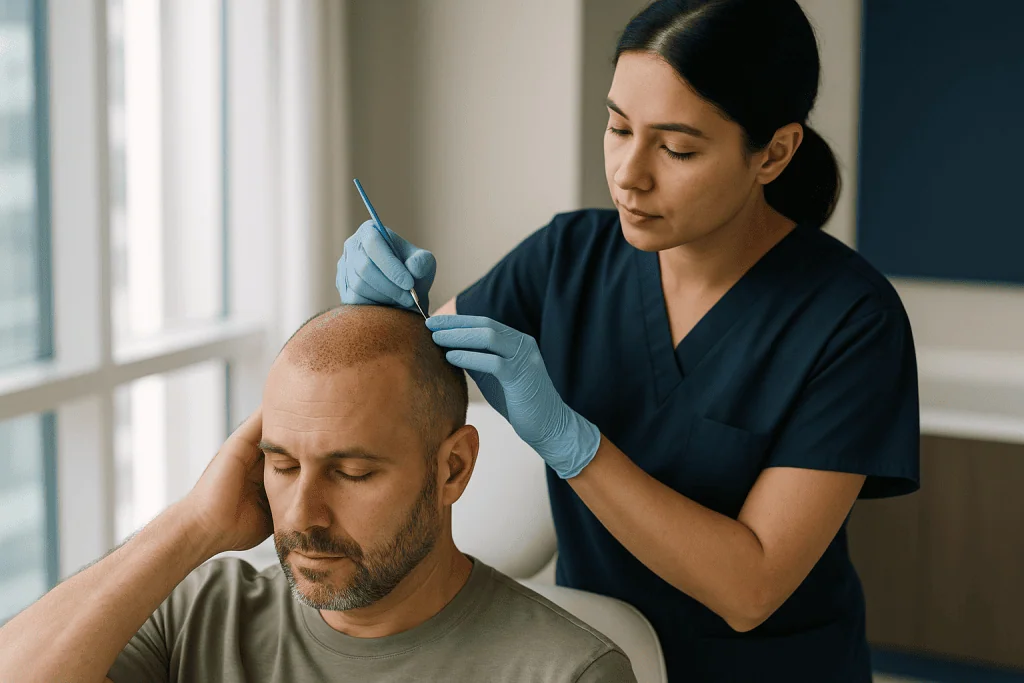
An FUE session usually unfolds in three phases. First, the donor area is trimmed short and numbed with local anesthetic, meaning an injected medicine that blocks pain in one region while you stay awake. A small circular punch frees each follicular unit, a natural grouping of one to four hairs, and it is lifted out with fine forceps. The units are then stored in a cool holding solution while the next phase begins.
Second comes channel creation. The surgeon opens a tiny slit for each graft in the recipient area, choosing angle, direction and depth to mimic how hair naturally lies. This is where the sapphire tip is used. The channels are so small that they will seal without stitches.
Third, each graft is placed into its channel. From that moment the follicle has no blood supply of its own. It survives on fluid seeping from surrounding tissue until new capillaries grow into it over the following days. This early window, when the graft is held in place mainly by the snug fit of the channel and a small clot, is the reason every recovery sheet is so protective about the first week.
The NHS notes that the procedure can take a full day depending on how many grafts are moved, and that people go home the same day with the donor area dressed.
What channel closure means, and why it decides your hat date
Channel closure is a surgeon’s phrase, not a textbook one, but it maps neatly onto ordinary wound biology. When the skin is cut, the body works through overlapping stages that MedlinePlus lays out in plain language: bleeding stops as platelets form a clot, the area becomes red and slightly swollen as immune cells clear debris, new tissue and small blood vessels fill the gap, and finally the surface re-covers with skin cells.
For a recipient channel, which is only a couple of millimeters wide and shallow, these stages run quickly. The clot forms within minutes and is what people later see as a crust around each graft. Over the following days skin cells migrate across the tiny opening. Once that surface layer has re-formed, the channel is effectively closed: the graft is no longer sitting in an open wound but is embedded in skin that has knitted around it.
Two things follow from this. The first is that a closed channel is far less vulnerable to shear, the sideways rubbing force that a hat brim or a pillowcase can apply. Before closure, shear can lift a graft. After closure, it mostly cannot. The second is that closure is a process, not a switch. Skin that has just re-covered is thin and easily abraded. Deeper remodeling of collagen, the protein that gives skin its strength, continues for weeks.
That is why most instruction sheets separate two hat milestones. The earlier one, around the end of the first week, is for a loose hat that does not touch or barely touches the grafted area. The later one, several weeks out, is for anything with pressure or friction: fitted caps, helmets, headbands. Both are typical ranges rather than rules, and the surgeon who saw your scalp and knows how densely it was grafted sets the actual day.
Sapphire hair transplant healing timeline: the first fourteen days at a glance
Healing sheets from different teams differ in wording but agree on shape. What follows is a typical pattern drawn from NHS and MedlinePlus descriptions of hair transplant recovery and general wound healing. Your own experience may run a little faster or slower.
| Window | What is usually happening | Hats and handling |
|---|---|---|
| Day 0 to 2 | Clots form around each graft; recipient area is pink and may be swollen. Donor dressing often removed within a day or two. | No hat on the grafts. Sleep with head raised. Avoid touching. |
| Day 3 to 5 | Crusts harden and darken. Swelling may drift toward the forehead or eyes. Gentle washing usually begins per the surgeon’s method. | Still no pressure on grafted zone; some teams permit a very loose covering held away from the skin. |
| Day 6 to 10 | Surface skin re-covers channels. Crusts loosen with washing. Redness fades in the donor area. | Loose, clean, breathable hat commonly allowed toward the end of this window. |
| Day 11 to 14 | Most crusts gone. Grafts are anchored. Scalp may itch or feel tight. | Loose hats fine; tight or rigid headwear still generally deferred. |
The NHS describes tenderness for a few days and a return to most normal activities within about three days for many people, with strenuous exercise deferred longer. MedlinePlus notes that the scalp may be sore and that most people can return to work within days.
Two features of this table deserve emphasis. Swelling that migrates downward toward the brow around day three or four alarms people but is expected; fluid follows gravity. And itching in week two is usually a sign of healing skin rather than a problem, though scratching is the one thing to resist.
When to wear a hat after FUE, and which hat is safe
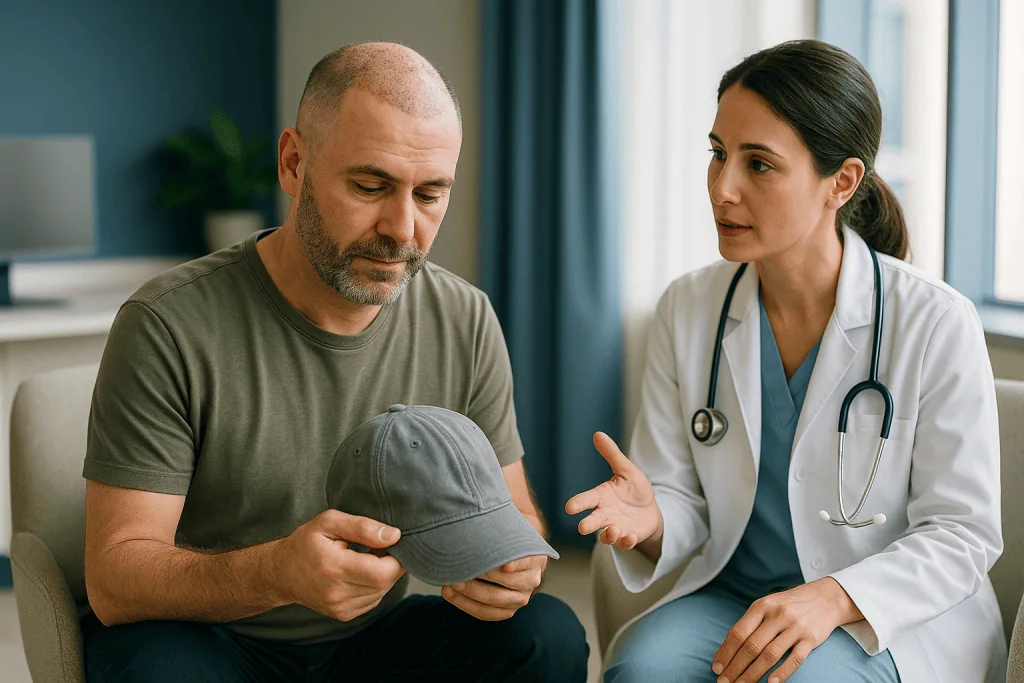
Here is the practical answer most people are looking for. In the sapphire hair transplant healing timeline, the window in which a loose hat becomes acceptable typically opens around day 7 to 10, in line with the surface re-covering of small wounds described by MedlinePlus. Before that, a hat risks lifting grafts that are held only by clot and channel fit. After it, the main risks shift from dislodgement to abrasion and infection.
Not all hats are equal. Think in terms of three questions: does it press, does it rub, and does it breathe?
- Pressure: a fitted baseball cap, a beanie that stretches over the crown, or anything with an internal band that sits on grafted skin applies steady force. These are usually deferred until roughly week 3 or 4, when collagen remodeling has given the skin more resilience.
- Friction: a hat that slides as you move creates shear. A bucket hat or a loose, wide-fit cap that sits high and stays still is usually preferred in the early window.
- Breathability: sweat and warmth soften crusts and can encourage bacterial growth. Light cotton or linen is generally favored over synthetics or wool.
How you put the hat on matters as much as which one. Lower it straight down from above rather than pulling it forward over the hairline, and lift it straight up to remove. Do not adjust it repeatedly through the day. If you can feel it touching the grafts, it is too snug.
Helmets, hard hats and headphones with a band across the crown fall in the pressure category and are commonly held off for several weeks. If your work requires one, raise this at the pre-operative visit so the team can plan time off or a temporary alternative. The decision, and the exact day, rests with them.
Hair transplant scabs falling off: what crust shedding really is
Around each graft a small crust forms within the first day. It is made of dried blood, tissue fluid and skin cells, and it does two useful jobs: it seals the channel against bacteria and it holds the graft steady while blood vessels grow in. People often call the crusts scabs, and that is close enough, though they are smaller and more uniform than the scab on a scraped knee.
Crusts are meant to fall off. The question is when and how. If they are pulled early, they can take the graft with them, because in the first days the crust and the top of the graft are bound together. If they are left far too long, they can trap moisture and debris. Most teams therefore introduce gentle washing within the first few days and let the crusts soften and release on their own schedule. The NHS advises following the specific washing instructions given after surgery rather than improvising.
A typical washing method involves a mild shampoo diluted in water, applied by pouring or dabbing rather than rubbing, left briefly, then rinsed with low-pressure water. As the days pass, the crusts turn from dark red to brown to a lighter flake, and begin to lift. Some come away in the rinse water; others fall onto the pillow. Seeing a short hair attached to a fallen crust does not mean the graft is lost. The hair shaft frequently detaches from the follicle while the follicle itself stays put, and this same shedding is expected in the weeks that follow anyway.
By around the end of the second week most crusts have gone, leaving a pink scalp with short stubble. If crusts remain much beyond that, or if any area looks moist, yellow or increasingly red rather than fading, that is a reason to contact the team rather than to scrub harder.
Can you dislodge grafts after 10 days? What the healing biology suggests
This is one of the most searched questions in recovery, and it deserves a careful answer rather than a reassuring one-liner. The short version: by day 10, grafts in a normally healing scalp are anchored and ordinary contact is very unlikely to move them. The longer version has some nuance.
Anchoring happens in stages. In the first hours the graft is held by friction and clot. Over the first few days fibrin, the protein mesh of a clot, and early tissue growth bind it more firmly. Within about a week the surface has re-covered, as MedlinePlus describes for small wounds, and the graft is effectively part of the skin. Surgeons often quote a window of roughly 7 to 10 days as the point after which grafts are considered secure, and that figure is consistent with the general timeline of epithelial closure, though the specific studies behind it are small.
What that does not mean is that anything goes. A forceful blow to the head, aggressive scratching that tears healing skin, or picking a crust that has not yet loosened can still cause bleeding and damage a follicle even after day 10. The risk has shifted from dislodgement to injury. Sunburn is another late hazard; new skin over the channels is thin and burns easily, which is one more argument for a hat once the team clears it.
There is also individual variation. People who heal slowly because of a medical condition, smoking, or poor nutrition may need a longer protective window. Recipient areas grafted very densely may be more fragile for slightly longer. This is why a written instruction sheet from your surgeon outranks any general timeline, including this one. If your sheet says two weeks of caution, follow the sheet.
Who a sapphire FUE transplant is usually for, and who is usually asked to wait
A hair transplant redistributes hair; it does not create new follicles. That single fact shapes who is offered the procedure. The NHS and Mayo Clinic describe the typical candidate as an adult with stable, patterned hair loss, enough healthy donor hair at the back and sides to cover the thinning area, and realistic expectations about density.
People who are usually asked to wait, or to consider other options first, include:
- Those whose hair loss is still actively progressing at a young age, because transplanted hair may end up isolated as surrounding native hair continues to thin.
- Those with limited donor supply, since the donor zone is finite and over-harvesting leaves visible thinning at the back.
- Those with hair loss from an untreated medical cause, such as a thyroid disorder, iron deficiency or an inflammatory scalp condition. Mayo Clinic notes that the cause of hair loss should be established before treatment is chosen.
- Those with scarring alopecias, a group of conditions in which inflammation destroys follicles; transplanting into active disease can fail.
- Those with bleeding disorders, uncontrolled diabetes or other conditions that impair healing, until these are managed.
Diffuse thinning across the whole scalp, common in some women, is another situation where a transplant may not be the first suggestion, because the usual donor area may itself be affected.
The sapphire blade does not change any of this. Candidacy is about the pattern, stability and cause of hair loss, and about the health of the person, not about the tool used to open channels. A thorough consultation should include a scalp examination, a review of medical history and medicines, and sometimes blood tests. If that step is skipped, it is reasonable to ask why.
Weeks three to twelve and beyond: shedding, the quiet phase and first growth
Once the crusts are gone and hats are back in rotation, a new phase begins that catches many people off guard. The transplanted hairs fall out. The NHS describes this as normal, typically starting around two to three weeks after surgery, and MedlinePlus notes that most transplanted hair sheds within the first weeks. The follicle beneath is not lost; it has been jolted into a resting phase by the trauma of being moved, and it sheds its old shaft before producing a new one.
Some people also notice thinning of their existing hair around the grafted area, a phenomenon called shock loss. This is the same resting-phase response affecting native follicles disturbed by the surgery. It is usually temporary, though it can be unsettling to look thinner in month two than you did in month one.
Months two and three are often the quietest and most discouraging. The scalp looks much as it did before surgery. Redness in the recipient area gradually fades, though people with fair skin may notice a pink tinge persisting for a while. Patience here is not a platitude; it is the schedule of the hair cycle.
New growth typically becomes visible from around three to four months, according to MedlinePlus, emerging first as fine, sometimes lighter hairs that thicken with subsequent cycles. The NHS advises that the fuller result of a transplant takes many months to appear, and most teams describe assessing the outcome at around a year, with texture and density continuing to mature after that.
Through all of this, hats are no longer a healing issue. The only reasons to keep one handy are sun protection for a scalp with less coverage than before, and personal preference during the quiet phase.
Sapphire FUE vs DHI vs steel-blade FUE: what the evidence actually shows
Marketing around hair surgery leans heavily on technique names, so it helps to separate what is different from what is claimed. Standard FUE opens channels with a fine steel blade, then places grafts in a second step. Sapphire FUE is identical except that the blade tip is sapphire. DHI, short for direct hair implantation, uses a pen-shaped implanter that opens the channel and places the graft in one motion, so channel creation and placement are combined.
The theoretical advantages put forward for sapphire tips are a sharper edge that dulls less over a long session, smoother channel walls, and the ability to make slightly narrower, more closely spaced slits. For DHI, the claim is reduced time that the graft spends outside the body and more control over angle.
What does the published evidence say? Not a great deal, and that is the honest summary. Mainstream patient resources from the NHS, Mayo Clinic and MedlinePlus describe FUE and strip harvesting as the two established approaches and do not single out sapphire or implanter-pen variants as superior. Comparative studies of blade material are few, small, and often authored by people with a commercial interest. Claims that sapphire reduces crusting, shortens the healing timeline or improves graft survival are plausible but not established by high-quality trials. A reasonable position is that sapphire is a legitimate tool choice, not a different operation, and that healing follows the same biology.
What consistently matters more than the blade is the surgeon’s skill in extracting intact follicles, the time grafts spend outside the body, careful handling, appropriate density, and the health of the recipient scalp. When choosing a technique, asking about those factors will tell you more than the name on the brochure.
What people often get wrong about success rates, celebrities and healing
Recovery forums are full of confident statements that do not hold up. A few deserve direct correction.
“Sapphire transplants have a 98 percent success rate.” No major guideline or independent systematic review supports a specific survival figure for sapphire FUE, and the term success is rarely defined. Graft survival, patient satisfaction and visible density are different measures, and results depend on the surgeon, the donor quality and the pattern of ongoing hair loss. Treat any precise percentage on a promotional page as unverified.
“A famous entrepreneur regrew his hair with a secret method.” Speculation about a well-known tech founder’s hairline circulates constantly. No treatment regimen has been publicly confirmed, and even if it were, one person’s outcome says nothing about yours. The established options for pattern hair loss, as Mayo Clinic outlines, are medicines that act on the hair cycle, surgery that relocates follicles, and camouflage. There is no hidden fourth category.
“Once the scabs are off, healing is finished.” Crust shedding marks surface closure, not the end of recovery. Skin strength keeps building for weeks, and the hair cycle takes months to show the result.
“Wearing a hat causes hair loss.” Ordinary hat-wearing does not cause pattern baldness. The reason to delay hats after surgery is purely mechanical protection of fresh grafts.
“If a hair falls out with a crust, that graft is dead.” The shaft often separates from the follicle while the follicle stays. Shedding of transplanted shafts in the first weeks is expected, as the NHS notes.
“More grafts always means a better result.” Donor hair is finite. Over-harvesting thins the back of the head permanently, and packing grafts too densely can compromise their blood supply. A conservative, well-planned session often ages better than an ambitious one.
Medicines sometimes discussed alongside a transplant, and what they do
Because a transplant moves hair rather than stopping loss, surgeons often talk with people about medical treatment for the native hair that remains. Two classes come up repeatedly, and it helps to understand their mechanisms without treating this as a recommendation. Whether either is appropriate for you, and when to start or stop around surgery, is a decision for the prescribing clinician.
The first is a topical vasodilator, minoxidil, applied to the scalp. Its exact mechanism in hair is not fully understood, but it appears to prolong the growth phase of the hair cycle and enlarge shrunken follicles. Mayo Clinic notes that it typically takes several months of use before any effect is visible, and that shedding may temporarily increase when it is first started as follicles reset. Some surgeons ask people to pause it around the operation and resume once the scalp has healed, because the liquid or foam can irritate fresh wounds.
The second is an oral 5-alpha-reductase inhibitor, finasteride, which lowers the level of the hormone dihydrotestosterone that miniaturizes genetically sensitive follicles. It is intended for men, and Mayo Clinic describes a similar multi-month timeline before results appear, along with potential side effects that should be discussed with a doctor. It does not affect the transplant itself but may help protect surrounding native hair.
Other approaches, including platelet-rich plasma injections and low-level laser devices, are marketed widely. The evidence for them is mixed and of variable quality; mainstream resources describe them as under study rather than established.
Around the surgery itself, teams may prescribe a short course of pain relief, an antibiotic, or a medicine to limit swelling. Take these exactly as directed by the team, and tell them about every medicine and supplement you already use, since some affect bleeding or healing.
Questions to ask your care team before and after a sapphire FUE transplant
A good consultation leaves you with a written plan and no surprises in week one. These questions help surface the details that matter most for healing and for the hat timeline.
- What is the cause of my hair loss, and is it stable enough for surgery now? If tests are needed to rule out medical causes, which ones?
- How many grafts do you plan, where will they be placed, and how much donor hair will remain for the future?
- Who will perform each step: extraction, channel creation and placement? What is their training?
- What exactly does the first wash involve, and on which day? Can you show me the method before I leave?
- On what day can I wear a loose hat, and on what day a fitted one or a helmet? What should I do if my job requires head protection?
- How should I sleep, and for how many nights? What about sweating, showers and exercise?
- What will the crusts look like as they shed, and what would look wrong?
- Which medicines should I pause before surgery and when should I resume them?
- How do I reach someone after hours if I see bleeding, swelling or signs of infection?
- When are the follow-up visits, and how will you assess the result at the one-year mark?
Notice that none of these questions are about the blade. Sapphire versus steel is a small variable in a process dominated by planning, technique and aftercare. A team that answers these ten questions clearly, in writing, and without pressure to decide on the spot is giving you the information that actually predicts a smooth recovery.
When to call your doctor after a sapphire hair transplant
Most recoveries are uneventful: some tenderness for a few days, swelling that comes and goes, crusts that shed on schedule, itching in week two. A small number of people develop complications, and early contact with the surgical team makes them easier to manage. The NHS and Cleveland Clinic list infection, bleeding, swelling, numbness, folliculitis and poor graft growth among recognized risks of hair transplantation.
Contact your team the same day if you notice:
- Bleeding from the donor or recipient area that does not stop with several minutes of gentle, steady pressure.
- Increasing redness, warmth or pain in any area after day three, rather than gradual improvement.
- Yellow or green discharge, a foul smell, or crusts that look wet and spreading rather than drying and shrinking.
- Fever, chills or feeling generally unwell.
- Swelling that worsens after day five, closes an eye, or is accompanied by difficulty seeing.
- Clusters of small pus-filled bumps around hairs, which may indicate folliculitis, an infection of the follicle.
- A patch of skin that turns dusky, gray or black, which can signal compromised blood supply.
- Severe or worsening headache, or numbness that spreads rather than slowly resolving.
Seek emergency care immediately for signs of a serious allergic reaction, such as swelling of the lips or tongue, wheezing, or difficulty breathing, or for heavy bleeding that soaks through dressings.
Less urgent but still worth a call: crusts that have not begun to loosen by the end of the second week, persistent numbness of the donor area beyond a couple of months, or areas where no new growth appears by the time surrounding grafts have started to sprout. None of these are emergencies, but each is a reason for the team to look rather than for you to guess. Every decision about treatment, including whether anything needs to change, sits with the clinicians who performed the procedure.
Frequently asked questions
When can I wear a hat after an FUE hair transplant?
A loose, clean, breathable hat is commonly allowed about 7 to 10 days after surgery, once the surface of each recipient channel has re-covered with skin. Fitted caps, helmets and anything that presses or rubs on the grafts are usually deferred for around 2 to 4 weeks. Your surgeon’s written instructions override any general timeline, because graft density and individual healing vary.
Can you dislodge grafts after 10 days?
It is very unlikely in a normally healing scalp. By about day 10 grafts are anchored by new tissue and the channels have sealed at the surface. The risk after that point shifts from dislodgement to injury: aggressive scratching, a direct blow, or picking an unloosened crust can still cause bleeding and damage a follicle. People who heal slowly may be advised a longer cautious period.
When do hair transplant scabs fall off?
Crusts usually begin loosening once gentle washing starts, typically within the first few days, and most have shed by around the end of the second week. They turn from dark red to brown to a light flake before releasing. Crusts that remain wet, spread, or persist well beyond two weeks are a reason to contact your team rather than to scrub harder.
Is sapphire FUE better than DHI?
There is no high-quality evidence that one is superior. Sapphire FUE uses a sapphire-tipped blade to open channels before graft placement; DHI uses an implanter pen that opens and places in one motion. Both are variations of follicular unit extraction. Mainstream resources do not rank them, and outcomes depend far more on surgeon skill, graft handling and planning than on the instrument.
What is the success rate of a sapphire hair transplant?
No major guideline or independent systematic review publishes a specific success rate for sapphire FUE, and the word success is rarely defined in promotional figures. Graft survival, visible density and patient satisfaction are separate measures that depend on donor quality, technique and ongoing hair loss. Treat precise percentages on marketing pages as unverified, and ask your surgeon how they assess outcomes.
What did a famous entrepreneur use to regrow hair?
No treatment has been publicly confirmed, and speculation about any celebrity’s hairline is just that. The established options for pattern hair loss are medicines that act on the hair cycle, surgery that relocates follicles, and camouflage products. One well-known person’s apparent result tells you nothing about which approach, if any, is appropriate for your scalp and history.
Why is my transplanted hair falling out after three weeks?
This is expected. Moving a follicle pushes it into a resting phase, so it sheds its old shaft before growing a new one. The NHS describes this shedding as normal, usually starting two to three weeks after surgery. Nearby native hair may also thin temporarily, a phenomenon called shock loss. New growth typically becomes visible from around three to four months.
How should I sleep after a sapphire hair transplant?
Most teams advise sleeping with the head raised on extra pillows or in a recliner for the first several nights to limit swelling, and positioning yourself so the grafted area does not rub on the pillow. Some suggest a travel pillow to stabilize the neck. Follow your own surgeon’s instructions on duration, which often span the first week.
Does wearing a hat cause hair loss?
Ordinary hat-wearing does not cause pattern hair loss, which is driven by genetics and hormones acting on sensitive follicles. The reason hats are restricted after a transplant is mechanical: pressure and friction can lift fresh grafts or abrade newly healed skin. Once the team clears headwear, a hat is actually useful for shielding the thin new skin from sunburn.
How long does the full sapphire hair transplant healing timeline take?
Surface healing is quick: tenderness eases within days, crusts shed within about two weeks, and grafts are anchored by roughly day 10. The visible result takes far longer because of the hair cycle. Shedding occurs at two to three weeks, the scalp looks quiet through months two and three, growth appears from around three to four months, and most teams assess the outcome at about a year.
References
This article is for general information only and is not a substitute for professional medical advice. Please consult a qualified doctor about your individual situation.

More from the Blog
Questions to Ask Before Robotic Hair Surgery: Who Places the Grafts and How Results Are Checked
Before robotic hair surgery, ask who performs each stage: the robot usually harvests follicular units, but a surgeon or trained technicians still make recipient…
Why the Cause of Hair Loss Sets the Plan: Tests Before Non-Surgical Hair Restoration
Before non-surgical hair restoration, clinicians usually confirm the cause first: a history and scalp examination, a gentle pull test, magnified scalp imaging (trichoscopy), and…
Who Is a Candidate for Laser Hair Therapy? Early Thinning vs Long-Standing Bald Areas
A laser hair therapy candidate is usually an adult with early to moderate hereditary (pattern) thinning, where follicles have shrunk but are still alive,…
How Scalp Micropigmentation Is Done: Pigment Dots, Session Spacing and Matching Your Hair Shade
Scalp micropigmentation is a cosmetic tattooing technique in which a trained practitioner deposits thousands of tiny pigment dots into the upper layer of the…
Hair Transplant Repair for International Patients: Photo Review, Staged Sessions and Follow-Up
Hair transplant repair for international patients usually begins with a remote photo review, followed by an in-person examination that checks the donor area, scar…
Hair Transplants for a Receding Hairline: Timing, Design and Realistic Density
A hair transplant can restore a receding hairline by moving follicles from the back of the scalp, where hair is genetically resistant to balding,…