

When Does a Febrile Seizure Lead to Pediatric Neurology Follow-Up? Simple vs Complex Events
Key Takeaways
- Febrile seizures occur in roughly 2 to 5 percent of children, most often between 6 months and 5 years, and the vast majority are simple events that stop within minutes.
- A seizure becomes complex, and neurology referral is usually considered, if it is focal, lasts 15 minutes or longer, or recurs within 24 hours.
- EEG and brain imaging are not recommended after a simple febrile seizure in a child who has recovered normally, because they rarely change management.
- About one in three children will have another febrile seizure, with the highest recurrence risk in those under 18 months at the first event or with a family history.
- Epilepsy risk after a simple febrile seizure is about 2 percent, close to the general population; complex features and developmental concerns raise it but still leave most children seizure-free.
- Fever-reducing medicines improve comfort but have not been shown to prevent febrile seizures, so a recurrence is not a sign that a fever was managed badly.
A simple febrile seizure, meaning a brief generalized convulsion during fever in a child roughly 6 months to 5 years old that does not recur within 24 hours, does not usually need pediatric neurology follow-up. Referral is typically considered when the event is complex: focal, lasting longer than 15 minutes, repeating within a day, or occurring in a child with developmental concerns, an unusual age, or a family history of epilepsy.
It is a little after two in the morning. A toddler who went to bed warm and grumpy is suddenly stiff, then jerking, eyes rolled back, lips faintly blue. Her father counts the seconds out loud because someone once told him to. It stops before he reaches ninety. By the time the ambulance arrives she is limp, sleepy, and breathing normally, and he feels like he has aged a decade.
A few hours later an emergency physician says the words nobody in the family has heard before: simple febrile seizure. Then comes the part that unsettles many parents even more than the seizure itself. No scan, no brain-wave test, no specialist appointment. Go home, treat the ear infection, watch her.
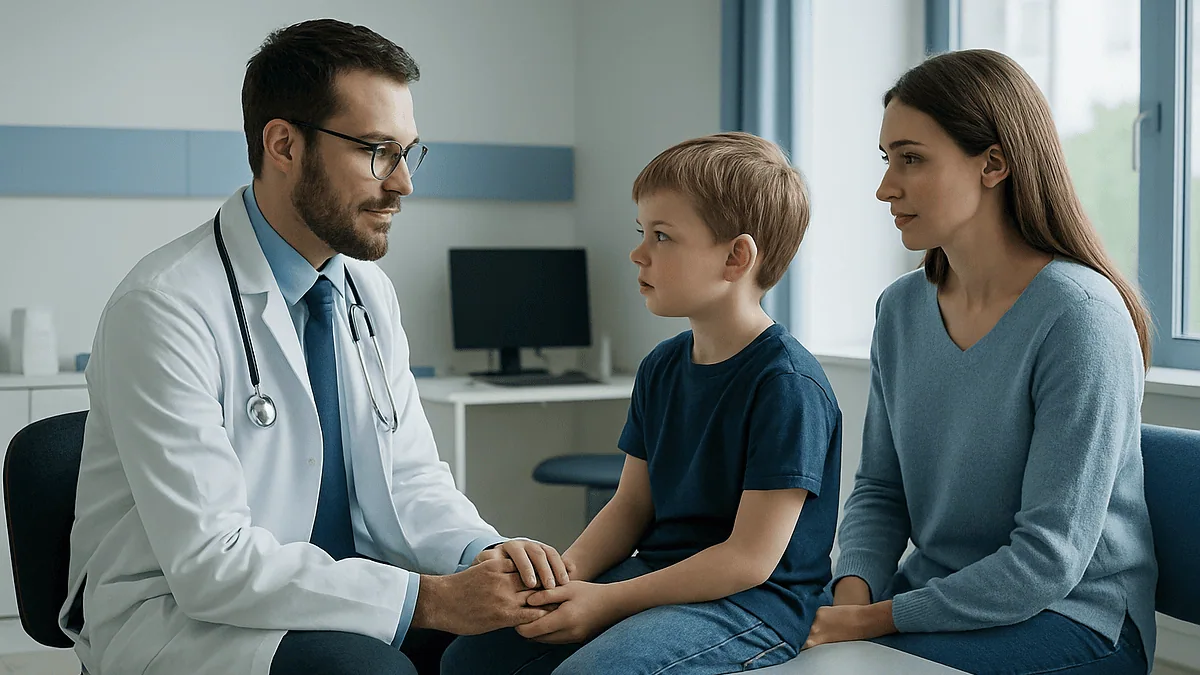
That is often the right call, and this article explains why. It also lays out the specific features that do turn a febrile seizure neurology referral from optional into expected, so you understand which side of the line your child is on and what the follow-up actually involves.
What actually happens in a child's brain during a febrile seizure
A seizure is a burst of abnormal, synchronized electrical activity in the brain that temporarily overrides normal function. A febrile seizure is one that happens during a fever, usually 100.4°F (38°C) or higher, in a child who has no infection of the brain itself and no history of seizures without fever. The National Institute of Neurological Disorders and Stroke (NINDS) puts the frequency at roughly 2 to 5 percent of children, most often between 6 months and 5 years, with a peak in the second year of life.
Why does fever do this to some young children and not others? The honest answer is that the mechanism is only partly mapped. A developing brain has a lower threshold for runaway electrical firing than an adult brain. Fever adds two extra nudges: the rise in temperature itself, and the inflammatory chemical messengers (cytokines) the immune system releases while fighting the infection, which appear to make neurons more excitable. Genes matter too. Children whose parents or siblings had febrile seizures are more likely to have them, which is why the family history question comes early in any evaluation.
Most febrile seizures are generalized tonic-clonic events: the body stiffens (tonic), then jerks rhythmically (clonic), and the child is unresponsive throughout. According to Mayo Clinic, the majority last only a few minutes and stop on their own. Afterward comes the postictal phase, a period of deep drowsiness or confusion as the brain resets. That sleepiness alarms parents, but it is the expected aftermath of the electrical storm, not a sign of ongoing damage. What matters clinically is that the child gradually wakes up and behaves like herself again.
Simple vs complex febrile seizure: the definitions that drive every decision
The single most useful thing a parent can understand is how clinicians split febrile seizures into two groups, because that split shapes almost every downstream choice, from blood tests to specialist referral. The categories are not about how frightening the seizure looked; they rest on three observable features.

| Feature | Simple febrile seizure | Complex febrile seizure |
|---|---|---|
| Type of movement | Generalized, whole body, both sides | Focal: one side, one limb, or eyes pulled to one side |
| Duration | Under 15 minutes (most under 5) | 15 minutes or longer |
| Recurrence | Once in a 24-hour period | More than once within 24 hours |
| Recovery | Back to baseline within a typical postictal period | Recovery may be slower, or weakness on one side may linger |
| Usual neurology follow-up | Not routinely needed | Often considered, especially with other risk factors |
A child needs only one complex feature to be placed in the complex group. Roughly four out of five febrile seizures are simple, based on the pattern described by NINDS and Cleveland Clinic, which is why so many families leave the emergency department with reassurance rather than appointments.
Two terms sit at the far end of the complex category. Febrile status epilepticus describes a febrile seizure, or a cluster without full recovery between, lasting 30 minutes or more. Focal, or partial, means the electrical activity began in one region of the brain rather than everywhere at once. Both push clinicians to look harder, because they are the features most associated with a later diagnosis of epilepsy or with an underlying cause that deserves its own evaluation.
Is a febrile seizure a neurological condition?
Strictly speaking, yes: it is a neurological event, because it originates in the brain. But the question people are really asking is whether it means their child has a neurological disease, and here the evidence is reassuring. A febrile seizure is classified as a provoked seizure. The fever is the trigger, and when the fever goes, so does the tendency. Epilepsy, by contrast, is defined by a tendency to have seizures that are unprovoked, meaning they arrive without a fever, injury, or other identifiable cause.
The NHS describes febrile seizures as common and, for most children, harmless in the long run. NINDS is more specific: there is no evidence that simple febrile seizures cause brain damage, lower intelligence, or impair learning. Large follow-up studies of children who had febrile seizures have not found differences in school performance or behavior compared with siblings who never had one. That is a genuinely different picture from epilepsy, where the underlying brain tendency persists and often needs long-term management.
So why do neurologists get involved at all? Because a small minority of febrile seizures are the first visible sign of something that will need attention. A child with a focal febrile seizure, or one who has developmental delays, may have a brain that is more vulnerable to seizures in general. A very prolonged febrile seizure in an infant occasionally turns out to be the opening chapter of a genetic epilepsy syndrome. The referral exists to catch that minority early, not because a febrile seizure by itself is a diagnosis of neurological illness.
Put plainly: a febrile seizure is something the nervous system does, not usually something wrong with it.
Febrile seizure neurology referral: who is usually referred, and who is usually asked to wait
Guideline-level practice across major health systems, including the NHS and the frameworks summarized by NINDS and Mayo Clinic, is consistent on the central point: a first simple febrile seizure in an otherwise healthy child within the typical age range does not, on its own, warrant a referral to pediatric neurology. The emergency clinician or family doctor looks for the source of the fever, confirms the child has recovered, and educates the family.
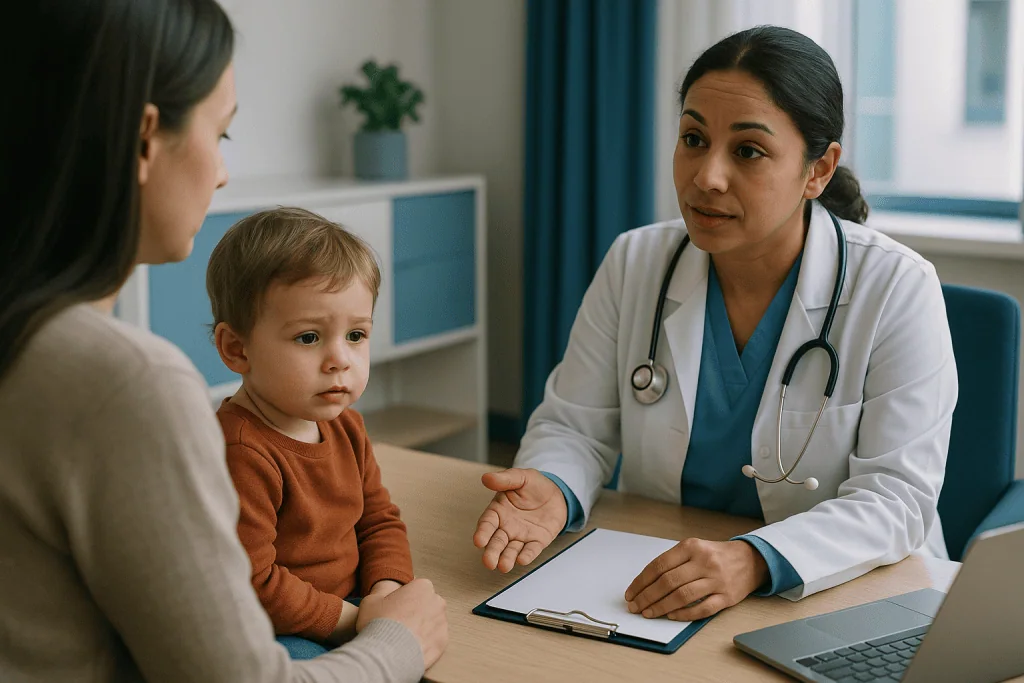
Referral is generally considered when one or more of the following apply:
- Any complex feature: focal movements, duration of 15 minutes or more, or recurrence within 24 hours.
- Febrile status epilepticus, the 30-minute-plus event.
- Age outside the usual window, particularly a first febrile seizure before 6 months or after about 6 years.
- Pre-existing developmental delay, cerebral palsy, or a known neurological condition.
- Persisting weakness on one side, unusual drowsiness, or any abnormality on the neurological exam after the child should have recovered.
- A first-degree family history of epilepsy, as opposed to febrile seizures alone.
- Any seizure that has happened without fever.
- Several recurrences, especially when they are becoming longer or more frequent.
Who is usually asked to wait? The child who fits the classic profile: aged 1 to 3, a single generalized seizure under 5 minutes, fully back to normal within the hour, a clear infectious cause, normal development, and no red flags on examination. Waiting is not neglect. It reflects decades of follow-up data showing that this child is very unlikely to benefit from testing or specialist review and is exposed to the anxiety and false-positive findings that come with tests done without a clear question to answer.
A middle group exists, and honesty requires acknowledging it. A child with a simple seizure but a strong family history, or a second simple seizure in a few months, may be referred in one hospital and reassured in another. Both approaches sit within accepted practice. The decision belongs to the treating team, who weigh the individual child, the family’s history, and what the examination shows.
What the emergency evaluation usually involves
The emergency assessment after a febrile seizure has one dominant goal that surprises many parents: it is aimed at the fever, not the brain. The clinician wants to know what infection caused the temperature, and above all to rule out meningitis, an infection of the membranes around the brain that can itself cause seizures and requires urgent treatment.
Expect a careful history. How long did it last, what did the movements look like, was it one side or both, how quickly did she wake, had she been unwell for hours or days, is she up to date on vaccines, and does anyone in the family have seizures? Expect a thorough examination, including ears, throat, chest, skin, and a check of the neck and the soft spot on an infant’s head.
Blood tests are not automatic. Mayo Clinic and Cleveland Clinic both note that laboratory work is ordered to investigate the fever’s source, not the seizure itself. A blood sugar check may be done because low glucose can provoke seizures. A urine test is common in young children because urinary infections are a frequent, hidden cause of fever.
A lumbar puncture, meaning a needle placed in the lower back to sample the fluid around the spinal cord, is considered rather than routine. It is more likely in infants under 12 months, in children who have not completed their early vaccinations, in those already taking antibiotics that could mask meningitis, and whenever the child looks ill or has neck stiffness or a rash.
What is usually not done? An electroencephalogram (EEG), the test that records the brain’s electrical rhythms through scalp sensors, and brain imaging such as CT or MRI. Neither is recommended after a simple febrile seizure, because in a child who has recovered normally they rarely change management and can produce incidental findings that lead nowhere useful.
Complex febrile seizure follow up: what the pediatric neurology visit involves
When a referral is made, the appointment is typically outpatient and calmer than the emergency department. A pediatric neurologist is a doctor trained in disorders of the nervous system in children. Much of the visit is conversation: a minute-by-minute reconstruction of the seizure, the child’s developmental milestones, birth history, past illnesses, and a family tree that goes beyond parents to grandparents, aunts, and cousins.
The examination looks for subtle asymmetries in strength, reflexes, coordination, and tone, and for developmental signs appropriate to the child’s age. In a toddler this often looks like play: stacking blocks, walking across the room, reaching for a toy with each hand.
Testing depends on what that conversation and exam reveal. An EEG is more likely after focal or prolonged seizures, or when the neurologist suspects the febrile event may have unmasked a broader seizure tendency. It is painless, takes about an hour including setup, and is often more informative when the child is sleepy or asleep. A normal EEG does not rule out future seizures, and an abnormal one does not diagnose epilepsy on its own; it is one piece of evidence, weighed alongside everything else.
MRI, which uses magnetic fields rather than radiation to picture the brain’s structure, is considered when there are focal features, persistent weakness on one side, developmental concerns, or a neurological exam that is not fully normal. Young children usually need sedation to stay still, which is one reason it is reserved for cases where the result could genuinely alter the plan.
The neurologist’s output is often a risk conversation rather than a diagnosis: what this child’s pattern suggests about recurrence, whether any treatment plan is warranted, and what specific signs would prompt an earlier return visit.
Is it normal for a 7-year-old to have a febrile seizure?
It is uncommon, and that is precisely why it tends to prompt a closer look. NINDS places the typical age range for febrile seizures between 6 months and 5 years, and the NHS extends it to about 6 years. By the time a child is in second grade, the brain’s threshold for fever-triggered seizures has usually risen well past the point where an ordinary viral illness could tip it over.
A seizure with fever at 7 does not automatically mean something serious. Some children simply mature out of the tendency later than average, particularly if they had febrile seizures as toddlers and this is a late straggler. But a first-ever seizure during fever at that age sits outside the pattern, so clinicians ask a different set of questions. Was the fever really the cause, or did it coincide with a seizure that would have happened anyway? Could an infection have reached the brain itself? Is there a metabolic problem, an electrolyte disturbance from vomiting or diarrhea, or a medication effect?
For this reason, a first febrile seizure in an older child is one of the accepted triggers for a neurology referral even when the seizure itself was brief and generalized. The neurologist may recommend an EEG, since a seizure at this age is more likely to represent a genuine epilepsy tendency that fever merely revealed. Imaging is considered case by case.
The same logic applies at the other end. A febrile seizure before 6 months of age is also outside the typical window, and infants that young are far harder to assess for meningitis, so evaluation is more thorough and a lumbar puncture is more likely.
The reassuring point for parents of a school-age child: unusual is not the same as dangerous. It means the shortcut of calling it simple and moving on is not available, so the team does the fuller workup.
What is the rule of 3 for seizures? The numbers that actually matter
Search that phrase and you will find it applied to several different ideas, none of which appear in febrile seizure guidelines under that name. Some people use it to mean the three features that make a seizure complex: focal, prolonged, repeated. Others use it for the three-year peak age. A few confuse it with a supposed three-minute threshold for calling an ambulance. Because it means different things to different people, it is worth setting aside and replacing with the timing numbers that clinicians genuinely use.
- 5 minutes. The NHS advises calling emergency services if a seizure lasts longer than 5 minutes. This is the action threshold for parents. It is also roughly the point at which a seizure becomes less likely to stop on its own and clinicians begin considering medication to end it.
- 15 minutes. The dividing line between simple and complex. A seizure this long is a complex feature regardless of what the movements looked like.
- 24 hours. A second febrile seizure within a day of the first makes the episode complex, even if each individual seizure was short.
- 30 minutes. The definition of febrile status epilepticus, the longest and most closely evaluated category.
- 60 minutes. Roughly the window within which a child is expected to be waking and recognizing family. Drowsiness far beyond this, or a child who cannot be roused, needs urgent reassessment.
One practical instruction cuts through all of it: note the time the seizure starts. Parents consistently overestimate duration in the moment, and a seizure that felt like ten minutes was often under two. If you can, film it on a phone once the child is safely positioned. A short video is worth more to a neurologist than the most careful verbal description, because focal features such as head turning or one-sided jerking are easy to miss in the panic and impossible to recall accurately afterward.
What is the first-line treatment for a febrile seizure?
For the large majority of febrile seizures, the first-line treatment is not a medicine at all. It is safe positioning and a clock. The seizure ends on its own, usually within a few minutes according to Mayo Clinic, and the child’s job is simply to breathe safely while it runs its course.
The NHS first aid guidance is straightforward. Place the child on a soft surface on her side, so saliva or vomit drains away from the airway. Move hard objects out of reach. Do not restrain the movements, and never put anything in the mouth; the fear of tongue swallowing is a myth, and fingers or objects are far more likely to cause injury. Loosen tight clothing. Note the start time. Stay with her until she is awake, and call emergency services for a first seizure, for any seizure passing 5 minutes, or if she has trouble breathing or does not recover.
When a seizure does not stop, clinicians step in. The medicines used to end a prolonged seizure belong to the benzodiazepine class. They work by enhancing the effect of GABA, the brain’s main inhibitory chemical messenger, which dampens the excessive electrical firing. In a hospital they are typically given once the seizure has passed the 5-minute mark, with the route and amount decided entirely by the treating team. For a small number of children with a history of prolonged febrile seizures, a neurologist may discuss a rescue plan for use at home; whether that is appropriate, and how it would work, is a decision for the prescribing clinician, not something to infer from an article.
Two things are notably absent from first-line care. Fever-reducing medicines make a child more comfortable, but both the NHS and Mayo Clinic are explicit that they have not been shown to prevent febrile seizures. And daily anti-seizure medication is not used to prevent simple febrile seizures, because the side effects outweigh any benefit in a condition that children outgrow.
Febrile seizure epilepsy risk and recurrence: what the evidence actually shows
Two separate risks get blurred together in most parents’ minds. The first is recurrence, another febrile seizure with a future fever. The second is epilepsy, seizures without fever at all. They have different odds and different drivers.
Recurrence is common. The NHS estimates that about one in three children who have a febrile seizure will have another. Mayo Clinic identifies the factors that raise that chance: a first seizure before 18 months of age, a family history of febrile seizures, a relatively low temperature at the time of the seizure, and a short interval between the fever starting and the seizure. A child with none of these has a lower recurrence risk; a child with several may have a substantially higher one. Recurrences cluster in the year after the first event and taper off as the child grows.
Epilepsy risk is a different story. NINDS notes that most children who have febrile seizures never develop epilepsy. After a simple febrile seizure the risk is about 2 percent, only modestly above the roughly 1 percent seen in the general population. Complex features shift that figure upward. Focal seizures, prolonged seizures, multiple seizures in 24 hours, pre-existing developmental problems, and a family history of epilepsy each independently raise the risk, and children with several of these factors have been reported in some cohorts with risks approaching 10 percent or more.
The essential nuance, and the reason neurologists resist promising anything, is that these are population averages. They describe what happens across thousands of children, not what will happen to yours. A complex febrile seizure means a closer look and clearer instructions about what to watch for. It is not a prediction, and it is not a diagnosis. Even among children with elevated risk, the majority go on to have no further seizures of any kind.
What the following days and weeks usually look like
The first hour is the strangest. After the seizure most children sleep heavily or seem dazed, and then, sometimes abruptly, they surface: crying for a parent, asking for a drink, irritable but recognizable. That return to normal is the most reassuring sign a clinician can see, and it is why the emergency team may observe rather than test.
The first day is about the fever’s cause. If the source is an ear infection, a virus, or a urinary infection, that gets treated on its own merits. Many children are discharged the same day once they are alert and the source is identified. Some, particularly infants or children whose seizure was complex, are kept for observation overnight.
The first week is often harder on parents than on the child. Toddlers bounce back within a day or two; the adults lie awake listening to breathing. Sleep disruption and heightened anxiety are almost universal and worth naming to your family doctor, who sees this pattern constantly. A follow-up visit with the pediatrician or family physician within a few days is common practice, to confirm recovery, check the infection is resolving, and answer the questions that only occur to you after the adrenaline fades.
If a neurology referral was made, waiting times vary widely between health systems, and the appointment may be weeks away. That delay is usually acceptable for outpatient review because the assessment is about pattern and risk, not urgent treatment. Any new seizure, particularly one without fever, should be reported straight away rather than saved for the appointment.
The following months are the true test of the simple versus complex distinction. Fevers will come, because children get infections. Most will pass without incident. For the minority who have a recurrence, the plan is the same first aid, the same timing thresholds, and a lower bar for calling the doctor. Nearly all children, whichever category they started in, leave febrile seizures behind by school age.
What people often get wrong about febrile seizure neurology referral
Misconceptions cluster around this topic because the event is so terrifying and the medical response often seems so calm. Correcting them matters, because several lead parents to demand tests that will not help or to skip care that would.
No referral means the doctor did not take it seriously. The opposite is closer to the truth. Withholding an EEG and a scan after a simple febrile seizure is a deliberate, evidence-based choice, not an oversight. Tests without a clinical question generate incidental findings and anxiety, not answers.
Keeping the fever down will prevent the next one. The NHS and Mayo Clinic both state that fever-reducing medicine has not been shown to prevent febrile seizures. Treat a fever for comfort, and follow the label or your clinician’s guidance, but do not measure your success as a parent by the thermometer.
A febrile seizure damaged the brain. NINDS is unambiguous that simple febrile seizures do not cause brain damage or affect intelligence. Prolonged febrile status epilepticus is studied more cautiously, which is exactly why it triggers referral, but even there most children recover fully.
A complex seizure means epilepsy. It means a higher risk than the baseline, not a diagnosis. Most children with a complex febrile seizure never develop epilepsy.
The child needs daily seizure medicine to be safe. Preventive daily medication is not recommended for simple febrile seizures, and for complex ones it is a rare, individualized decision made by a neurologist weighing specific risks.
You should hold the child still or put something in the mouth. Both increase the chance of injury. Side-lying, a clear space, and a timer are the whole job.
A normal EEG proves it will never happen again. It cannot. The EEG samples an hour of brain activity; it is a snapshot, useful mainly for spotting patterns that suggest a broader seizure tendency, not a guarantee in either direction.
Questions to ask your care team
Emergency departments are noisy, and the moment when a clinician is explaining the plan is often the moment your child starts crying. Writing questions down in advance, or before a neurology appointment, changes the quality of the answers you take home.
- Was this classified as a simple or a complex febrile seizure, and which specific feature put it in that category?
- What was the source of the fever, and does that infection need its own follow-up?
- Did anything in the examination concern you, or was everything back to normal?
- Given my child’s age, family history, and this event, roughly how likely is another febrile seizure, and what would make you want to see us sooner?
- Is a neurology referral being made? If not, what would change your mind in the future?
- If a referral is made, what question are you hoping the neurologist will answer?
- Would an EEG or imaging be considered for my child, and if not, why not?
- What exactly should I do during another seizure, and at what point should I call emergency services?
- Are there any medicines my child is taking, or might be given for the current illness, that could affect seizure risk?
- Should nursery, school, or other caregivers be given a written plan?
- Who do I contact if I have questions next week, and is there a nurse line or clinic I can reach?
For the neurology visit specifically, bring the video if you have one, the discharge paperwork, a list of relatives with any seizure history, and a note of your child’s developmental milestones. Ask the neurologist to summarize the plan in one or two sentences before you leave, and ask what would prompt an earlier return. The best appointments end with a parent who knows what to watch for and what not to worry about, which is a more useful outcome than any single test result.
When to call your doctor
Most febrile seizures end quietly and need no more than a routine check. A short list of signs changes that calculation, and knowing them in advance is worth more than any reassurance.
Call emergency services immediately if:
- The seizure lasts longer than 5 minutes, or a second seizure starts before your child has fully recovered from the first.
- Your child has difficulty breathing, turns blue around the lips beyond the seizure itself, or does not start breathing normally once the jerking stops.
- The movements involve only one side of the body or one limb, or the eyes stay pulled to one side.
- Your child was injured during the seizure, particularly to the head.
- This is a first seizure, whatever its length; the NHS advises emergency care for any first episode.
Seek urgent same-day medical assessment if:
- Your child is not gradually waking within about an hour, cannot be roused, or seems confused far longer than expected.
- There is neck stiffness, a headache the child cannot tolerate light with, persistent vomiting, or a rash that does not fade when a glass is pressed against it. These can point to meningitis.
- In an infant, the soft spot on the head appears bulging or tense.
- One arm or leg seems weak or is not being used normally after recovery.
- Your child seems very unwell, unusually pale or mottled, or is not drinking or passing urine.
Contact your regular doctor within a day or two if:
- You were sent home without follow-up and want the classification and plan explained again.
- Your child has had a second febrile seizure in a separate illness.
- You notice any change in development, speech, or behavior in the weeks that follow.
- Any seizure has occurred without a fever, however brief; this always needs review.
None of these lists replaces the judgment of the team who examined your child. If you are frightened and unsure, that alone is a valid reason to call. Clinicians would far rather hear from a worried parent about a child who turns out to be fine than not hear about one who is not.
Frequently asked questions
Is a febrile seizure a neurological condition?
It is a neurological event but not usually a neurological disease. A febrile seizure is provoked by fever in a developing brain and, according to NINDS, simple febrile seizures do not cause brain damage or affect intelligence. Epilepsy, by contrast, involves unprovoked seizures. Only a small minority of febrile seizures, mostly complex ones, turn out to be an early sign of an underlying seizure tendency that needs specialist review.
What is the rule of 3 for seizures?
There is no formal rule of 3 in febrile seizure guidelines; the phrase is used loosely for different ideas. The numbers clinicians actually rely on are 5 minutes to call emergency services, 15 minutes as the line between simple and complex, 24 hours for recurrence counting as complex, and 30 minutes for febrile status epilepticus. Timing the seizure from its start is the most useful thing a parent can do.
What is the first-line treatment for a febrile seizure?
Safe first aid, not medicine, is first line for most febrile seizures because they stop on their own within minutes. Place the child on her side, clear the area, put nothing in the mouth, note the time, and call emergency services if it passes 5 minutes. Prolonged seizures are treated by clinicians with benzodiazepine-class medicines, with all decisions about their use resting with the treating team.
Is it normal for a 7-year-old to have a febrile seizure?
It is uncommon, since the typical age range is 6 months to about 5 or 6 years, and a first febrile seizure at 7 usually prompts a fuller evaluation including possible neurology referral. Unusual does not mean dangerous; some children outgrow the tendency later than average. Clinicians look more carefully because a seizure at this age is somewhat more likely to reflect a broader seizure tendency that fever revealed.
What is the difference between a simple vs complex febrile seizure?
A simple febrile seizure is generalized, lasts under 15 minutes, and happens once in 24 hours. A complex febrile seizure has at least one of three features: focal movements on one side, duration of 15 minutes or more, or recurrence within a day. Roughly four in five febrile seizures are simple. The distinction guides whether further testing or specialist follow-up is considered.
Is an EEG after a febrile seizure necessary?
Not after a simple febrile seizure in a child who recovers normally; major sources including Mayo Clinic and Cleveland Clinic note it is not routinely recommended. An EEG becomes more likely after focal or prolonged seizures, in older children, or when developmental concerns exist. Even then, a normal result does not rule out future seizures and an abnormal one does not by itself diagnose epilepsy.
What does complex febrile seizure follow up involve?
It usually means an outpatient visit with a pediatric neurologist who reconstructs the seizure in detail, reviews development and family history, and performs a neurological examination. Tests such as EEG or MRI are ordered only if the history or exam raises a specific question. The visit typically ends with a personalized risk discussion, clear instructions on what to watch for, and criteria for returning sooner.
How high is the febrile seizure epilepsy risk?
After a simple febrile seizure, about 2 percent of children later develop epilepsy, only slightly above the roughly 1 percent seen in the general population, according to NINDS. Complex features, developmental delay, and a family history of epilepsy each raise that figure, and children with several risk factors have been reported with risks approaching 10 percent. Even in higher-risk groups, most children never have an unprovoked seizure.
Will another fever cause another seizure?
Possibly, but not usually. The NHS estimates about one in three children will have a recurrence, most often within a year of the first event. Risk is higher with a first seizure before 18 months, a family history of febrile seizures, a relatively low fever at the time, or a seizure early in an illness. Fever-reducing medicine has not been shown to prevent recurrences, so treat fever for comfort rather than as prevention.
Do children need daily medicine to prevent febrile seizures?
No, daily anti-seizure medication is not recommended to prevent simple febrile seizures, because side effects outweigh the benefit in a condition children outgrow. For a small number of children with prolonged or frequent complex seizures, a neurologist may discuss an individualized plan, sometimes including a rescue medicine to end a long seizure. Whether that is appropriate is a decision for the prescribing clinician alone.
References
- Febrile Seizures, National Institute of Neurological Disorders and Stroke (NIH)
- Febrile seizures, NHS
- Febrile Seizures, Cleveland Clinic
- Febrile seizures, MedlinePlus Medical Encyclopedia
This article is for general information only and is not a substitute for professional medical advice. Please consult a qualified doctor about your individual situation.

More from the Blog

How Parents Can Support a Child in Intensive Care After Pediatric Cardiac Surgery
Parents in the PICU after a child's heart surgery help most by being a steady, familiar presence: talking and singing in a normal voice,…

Head Lice: What Works Now That Resistance Is Common
Head lice in the United States are now widely resistant to over-the-counter permethrin and pyrethrin products, so a failed first treatment usually reflects resistance…

Night Terrors in Toddlers: What They Are and Are Not
No. Night terrors in toddlers are not a sign of mental illness. They are a common parasomnia, a partial arousal from deep sleep in…

Pediatric Physical Therapy vs Occupational Therapy: Which Skills Does Each One Work On?
Pediatric physical therapy mainly works on how a child moves through space: strength, balance, posture, walking and other large-muscle skills. Pediatric occupational therapy works…
Going Home After Neonatal Sepsis Treatment: Discharge Criteria and Development Reviews
Babies usually go home after neonatal sepsis once the treating team is satisfied that the infection is controlled, the antibiotic course is complete or…

Preparing Your Child for Pediatric Plastic Surgery: Evaluations, Tests and Talking It Through
Preparing a child for plastic surgery usually means a consultation with the surgical team, a separate anesthesia assessment, and only the tests the child's…