

When Does Juvenile Scoliosis Move From Monitoring to Bracing or Surgery? The Decision Points

Key Takeaways
- Juvenile idiopathic scoliosis is a curve of at least 10 degrees appearing between roughly ages 4 and 10 with no identified cause, and its years of remaining growth are why it is monitored every four to six months rather than yearly.
- Bracing is typically considered when a growing child's curve reaches about 25 to 40 degrees or shows progression, and its purpose is to hold the curve steady until growth ends, not to straighten it.
- In the BrAIST trial, 72 percent of braced adolescents reached skeletal maturity without a surgical-range curve versus 48 percent observed only, with wear of at least 12.9 hours daily linked to the best results.
- Surgery is usually discussed at about 45 to 50 degrees, but in a child under about ten it typically means growth-friendly rods lengthened every few months rather than a definitive spinal fusion.
- Fusion stops lengthwise growth only in the fused segment; the legs, arms and unfused spine keep growing, which is why fusion is generally timed for adolescence.
- After fusion, the NHS describes a hospital stay of around a week, return to school after a few weeks, and restriction from contact sports for months up to a year while the bone heals.
Juvenile scoliosis is usually monitored while the curve stays below about 20 to 25 degrees, braced when a still-growing child's curve reaches roughly 25 to 40 degrees or is clearly progressing, and considered for surgery when it approaches 45 to 50 degrees or keeps advancing despite bracing. Remaining growth, curve pattern and lung development weigh as heavily as the angle itself, and the treating team makes each decision individually.
The X-ray is already on the screen when the family walks in. A parent reads the number before the doctor says it: 31. Six months ago it was 24. Their eight-year-old, who spent the car ride asking whether she can still do gymnastics, is swinging her legs from the exam table. What the family wants to know is simple to ask and hard to answer: has the moment arrived when juvenile scoliosis bracing or surgery replaces watching and waiting?
Scoliosis found in a child this young sits in an awkward middle ground. It is rarer than the teenage kind, less predictable, and it arrives with far more growing still ahead. That extra growth is exactly what makes clinicians attentive, because growth is what drives a curve forward.
This explainer walks through the thresholds spine teams actually use, why a single degree reading never settles the question on its own, and what each path realistically involves for a child and the people who love them.
Why juvenile scoliosis is watched more closely than the teenage kind
Scoliosis is a sideways curve of the spine measuring at least 10 degrees on a standing X-ray. When it appears in a child between roughly 4 and 10 years old with no identifiable cause, it is called juvenile idiopathic scoliosis. “Idiopathic” simply means no underlying disease has been found to explain it. Adolescent scoliosis, the far more common type, is diagnosed after about age 10 and is what most people picture when they hear the word.
The distinction matters for one reason above all: time. A child diagnosed at seven may have eight or more years of spinal growth left, and a curve tends to advance during growth, not after it. The same 30-degree curve carries a different meaning in a first-grader than in a fifteen-year-old who has nearly finished growing.
Lungs are the second reason. The chest wall and airways are still developing through early childhood, so a large curve that arrives early can affect the space in which the lungs mature. That concern shapes why spine teams intervene in younger children at thresholds they might simply watch in a teenager.
A curve found this young is also more likely to prompt an MRI scan of the whole spine. Mayo Clinic notes that imaging beyond X-ray is used when an underlying condition, such as a spinal cord abnormality, is suspected, and an early-onset curve raises that suspicion. Most scans come back reassuring, but the check is part of the standard workup.
None of this means panic. Many juvenile curves stay small. It does mean the monitoring schedule is tighter, typically every four to six months in a growing child according to Mayo Clinic guidance, so that a shift like the one in our opening scene is caught early rather than discovered years later.
What the Cobb angle measures, and why one number never decides alone
The Cobb angle is the standard measurement of a spinal curve. A radiologist draws a line along the top of the most tilted vertebra at the upper end of the curve, another along the bottom of the most tilted vertebra at the lower end, and measures the angle where those lines meet. That angle is the number families learn to track from visit to visit.
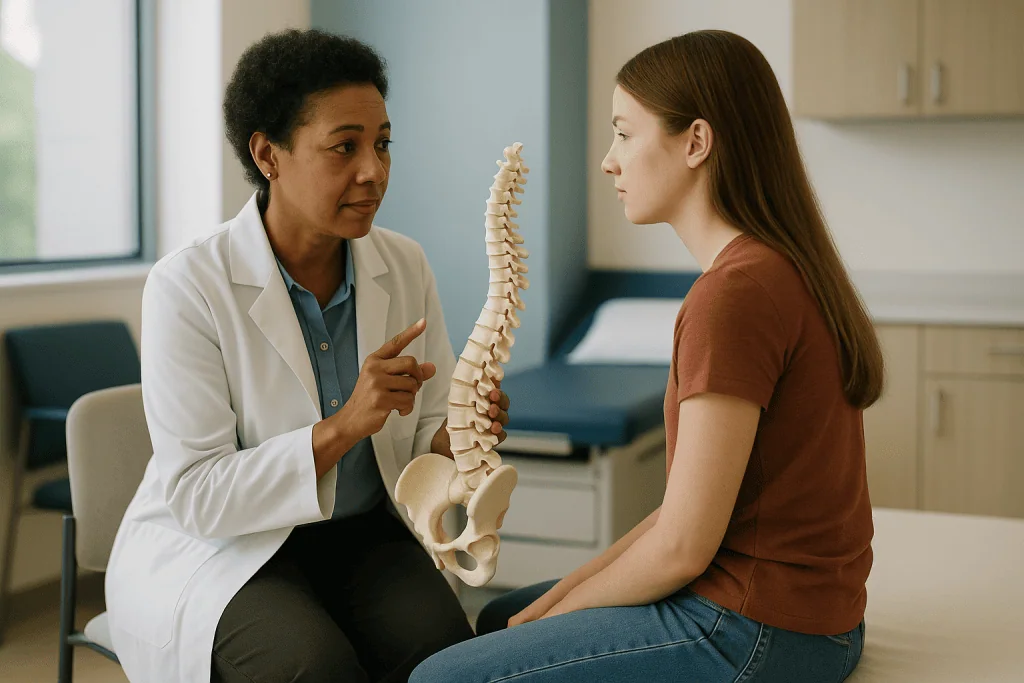
Useful as it is, the Cobb angle is a single snapshot of a three-dimensional problem. Scoliosis is not only a side-to-side bend; the vertebrae also rotate, which is why a rib prominence or uneven waist can look more dramatic than the number suggests. A curve can also change slightly depending on how a child stands, how tired they are, or how the film was positioned. Clinicians generally treat a change of a few degrees with caution and look for a consistent trend across visits before calling it progression.
Curve pattern matters too. A single thoracic curve behaves differently from a double curve or a long, sweeping one, and a curve in the upper spine is watched more warily for its potential effect on the chest than one lower down.
Then there is the question that dominates every juvenile scoliosis decision: how much growth is left? A 35-degree curve in a child at the start of a growth spurt is expected to behave very differently from the same curve in a child whose growth plates are nearly closed. Cleveland Clinic and Johns Hopkins both frame the treatment choice around curve size combined with remaining growth and the risk of the curve worsening.
The Cobb angle, in other words, opens the conversation. The child’s growth, curve shape and trajectory over time finish it.
Juvenile scoliosis bracing or surgery: the three thresholds care teams use
Spine teams describe treatment in three broad bands, and while every child is assessed individually, the bands are remarkably consistent across major medical sources. The table below summarizes typical ranges described by Mayo Clinic, Johns Hopkins and the NHS. Treat it as a map of how teams think, not a rule that overrides your own child’s clinician.
| Cobb angle (typical range) | Usual approach in a growing child | What tips the balance |
|---|---|---|
| 10° to about 20–25° | Observation with repeat X-rays every few months | Rapid change between visits, very young age, or a curve pattern that threatens the chest |
| About 25° to 40–45° | Bracing, worn during remaining growth | Documented progression, brace tolerance, and how much growth remains |
| About 45–50° and above | Surgery is discussed; type depends on age and growth | Continued progression despite bracing, effect on lung development, spinal balance |
Two honest caveats. First, the boundaries blur in practice. A 22-degree curve that has jumped several degrees in six months may be braced sooner than a 27-degree curve that has held steady for a year. Second, “surgery” in a young child usually does not mean the spinal fusion most people associate with scoliosis. It more often means a growth-friendly operation that controls the curve while the spine keeps lengthening, a distinction covered later.
What families sometimes miss is that observation is an active choice. Watching a curve with regular imaging is how a team gathers the evidence that justifies stepping up, or the reassurance that justifies staying put.
How growth is measured: Risser, hands and the pelvis
Because remaining growth drives so many decisions, clinicians spend a surprising amount of a scoliosis visit looking at bones other than the spine.

The Risser sign is the most familiar tool. It grades how much of a small cap of bone along the top rim of the pelvis has formed and fused, on a scale that runs from no visible cap to complete fusion. A low Risser grade means substantial growth remains; a high grade means the spurt is largely over. In juvenile scoliosis the Risser sign is almost always at the low end, which is precisely why these children are watched so carefully.
The triradiate cartilage is a Y-shaped growth zone in the hip socket, visible on the same pelvic X-ray. While it is still open, a child is considered to be well before their fastest period of growth. Its closure is one of the earliest signals that the spurt is approaching, and some teams use it as a marker for when curve progression risk peaks.
Hand and wrist X-rays offer a third view. A radiologist compares the growth plates in the fingers and wrist against reference standards to estimate skeletal age, which can differ from birthday age by a year or more in either direction. This estimate often refines the picture when the pelvis alone is ambiguous.
Plain measurement matters as much as imaging. Standing height recorded at each visit reveals growth velocity, and a sudden acceleration is a cue that the spine may be about to move too. For a child who is clearly heading into a growth spurt with a curve already in the mid-20s, that velocity reading can be the single detail that shifts a team from watching toward bracing.
What actually happens during brace treatment
A scoliosis brace is a molded rigid shell, usually plastic, that wraps the trunk from beneath the arms to the hips. The most common type is a thoracolumbosacral orthosis, or TLSO, a term that simply describes the region it covers. The brace is custom-made from a scan or cast of the child’s torso and includes pads positioned to press against the outward side of the curve.
The mechanism is straightforward: a brace does not straighten a curve permanently. It holds the spine in a corrected position while the child grows, aiming to stop the curve from advancing until growth ends. The NHS describes the goal plainly as preventing the curve from getting worse, not reversing it. Any correction seen in the brace usually relaxes when it is removed.
How many hours a day the brace is worn is the variable that most influences results. The NHS describes a typical prescription as around 23 hours a day, removed for bathing, swimming and contact sports. The large randomized BrAIST trial, published in the New England Journal of Medicine, found a clear dose-response effect: adolescents who wore their brace at least 12.9 hours daily had far better outcomes than those who wore it less. A team may prescribe a nighttime-only bending brace for certain curve types, which trades fewer hours for stronger correction while lying down.
Day to day, bracing means a fitting appointment, an adjustment period of a week or two as skin toughens under the pads, regular checks for pressure sores, and a new brace whenever a growth spurt outpaces the old one. Children can typically attend school, play most sports and sleep in the brace. For a juvenile child, the reality is that this routine may last several years, which is why the team’s attention to comfort, fit and family support is not a side issue.
Scoliosis bracing age: when is a child old enough, or too old, for a brace?
Families often ask what age is best for scoliosis bracing. The evidence-based answer reframes the question: bracing works during growth, so the right age is any age at which the child is still growing and the curve sits in the bracing range. There is no ideal birthday.
At the young end, very small children with significant early-onset curves are sometimes treated not with a removable brace but with a series of plaster casts applied under anesthesia and changed every few months as the child grows. The NHS lists casting as an option for young children whose curves need active control before a brace is practical. Casting is a specialist decision and is not typical for the average juvenile curve.
Through the classic juvenile years of roughly 4 to 10, a rigid brace is the mainstay for curves that reach the mid-20s or show progression. The challenge is duration. An adolescent may brace for two or three years; a seven-year-old may face six or more. Teams are candid that a brace is only as effective as the hours it is worn, and sustaining that for years requires a routine the whole family can live with.
At the old end, the limit is not age but skeletal maturity. Once the growth plates close, a brace has little left to influence. This is why a clinician may recommend against starting a brace in a teenager whose Risser sign shows growth is almost complete, even if the curve is in the bracing range.
For a juvenile child, then, the practical timing question is usually not whether they are the right age but whether the curve has crossed from watchful waiting into active control, and whether the family is ready for what that control requires.
Who is usually braced, and who is usually asked to wait
The typical candidate for bracing is a child who is still growing, whose Cobb angle has reached roughly 25 degrees or more, and whose curve has either progressed between visits or is judged likely to progress given the growth ahead. Mayo Clinic and Johns Hopkins describe this combination of moderate curve plus remaining growth as the standard trigger.
Children who are usually asked to wait fall into a few groups. The largest is those with curves below about 20 to 25 degrees that have stayed stable across two or more X-rays. For them, the risk and burden of a brace outweigh a benefit that may never be needed, and observation every four to six months is the recommended path.
A second group waits for the opposite reason: the curve is already large enough that a brace is unlikely to hold it, and the conversation moves toward surgical options instead. Bracing a 55-degree curve is generally not considered effective control.
A third group includes children whose scoliosis is caused by a neuromuscular or genetic condition rather than being idiopathic. Their pathway is different, often involving a broader medical team, and the thresholds described here may not apply.
Some children are braced at lower angles than usual, for instance when a curve in a very young child is rising quickly or sits high in the thoracic spine where lung development is a concern. Others with mid-range curves may be watched a little longer if the growth markers suggest the spurt is years away and the curve has not budged.
The consistent thread is that bracing is prescribed for a trajectory, not a snapshot. If your child has been placed in the waiting group, ask what specific change would move them out of it.
Cobb angle for surgery: when bracing stops being enough
Surgery enters the discussion when a curve approaches 45 to 50 degrees, when it continues to progress despite a well-worn brace, or when its size or location threatens the developing chest. Those thresholds, described consistently by Mayo Clinic, Johns Hopkins and the NHS, exist because curves of that magnitude in a growing child tend to keep advancing after growth ends, and because larger curves are technically harder to correct later.
A curve crossing 45 degrees does not trigger an operation the following week. Scoliosis surgery in children is almost always elective in timing, planned months ahead once the team, the family and where appropriate the child agree that the balance has shifted. There is usually room to gather a second X-ray, complete lung function testing, finish the MRI if it has not been done, and talk through alternatives.
Bracing itself can end for reasons other than curve size. A child may simply not tolerate the hours required, or skin problems may make wear impractical. In those situations the team weighs whether a different brace design, a period of closer observation, or an operation better serves the child.
What does the evidence say about avoiding surgery? The BrAIST trial defined success as reaching skeletal maturity without the curve hitting 50 degrees, the point at which surgery is typically recommended. Success occurred in 72 percent of braced adolescents versus 48 percent of those observed only. Those figures come from adolescents, not juvenile children, so they should be read as supportive rather than directly transferable.
The age of the child changes the type of surgery far more than the threshold for it. A ten-year-old approaching 50 degrees may be a candidate for growth-friendly implants; a fourteen-year-old at the same angle may be steered toward fusion. That distinction is the subject of the next two sections.
Growing rods for scoliosis and other growth-friendly operations
Growing rods for scoliosis are metal rods anchored above and below the curve, spanning it without fusing the vertebrae in between. The rods hold the spine in a corrected position while the growth plates of the unfused segments keep working. As the child grows, the rods are lengthened to keep pace.
Traditional growing rods are extended during brief operations repeated as the child grows, which the NHS describes as taking place every few months. Newer magnetically controlled rods can be lengthened in clinic using an external magnet placed against the back, reducing the number of anesthetics a child undergoes over the course of treatment. The NHS notes both approaches are in use; which is suitable depends on the child’s anatomy and the team’s assessment.
Growth-friendly surgery is generally reserved for children who are too young for definitive fusion, typically below about ten, with curves that a brace has failed to control. The aim is to buy years of chest and spinal growth. At skeletal maturity, most children then undergo a final fusion to lock the correction in place.
The honest trade-offs deserve stating. Growing rods involve a long relationship with the operating room: multiple procedures, the possibility of rod breakage, anchor loosening or infection, and the wear of repeated recovery periods on a child and family. Complication rates are meaningful and vary widely between series, so ask your team what their published sources report rather than accepting a general reassurance.
Vertebral body tethering, in which a flexible cord is attached to the outer side of the curve to slow growth on that side, is a newer technique that avoids fusion. Long-term evidence is still limited, and mainstream sources describe it as an emerging option rather than an established standard. If it is offered, ask specifically what is and is not known about its durability.
Spinal fusion in a growing child, and do kids still grow after scoliosis surgery?
Spinal fusion is the operation most people associate with scoliosis. The surgeon straightens the curve using rods and screws, then places bone graft along the corrected segment so that, over months, the treated vertebrae knit into one solid unit. The rods hold the position while the bone heals; once fused, the spine relies on the bone rather than the metal.
Fusion stops lengthwise growth in the fused segment permanently. That is the reason surgeons hesitate to fuse very young children. Fusing a long stretch of a seven-year-old’s spine would leave a short trunk relative to the legs and, more seriously, limit the chest cavity in which the lungs are still developing. There is also a phenomenon called crankshaft, in which the front of the spine keeps growing after the back has been fused, causing the fused section to twist. This is why growth-friendly surgery, not fusion, is the usual first surgical step in juvenile scoliosis.
So do kids still grow after scoliosis surgery? Yes, in several ways. The legs, arms and any unfused portion of the spine grow normally. Children with growing rods continue to gain spinal length between lengthenings. Even after fusion, a child often measures taller immediately, because straightening a curve recovers height that the bend had folded away, though this is a one-time gain rather than ongoing growth.
Fusion is typically timed for adolescence, once most growth is complete, when it can be performed once and expected to hold. Johns Hopkins and Mayo Clinic both frame the decision as a balance between correcting a curve that will otherwise worsen and preserving as much growth as the child’s age allows. For a juvenile child, that balance usually means controlling now and fusing later.
Scoliosis surgery recovery time, child by child: the first days, weeks and months
Recovery depends heavily on which operation was performed, so timelines here are typical ranges drawn from NHS and Mayo Clinic descriptions, not promises.
After a fusion, most children stay in the hospital for around a week according to the NHS. The first two or three days are the hardest. Pain is managed with a combination of medicines chosen by the anesthesia and surgical team, moving from intravenous to oral forms as the child improves; families should expect the team to explain the plan and adjust it, and should never alter it themselves. Nurses and physical therapists usually have the child sitting on the first or second day and walking short distances soon after, because early movement reduces complications and speeds return to normal function.
Going home does not mean going back to normal. The NHS describes a return to school after a few weeks and a full recovery that may take several months. Bending, lifting and twisting are restricted while the fusion heals, and contact sports are usually off the table for months, in some cases up to a year, depending on the surgeon’s assessment of bone healing on follow-up X-rays.
Recovery after a growing-rod lengthening is far shorter. A traditional lengthening typically involves an overnight stay or less, while a magnetic lengthening in clinic may need no recovery at all beyond a few hours of soreness. The pattern, though, repeats every few months for years.
The question families ask most is how long a 12-year-old takes to recover. The physical answer follows the ranges above. The emotional answer is that children in this age range often bounce back faster than adults but may need help with the frustration of missing sports, the visibility of a scar and the loss of independence in the first weeks. Building school communication and a return-to-activity plan into the discharge conversation makes those weeks easier.
What people often get wrong about juvenile scoliosis bracing or surgery
The most common misunderstanding is that a brace straightens the spine. It does not. A brace aims to hold a growing curve where it is until growth stops. Families who expect the number to fall can feel bracing has failed when it has in fact done its job by keeping the number steady.
A second myth runs the opposite way: that bracing is pointless. The BrAIST trial was stopped early because the benefit of bracing over observation was clear, with 72 percent of braced adolescents avoiding a surgical-range curve compared with 48 percent of those observed. Bracing is not guaranteed, but the evidence that it changes trajectories is among the strongest in pediatric orthopedics.
Third, many people believe scoliosis is caused by posture, heavy backpacks or sleeping position. MedlinePlus and Mayo Clinic are explicit that idiopathic scoliosis has no known cause and is not the result of anything the child or parents did. Nothing about a backpack will make a curve appear or disappear.
Fourth, exercise programs are sometimes marketed as an alternative to bracing or surgery. Physical therapy, including scoliosis-specific approaches, may help with posture, strength and comfort, and some teams use it alongside bracing. Mayo Clinic notes that evidence for exercise preventing progression is limited. Presenting it as a substitute for a brace in a progressing juvenile curve is not supported.
Fifth, surgery is often imagined as a single, final, all-or-nothing event. In a juvenile child it is more often a sequence: growth-friendly control now, definitive fusion later. Understanding that sequence spares families the shock of hearing that a second operation was always part of the plan.
Finally, a mild curve is not a lifelong sentence. Many small curves never progress, and most children with scoliosis grow up to live fully active lives regardless of which path their care took.
Questions to ask your care team
A scoliosis appointment moves quickly, and the questions that matter most are easy to forget once the X-ray is on the screen. Writing them down ahead of time is worth doing. These are the ones that consistently help families understand where their child sits on the pathway.
- What is my child’s current Cobb angle, and how has it changed since the last X-ray?
- How much growth do you estimate remains, and which markers are you using to judge that?
- What specific change would move us from monitoring to bracing, or from bracing to a surgical discussion?
- If a brace is recommended, how many hours a day do you expect it to be worn, and how will we track wear?
- Has an MRI been done or considered, and what would it look for?
- If surgery is being discussed, is it a growth-friendly procedure or a fusion, and why that choice for my child’s age?
- How many procedures might this pathway involve over the coming years?
- What complications do the published sources you rely on report for this operation, and how would we recognize them?
- Which activities can my child continue in a brace or after surgery, and which should pause?
- Who should we contact between visits if something changes, and how quickly?
Two of these deserve emphasis. The question about what would trigger a change in plan turns an abstract threshold into a concrete personal target, and it makes the next visit far less anxious. The question about complications invites honesty rather than reassurance, and a team that answers it directly is one you can work with over the long years that juvenile scoliosis often demands.
Bring your child into the conversation at a level suited to their age. Children who understand why a brace matters tend to wear it, and children who helped choose the timing of an operation tend to recover with fewer surprises.
When to call your doctor
Most changes in juvenile scoliosis are slow, and the scheduled visit is the right place to discuss them. Some situations should not wait for the next appointment.
Call the care team promptly if your child develops new or worsening back pain that is persistent rather than occasional, especially pain that wakes them at night. Idiopathic scoliosis in a young child is usually painless, so significant pain is a reason to reassess rather than reassure. Seek same-day advice for any new numbness, tingling or weakness in the legs, changes in walking such as tripping or stumbling, or new difficulty controlling the bladder or bowel; these can indicate the spinal cord is affected and warrant urgent evaluation.
Breathing changes also matter. A child who becomes short of breath with ordinary play, or whose curve appears to have changed visibly over a few weeks, should be seen sooner than planned.
For a child in a brace, contact the team if skin under the pads becomes broken, blistered or does not return to normal color within a short time after removal, if the brace no longer fits after a growth spurt, or if wearing hours have dropped substantially and you need help getting back on track. None of these are emergencies, but all of them affect whether the brace can do its work.
After surgery, call immediately for fever, redness, swelling or drainage at the incision, pain that escalates rather than settles, calf pain or swelling, chest pain or difficulty breathing, or any new numbness or weakness. Persistent nausea preventing fluids also needs a call.
Every decision described in this article sits with the treating team who knows your child’s spine, growth and circumstances. Use them. A phone call that turns out to be nothing is always the better outcome.
Frequently asked questions
What age is best for scoliosis bracing?
There is no single best age; a brace is useful whenever a child is still growing and the curve is in the bracing range of roughly 25 to 40 degrees. In juvenile scoliosis that may mean starting as young as five or six and continuing for years. Once growth plates close, bracing offers little further benefit, so skeletal maturity rather than birthday age marks the upper limit.
How long does it take for a 12-year-old to recover from scoliosis surgery?
After spinal fusion, the NHS describes a hospital stay of around a week, a return to school after a few weeks, and several months to full recovery, with contact sports often restricted for up to a year. Recovery after a growing-rod lengthening is far shorter, usually a day or two. Individual timelines vary, and the surgical team sets the specific milestones.
What age is best to get scoliosis surgery?
Definitive spinal fusion is generally timed for adolescence, once most spinal and chest growth is complete, so that it can be done once and hold. Younger children whose curves cannot be controlled by bracing are more often offered growth-friendly surgery such as growing rods, with fusion deferred until maturity. The right timing depends on curve size, growth markers and lung development, judged by the treating team.
Do kids still grow after scoliosis surgery?
Yes. The legs, arms and any unfused part of the spine continue to grow normally. Children with growing rods also gain spinal length between lengthenings. After fusion, the fused segment no longer lengthens, though children often measure taller immediately because straightening the curve recovers height the bend had hidden. This is why surgeons avoid long fusions in young children.
How often are growing rods for scoliosis lengthened?
Traditional growing rods are lengthened in short operations every few months as the child grows, according to NHS guidance. Magnetically controlled rods can be lengthened in clinic with an external magnet, reducing the number of anesthetics. The schedule continues until the child reaches skeletal maturity, when a final fusion is usually performed to lock the correction in place.
What Cobb angle for surgery is typical in children?
Surgery is usually discussed when a curve approaches 45 to 50 degrees, or when it keeps progressing despite well-worn bracing, according to Mayo Clinic and Johns Hopkins. The angle alone does not decide; remaining growth, curve location and effect on the chest all weigh in. In a young child, crossing that threshold typically leads to growth-friendly surgery rather than immediate fusion.
Can bracing prevent the need for scoliosis surgery?
Often, but not always. The BrAIST trial found 72 percent of braced adolescents reached maturity without a surgical-range curve compared with 48 percent of those only observed, and wearing the brace at least 12.9 hours daily was linked to the best outcomes. Those results come from teenagers; juvenile curves have more growth ahead, so the team will judge the likelihood for your child individually.
Can my child play sports while wearing a scoliosis brace?
Usually yes. Most braces are removed for swimming, bathing and contact sports, and many children continue gymnastics, dance and team sports either in or out of the brace depending on the activity. The NHS describes removal for these reasons as part of a typical wearing plan. Ask the team which activities they prefer done in the brace and how to count those hours.
What happens if a child refuses to wear the brace?
Tell the care team rather than hiding it, because wear hours drive results. Options include adjusting the brace for comfort, switching to a nighttime-only design where the curve pattern allows, involving a child life specialist or psychologist, and setting realistic hour targets. If wear cannot be sustained and the curve progresses, the team will discuss whether closer observation or a surgical option is the better route.
Is physical therapy or exercise enough to treat juvenile scoliosis?
Not on its own for a progressing curve. Mayo Clinic notes that evidence for exercise preventing curve progression is limited, and mainstream guidance does not recommend it as a substitute for bracing when a brace is indicated. Scoliosis-specific physical therapy may help with posture, strength and comfort alongside other treatment, and many teams include it, but decisions rest with your child’s clinicians.
References
This article is for general information only and is not a substitute for professional medical advice. Please consult a qualified doctor about your individual situation.

More from the Blog
Which Spine Operation Fits Which Problem? Decompression, Fusion and Disc Surgery Compared
Decompression, fusion and disc surgery treat different mechanical problems. Decompression removes bone or ligament that is squeezing nerves, usually for spinal stenosis. Disc surgery…

Which Symptoms After Spine Surgery Need a Same-Day Call? Wound, Bladder and Leg Changes
Call your surgical team the same day if you notice new or worsening leg weakness, numbness spreading between the legs or around the genitals,…

Who Benefits From the Schroth Method? Curve Size, Age and Growth Stage Considerations
The Schroth method is usually considered for people with idiopathic scoliosis and mild to moderate curves, most often growing adolescents with Cobb angles roughly…

Who Is Suitable for Endoscopic Disc Surgery? Herniation Type, Location and Prior Surgery
An endoscopic disc surgery candidate is typically an adult with a single, imaging-confirmed lumbar disc herniation that presses on one nerve root, causing leg…
How Long Does an Artificial Disc Last? Wear, Motion Over Time and Realistic Expectations
Nobody can promise a fixed number of years for an artificial disc. Published follow-up now stretches to roughly seven to ten years for several…

Laminectomy Recovery: Healing After Spinal Decompression
Most people recovering from a laminectomy walk within a day of surgery, return to light activity in a few weeks, and resume most normal…