

When Does Medication Come Before or After Acromegaly Surgery? How the Sequence Is Decided

Key Takeaways
- The Endocrine Society guideline recommends surgery as first-line treatment for most growth-hormone-secreting pituitary adenomas, with medication reserved for persistent disease or for people who cannot or choose not to have an operation.
- Medication before surgery is suggested mainly to lower anesthetic risk in people with severe airway thickening, sleep apnea or heart failure, not as a routine step for everyone.
- Whether a preoperative course of somatostatin analog improves long-term hormone control after surgery remains uncertain in the published trials the guideline reviewed.
- Surgical biochemical control is reported at roughly 80% or more for microadenomas but under half for macroadenomas, with cavernous sinus invasion the strongest predictor of residual disease.
- IGF-1 lags behind growth hormone by weeks, so the decisive post-operative hormone check is made around 12 weeks after surgery rather than in the first days.
- When IGF-1 and growth hormone are brought into the target range by any route, mortality falls to a level approaching that of the general population.
In acromegaly, surgery to remove the pituitary tumor is usually the first treatment, and medication typically follows only if growth hormone remains high afterward. Medication is given before surgery in selected cases, mainly to settle breathing, heart or airway problems that would make anesthesia riskier, or when the tumor cannot be safely removed. The sequence is decided case by case by the endocrine and neurosurgical team.
The clinic letter sits on the kitchen table, and one line keeps pulling the eye back: “pituitary adenoma, somatotroph, likely macroadenoma.” Rings have been resized twice. Shoes went up a size in a decade when nothing else about the person changed. Now there is a diagnosis, a surgeon’s name on a referral, and a second letter from an endocrinologist that mentions injections. Which comes first, and why does the order even matter?
It matters because acromegaly medication before surgery is not the default, yet it is not rare either. Growth hormone excess thickens the soft tissue of the tongue and throat, enlarges the heart, and raises blood sugar, and each of those things changes how safely a person can be anesthetized and operated on. Equally, a tumor that has grown sideways into the cavernous sinus, the web of veins and nerves beside the pituitary, may never be fully reachable with a scalpel.
So the sequence is a judgment, not a rule. This article walks through how that judgment is made, what the guidelines actually say, and which questions are worth asking before anything is scheduled.
What are the acromegaly treatment options, and why is order a real question?
Acromegaly is the condition caused by too much growth hormone in adulthood, almost always from a benign tumor (an adenoma) in the pituitary gland at the base of the brain. The hormone itself does not cause most of the damage directly; it tells the liver to make insulin-like growth factor 1 (IGF-1), the messenger that drives tissue overgrowth, joint change and the metabolic strain on the heart and pancreas.
Three tools exist to bring those two hormones back into range. Surgery removes the source. Medication either stops the tumor releasing growth hormone or blocks the hormone from acting. Radiotherapy shrinks and quiets the tumor slowly, over years rather than weeks. Each tool has a different speed, a different chance of lasting control, and a different side-effect profile, which is exactly why the order in which they are used becomes a genuine clinical decision rather than a formality.
The mainstream position is clear. The Endocrine Society clinical practice guideline recommends surgery as the first-line treatment for most people with a growth-hormone-secreting adenoma, with medication reserved for persistent disease afterward or for people who cannot have, or choose not to have, surgery. The same guideline leaves room for a short course of medication before surgery in specific circumstances, and that is the space where most patient confusion lives.
Two things are worth fixing in mind early. First, the tumor is almost always benign; it does not spread, and the urgency is about hormone control and pressure on nearby structures, not cancer. Second, the sequence is chosen for the individual, based on tumor size and position, hormone levels, other medical problems and personal preference. No one is “behind” because their plan begins with an injection rather than an operation.
What actually happens during acromegaly surgery?
Nearly all pituitary operations for acromegaly are transsphenoidal, meaning the surgeon reaches the gland through the nose and the sphenoid sinus, the air-filled cavity directly behind it, rather than opening the skull. A thin endoscope or microscope is passed along the nasal passage, the thin bone at the back of the sinus is opened, and the tumor is removed in pieces while the surrounding normal gland is protected as far as possible.
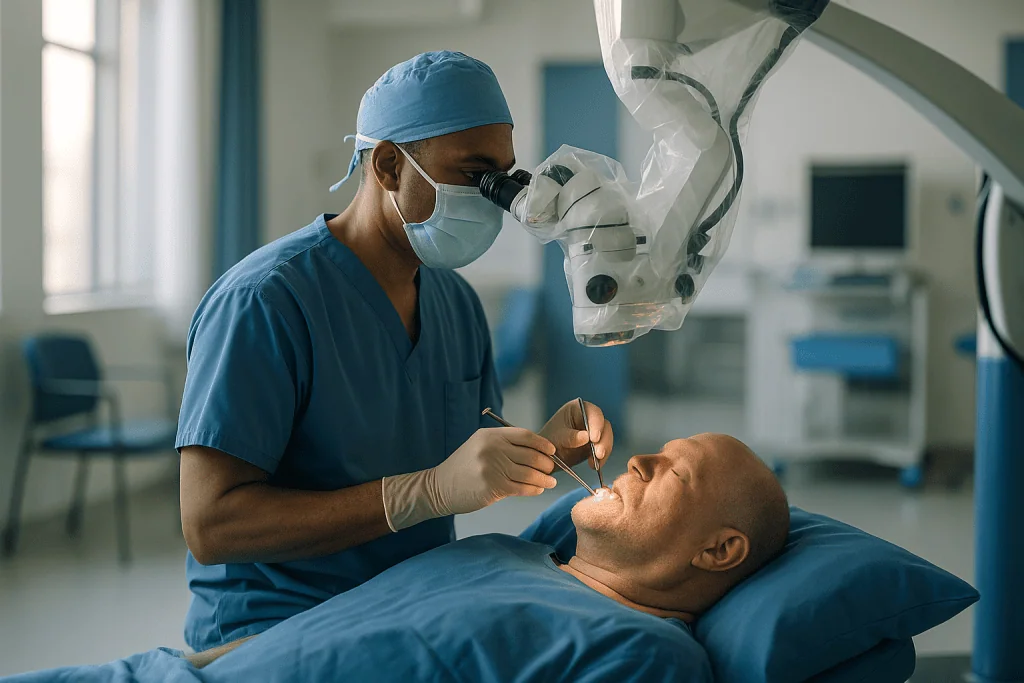
Most people are under general anesthesia for a few hours. There is usually no visible scar. Afterward the nose may be packed for a short time, and a small plug of the patient’s own fat or a synthetic patch is sometimes used to seal the space and prevent cerebrospinal fluid, the clear fluid that bathes the brain, from leaking.
The reason size matters so much is anatomical. A microadenoma, a tumor under 10 millimeters across, generally sits entirely within the gland and can often be removed whole. A macroadenoma, 10 millimeters or larger, may push upward against the optic nerves or sideways into the cavernous sinus, where the internal carotid artery and the nerves that move the eye run. Tissue in that lateral space is frequently not safe to chase.
Hormone response is fast when removal is complete. Growth hormone has a half-life measured in minutes, so blood levels can fall within hours of a successful operation. IGF-1 is slower, because it reflects weeks of prior growth hormone exposure, which is why the Endocrine Society guideline advises measuring it about 12 weeks after surgery rather than in the first few days. That lag is one of the main reasons patients are told to wait before anyone pronounces the surgery a success or a partial result.
Why do guidelines usually put surgery first?
Speed, finality and the possibility of needing nothing else: those three advantages explain the surgery-first position. Medication has to be continued for as long as the tumor is active, often indefinitely. Radiotherapy takes years to take full effect. A complete surgical removal can bring hormones into the normal range within days and, if it holds, ends the need for ongoing treatment.
The odds depend heavily on what the scan shows. The Endocrine Society guideline summarizes published series in which biochemical control after surgery alone is achieved in roughly 80% or more of microadenomas but in fewer than half of macroadenomas, with invasion of the cavernous sinus the single strongest predictor of residual disease. Those figures are pooled averages from experienced pituitary centers and are not a forecast for any one person.
Surgery also does something medication cannot: it relieves pressure. A large adenoma pressing on the optic chiasm, the crossing point of the two optic nerves, can narrow peripheral vision, and prompt decompression protects sight. No drug reliably shrinks a tumor quickly enough to be relied on when vision is at stake.
There is a further, less obvious argument. Even when a surgeon knows in advance that the tumor cannot be fully removed, taking out the bulk of it, a procedure called debulking, lowers the amount of hormone-producing tissue left behind. The guideline notes that this can improve the response to medication given afterward. Surgery, in other words, is sometimes done to make the later medicine work better, not to replace it.
None of this makes surgery automatic. Fitness for anesthesia, the person’s wishes, tumor anatomy and the availability of an experienced pituitary team all weigh in before the sequence is settled.
Acromegaly medication before surgery: when is it considered?
Picture a person whose tongue has thickened enough to cause severe obstructive sleep apnea, whose heart has enlarged and is pumping inefficiently, and whose blood sugar is running high. Intubating that airway and keeping that heart stable through a few hours of anesthesia carries more risk than usual. This is the scenario the Endocrine Society guideline has in mind when it suggests that preoperative medical therapy may be considered to reduce surgical risk in people with severe pharyngeal thickening and sleep apnea, or with high-output heart failure.

The medicine used in this setting is nearly always a long-acting somatostatin receptor ligand, a drug class that mimics the body’s natural “off” signal to the pituitary. Over weeks to a few months it can lower growth hormone, reduce soft-tissue swelling, and in some people modestly shrink the tumor. The aim is not to replace surgery but to make the operation and the anesthetic safer.
A separate question, whether a routine course of medication before surgery improves the chance of lasting hormone control afterward, has been studied in several trials with mixed results. The guideline, reviewing that evidence, does not recommend routine preoperative treatment for all patients and describes the benefit on surgical outcome as uncertain. Honest advice therefore sounds like: medicine first can be worth it for your airway or heart; whether it changes what the surgeon finds is far less certain.
Other reasons the sequence may start with medication include a long wait for a pituitary surgical slot, a tumor whose position means surgery is unlikely to succeed on its own, or a patient who has decided against an operation for now. In every case the prescribing clinician sets the plan, the duration and the monitoring; the patient’s part is to ask why this order was chosen and what will be re-checked before the surgical date.
Who usually goes straight to surgery, and who is asked to wait?
Straight to theater, in general terms, is the path for someone with a well-defined tumor on MRI, no invasion of the cavernous sinus, reasonable heart and lung function, and no threat to vision that needs emergency relief, or conversely an urgent threat to vision that cannot wait for a drug to work. The guideline’s logic is simple: when the chance of complete removal is high and the anesthetic risk is ordinary, delaying for medication adds little.
Waiting, with medication bridging the gap, is more often advised when one or more of the following apply:
- Severe obstructive sleep apnea or marked airway soft-tissue thickening that an anesthetist flags as high risk.
- Heart failure or significant cardiomyopathy attributed to growth hormone excess.
- Poorly controlled diabetes or very high blood pressure that needs optimizing first.
- A macroadenoma with clear cavernous sinus invasion, where the team expects residual tumor and may plan debulking plus medication from the outset.
- Other medical conditions, or frailty, that make general anesthesia a serious undertaking.
People in the second group are not being denied surgery. They are being prepared for it, or steered toward a sequence where surgery plays a supporting role. Several of these conditions, particularly sleep apnea and cardiomyopathy, improve when growth hormone falls, so the medication phase often doubles as treatment for the complications themselves.
Age alone is not a deciding factor in guidelines; fitness is. Nor is the severity of facial change, which reflects duration of disease rather than how dangerous the operation will be. What tips the balance is the combination of tumor anatomy, hormone levels and the body’s readiness for anesthesia, assessed jointly by endocrinology, neurosurgery and anesthesia. If the plan is unclear, asking which of those three factors drove it is a fair and useful question.
How do somatostatin analogs for acromegaly actually work?
Somatostatin is a short hormone the brain and gut make naturally, and one of its jobs is to tell pituitary somatotroph cells to stop releasing growth hormone. Most growth-hormone-secreting adenomas still carry receptors for it. Somatostatin receptor ligands, often called somatostatin analogs, are synthetic versions built to last far longer in the body, so a single long-acting injection keeps the “stop” signal on for weeks.
Three things follow from that mechanism. Growth hormone output falls, and with it IGF-1. Tumor cells receiving a constant inhibitory signal often slow their growth, and the guideline notes that measurable tumor shrinkage occurs in a proportion of treated people, which is part of why this class is chosen when a tumor needs settling before surgery. Soft tissue, including the swollen tongue and pharynx that trouble anesthetists, can soften as hormone levels drop.
Response is not universal. Tumors differ in how many and which somatostatin receptor subtypes they carry, and those with few receptors respond poorly. Some people reach normal IGF-1, others improve without normalizing, and a minority see little change. Because of that spread, endocrinologists re-measure hormones after a few months and adjust the plan rather than assuming the drug will work.
Side effects cluster in the digestive system. Somatostatin also slows the gut and gallbladder, so loose stools, bloating and abdominal discomfort are common early on, and gallstones develop more often with long-term use. Blood sugar can move in either direction. Injection-site soreness is frequent. None of these is a reason to stop a prescribed course without talking to the prescriber; they are reasons to report symptoms so the team can weigh them.
Where somatostatin analogs sit in the sequence, before surgery, after it, or as the main treatment, is a decision for the endocrinologist. The reader’s job is to understand the mechanism well enough to ask informed questions, not to time the drug themselves.
Why are dopamine agonists used for acromegaly, and what about receptor blockers?
Dopamine is better known as a brain messenger, but in the pituitary it acts as a brake. Dopamine agonists, oral drugs that stimulate dopamine receptors, are the standard treatment for prolactin-secreting tumors, and some growth-hormone-secreting adenomas carry the same receptors. The Endocrine Society guideline notes that dopamine agonists can be tried in people with mildly elevated IGF-1, particularly when the tumor also secretes prolactin, and that they are generally less effective than somatostatin analogs for most patients.
Their appeal is practical. Tablets rather than injections, a long safety record, and usefulness as an add-on when another drug has brought hormones close to, but not into, the normal range. The trade-offs are nausea, light-headedness from a drop in blood pressure, and, at the higher exposures used in other conditions, concern about heart valve changes, which is why monitoring is part of the plan.
The third drug class works at the other end of the pathway. Growth hormone receptor antagonists do not touch the tumor at all; they block growth hormone from docking with its receptor on liver and tissue cells, so IGF-1 falls even though growth hormone in the blood stays high or rises. The guideline recommends this class for people whose IGF-1 remains elevated despite somatostatin analog treatment, and it is particularly considered when diabetes is a problem, because blocking the receptor tends to improve glucose control rather than worsen it.
Because the tumor is untouched, the scan matters more with receptor antagonists; teams monitor MRI to check the adenoma is not growing. Liver enzymes are also checked, since the drug can raise them. Combination approaches, pairing a somatostatin analog with either of the other classes, are used when a single agent falls short.
Which class, in what combination, and for how long, remains the prescriber’s call. The point of knowing the mechanisms is to recognize why one person is given tablets, another injections, and a third both, without reading a difference in treatment quality into it.
When does medication come after surgery, and where does radiotherapy fit?
For most people the sequence is surgery first and the post-operative hormone results decide everything else. The Endocrine Society guideline advises checking IGF-1 and a growth hormone measurement around 12 weeks after the operation. If both are in range, follow-up continues without medication. If IGF-1 stays high, or the growth hormone response to a glucose drink does not suppress normally, the disease is called persistent and medication becomes the next step.
Persistence is more common after macroadenoma surgery, and the choice of drug follows the same logic as above: a somatostatin analog first for most people, a dopamine agonist for mild residual elevation, a growth hormone receptor antagonist if the analog does not normalize IGF-1, or combinations. The guideline also supports repeat surgery in selected cases where a clearly resectable remnant is seen on MRI.
Radiotherapy, whether delivered in a single focused session (stereotactic radiosurgery) or in fractions over several weeks, is generally reserved for tumor that remains after surgery and is not controlled by medication, or for people who cannot tolerate long-term drugs. Its weakness is time. Hormone levels fall gradually, and the guideline describes a lag that can extend to many years before full effect, so medication is usually continued in the interim. Its other recognized cost is a progressive loss of other pituitary hormones, which happens in a substantial proportion of people over the following decade and requires replacement therapy.
Some patients ask whether they can skip the operation and go straight to drugs for life. For a tumor that is not resectable, or for someone unfit for anesthesia, that is a legitimate primary strategy. For a resectable tumor, guidelines favor surgery because it offers the only realistic route to being free of ongoing treatment. Either way, the team re-evaluates at each hormone check, and the plan can change direction more than once over the years.
Sequence scenarios at a glance
The table below pulls the common sequences together. It describes patterns drawn from the Endocrine Society guideline and major patient-information sources; it is not a decision tool, and the treating team may depart from any row for good reasons.
| Typical situation | Usual first step | What usually follows | Why that order |
|---|---|---|---|
| Microadenoma, no invasion, fit for anesthesia | Surgery | Hormone check at about 12 weeks; medication only if persistent | High chance of complete removal, ordinary anesthetic risk |
| Macroadenoma pressing on optic nerves | Surgery, often promptly | Medication and/or radiotherapy if residual tumor | Vision needs physical decompression |
| Severe sleep apnea, airway thickening or heart failure | Somatostatin analog for a period set by the prescriber | Surgery once anesthetic risk is reduced | Guideline suggests pre-treatment to lower surgical risk |
| Tumor invading the cavernous sinus | Debulking surgery or medication, by team choice | Long-term medication; radiotherapy if uncontrolled | Complete removal unlikely; reducing tumor bulk helps drugs work |
| Unfit for anesthesia, or surgery declined | Medication as primary therapy | Radiotherapy if medication fails or is not tolerated | Surgery not an option for now |
| Persistent disease after surgery | Somatostatin analog, dopamine agonist for mild elevation | Receptor antagonist, combinations, repeat surgery or radiotherapy | Stepwise escalation set by hormone response |
Two patterns are worth noticing. Medication before surgery appears only where a specific problem makes the operation riskier or less likely to succeed. And the post-operative hormone check, not the surgeon’s impression in the operating room, is what decides whether the sequence continues.
Acromegaly surgery recovery: what do the days and weeks afterward look like?
The first night is usually spent in hospital, often with a short monitoring period for a complication called diabetes insipidus, where the pituitary temporarily under-produces the hormone that controls urine volume. Thirst and large volumes of pale urine are the signs; most cases settle within days, and the team manages fluids and, if needed, replacement in the meantime. Nasal congestion, a dull headache and tiredness are ordinary. Blowing the nose, straining and bending are typically discouraged for a period the surgical team specifies, to protect the repair at the back of the sinus.
Hospital stays of a few days are typical according to patient information from the NHS and major US academic centers, with a return to desk-based work often possible within a few weeks, though the surgical team’s advice on an individual case always takes precedence. Sense of smell and taste may be blunted for weeks. A follow-up MRI is usually arranged some months later, once post-operative swelling has settled enough for the scan to be read reliably.
Hormonally, the picture changes in two phases. Growth hormone can fall within hours; some people notice their rings loosening and facial puffiness easing within the first week or two as fluid shifts. IGF-1 lags, which is why the Endocrine Society guideline sets the decisive check at around 12 weeks. A reading taken earlier can still be high even after a complete removal, and reading too much into an early number is a common source of needless worry.
Other pituitary hormones are also tested in the weeks after surgery, because cortisol or thyroid output can be reduced temporarily or permanently, and replacement may be needed. Joint pain and bony changes do not reverse; soft-tissue swelling, sweating, sleep apnea and blood sugar often improve. Patience is part of the treatment, and the three-month hormone result, not the hospital discharge summary, is the real turning point in the sequence.
Can acromegaly be stopped, and what does it mean for life expectancy?
Acromegaly can be controlled, and in many people the hormone excess can be brought fully into the normal range. The honest version of “stopped” is this: the growth hormone and IGF-1 driving the condition can be returned to normal by surgery, medication, radiotherapy or a combination, and when that happens the metabolic and cardiovascular strain lifts. Bone and joint changes that have already occurred do not reverse, but they stop progressing.
The life expectancy question has a clearer answer than many people fear. Untreated or poorly controlled acromegaly is associated with increased mortality, mainly from cardiovascular, respiratory and metabolic complications. The Endocrine Society guideline states that when IGF-1 and growth hormone are brought into the target range, mortality falls to a level approaching that of the general population. Control is the variable that matters, not the route by which it is achieved.
Pituitary adenomas themselves are overwhelmingly benign. They do not spread to other organs and are not cancers in the usual sense, so a diagnosis of “pituitary adenoma” on its own does not carry a survival forecast. What shapes outlook is how much hormone the tumor makes, how much it presses on surrounding structures, and how well those two problems are managed over time.
Follow-up is lifelong even after an apparently complete operation. The guideline recommends ongoing IGF-1 monitoring because recurrence, though uncommon after true biochemical remission, does occur years later, and because the other pituitary hormones may decline. Management of the associated conditions, sleep apnea, high blood pressure, diabetes, colon screening and joint care, continues alongside hormone checks.
Why diagnosis is often delayed also deserves saying. Features such as enlarging hands, coarsening facial features and jaw growth develop over years, and patient-information sources from Cleveland Clinic and the NIDDK describe the condition commonly going unrecognized for a long period. That delay, not the choice between surgery-first and medicine-first, is the larger threat to long-term health.
What people often get wrong about the treatment sequence
“If they are giving me injections first, the surgeon must think the tumor is inoperable.” Not usually. The most common reason for a medication phase before surgery is to reduce anesthetic risk from airway thickening or heart strain, which is a statement about the body’s readiness, not the tumor’s reachability. Asking the team which factor applies clears this up quickly.
“Medication before surgery guarantees a better operation.” The evidence is genuinely mixed. The Endocrine Society guideline reviewed trials of routine preoperative somatostatin analogs and did not find enough consistent benefit on long-term hormone control to recommend the practice for everyone. It may still be the right choice for a specific person; it is not a general upgrade.
“A normal growth hormone level the day after surgery means it worked.” A low early value is encouraging, and surgeons do use it, but IGF-1 reflects weeks of prior hormone exposure and is the figure the guideline anchors to, measured around 12 weeks later. The reverse error is equally common: an early high IGF-1 is not proof of failure.
“Pituitary tumors are brain cancer.” They are benign in the vast majority of cases and sit below the brain, not within it. Treatment urgency comes from hormone excess and pressure on nerves, not from spread.
“Once controlled, you are finished with the endocrinologist.” Lifelong monitoring is standard because recurrence, hormone deficiencies after surgery or radiotherapy, and associated conditions all need watching. Follow-up intervals stretch out, but they do not end.
“Drugs for life are a second-class outcome.” For a tumor that cannot be safely removed, long-term medication with normal IGF-1 delivers the same reduction in risk the guideline describes for surgical remission. Control is the goal; the tool is secondary.
“Radiotherapy is the backup you can call on quickly.” It takes years to reach full effect, which is precisely why it sits last in most sequences and why medication usually continues alongside it.
Questions to ask your care team before the sequence is fixed
A good consultation leaves a person able to explain their own plan in two sentences. These questions tend to get there. Take them in writing; the answers are easier to compare later.
- Is my tumor a microadenoma or a macroadenoma, and does the MRI show invasion of the cavernous sinus or contact with the optic nerves?
- Based on that anatomy, what is the realistic chance that surgery alone brings my IGF-1 into the normal range, and what published figures is that estimate drawn from?
- Are you recommending medication before surgery, and if so, is the reason my airway, my heart, my blood sugar, the waiting time, or the tumor itself?
- How will you decide that the pre-surgical medication has done its job, and what will be re-measured before the operation is booked?
- If disease persists after surgery, which drug class would you try first for me, and why that one?
- What other pituitary hormones might be affected by the operation, and how will they be checked?
- When is the decisive post-operative hormone test, and what result would prompt a change of plan?
- Will radiotherapy be part of my plan, and if so, at what point and with what expected timeline?
- Which of my current problems, sleep apnea, joint pain, blood sugar, blood pressure, are likely to improve with hormone control, and which will need their own treatment?
- How often will I be seen in the first year, and who do I contact between appointments if something changes?
One more question is rarely asked and often the most useful: “If you had to choose a different sequence for me, what would make you do so?” The answer reveals how firm the recommendation is and which findings the team is watching. It also sets the right expectation that the plan is reviewed at every hormone check rather than carved once and left alone.
When to call your doctor: red-flag signs during any phase of treatment
Most of the sequence unfolds on a schedule of outpatient checks, but a few symptoms should not wait for the next appointment, whether they appear while on medication before surgery, in the days after the operation, or years later on long-term therapy.
Seek urgent medical help, through emergency services if severe, for a sudden severe headache unlike any before, new loss of vision or double vision, drooping of an eyelid, confusion or drowsiness, or vomiting with headache. These can signal bleeding into the tumor (pituitary apoplexy) or raised pressure, and they are emergencies at any stage.
After surgery, contact the surgical team the same day for clear watery fluid dripping from the nose, especially when leaning forward, a salty taste at the back of the throat, fever with a stiff neck or worsening headache, heavy nosebleed, or extreme thirst with large volumes of pale urine. These point to a cerebrospinal fluid leak, infection or diabetes insipidus, all of which are treatable when caught early.
At any time, report profound tiredness, dizziness on standing, nausea and loss of appetite, or feeling very unwell with a minor illness; these can reflect low cortisol after pituitary surgery or radiotherapy and need prompt assessment.
On medication, call the prescriber rather than stopping the drug for severe or persistent abdominal pain, particularly in the upper right side, which can indicate gallstone problems; yellowing of the skin or eyes; symptoms of very high or very low blood sugar; or fainting. Shortness of breath on lying flat, swelling of the ankles or chest pain should be assessed quickly given the cardiac strain acromegaly can cause.
When in doubt, the rule is simple: a new symptom that is severe, sudden or steadily worsening deserves a phone call, and the treating team would rather hear about it early. Every decision about whether to pause, continue or change treatment belongs with them.
Frequently asked questions
Is acromegaly medication before surgery always needed?
No. Guidelines recommend surgery first for most people and reserve medication before the operation for specific situations, chiefly severe sleep apnea or airway thickening, heart failure from growth hormone excess, or a tumor that cannot be fully removed. The aim in those cases is to make anesthesia safer or to begin controlling hormones early. Whether a preoperative course is right for an individual is decided by the endocrinologist and surgeon together.
Can acromegaly be stopped completely?
The hormone excess can often be brought fully into the normal range, which is what clinicians mean by biochemical control or remission. That is achieved by surgery in many people, by medication or radiotherapy in others, and by combinations in the rest. Bone and joint changes that have already happened do not reverse, but they stop progressing, and metabolic and cardiovascular risks fall. Lifelong follow-up is still needed to detect recurrence.
What is the life expectancy of someone with a pituitary adenoma causing acromegaly?
Pituitary adenomas are almost always benign and do not spread, so the tumor itself does not set a survival forecast. Uncontrolled acromegaly is linked to higher mortality, mostly from heart, breathing and metabolic complications. The Endocrine Society guideline notes that once IGF-1 and growth hormone are brought into the target range, mortality approaches that of the general population, regardless of whether surgery, medication or radiotherapy achieved it.
What are the two types of growth hormones people refer to?
Most often the phrase refers to growth hormone itself, made by the pituitary, and insulin-like growth factor 1 (IGF-1), the messenger the liver produces in response and the one that drives tissue growth. In acromegaly both are elevated and both are measured. Less commonly the term distinguishes the body’s natural growth hormone from the laboratory-made version used to treat deficiency, which is not relevant to acromegaly treatment.
Why are dopamine agonists used for acromegaly if they are prolactin drugs?
Some growth-hormone-secreting adenomas carry dopamine receptors, and stimulating those receptors with an oral dopamine agonist can dampen growth hormone release, especially when the tumor also makes prolactin. Guidelines describe them as an option for mildly raised IGF-1 or as an add-on to other drugs, while noting they are generally less effective than somatostatin analogs. Their advantages are tablet form and a long track record.
How do somatostatin analogs for acromegaly fit into the surgery sequence?
They are the usual first drug class whether given before surgery to reduce anesthetic risk, after surgery for persistent disease, or as primary treatment when surgery is not possible. They mimic the body’s natural signal that tells pituitary cells to stop releasing growth hormone, and over weeks to months they can lower hormone levels and sometimes shrink the tumor. The prescriber decides timing, duration and monitoring.
How long is acromegaly surgery recovery before hormone results are known?
Growth hormone can drop within hours of a complete removal, but IGF-1 reflects weeks of previous exposure, so the Endocrine Society guideline places the decisive hormone check around 12 weeks after the operation. Physical recovery is typically quicker, with a hospital stay of a few days and a gradual return to normal activity over several weeks, subject to the surgical team’s instructions on nose-blowing, straining and lifting.
What are the main acromegaly treatment options if surgery does not control hormones?
The guideline-supported steps are medication first, usually a somatostatin analog, with a dopamine agonist for mild elevation or a growth hormone receptor antagonist if IGF-1 remains high; combinations of these are also used. Repeat surgery is considered when a clearly removable remnant is visible on MRI. Radiotherapy is generally reserved for tumor that persists despite medication, with drugs continued during the years it takes to work.
Does taking medication first mean my tumor cannot be operated on?
Not necessarily. The most common reason for a medication phase before surgery is to settle an airway, heart or metabolic problem that would make anesthesia riskier, which says nothing about whether the tumor is reachable. Medication may also bridge a wait for a surgical date. Asking the team directly which factor drove the sequence usually resolves the worry in a single conversation.
Will I still need follow-up if surgery brings my hormones to normal?
Yes, follow-up is lifelong. Guidelines recommend ongoing IGF-1 monitoring because recurrence can occur years after an apparently complete removal, and because other pituitary hormones may decline after surgery or radiotherapy and require replacement. Associated conditions such as sleep apnea, high blood pressure, diabetes, joint problems and bowel screening continue to be managed alongside the hormone checks, with visits spaced further apart over time.
References
- Acromegaly, NIDDK, National Institutes of Health
- Acromegaly, NHS
- Acromegaly, Cleveland Clinic
- Acromegaly, MedlinePlus Medical Encyclopedia
This article is for general information only and is not a substitute for professional medical advice. Please consult a qualified doctor about your individual situation.

More from the Blog

Reading Your Thyroid Treatment Plan: Questions to Ask Before Choosing Medication or Surgery
Before choosing thyroid medication or surgery, ask your doctor what your exact diagnosis is, what each option does to the gland, how long results…

How Type 1 Diabetes Care Is Planned From Diagnosis: Monitoring, Education and Follow-Up
A type 1 diabetes care plan is a written, individualized agreement between the person and their diabetes team covering four pillars: insulin replacement, glucose…

Watchful Waiting, Medication or Surgery for a Pituitary Tumor: How Do Specialists Decide?
Specialists choose between watchful waiting, medication and surgery for a pituitary tumor by weighing three things: whether the tumor secretes excess hormone, how large…

Transsphenoidal Surgery for Acromegaly: How the Adenoma Is Removed Through the Nose
Acromegaly is usually treated first by removing the growth hormone-producing pituitary adenoma through the nose, a procedure called transsphenoidal surgery. Working through a nostril…

How to Read a Longevity Report: Cardiovascular, Metabolic and Cancer Risk Markers Explained
A longevity report explained simply is a bundle of standard laboratory tests, blood pressure readings and sometimes imaging, grouped into cardiovascular, metabolic and cancer…

Graves Disease Work-Up: Thyroid Hormone Tests, Antibodies, Ultrasound and Scintigraphy
Graves disease is usually diagnosed with blood tests first: a low or undetectable TSH with raised free T4 or T3 confirms an overactive thyroid,…