

Which Tests Tell Essential Tremor Apart From Other Causes of Shaking Hands?

Key Takeaways
- Essential tremor is diagnosed by examination and history; Mayo Clinic confirms no blood test or scan can prove it, and investigations exist mainly to exclude other causes.
- Timing is the key clue: essential tremor appears when holding a posture or performing an action, while the Parkinson's tremor appears at rest, according to NINDS.
- Thyroid function, liver and kidney tests, glucose, and copper studies in people under 40 form the standard panel for excluding treatable causes of shaking hands.
- A DaTscan can show whether a tremor is Parkinsonian by measuring dopamine transporter in the brain, but a normal result does not by itself diagnose essential tremor.
- About half of people with essential tremor have an inherited form, so asking relatives about shaky hands, head nodding or a quavering voice is genuinely diagnostic information.
- Caffeine, stress, fatigue, low blood sugar and several medicine classes amplify normal physiological tremor, and this enhanced tremor is the look-alike most often confused with essential tremor.
No single test confirms essential tremor. Doctors diagnose it mainly through a neurological examination that watches how the hands shake at rest, when held out and during tasks such as drawing a spiral. Blood tests for thyroid, liver, copper and glucose rule out other causes, and a brain scan or dopamine transporter scan is added only when Parkinson's disease or another condition is suspected.
The card goes around the table at a colleague’s retirement lunch, and when it reaches her, she signs quickly and slides it on before anyone can watch. Her signature has grown shaky this year. Holding a full coffee cup takes two hands now. Her mother shook the same way, and a cousin has Parkinson’s disease, which is the word she cannot stop thinking about.
That mix of worry and guesswork is exactly where most people start. Shaking hands have a long list of possible explanations, from an overactive thyroid to a new inhaler, and the phrase essential tremor tests turns up in search bars because people want something definitive: a scan, a number, a clear answer.
The honest picture is more interesting than a single test. Diagnosis is a process of pattern recognition backed by targeted lab work and, occasionally, imaging. Knowing how that process works makes the first appointment far less unnerving, and it helps you give the clinician the details that matter most.
How is essential tremor diagnosed when there is no single test?
Essential tremor is a neurological condition that causes rhythmic, involuntary shaking, most often in the hands, that shows up during movement or while holding a position. It is one of the most common movement disorders: roughly 1% of people worldwide live with it, and the figure climbs to about 5% of adults over 60, according to Cleveland Clinic.
Despite that prevalence, no blood marker, scan or genetic panel can confirm it. Mayo Clinic is blunt about this: the diagnosis rests on a review of your medical history, your family history and your symptoms, plus a physical examination. Everything else in the workup is there to exclude look-alikes.
That framing matters because it changes what a good appointment looks like. Instead of waiting for a lab to deliver a verdict, the clinician is building a case from several directions at once. When did the shaking start, and did it arrive gradually or overnight? Is it worse when you reach for something, or when your hands rest in your lap? Does it affect both hands roughly equally? Did a parent or sibling shake the same way? Has a medicine changed recently? Do you drink a lot of coffee, sleep badly or feel unusually anxious?
The examination then tests those answers against what the body actually does. A tremor that fits the classic essential tremor pattern, with no features pointing elsewhere and normal screening bloods, is often diagnosed on clinical grounds alone. A tremor that breaks the pattern, for example by appearing on one side only or while the hand is completely still, sends the clinician down a different branch of the decision tree, where scans and specialist referral come into play.
Understanding this structure is the single most useful thing a patient can bring to the room. The tests make sense once you know what question each one is answering.
What actually happens in the tremor examination
The physical examination is the core essential tremor test, and it is surprisingly low-tech. Neurologists sort tremor by when it appears, because that timing points toward its origin in the brain.
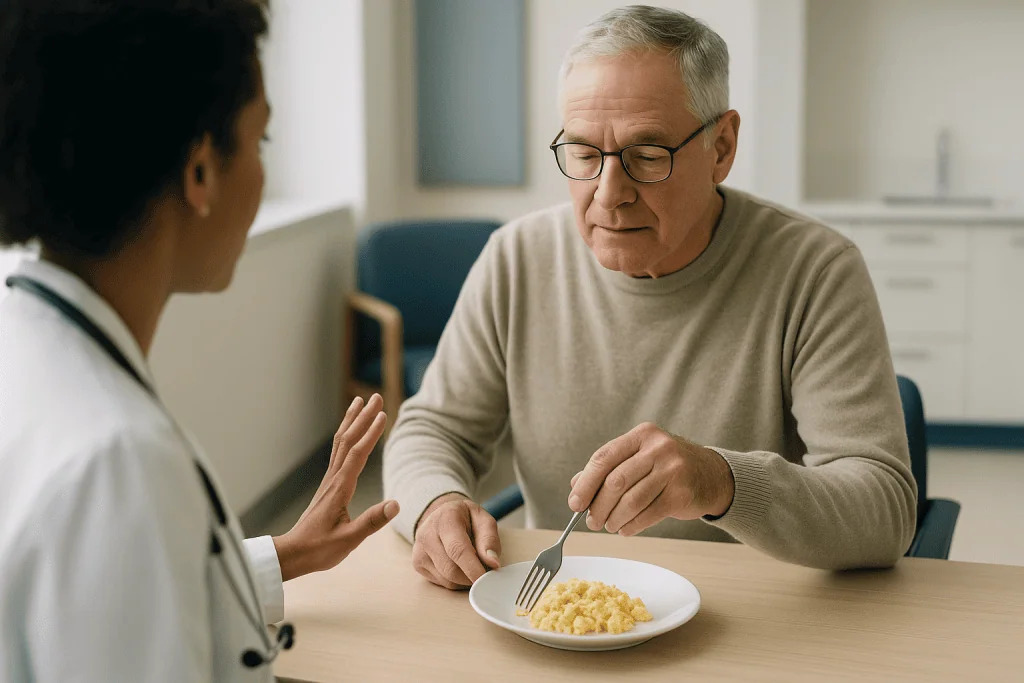
A rest tremor shows up when the limb is fully supported and relaxed, such as hands lying on the thighs. A postural tremor appears when you hold a position against gravity, arms stretched out in front. A kinetic or action tremor appears during a deliberate movement, like bringing a finger to your nose or reaching for a glass. Essential tremor is classically a postural and action tremor affecting both hands; Parkinson’s disease classically produces a rest tremor that often begins on one side, as the NIH’s National Institute of Neurological Disorders and Stroke (NINDS) describes.
So the clinician will ask you to sit with hands relaxed, then hold both arms out, then perform finger-to-nose movements, then possibly hold a cup or point at a target. They are watching for the moment the shaking starts, its rhythm, whether it has a fine fast quality or a slower coarse one, and whether it is symmetrical. NINDS notes that essential tremor typically oscillates at around 4 to 12 cycles per second, whereas the Parkinson’s rest tremor is usually slower, in the 4 to 6 range. An experienced eye can often estimate this without equipment.
The exam does not stop at the hands. The clinician checks muscle tone for stiffness, asks you to tap fingers quickly to look for slowing, watches you walk and turn, and listens for a tremulous voice or looks for a rhythmic head movement, both of which occur in some people with essential tremor but are unusual in early Parkinson’s. Reflexes, eye movements and coordination are checked too, because a tremor arising from the cerebellum, the brain’s balance and coordination center, comes with its own tell-tale signs.
Spiral drawing, handwriting and the water-pouring test
If you leave the appointment having drawn a snail shell on a piece of paper, you have had one of the most informative essential tremor tests available. The Archimedes spiral, a simple spiral drawn freehand from the center outward, is a standard part of the movement disorder examination, and Mayo Clinic lists it alongside handwriting and drinking from a glass as a routine performance task.
Why a spiral? Drawing it demands sustained, controlled action, exactly the situation that provokes an action tremor. In essential tremor the line typically wobbles in a regular, wavy pattern along its whole length, and it is often clearest in the hand you draw with and still visible, though usually milder, in the other. The clinician may ask you to draw one with each hand so the two can be compared.
Handwriting adds a second clue. People with essential tremor tend to produce large, tremulous script, the letters shaky but their size preserved. People with Parkinson’s disease frequently show the opposite: writing that starts at normal size and shrinks across the line, a sign called micrographia, meaning abnormally small handwriting. An old signature from a check or a passport can be a useful comparison if you have one.
Pouring water between two cups, or lifting a nearly full cup to the lips, tests the same thing in everyday terms and gives the clinician a sense of how much the tremor interferes with life rather than just whether it exists. Some clinics score these tasks on standardized rating scales, which makes it possible to compare visits years apart.
None of these tasks produces a diagnosis on its own. What they do is capture the tremor in action, in a form that can be filed, re-examined and, if needed, shown to a second specialist.
Which blood tests help rule out other causes of shaking hands?
Blood work cannot confirm essential tremor, but it can quietly dismantle several other explanations for shaking hands, which is why an essential tremor blood test panel is almost always part of the first round of investigation.

Thyroid function tests come first. An overactive thyroid speeds up metabolism and can produce a fine, fast tremor of the outstretched hands that looks very similar to essential tremor, often alongside weight loss, heat intolerance and a racing pulse. MedlinePlus specifically lists thyroid testing among the investigations used to exclude other causes. Because the tremor settles once the thyroid is treated, this is one of the most important look-alikes to catch.
Liver and kidney function tests follow. Advanced liver disease and kidney failure both allow substances to build up in the bloodstream that irritate the nervous system, producing tremor or a flapping movement of the hands. Blood sugar is checked, since low glucose triggers an adrenaline surge and shaking. Electrolytes such as calcium and magnesium may be included, along with vitamin B12, a deficiency of which can damage nerves.
In anyone whose tremor begins before roughly age 40, clinicians also consider Wilson disease, a rare inherited condition in which copper accumulates in the liver and brain. NINDS highlights it as a cause of tremor that must not be missed, because it is treatable and progressive if ignored. The screening tests are serum copper and ceruloplasmin, the protein that carries copper, sometimes with a 24-hour urine copper collection and an eye examination for copper rings in the cornea.
A completely normal panel is a reassuring result in this context. It tells the clinician that the tremor is not a symptom of a metabolic or hormonal illness elsewhere in the body, and it nudges the diagnosis toward a primary movement disorder, of which essential tremor is by far the most common.
Medicines, caffeine and stress: the tremor that mimics essential tremor
Every person alive has a tremor. Hold your hands out after three espressos and a sleepless night and you will see it. This normal background shaking is called physiological tremor, and when something amplifies it, the result is enhanced physiological tremor, the condition most often mistaken for essential tremor in a busy clinic.
The amplifiers are familiar. Mayo Clinic lists caffeine, stress, fatigue and temperature extremes as factors that make tremor more noticeable. Anxiety and alcohol withdrawal are classic triggers. Low blood sugar belongs on the list, as does an overactive thyroid, which is why the blood tests above are ordered.
Medicines deserve their own paragraph, and this is where a careful history earns its keep. Drug classes known to provoke or worsen tremor include certain asthma and bronchodilator medicines, some antidepressants, the mood stabilizer lithium, the anticonvulsant valproate, corticosteroids, some immunosuppressants and stimulant medicines. Cleveland Clinic and NINDS both note that medicine-induced tremor is common and usually improves when the responsible drug is adjusted or withdrawn under medical supervision.
This is not a cue to stop anything. Stopping an asthma inhaler or an antidepressant abruptly can be far more dangerous than the tremor it causes. The clinician’s job is to weigh whether a suspected medicine is genuinely contributing, whether an alternative exists and whether the timing of the tremor matches the start of the prescription. Bring a complete list, including over-the-counter products, supplements and anything you take only occasionally.
One distinguishing feature helps here. Enhanced physiological tremor tends to be faster and finer than essential tremor, it rarely runs in families, and it fluctuates with the trigger: better after a good week of sleep, worse before an exam. Essential tremor is steadier, present most days and slowly changing over years rather than hours.
Essential tremor vs Parkinson's: how clinicians tell them apart
The question underneath almost every tremor appointment is whether this is Parkinson’s disease. Both conditions involve shaking, and both become more common with age, but they arise in different parts of the brain and behave differently at the bedside. The table summarizes the features clinicians weigh, drawing on descriptions from NINDS and Mayo Clinic.
| Feature | Essential tremor | Parkinson’s disease tremor |
|---|---|---|
| When the shaking appears | Holding a posture or performing an action | At rest, easing with purposeful movement |
| Typical speed | About 4 to 12 cycles per second | About 4 to 6 cycles per second, often a ‘pill-rolling’ thumb and finger motion |
| Which side | Usually both hands, one may be worse | Often starts on one side |
| Head and voice | Rhythmic head nodding or shaky voice can occur | Head tremor uncommon; jaw or chin tremor more typical |
| Handwriting | Large and wobbly | Small and shrinking |
| Other signs | Usually none beyond tremor | Slowness, stiffness, reduced arm swing, soft voice, changes in facial expression |
| Family history | Present in about half of cases | Less often inherited |
Two features carry particular weight. A tremor present while the hand is completely at rest is the strongest single pointer toward Parkinson’s. The presence of slowness or stiffness alongside tremor, even subtle, moves the clinician in the same direction, because Parkinson’s is a disorder of movement as a whole rather than of tremor alone.
People sometimes mention that a glass of wine steadies their hands. Mayo Clinic notes that small amounts of alcohol can temporarily improve essential tremor, and clinicians will ask about it as one clue among many. It is not a diagnostic test, and no one should be drinking to check their tremor; alcohol can worsen the shaking afterward and carries its own risks.
When the exam is clear-cut, the distinction is often made in the room. When it is ambiguous, imaging helps.
When do a DaTscan, an MRI or tremor recordings help?
Scans enter the picture only when the clinical examination leaves a question open. Mayo Clinic states plainly that essential tremor does not require laboratory or imaging tests to diagnose, but the tests are valuable for excluding alternatives.
A DaTscan is a nuclear medicine study that uses a small injected tracer to show how much dopamine transporter protein is present in the striatum, a deep brain region. In Parkinson’s disease, the nerve endings that carry dopamine have died back, and the scan shows a reduced signal. In essential tremor the dopamine system is intact, so the scan looks normal. Clinicians order it when the exam cannot settle whether a tremor is Parkinsonian, for example in an older adult with a mixed rest and action tremor. A normal DaTscan does not diagnose essential tremor; it only indicates the tremor is not caused by dopamine loss.
A brain MRI, which uses magnetic fields to produce detailed images of brain structure, is usually normal in essential tremor. It is reserved for tremor with atypical features: sudden onset, one-sided symptoms, headache, weakness, numbness, speech changes or signs of cerebellar dysfunction. In those situations the scan is checking for stroke, multiple sclerosis, a tumor or other structural causes. A CT scan may be used when MRI is unavailable or unsuitable.
In specialist movement disorder clinics, tremor can also be measured electronically. Electromyography records the electrical activity of muscles through small surface sensors, and an accelerometer attached to the hand measures the tremor’s frequency and amplitude. Loading the hand with a small weight is a classic maneuver: enhanced physiological tremor tends to slow down under the added mass, whereas essential tremor tends to keep its frequency. These recordings are not routine and are mostly used in research settings or when a diagnosis has proven genuinely difficult.
At what age do most people get essential tremor, and does family history matter?
Essential tremor can begin at any age, including in childhood, but Mayo Clinic notes it is most common in people over 40, and prevalence rises steadily with each decade. Many clinicians describe two peaks, one in early adulthood and a larger one in later life, though the older group dominates numerically.
Age shapes the workup in a practical way. A new tremor in a person in their twenties prompts the copper tests for Wilson disease described earlier, along with a closer look at medicines and thyroid function. A new tremor in a person in their seventies raises the probability of Parkinson’s disease enough that the examination for slowness and stiffness becomes especially careful, and a DaTscan is more likely to be considered if the picture is mixed.
Family history is one of the strongest supporting clues in the entire assessment. Mayo Clinic reports that about half of cases appear to result from an inherited genetic change, passed in an autosomal dominant pattern, which means a child of an affected parent has a 50% chance of inheriting it. The inherited form is sometimes called familial tremor. Several genes have been linked to the condition, but none is used in routine testing, because no single gene explains more than a small share of cases and a negative result would not rule the condition out.
So when the clinician asks whether a parent, grandparent, aunt or sibling had shaky hands, a nodding head or a quavering voice, that question is doing real diagnostic work. People often dismiss a relative’s tremor as simply old age, so it is worth asking the family before the appointment. A clear history of the same action tremor across generations, in the absence of Parkinson’s features, makes essential tremor considerably more likely and can spare a person unnecessary imaging.
Can I test for essential tremor at home?
Not in any way that replaces an examination, but you can do something genuinely useful: document the tremor so the clinician sees it as it really is. Tremor is notorious for behaving in clinic, either flaring under the stress of being watched or vanishing for the ten minutes that matter.
A short phone video is the most valuable thing you can bring. Record your hands resting in your lap, then held out in front of you, then performing a task such as drinking from a cup or writing a sentence. Film both hands. Try to capture a bad moment and a typical one, and note what was going on at the time: how much coffee, how much sleep, what medicines were taken that morning and how you were feeling. Several clinicians specifically request this kind of footage because it shows the tremor in its natural setting.
Keeping a brief diary for a couple of weeks helps too. Note when the shaking is worst and best, which activities it disrupts, whether the head or voice is involved and whether anyone in the family has had something similar. A sample of your current handwriting next to an older signature is a small, concrete piece of evidence.
What you should not do is score yourself against an online checklist and arrive with a conclusion. Rest tremor, action tremor and enhanced physiological tremor can look identical to an untrained eye on a phone screen, and the distinguishing features, such as subtle slowness or a change in arm swing, are things a clinician tests for deliberately rather than things you can see in a mirror.
Treat home observation as evidence gathering, not diagnosis. The better the raw material you bring, the fewer visits and fewer tests it usually takes to reach a confident answer.
Who is tested straight away, and who is usually asked to wait and watch
The pace of investigation depends on how closely the tremor fits the classic pattern, and a sensible clinician will explain which group you fall into.
Fast-track features, the ones that trigger imaging, urgent referral or an expanded blood panel, include tremor that appeared suddenly rather than over months, tremor confined to one side, tremor present at rest, any accompanying weakness, numbness, speech difficulty, unsteadiness or headache, tremor beginning before age 40, tremor that started shortly after a new medicine, and tremor accompanied by symptoms of a general illness such as weight loss, palpitations, sweating or confusion. Each of these points to a diagnosis other than essential tremor, and several point to conditions where delay carries real cost.
The watch-and-wait group looks different. A gradual, symmetrical action tremor in an adult over 40, with normal screening bloods, no Parkinsonian signs on examination and a family history of the same thing, meets the clinical description of essential tremor closely enough that most clinicians will make the diagnosis without scans. NINDS and Mayo Clinic both describe the diagnosis as clinical in exactly this situation. Rather than ordering more tests, the plan is usually a follow-up review to confirm the tremor is behaving as expected over time, since essential tremor progresses slowly while other conditions tend to declare themselves.
Waiting is not the same as being dismissed. If the tremor interferes with eating, writing, dressing or work, treatment can be discussed at the same visit regardless of how mild the shaking looks in the room. Equally, a person in the watch-and-wait group who develops a new feature, such as stiffness on one side or a change in walking, should be reassessed rather than left on the original plan.
Referral to a neurologist, or to a movement disorder specialist, is usual when the diagnosis is uncertain, when the tremor is severe, or when first-line treatment has not helped.
What the following weeks usually look like after essential tremor tests
For most people the sequence is unhurried. The first appointment covers the history and examination, blood samples are taken the same day or soon after, and the results return before any decision about imaging is made. If the bloods are normal and the exam fits, the next conversation is often about whether treatment is wanted at all.
If a DaTscan is ordered, expect a referral to a nuclear medicine department. The scan involves a tracer injection followed by a waiting period before imaging, and the report goes back to the referring neurologist rather than being handed to you at the scanner. An MRI, if needed, is a separate appointment. Timelines for both vary widely by health system, so ask your care team what to expect locally rather than relying on a general figure.
When the diagnosis is essential tremor and the shaking is mild, many people choose observation plus practical adjustments: heavier cutlery, wrist weights for specific tasks, limiting caffeine, better sleep, and managing stress. Mayo Clinic notes that treatment is not needed when symptoms are mild.
When the tremor interferes with daily life, the medicines guidelines list first are beta blockers, which dampen the body’s adrenaline response, and the anticonvulsant primidone, which calms overactive nerve signaling. Both are described by Mayo Clinic and Cleveland Clinic as standard first options. Some people respond well, some partially, some not at all, and finding out typically takes several weeks of supervised adjustment. Whether to start, which to try and how to proceed are decisions for the prescribing clinician, who will weigh your other conditions and medicines.
For severe, treatment-resistant tremor, specialist procedures exist, including deep brain stimulation and focused ultrasound thalamotomy, both of which target the brain circuit responsible. They are considered only after a careful specialist assessment, with risks and alternatives laid out in full.
What people often get wrong about essential tremor and its tests
The first and most persistent error is believing essential tremor is early Parkinson’s disease or a milder version of it. They are distinct conditions with different mechanisms: Parkinson’s involves loss of dopamine-producing cells, while essential tremor is linked to abnormal signaling in the cerebellum and its connections, as NINDS describes. The question people ask, whether essential tremor is as bad as Parkinson’s, has a careful answer. Essential tremor does not shorten life, is usually slowly progressive and does not cause the stiffness, slowness and non-movement symptoms of Parkinson’s. It can nonetheless be seriously disabling, making eating in public, writing and fine work difficult, which is why the older label ‘benign essential tremor’ has fallen out of favor. Different, not necessarily trivial.
The second error is treating a normal MRI as proof that nothing is wrong. A normal scan is the expected finding in essential tremor. It excludes structural disease; it does not exclude the diagnosis.
The third is the reverse: assuming a DaTscan can diagnose essential tremor. It cannot. It measures the dopamine system and answers one question only, whether the tremor is Parkinsonian.
Fourth, people assume that shaky hands in later life are simply part of aging and never raise it. Tremor is common with age, but it always has a cause, and some of those causes, thyroid disease and medicine effects among them, respond to treatment.
Fifth, people conclude that because alcohol eases the tremor it must be essential tremor, or that because they shake they must be nervous or drinking. Alcohol responsiveness is a clue, not a test, and tremor is a neurological sign, not a character flaw.
Finally, a surprising number of people believe a genetic test will settle the matter. No routine genetic test exists for essential tremor, and family history, gathered by simply asking relatives, is the only inherited clue in standard use.
Questions to ask your care team
A good appointment is a two-way exchange, and specific questions tend to get more useful answers than general ones. These are the questions seasoned patients and clinicians suggest bringing.
- Based on what you saw today, does my tremor fit the pattern of essential tremor, or are there features that point elsewhere?
- Which blood tests are you ordering, and what would an abnormal result in each one mean for me?
- Do I need a brain scan or a DaTscan, and if not, what finding would change your mind?
- Could any of my current medicines or supplements be causing or worsening the shaking, and how would we find out safely?
- Is there anything in my family history you would like me to check with relatives?
- Should I be referred to a neurologist or a movement disorder specialist, and at what point?
- If this is essential tremor, how do you expect it to change over the coming years?
- What non-medicine strategies are worth trying first, and how will we judge whether they are enough?
- If medicines are considered, what are the main options, how long does it usually take to know whether one is helping, and what side effects would you want to hear about?
- What new symptoms should prompt me to come back earlier than planned?
Write the answers down or ask whether the clinic can summarize them in your record. Tremor appointments cover a lot of ground, and the details about what was and was not excluded are the ones most people wish they had remembered.
Bringing a family member or friend can help, both as a second pair of ears and because they may have noticed changes in your movement, posture or voice that you have adapted to without realizing.
When to call your doctor
Most tremor is not an emergency, but a few patterns need prompt attention, and the distinction is worth knowing.
Call emergency services immediately if shaking begins suddenly alongside weakness or numbness on one side of the body, drooping of the face, slurred or confused speech, sudden loss of balance, sudden severe headache or any change in consciousness. These are features of stroke or another acute brain event, and treatment is time-critical.
Seek same-day care if tremor comes with fever, confusion, a very fast heartbeat, severe agitation, heavy sweating or vomiting, especially after recently stopping alcohol or a sedative medicine, or if a new tremor develops within days of starting a new prescription.
Arrange a routine appointment, sooner rather than later, if you notice any of the following.
- Shaking that is present while your hands rest completely still.
- Tremor that affects only one side, or started in one limb and stayed there.
- New slowness, stiffness, smaller handwriting, a softer voice or reduced arm swing when walking.
- Tremor beginning before age 40, particularly with fatigue, jaundice or changes in mood or behavior.
- Shaking accompanied by weight loss, heat intolerance, palpitations or a visibly enlarged neck.
- Unsteadiness, falls, double vision or difficulty coordinating movements.
- Tremor that has worsened noticeably over weeks rather than years, or that now interferes with eating, drinking, writing or work.
If you have already been diagnosed with essential tremor, the same rule applies: any feature that does not fit the original diagnosis is a reason to be re-examined, not to assume it is simply progression. The care team that knows your history is best placed to decide whether further tests, a change in plan or a specialist opinion is the right next step.
Frequently asked questions
At what age do most people get essential tremor?
Essential tremor can begin at any age, but Mayo Clinic notes it is most common in people over 40, and prevalence rises with each decade; Cleveland Clinic puts it at roughly 5% of adults over 60. A smaller group develops it in early adulthood, often with a strong family history. Tremor starting before 40 prompts additional blood tests for copper to rule out Wilson disease.
Can I test for essential tremor at home?
No home test can confirm essential tremor, but you can gather useful evidence. Film your hands at rest, held out, and during a task like drinking or writing, note caffeine, sleep and medicines at the time, and keep a short diary of when shaking is worst. Bring this to the appointment; it helps the clinician see the tremor in its natural setting rather than only in the clinic.
Is essential tremor as bad as Parkinson's?
They are different conditions rather than points on one scale. Essential tremor does not shorten life and usually progresses slowly, and it lacks the stiffness, slowness and non-movement symptoms of Parkinson’s disease. It can still be disabling, affecting eating, writing and work, which is why clinicians no longer call it benign. Your care team can explain what the diagnosis is likely to mean for you specifically.
What can be mistaken for essential tremor?
The most common look-alike is enhanced physiological tremor, normal shaking amplified by caffeine, stress, fatigue, low blood sugar, alcohol withdrawal or medicines such as some asthma, antidepressant, anticonvulsant and steroid drugs. An overactive thyroid produces a similar fine tremor. Parkinson’s disease, dystonic tremor, cerebellar disorders and, in younger people, Wilson disease are other possibilities the examination and blood tests are designed to separate.
How is essential tremor diagnosed if there is no specific test?
Clinicians combine a detailed history, including family history and medicines, with a neurological examination that watches the tremor at rest, in posture and during action, often using spiral drawing, handwriting and cup tasks. Blood tests exclude thyroid, liver, kidney, glucose and copper problems. If the pattern fits and nothing points elsewhere, the diagnosis is made clinically; scans are added only when features are atypical.
What does an essential tremor blood test actually check?
There is no blood test for essential tremor itself. The panel checks for other causes of shaking: thyroid hormones for an overactive thyroid, liver and kidney function, blood glucose, electrolytes and sometimes vitamin B12. In people under about 40, serum copper and ceruloplasmin screen for Wilson disease. Normal results support a primary movement disorder diagnosis by removing the alternatives.
Essential tremor vs Parkinson's: what is the single clearest difference?
Timing. The Parkinson’s tremor appears when the hand is completely at rest and eases with movement, while essential tremor appears when holding a position or performing a task, as NINDS describes. Parkinson’s also brings slowness and stiffness, usually starting on one side, and small shrinking handwriting; essential tremor typically affects both hands with large shaky writing and sometimes a head or voice tremor.
Can a DaTscan or MRI diagnose essential tremor?
Neither can. A DaTscan measures dopamine transporter in the brain and is reduced in Parkinson’s disease but normal in essential tremor, so it answers only whether a tremor is Parkinsonian. An MRI is usually normal in essential tremor and is ordered to exclude stroke, multiple sclerosis or a tumor when the tremor has unusual features. A normal scan is consistent with essential tremor but does not prove it.
What causes shaking hands besides essential tremor?
Common causes include enhanced physiological tremor from caffeine, anxiety, fatigue or low blood sugar; medicine side effects; an overactive thyroid; alcohol withdrawal; and Parkinson’s disease. Less common causes include cerebellar disorders, multiple sclerosis, stroke, peripheral nerve damage and Wilson disease in younger people. Because several of these are treatable, new or changing tremor deserves a proper assessment rather than being put down to age.
Do I need to see a neurologist for essential tremor tests?
Not always. A primary care clinician can take the history, perform the examination and order screening blood tests, and many typical cases are diagnosed at that level. Referral to a neurologist or movement disorder specialist is usual when the diagnosis is uncertain, when features suggest Parkinson’s or another condition, when the tremor is severe, or when initial treatment has not helped. Your care team decides based on the findings.
References
- NIH NINDS: Tremor
- MedlinePlus: Essential tremor
- Cleveland Clinic: Essential tremor
- NHS: Tremor or shaking hands and arms
This article is for general information only and is not a substitute for professional medical advice. Please consult a qualified doctor about your individual situation.

More from the Blog

Questions to Ask Before Starting Immunotherapy for Myasthenia Gravis
Before starting immunotherapy for myasthenia gravis, ask why this treatment is being proposed now, which medicine class is recommended and why, how long it…

What Happens on Deep Brain Stimulation Surgery Day for Parkinson’s Disease? Step by Step
On DBS surgery day for Parkinson's disease, a neurosurgical team maps the brain with imaging, secures the head with a frame or a frameless…

Which Medicines Can Worsen Myasthenia Gravis? What Your Team Checks Before Any Prescription
Several medicine classes can worsen myasthenia gravis by interfering with signaling between nerves and muscles. The best-documented include aminoglycoside and fluoroquinolone antibiotics, macrolides, intravenous…

Spinal Cord Disorders: How Imaging, Surgery and Rehabilitation Are Matched to the Cause
Spinal cord disorders are treated according to their cause, not their symptoms alone. Imaging, usually MRI, first shows whether the cord is being compressed,…

Preparing for a Cerebral Palsy Assessment: What Parents Are Asked to Bring and Describe
Preparing for a cerebral palsy assessment usually means gathering pregnancy, birth and newborn records, a list of your child's medical history and current concerns,…
What Does Video EEG Monitoring Show That a Routine EEG Cannot in Epilepsy Care?
Video EEG monitoring records brain-wave activity and a synchronized video of the person for many hours or several days, so clinicians can see what…