

Who Is a Candidate for J Plasma? Mild Loose Skin vs Cases That Need a Surgical Lift
Key Takeaways
- Subdermal J Plasma is a heat tool used inside a liposuction procedure; it contracts skin modestly and removes nothing, so a hanging fold is beyond what it can do.
- In the US the device is cleared for tissue contraction after liposuction and for loose neck and under-chin skin; use elsewhere is off-label and rests on the surgeon's judgement and limited studies.
- Surgeons judge candidacy by skin recoil on the pinch test, whether skin drapes into a true fold, stretch-mark density and abdominal muscle integrity, not by age.
- Separated abdominal muscles (diastasis recti) cause a bulge no skin treatment corrects, which is why Mayo Clinic describes muscle repair as a core part of a tummy tuck.
- Recovery follows liposuction guidance: the NHS describes several weeks in a compression garment and up to about six months for the area to settle fully.
- Device-specific risks include burns from beneath the skin and trapped gas that can spread toward the chest, on top of the standard liposuction risks of infection, seroma and contour irregularity.
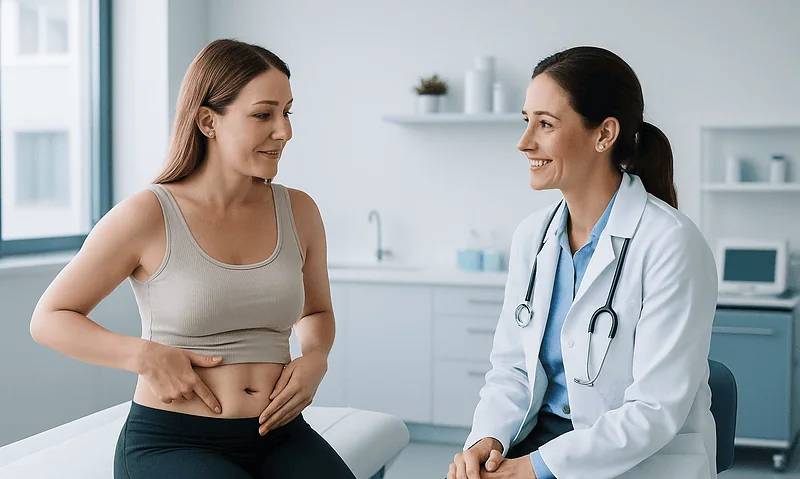
A typical J Plasma candidate has mild to moderate loose skin with reasonable elasticity, a stable weight, and is already planning liposuction in the same area, since the helium plasma energy is delivered under the skin through those access points. People with a hanging skin fold, separated abdominal muscles, or heavily stretch-marked skin are usually better served by a surgical lift. Only an in-person assessment by a qualified surgeon can settle which group you fall into.
The mirror in a changing room is honest in a way the bathroom one at home never is. You have lost the weight, or had the babies, or simply turned fifty, and the number on the scale is finally where you wanted it. Yet the skin at the lower belly, or the inner arm, gathers slightly when you lean forward. It is not a fold. It is not an apron. It is just a little too much of you for the frame underneath.
That is the exact moment most people type “j plasma candidate” into a phone at midnight. The pitch they find is seductive: a wand, a few small incisions, tighter skin, no long scar. The reality is narrower and more interesting.
This explainer walks through who the procedure is usually offered to, who is usually asked to wait or to consider a lift instead, what the evidence actually shows, and how to tell mild laxity from the kind of skin excess that only a scalpel resolves.
What is J Plasma, and why does the name confuse people?
J Plasma is a trade name. The device behind it delivers helium gas that has been energized by radiofrequency current, which turns the gas into plasma: a hot, electrically charged stream that transfers heat to tissue in a very controlled burst. The generic description you will see in medical writing is helium plasma radiofrequency, or helium-based subdermal tightening. Another trade name is often used interchangeably, which is part of why online searches feel like a hall of mirrors.
Two very different uses hide under the same name. The first, and the one this article is about, is subdermal use: a slim wand is passed beneath the skin through the small openings made for liposuction, and the energy heats the underside of the skin and the connective tissue just below it. The second is surface use, in which the plasma is swept across the outside of the skin as a resurfacing treatment. Surface use has drawn regulatory safety communications in the United States about burns and other injuries, and it is not what most surgeons mean when they discuss loose skin after liposuction.
Regulatory clearance in the US is specific and limited. The device has clearance for contracting the soft tissue beneath the skin after liposuction, and for loose skin in the neck and under the chin. Use anywhere else, or for any other purpose, is off-label. Off-label use is legal and common in surgery, but it shifts the weight of proof onto the individual surgeon and the published studies, not onto the clearance itself.
It also helps to know what J Plasma is not. It is not a laser, not focused ultrasound, and not the radiofrequency microneedling done in a dermatology chair. It does not remove skin, and it does not remove fat on its own. It is a heat tool used inside a surgical procedure. Framing it that way from the start makes every later question about candidacy easier to answer.
How J Plasma skin tightening works, in plain language
Picture the skin as a three-layer structure. The epidermis is the thin surface you can see. The dermis beneath it is a thick mat of collagen and elastin, the proteins that give skin its firmness and snap. Under that sits the subcutaneous layer, mostly fat, threaded through with fine collagen bands that tether skin to the deeper tissue. Surgeons call those bands the fibroseptal network. When they slacken with age or weight change, skin drapes rather than clings.
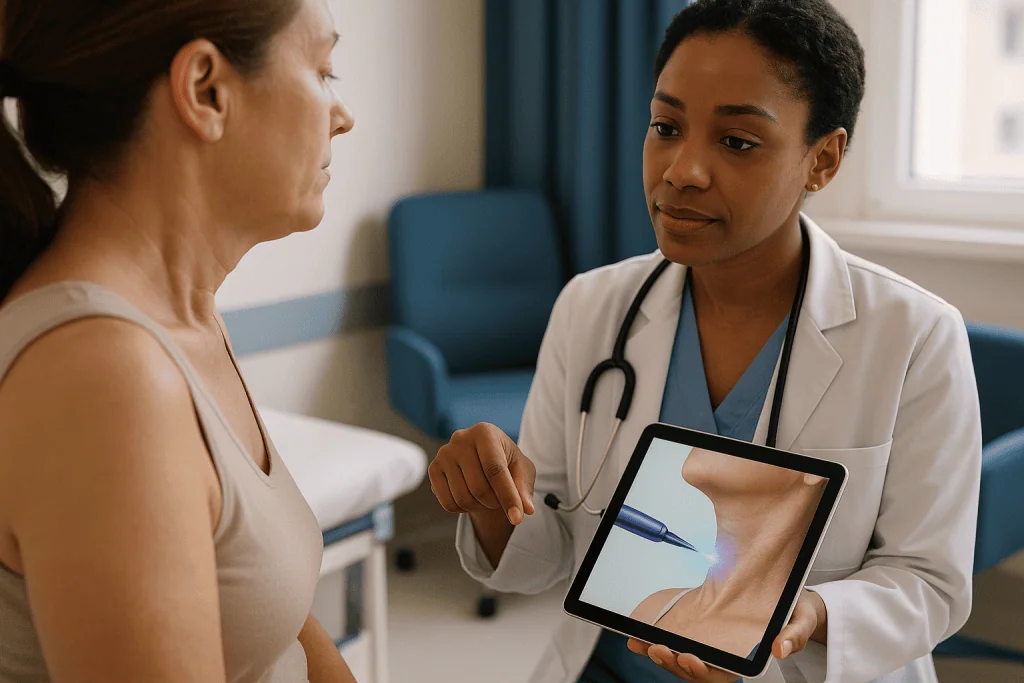
Liposuction comes first. The surgeon infuses fluid, breaks up fat with a cannula (a thin hollow tube), and suctions it out, which creates a tunnel-like space under the skin. The plasma wand is then passed through the same openings into that space. Each pass delivers a short pulse of heat to the underside of the dermis and the collagen bands.
Two things follow. Collagen fibers contract almost immediately when heated to a critical temperature, which is why surgeons often see the tissue draw in on the table. Then the body treats the heated zone as a mild injury and responds with a healing cascade that lays down new collagen over the following months. The second phase is slower, less predictable, and depends heavily on how well your own tissue heals.
Helium is used because it ionizes at a relatively low energy and the plasma cools quickly once the pulse stops. The design intent is to heat a thin band of tissue very fast and let it cool before heat spreads sideways. That is the theoretical safety margin, and it is also why the tool demands a practised hand: too long in one spot and the heat reaches the skin surface.
Notice what the mechanism does not include. Nothing is excised. No muscle is repaired. The skin you have is encouraged to shrink a little onto a smaller frame. If there is more skin than any amount of shrinkage could account for, the mechanism has nothing to offer.
Who is a J Plasma candidate? The profile surgeons usually describe
The candidacy question is a skin question far more than a weight question. Surgeons who use helium plasma routinely describe a fairly consistent profile of the person who tends to be offered it.
- Mild to moderate laxity. The skin gathers or wrinkles when pinched or when the body bends, but there is no true fold that hangs when standing straight.
- Reasonable skin quality. Skin that still snaps back when released, without extensive stretch marks or a thin, crepe-paper texture, has more intact collagen to contract.
- Already planning liposuction. Because the wand travels through the liposuction tunnels, the procedure is an add-on to fat removal rather than a stand-alone treatment for most body areas.
- Stable weight. Both the NHS and Mayo Clinic advise that body contouring surgery is best considered once weight has stopped changing, because further loss or gain undoes the result.
- Good general health. No uncontrolled bleeding tendency, no active infection at the site, well-controlled long-term conditions, and a willingness to stop smoking around the time of surgery.
- Realistic expectations. The person is hoping for skin that sits a little tighter over a slimmer contour, not for the drum-flat result of a surgical lift.
Body areas where surgeons most often describe using it include the neck and under the chin (the one non-liposuction indication with clearance), the upper arms, the inner thighs, the abdomen and flanks, the bra-line and back, and the area just above the knees. Each of these is a place where liposuction alone can leave skin looking slightly deflated in someone who was on the edge of needing a lift.
One more trait tends to matter: age is less important than skin behaviour. A forty-year-old with sun-damaged, striated skin may be a poorer fit than a sixty-year-old with thick, elastic skin. The surgeon is reading tissue, not a birth certificate.
Who is not a J Plasma candidate yet, or is steered toward something else
A good consultation spends as much time on reasons to wait as on reasons to proceed. These are the situations in which surgeons commonly defer or redirect.

Weight is still moving. Anyone mid-way through a weight-loss plan, recently out of bariatric surgery, or planning another pregnancy is usually asked to wait. The NHS guidance on tummy tuck surgery is blunt that operating before weight is stable risks a result that does not last, and the same logic applies to any tightening procedure.
There is a true skin fold. If skin hangs over the waistband or drapes from the upper arm when it is held out level, that is excess, not laxity. Heat can shrink skin by a modest margin; it cannot make a fold disappear. This is the single most common reason a hopeful J Plasma candidate is told a lift is the honest option.
The abdominal muscles have separated. Diastasis recti, a gap between the two vertical abdominal muscles that is common after pregnancy, produces a bulge that no skin treatment touches. Mayo Clinic describes muscle repair as a core part of abdominoplasty for exactly this reason.
The skin is heavily stretch-marked or very thin. Stretch marks are small tears in the dermis. Skin riddled with them has less intact collagen to contract and heals less predictably.
Healing is compromised. Active smoking, poorly controlled diabetes, connective tissue disorders, a history of keloid scarring, or medicines that suppress immunity all raise the risk of wound problems. Mayo Clinic lists smoking as a reason surgeons decline or postpone body contouring because it slows healing and raises complication rates.
Implanted electrical devices. Radiofrequency energy can interfere with pacemakers and similar devices, so the treating team will want cardiology input or may advise against it.
None of these is a judgement about the person. They are statements about tissue and timing, and many people who are asked to wait become reasonable candidates later.
Mild loose skin vs cases that need a surgical lift: how the judgement is actually made
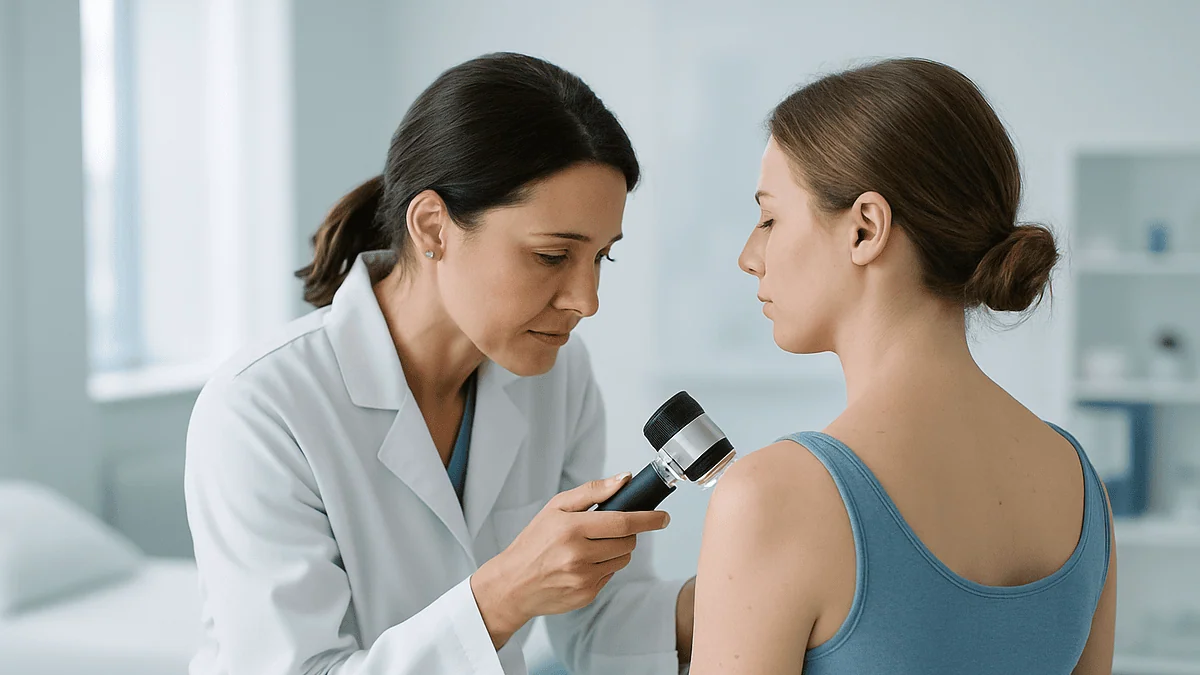
Surgeons rarely reach for a ruler. The assessment is a set of hands-on observations that together sort laxity into rough tiers. Knowing what they are looking for helps you understand the answer you receive.
The pinch and release. The surgeon gathers skin between thumb and finger, lets go, and watches how quickly it flattens. Skin that recoils promptly still has working elastin. Skin that settles slowly, like a cushion refilling, has lost much of its recoil and will contract less from heat.
The drape test. On the arm, you hold the limb out level and the surgeon looks at how much tissue hangs below the bone. On the abdomen, you lean forward, and the surgeon judges whether the skin merely wrinkles or forms a fold with a crease beneath it. A crease that stays damp or irritated is a fold, and folds are surgical territory.
The stretch-mark map. Wide, silvery striae across the lower belly tell the surgeon that the dermis has torn in many places and that contraction will be patchy.
The muscle check. Lying flat and lifting the head lets the surgeon feel for a gap between the abdominal muscles. If one is present, the conversation shifts to abdominoplasty, because the bulge people dislike is coming from beneath the skin, not from the skin itself.
The frame beneath. Liposuction with heat tightening works when there is a modest fat layer to remove and skin that can be coaxed onto the smaller shape. Very lean people with loose skin have little for liposuction to do, and heat alone offers less than they hope.
Roughly speaking, surgeons describe three tiers. Mild laxity with good recoil and little fat excess: heat tightening may be an option. Moderate laxity with some fat: liposuction plus heat, with the understanding that a limited lift might still be needed later. A fold, a muscle gap, or poor skin quality: a surgical lift, sometimes combined with liposuction elsewhere. The consultation is about placing you honestly in one of those tiers, and a surgeon who places you in the first when you belong in the third is doing you no favour.
J Plasma vs tummy tuck, arm lift and facelift: a side-by-side comparison
The clearest way to see where helium plasma fits is to set it beside the operations it is most often pitched against. The recovery figures below are typical ranges from public health sources for the surgical procedures; the plasma add-on is performed inside a liposuction procedure, so liposuction recovery guidance applies to it.
| Feature | Liposuction with helium plasma tightening | Surgical lift (tummy tuck, arm lift, facelift) |
|---|---|---|
| Main aim | Remove a modest fat layer and encourage the remaining skin to contract | Remove excess skin, reposition tissue, repair muscle where needed |
| Suits | Mild to moderate laxity with good skin recoil | True skin folds, muscle separation, poor skin quality |
| Cannot address | Hanging skin, separated abdominal muscles, stretch marks | Nothing structural is excluded, but scars are the trade-off |
| Scars | Small liposuction access points | Long incisions: hip to hip for a tummy tuck, elbow to armpit for an arm lift, around the ear for a facelift |
| Anesthesia | Local with sedation or general, decided by the team | Usually general |
| Typical recovery | NHS: a few weeks in a compression garment, up to about six months for the area to settle | Mayo Clinic and NHS: about six weeks to return to normal activity after a tummy tuck; several weeks for arm lift and facelift |
| Evidence base | Small, mostly short-term studies; regulatory clearance for limited indications | Decades of surgical literature and established technique |
| Reversibility if unhappy | Skin excess can still be lifted later | Excision is permanent; revision is possible |
The table makes one point that marketing rarely does. Choosing heat tightening does not close the door to a lift later, but it also does not replace one. For someone genuinely on the border, surgeons sometimes frame it as a reasonable first step with a clearly explained chance of needing more. For someone with a fold, it is a detour that costs time and a second recovery.
Does J Plasma really tighten skin? What the evidence shows
The honest answer has two halves. Yes, heating the underside of the skin to the right temperature contracts collagen, and that is basic tissue physiology, not marketing. Whether the amount of contraction is meaningful, lasting, and safe enough to justify the added risk is a question the current literature answers only partly.
What exists is mostly small case series and prospective single-arm studies, meaning groups of patients treated and followed, without a comparison group who had liposuction alone. Several were sponsored or supported by the manufacturer. Follow-up is often measured in months rather than years. Outcomes are frequently assessed by surgeon rating or patient satisfaction, and there is no standard, widely accepted way to measure “tightening” that lets one study be compared with another.
The regulatory clearance for soft-tissue contraction after liposuction was based on such data, and it tells you the regulator accepted that the device does what it says in that setting. It does not tell you how much better the result is than liposuction with a well-fitted compression garment and time, because that head-to-head evidence is thin.
There is also the matter of what the studies did not follow. Long-term durability, the behaviour of treated skin through later weight change or pregnancy, and outcomes in people with poorer skin quality are not well documented.
Given that, guideline-level language would be cautious: the device produces measurable short-term tissue contraction after liposuction in selected patients; comparative and long-term evidence is limited; surface resurfacing use has prompted safety warnings. That is a legitimate basis for a surgeon to offer it to a well-chosen patient with informed consent. It is not a basis for describing it as a proven alternative to a surgical lift, and any consultation that does so is overstating what is known.
What actually happens on the day of the procedure
The procedure begins well before the operating room. At the consultation, expect photographs, the pinch and drape tests described earlier, a medical history that goes into smoking, medicines, past surgeries and clotting problems, and a frank conversation about what heat can and cannot do for your particular skin. Some teams ask for routine blood tests. MedlinePlus advises telling the team about every medicine and supplement you take, because some affect bleeding.
On the day, marking comes first. With you standing, the surgeon draws the zones for fat removal and the zones for heat, since skin behaves differently upright than lying down. Anesthesia is chosen by the team according to the extent of the work: local anesthetic with sedation for smaller areas, general anesthesia for larger or multiple areas.
Tumescent fluid is infused next. This is a dilute solution containing local anesthetic and a medicine that narrows blood vessels, which reduces bleeding and bruising and swells the fat so it is easier to remove. Liposuction follows through openings a few millimetres wide.
The plasma wand is then introduced through those same openings. The surgeon moves it in overlapping passes beneath the skin, often with a hand on the surface to feel for warmth and avoid lingering. A gas stream is part of the process, so some helium remains under the skin afterward and is gradually absorbed. In many settings the openings are left open or loosely closed so fluid and gas can escape.
You leave in a compression garment that presses the skin against the newly contoured surface beneath. Most people go home the same day. Because sedation or general anesthesia is involved, an adult needs to take you home and stay with you, and driving is off the table until the team says otherwise.
What the following days and weeks usually look like
The first week is about swelling, and the amount surprises people. Treated areas feel firm, tender and puffy, and bruising can spread beyond the treated zone as fluid tracks downward. Numbness or a strange tight sensation across the skin is common and reflects small sensory nerves recovering from the liposuction and the heat.
Compression is the daily discipline. The NHS liposuction guidance notes that a support garment is usually worn for several weeks after surgery, and surgeons who add heat tightening tend to be strict about it, because the garment holds the contracted skin against the underlying contour while healing fixes it in place.
A soft, crackling feel under the skin can occur in the early days as residual helium is absorbed. Your team should tell you what is expected in your case; anything spreading toward the chest or neck belongs in the red-flag section below.
Most people return to desk-based work within a couple of weeks, in line with the NHS estimate for liposuction, and are steered away from heavy lifting and vigorous exercise until the surgeon clears them, commonly in the range of a few weeks. Walking early is encouraged because it lowers the risk of blood clots.
Then comes the long middle. Swelling fades over weeks, but the treated area can stay firm, lumpy or uneven for longer as the deeper tissue remodels. The NHS notes that it can take up to about six months for an area to settle fully after liposuction, and surgeons who use heat tightening generally ask patients to judge the skin result at least that far out, once collagen remodeling has run its course.
Follow-up visits are not optional extras. They are when the surgeon checks healing, spots a fluid collection early, and decides whether a small adjustment is needed. Skipping them is the most common self-inflicted wound in the recovery period.
Risks and complications, described in neutral clinical terms
Two sets of risks stack on top of each other: those of liposuction, and those specific to running heat beneath the skin.
Liposuction risks are well documented. MedlinePlus and the NHS list bleeding, infection, contour irregularities (lumps, dents or asymmetry), fluid collections beneath the skin called seromas, persistent swelling, numbness that can last months, skin discolouration, and, rarely, blood clots in the legs or lungs, fat entering the bloodstream, or injury to deeper structures. Larger-volume procedures carry more risk than smaller ones.
Heat adds its own list. The most discussed is thermal injury to the skin surface: if the wand lingers, or the tissue between wand and skin is very thin, the skin can burn from beneath, leaving a blister, a dark or pale patch, or, in severe cases, a full-thickness wound that heals with a scar or needs surgical care. Subcutaneous emphysema, gas trapped under the skin, is expected in small amounts but can occasionally be extensive; tracking of gas toward the chest has been reported and is treated as urgent. Nerve irritation can cause prolonged burning or tingling. Prolonged firmness, pigment changes, and irregular contraction that leaves the skin wavy rather than smooth are also described. Revision surgery is sometimes needed.
Regulators in the United States have issued safety communications about the device when used for surface resurfacing, citing reports of burns, infection and scarring. That is a different technique from subdermal use, but it is a reminder that the energy involved is real.
Alternatives deserve equal airtime in the consent conversation: liposuction alone with compression and time, a formal surgical lift, non-invasive energy treatments with their own limited evidence, or simply not treating. A well-run consultation walks through each of these without steering.
How long does J Plasma last? A realistic view
Nobody can give you a number that is both honest and precise, because the studies have not followed people long enough and because the answer depends on you more than on the device.
Start with what the treatment leaves behind. The contracted collagen and any new collagen laid down during healing are your own tissue. They do not carry an expiry date, but they age at the same rate as the rest of your skin. MedlinePlus describes the ordinary changes of aging skin: the dermis thins, collagen and elastin fibres lose strength, and the subcutaneous fat layer shrinks. A treated area does not escape that process; it simply starts from a slightly tighter baseline.
Weight is the bigger variable. Gaining a significant amount stretches skin again; losing a significant amount leaves it loose again. This is why surgeons insist on stable weight beforehand and why results tend to hold better in people whose weight stays steady afterward. Pregnancy after abdominal treatment stretches the skin and abdominal wall regardless of what was done before.
Sun exposure and smoking both degrade collagen. Mayo Clinic identifies ultraviolet light as the leading cause of premature skin aging and notes that smoking accelerates wrinkling by narrowing blood vessels and damaging collagen. A person who protects their skin from both will generally hold any contouring result longer than one who does not.
How does this compare with a surgical lift? Excised skin does not come back, so a lift removes excess permanently, but the remaining skin still ages and loosens over years. Neither approach stops time.
The practical framing surgeons tend to offer is this: judge the result once the tissue has fully settled, expect it to age with you thereafter, and understand that the durability question cannot yet be answered from robust long-term data. Anyone quoting a guaranteed number of years is guessing.
What people often get wrong about J Plasma
Because the procedure is marketed heavily online, a set of durable misunderstandings has grown up around it. Correcting them changes the questions people bring to a consultation.
It melts fat. It does not. Fat is removed by liposuction, a mechanical process. The plasma energy is directed at the underside of the skin and the connective tissue, not at bulk fat, and using it to try to dissolve fat would be both ineffective and dangerous.
It replaces a tummy tuck. Only in the sense that a modest amount of tightening can spare some borderline patients an operation they might otherwise have had. For anyone with a skin fold or separated muscles, it replaces nothing.
It is non-surgical. Subdermal helium plasma is performed inside a liposuction procedure under sedation or general anesthesia, with incisions, a compression garment and weeks of recovery. Calling it non-surgical describes the scar length, not the experience.
You see the result straight away. Some contraction happens on the table, but swelling hides it for weeks and remodeling continues for months. Early photographs are almost always misleading in both directions.
It is the same as a plasma pen. Hand-held plasma pens used on the skin surface for eyelids or fine lines are a different technology, a different depth and a different evidence base.
Anyone with loose skin qualifies. Skin quality, weight stability, muscle integrity and general health all decide candidacy, and a fair proportion of people who ask about it are gently redirected.
More heat means more tightening. Beyond the temperature at which collagen contracts, additional heat does not add benefit; it adds burn risk. Restraint is a feature of good technique, not a shortcoming.
It is proven. It is cleared for specific uses on the basis of limited studies. That is a meaningful distinction, and the honest surgeon will make it before you do.
Questions to ask your care team before deciding
A consultation is a two-way examination. These questions are the ones that tend to produce the most useful answers, and the way a surgeon responds to them tells you a great deal.
- Based on my skin, which tier do you place me in: mild laxity suited to heat tightening, borderline, or someone who really needs a lift? What did you see that led you there?
- If I have liposuction alone with good compression, how different do you expect my skin to look compared with adding heat? What is that expectation based on?
- Is the area you propose treating within the device’s regulatory clearance, or is this off-label use? If off-label, what evidence supports it for this area?
- How many of these procedures have you performed, and what complications have you personally seen, including burns and trapped gas?
- What is your plan if the skin contracts unevenly or a burn occurs? Who manages it, and does the surgical fee cover revision?
- Which anesthesia do you recommend for me, and who administers it?
- What is the realistic chance that I will still want or need a surgical lift afterward?
- How long will I wear compression, when can I return to work and exercise, and when should I judge the final result?
- What would make you cancel or postpone my surgery on the day?
- May I see photographs of patients with skin similar to mine, at least six months after treatment, rather than early results?
- What are my alternatives, including doing nothing for now?
Write the answers down or bring someone who will. The decision to proceed, defer or choose a different operation should be reached jointly with the treating team, with your skin and your health in front of them, not with a search result.
When to call your doctor after J Plasma or any body contouring procedure
Some discomfort, swelling, bruising and numbness are expected. The signs below are not, and each warrants a same-day call to your surgical team, or emergency care where indicated.
- Fever, spreading redness or warmth around an incision, foul-smelling or increasing discharge, or an incision that opens. These can indicate infection, which needs prompt assessment.
- A patch of skin over the treated area that turns white, grey, dark or purple, blisters, or feels dead to the touch. This can signal a thermal injury to the skin and should be seen quickly, because early care changes the outcome.
- A crackling or bubbling feeling under the skin that is spreading, especially toward the chest, neck or face. Small amounts of trapped gas are expected; spreading gas is not, and it must be checked.
- Chest pain, sudden shortness of breath, coughing up blood, or a racing heartbeat. Call emergency services. These can indicate a blood clot in the lung, a collapsed lung or gas in the chest.
- Pain, swelling, warmth or redness in one calf. This may be a clot in a leg vein and needs urgent assessment.
- Severe or worsening pain that is not controlled by the plan your team gave you, particularly if one side is much worse than the other.
- Rapid swelling on one side, a tense area that feels like a water balloon, or fresh bleeding that soaks through dressings. Fluid or blood collections need draining before they cause problems.
- Dizziness, fainting, confusion, or very little urine over a day. These can point to dehydration, bleeding or a medication reaction.
You are not being a nuisance by calling. Surgical teams would far rather hear about a false alarm than see a burn or an infection late. Keep the after-hours number somewhere you can find it at two in the morning, and use it.
Frequently asked questions
Is J Plasma really worth it?
It can be worthwhile for a narrow group: people with mild to moderate loose skin, good skin recoil and a stable weight who are already having liposuction. For them it may spare a lift. For anyone with a true skin fold, separated muscles or heavily stretch-marked skin, it adds cost, risk and recovery without solving the problem. The judgement rests on an in-person assessment of your skin with a qualified surgeon.
Does J Plasma really tighten skin?
Heating the underside of the skin does contract collagen, and short-term studies show measurable tissue contraction after liposuction in selected patients, which is the basis of its regulatory clearance for that use. What remains uncertain is how much it adds beyond liposuction with compression and time, and how long the difference lasts, because comparative and long-term evidence is limited. It tightens; the size of the benefit is the open question.
How much does J Plasma skin tightening cost in the US?
We do not publish prices, and fees vary widely with the number of areas treated, the type of anesthesia, the facility and the surgeon. Cosmetic procedures are not covered by insurance. When you ask a practice for a quote, request a full written breakdown that states what is included, whether follow-up visits and any revision are covered, and what happens if surgery is postponed for medical reasons.
How long does J Plasma skin tightening last?
No robust long-term data exist, so an honest surgeon will not give a fixed number of years. The contracted and new collagen is your own tissue and ages like the rest of your skin. Results tend to hold longer in people whose weight stays stable and who protect their skin from sun and do not smoke, both of which degrade collagen according to Mayo Clinic. Pregnancy or significant weight change can undo the effect.
J Plasma vs tummy tuck: which one do I need?
The deciding factors are whether you have a hanging skin fold, whether your abdominal muscles have separated, and how well your skin snaps back when pinched. A fold or a muscle gap points to a tummy tuck, because heat cannot remove skin or repair muscle. Mild laxity with good recoil and a modest fat layer is where liposuction with heat tightening is usually considered. Only an examination can place you accurately.
Can J Plasma be done without liposuction?
For most body areas it is performed through the openings and tunnels created by liposuction, so the two go together. The neck and under-chin region is the one area with regulatory clearance for loose skin treatment, and some surgeons treat it with minimal or no fat removal. Whether a stand-alone approach makes sense for you depends on your skin and anatomy, and the treating surgeon decides.
Is J Plasma a non-surgical procedure?
No. Subdermal helium plasma is carried out under sedation or general anesthesia, through small incisions, alongside liposuction, followed by weeks in a compression garment. The word non-surgical in marketing refers to the short scars rather than to the nature of the procedure. Plan for it as you would for any outpatient surgery, including time off work, help at home and follow-up visits.
Who is a good J Plasma candidate for the arms?
Someone whose upper arm skin wrinkles or gathers but does not hang below the bone when the arm is held out level, with skin that recoils when pinched and a modest fat layer for liposuction to remove. Skin that drapes into a fold, or that is thin and heavily striated, is usually better addressed by an arm lift, which trades a long inner-arm scar for removal of the excess.
What are the most serious J Plasma side effects?
Beyond the standard liposuction risks of infection, fluid collections, contour irregularities and rare blood clots, the heat can burn the skin from beneath, leaving blisters, colour change or a full-thickness wound. Gas trapped under the skin is expected in small amounts but can spread toward the chest, which is treated as urgent. Prolonged firmness, nerve irritation and uneven contraction are also described. Regulators have warned about burns with surface resurfacing use.
Should I lose weight before asking about J Plasma?
If your weight is still changing, most surgeons will ask you to reach and hold a stable weight first. The NHS and Mayo Clinic both advise that body contouring is best undertaken once weight has settled, because further loss loosens skin again and gain stretches it. Losing weight may also move you from one candidacy tier to another, sometimes toward heat tightening and sometimes toward a lift.
References
- MedlinePlus: Liposuction
- NHS: Liposuction
- NHS: Tummy tuck (abdominoplasty)
- MedlinePlus: Aging changes in skin
This article is for general information only and is not a substitute for professional medical advice. Please consult a qualified doctor about your individual situation.

More from the Blog

Why Thigh Lift Incisions Heal Slowly Near the Groin and Which Signs Need a Call
Thigh lift incisions near the groin heal slowly because the skin there is thin, constantly moving, warm, moist and under tension every time you…

Which Concerns Can Aesthetic Genital Surgery Address? Comfort, Anatomy and Candidacy
Aesthetic genital surgery most often addresses physical discomfort from labial tissue that chafes, pulls or twists during exercise, sex or in fitted clothing; visible…

Is It Better to Have Labiaplasty Before or After Children? How Delivery Affects the Result
There is no single right answer, but many surgeons suggest waiting until after childbearing, because pregnancy and vaginal delivery can change the size, color…
How a Brazilian Tummy Tuck Is Performed: Abdominoplasty Plus Waist Liposuction in One Session
A Brazilian tummy tuck is a marketing name, not a distinct medical operation. It usually describes a standard abdominoplasty (removing loose lower-abdominal skin and…
Is Vaser Liposuction Right for Stubborn Fat? Skin Elasticity, Weight and Other Checks
Vaser-style ultrasound-assisted liposuction suits adults who are close to a stable, healthy weight, have firm skin that snaps back, and want to reshape specific…
Reverse Tummy Tuck vs Traditional Abdominoplasty: Incision Placement and What Each Corrects
A reverse tummy tuck places the incision in the fold beneath the breasts and lifts loose skin of the upper abdomen upward, without addressing…