

Is Vaser Liposuction Done Under Local or General Anesthesia? How the Choice Is Made

Key Takeaways
- Every liposuction is done under some anesthesia; the tumescent fluid itself contains a local anesthetic and epinephrine, which is why small areas can be treated awake.
- Local anesthetics have a per-person safe ceiling, so each extra treatment area pushes the plan toward sedation or general anesthesia.
- The NHS gives one to three hours as the typical duration of liposuction, and time on the table plus the need to be turned over are major drivers of the anesthesia choice.
- After a general anesthetic or sedation, judgment and reaction time stay impaired for about 24 hours, so driving and being alone are off the table that day.
- Mayo Clinic notes most people return to work within a few days and to exercise after a few weeks, while the NHS says swelling can take up to six months to settle.
- Removed fat cells do not return, but remaining fat cells enlarge with weight gain, so weight stability matters more than anesthesia type for how results look a decade later.
Vaser liposuction can be performed under local anesthesia alone, local anesthesia with sedation, or general anesthesia. The choice depends on how many areas are treated, the volume of fat and fluid involved, how long the procedure will take, whether you must be repositioned, and your health. Small single areas are often done awake; larger or multi-area treatments usually involve sedation or general anesthesia, decided by the surgical and anesthesia team.
The consultation has been running for forty minutes, and the surgeon is already sketching curves on a body diagram, when the patient finally asks the question that has been sitting behind every other one: “Will I be awake for this?” It is a fair question, and the honest answer is that it depends. Vaser liposuction anesthesia is not a single setting on a dial; it is a decision, made for each person, about how much needs to be done and how safely and comfortably it can be done.
Search results do not help much. One page insists that modern liposuction is an office procedure done while you chat with the nurse. The next describes an operating room, a breathing tube and a night of grogginess. Both are describing real liposuction. They are simply describing different operations on different people.
This explainer sets out how surgeons and anesthesia teams make that call, what each option feels like from the table, and what the weeks afterward look like, so the question you bring to your own consultation is a sharper one.
How vaser liposuction anesthesia works: what actually happens in the room
Vaser is a trademarked form of ultrasound-assisted liposuction, which means a probe delivers sound-wave energy into the fat layer before the fat is suctioned out. Mayo Clinic describes the principle plainly: the ultrasound energy breaks up the walls of fat cells, turning firm fat into a looser, more liquid state that is easier to remove through a thin tube. That tube is a cannula, a hollow metal rod a few millimeters wide, connected to suction.
Whatever anesthesia is chosen, the sequence in the room is similar. The surgeon marks the treatment areas while you stand, because fat shifts when you lie down. Small incisions, usually under a centimeter, are made at the edges of each area. A large volume of dilute saline solution containing a local anesthetic and epinephrine is pumped through those openings until the tissue feels firm and swollen; this is the tumescent step, and it is the foundation of almost every modern liposuction, not just the awake kind. After the fluid has had time to work, the ultrasound probe is passed back and forth through the fat, then the cannula removes the loosened fat and excess fluid. Incisions are closed or left open to drain, and a compression garment goes on before you leave the table.
So where does vaser liposuction anesthesia enter the picture? The tumescent fluid numbs the area and shrinks blood vessels, but it does not change how long you lie still, how many areas are treated, or whether you need to be turned from your back to your front. Those practical details, more than the ultrasound technology itself, decide whether local anesthesia alone is enough, whether sedation is added, or whether a general anesthetic is the safer, more comfortable route. The sections that follow walk through each option and the reasoning behind the choice.
Is lipo under anesthesia? The three ways surgeons keep you comfortable
Yes, every liposuction is done under some form of anesthesia. The real question is which form, and both the NHS and Mayo Clinic note that the answer ranges from local anesthesia alone to a full general anesthetic depending on how much is being done.
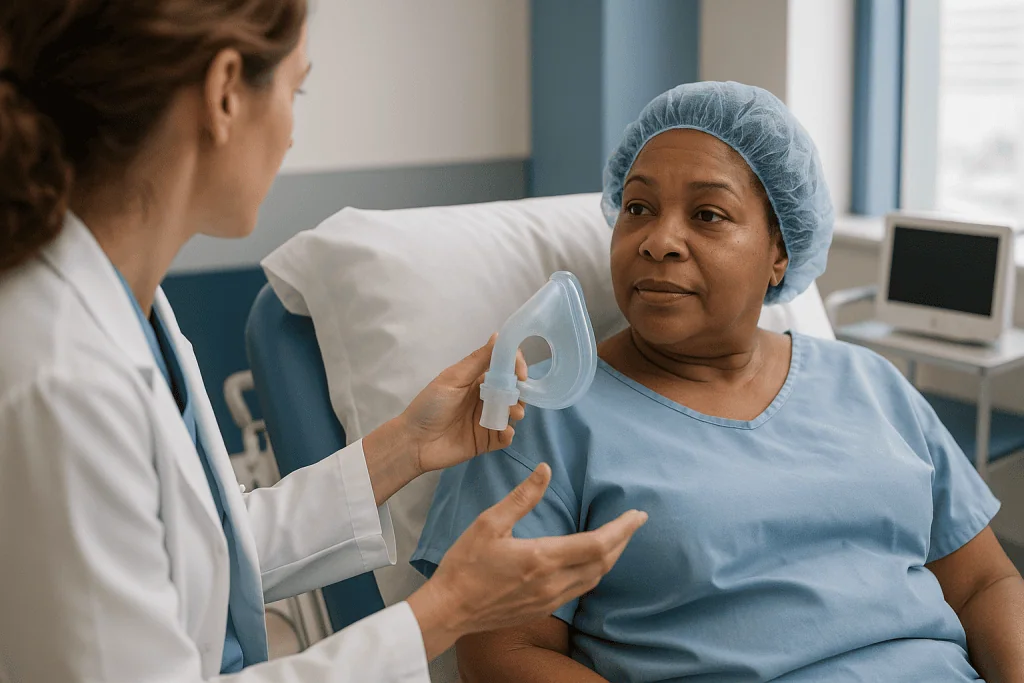
Local anesthesia numbs only the treated area. In liposuction that numbing comes almost entirely from the tumescent fluid, so a single small area can be treated while you are fully awake and talking. You feel pressure, pushing and a vibrating or tugging sensation, but not sharp pain. This is what clinics mean by awake liposuction.
Local anesthesia with sedation, which Johns Hopkins describes as monitored anesthesia care and many people call twilight sedation, adds a medicine given through a vein that makes you drowsy and relaxed. You breathe on your own, you can usually respond to a voice, and many people remember little afterward. An anesthesia professional watches your heart rate, blood pressure and oxygen throughout, because the line between “relaxed” and “too deeply asleep” needs watching.
General anesthesia makes you fully unconscious. Medicines are given through a vein and often through a breathing mask or tube, and an anesthesiologist or nurse anesthetist manages your breathing, your blood pressure and your pain for the entire procedure. The NHS explains that this is reserved for operations that would be too long, too extensive or too uncomfortable to tolerate awake.
Which of the three is chosen is not a mark of how brave you are or how “big” a patient you are. It reflects the volume of fat, the number of areas, the expected time on the table and your own medical history, which the next sections unpack in turn.
Why tumescent fluid is the key to liposuction under local anesthesia
The word tumescent simply means swollen. In liposuction it refers to injecting a large volume of very dilute fluid into the fat until the tissue becomes firm and pale. Mayo Clinic lists the three ingredients: sterile salt water, which expands the fat layer so it is easier to suction; a local anesthetic such as lidocaine, which numbs the nerves in the area; and epinephrine, which narrows blood vessels and reduces bleeding and bruising.
That combination is what made awake liposuction possible. Because the anesthetic is spread thinly through a large volume and the blood vessels are clamped down by epinephrine, the drug is absorbed slowly and the area stays numb for hours. Surgeons can treat a modest area with nothing more than this fluid, and the patient can stand up, be checked for symmetry, and walk out the same afternoon.
There is a catch, and it is the single most important technical reason the anesthesia choice changes with the size of the operation. Local anesthetics have a maximum safe amount for any given person, set by body weight and health. Each additional treatment area needs more tumescent fluid, and therefore more anesthetic. Past a certain point the only ways to keep going safely are to use less anesthetic per liter of fluid, which may leave areas under-numbed, or to switch to sedation or general anesthesia so that comfort no longer depends on the local anesthetic alone. Your surgeon calculates that ceiling for you; it is not something to work out yourself.
Tumescent fluid also explains a recovery quirk: for the first day or two, pinkish fluid leaks from the incisions. That is the dilute solution draining out, not bleeding, and it is expected whichever anesthesia was used.
How the vaser liposuction anesthesia choice is actually made
Picture the decision as a short list that the surgeon and anesthesia team work through together, usually at the pre-assessment visit rather than on the day.

How many areas, and how much fat. One flank or a small pocket under the chin is a very different operation from a circumferential waist, the so-called lipo 360, which treats the abdomen, flanks and back in one sitting. More areas mean more tumescent fluid, more time and, as the previous section explained, more pressure on the safe limit of local anesthetic.
How long you will be on the table. The NHS gives a typical range of one to three hours for liposuction. Lying still, awake, on a hard table for the upper end of that range is hard for anyone, and discomfort tends to raise blood pressure and movement, which makes precise sculpting harder.
Whether you need to be turned. Treating the back and the front means repositioning you partway through. Under general anesthesia the team turns you with your airway secured; awake, you shuffle over yourself, which some people manage easily and others find distressing once the fluid is in.
Your health. Anesthesia teams grade overall fitness on a scale that runs from healthy to seriously ill. Heart disease, lung disease, sleep apnea, obesity and certain medications all shift the calculation, sometimes toward avoiding general anesthesia, sometimes toward preferring it because an anesthesiologist is then present the entire time.
What is being done alongside. Fat transfer, a tummy tuck or a lift performed in the same session usually tips the balance toward general.
You. Anxiety, past experiences with anesthesia and your own preference are legitimate inputs. The treating team weighs all of this, and the final call is theirs to make with you.
Who is usually offered awake liposuction, and who is usually asked to wait
Most people who are offered liposuction under local anesthesia alone share a similar profile: they are in good general health, their weight has been stable for several months, their skin still has reasonable elasticity, and they want one or two modest areas refined rather than a whole-body change. Mayo Clinic is clear that liposuction is a contouring procedure for people near a healthy weight, not a treatment for obesity, and that framing applies regardless of the anesthesia used.
Who is usually asked to wait, or sometimes advised against the procedure altogether, is a longer list. Surgeons commonly pause when:
- weight is still changing, because fat removed today will be redistributed by tomorrow’s gain or loss;
- a medical condition is not yet well controlled, for example blood pressure, diabetes or a heart rhythm problem;
- there is a bleeding disorder or a medicine that affects clotting, which the prescribing clinician must review before any decision about pausing it;
- the person smokes or uses nicotine, which impairs wound healing and raises anesthesia risk;
- pregnancy or breastfeeding is current or planned soon;
- expectations center on dramatic weight loss, cellulite removal or tightening of very loose skin, none of which liposuction reliably delivers.
The waiting period is not a punishment. A stable weight means the result has a chance to last; a controlled condition means the anesthesia team can plan with confidence; a few weeks without nicotine means the small incisions and the sculpted tissue heal with less risk of complication.
One more group deserves a mention: people who are medically fit for local anesthesia but know they will not cope with the sounds, sensations and duration while awake. Saying so at the consultation is useful information, not weakness, and it often leads straight to a sedation plan.
Local, sedation or general for Vaser: a side-by-side comparison
Three options, one table. Use it as a map of what to expect, not a menu to order from; the column you end up in is a clinical judgment made with you by your treating team.
| Feature | Local anesthesia only | Local plus sedation | General anesthesia |
|---|---|---|---|
| Your awareness | Fully awake, can talk and stand to be checked | Drowsy, often little memory of the procedure | Unconscious throughout |
| Typical scope | One or two small areas | Several areas or longer sessions | Multi-area, circumferential or combined procedures |
| Breathing | On your own | On your own, oxygen often given | Supported by a mask device or breathing tube |
| Who monitors you | Surgical team | Anesthesia professional throughout | Anesthesiologist or nurse anesthetist throughout |
| Fasting beforehand | Per your team’s instructions, often minimal | Required | Required |
| Going home | Same day; follow instructions about an escort | Same day, escort required | Same day or overnight, escort required for 24 hours |
| Common after-effects | Soreness, fluid leakage, bruising | Grogginess for hours, plus the above | Nausea, sore throat, tiredness for about a day, plus the above |
Two rows deserve a second look. “Who monitors you” is why some anesthesiologists regard a well-run general anesthetic for a long procedure as the more controlled option rather than the riskier one: someone is watching the numbers every minute. “Going home” is the row people underestimate; the NHS advises against driving, drinking alcohol or signing legal documents for 24 hours after a general anesthetic, and sedation carries similar advice. Plan the ride, the overnight company and the next morning before you plan anything else.
What general anesthesia for liposuction involves, from fasting to waking up
If the plan is a general anesthetic, the pathway starts well before the day. You will have a pre-assessment, sometimes by phone, where the anesthesia team asks about previous anesthetics, allergies, medicines, snoring or sleep apnea, smoking and any family history of problems with anesthesia. Bring an accurate medication list, including supplements; some affect bleeding or interact with anesthetic drugs, and only your prescribing clinician should decide whether anything is paused.
Fasting instructions matter. The NHS explains that an empty stomach reduces the risk of food or fluid entering the lungs while you are unconscious. You will be told exactly when to stop eating and when to stop clear fluids; those two cut-offs are different, and both are given to you in writing.
In the anesthetic room a small cannula is placed in a vein, usually on the back of the hand. Monitoring stickers go on your chest, a cuff on your arm and a clip on a finger. The anesthetic itself is given through the vein and takes effect within about a minute, which is why many people remember counting and then nothing else. Once you are asleep, the team secures your airway with a soft mask-like device or a breathing tube and keeps you unconscious with gas or continuous intravenous medicine for as long as the surgery lasts. Pain relief and anti-sickness medicines are given during the operation so that waking is smoother.
Afterward you wake in a recovery area with a nurse beside you. Grogginess, a dry or sore throat, shivering and nausea are the common early effects, and the NHS notes that most of these pass within hours. Judgment and reaction times stay impaired for about a day, so a responsible adult needs to take you home and stay with you overnight.
Vaser liposuction recovery time: what the first days and weeks usually look like
Vaser liposuction recovery time depends on the number of areas, the volume removed and, to a smaller degree, the anesthesia used. The broad shape is the same for everyone.
The first 24 to 48 hours. Expect pinkish fluid to leak from the incisions; that is tumescent solution draining, and absorbent pads inside the garment catch it. Soreness is usually described as a deep bruise or the ache after a hard workout. If you had sedation or a general anesthetic you will also feel foggy and tired, and you should not be alone. Short walks around the house start the same day; they keep blood moving in the legs, which is the simplest protection against clots.
Days 3 to 7. Swelling and bruising peak and then begin to recede. Mayo Clinic notes that many people return to work after a few days, while the NHS suggests some may need a couple of weeks off, particularly after larger procedures. The compression garment stays on most of the day; Mayo describes several weeks of garment use as typical.
Weeks 2 to 6. Activity expands toward normal. Mayo advises waiting a few weeks before resuming exercise, and your surgeon will say when. Numb patches and firm, lumpy areas under the skin are common at this stage and usually soften with time.
Months 2 to 6. The NHS states that swelling can take up to six months to settle fully, and Cleveland Clinic gives a similar horizon for seeing the final shape, so what you see at week three is not the end result.
Where anesthesia makes a difference is mostly in that first day: awake patients are often mobile and eating within an hour, while general anesthesia adds a day of recovery from the anesthetic itself. After that, the tissue heals at its own pace.
How to poop after lipo 360: the question people are embarrassed to ask
It comes up in forums far more than in consultations, and it deserves a plain answer. Constipation after liposuction, especially after a circumferential lipo 360, is common and has several contributing causes rather than one.
Opioid pain medicines, if prescribed, slow the muscular movement of the bowel; this is a direct drug effect, not a side effect that only some people get. General anesthetic drugs can briefly do the same. Moving less, drinking less, eating less fiber in the first days, and the fact that a tight abdominal compression garment makes bearing down uncomfortable all stack on top.
What helps is mostly mechanical and dietary:
- Drink water steadily through the day; tumescent fluid draining out and reduced appetite both tend to leave people drier than usual.
- Walk, briefly and often. Gut movement follows body movement.
- Return to fruit, vegetables, whole grains and other fiber as soon as your appetite allows.
- Use the pain plan your surgeon gave you as written; if it includes an opioid, ask whether a non-opioid alternative or a shorter course is appropriate for you. That decision sits with the prescriber.
- Ask the team in advance whether they recommend a stool softener or laxative; many include one in the discharge plan, and they will tell you which kind and when.
- Do not strain. A small footstool under the feet changes the angle of the pelvis and makes passing stool easier without pushing against sore abdominal tissue.
Call your care team if you have had no bowel movement for several days, if the abdomen becomes distended or increasingly painful, or if you are vomiting. Those signs need a clinical opinion rather than another glass of prune juice.
The risks that change with the anesthesia choice, and the ones that do not
Honest risk talk separates a good consultation from a sales pitch. Mayo Clinic and the NHS list the complications of liposuction in similar terms, and it helps to sort them into those that depend on the anesthesia plan and those that come with the procedure itself.
Tied to local anesthesia. The main concern is local anesthetic toxicity: if too much is absorbed, it can affect the heart and nervous system. This is exactly why the safe ceiling discussed earlier is calculated per person and why very large awake procedures are approached cautiously. Awake patients may also move or tense, which can affect precision.
Tied to sedation and general anesthesia. Nausea and vomiting, sore throat, confusion in older adults, and allergic or unexpected reactions to anesthetic drugs are the recognized issues, and the NHS describes serious reactions as rare. Longer procedures, whatever the anesthesia, increase the time spent immobile, which is a factor in blood clots forming in the legs. Teams counter this with leg compression devices during the operation and early walking afterward.
Shared by every liposuction. The NHS lists lumpy or uneven results, bleeding under the skin, numbness that can last for months, changes in skin color, and, less commonly, fluid build-up in the lungs when large volumes are involved, and blood clots that travel to the lungs. Mayo Clinic adds infection, fluid collections called seromas, puncture of internal organs by the cannula, and fat embolism, in which loosened fat enters the bloodstream. The ultrasound step adds heat, so the probe is kept moving to reduce the chance of burns to the skin or the tissue beneath it.
None of these are percentages you can apply to yourself. Your own risk is a function of your health, the scope of the surgery and the team’s judgment, and only that team can estimate it.
What happens 10 years after liposuction?
Short answer, backed by Mayo Clinic: the fat cells that were removed do not come back. Adults have a roughly fixed number of fat cells; liposuction physically takes some away from the treated area, and the body does not replace them.
The longer answer is that the fat cells that remain, in treated and untreated areas alike, can still grow. Mayo Clinic explains that if you gain weight after liposuction, those remaining cells enlarge, and the new fat may settle in places that were not treated, or it may show again in the treated area if the gain is substantial. People sometimes describe this as fat “moving” to the arms or back after an abdominal procedure. Nothing moved; the untreated reserves simply did what fat cells do when there is a calorie surplus.
Skin follows its own timeline. A decade adds ten years of collagen loss, sun exposure and, for many people, pregnancies or weight cycles. Skin that was redraped over a slimmer contour at 35 will be looser at 45 regardless of the surgery, and someone with borderline elasticity to begin with may notice this more. The ultrasound step in Vaser is sometimes marketed as tightening skin; evidence for lasting skin contraction is limited, and it is safer to assume that liposuction of any kind removes fat and leaves skin to behave as skin does.
Anesthesia has no known long-term effect at this distance for healthy adults. The choice between local and general matters for the day and the week; by year ten the variables that matter are weight stability, activity, sun protection and ordinary aging.
The practical lesson for someone deciding now is that a stable weight before surgery is the best predictor of a result that still looks sensible a decade on.
What people often get wrong about vaser liposuction anesthesia
Myths cluster around this topic because the marketing on both sides is loud. A few corrections, each grounded in what the evidence actually shows.
“Local is always safer than general.” For a small area, local anesthesia avoids the airway, fasting and grogginess of a general, and that is a genuine advantage. Stretch an awake procedure across many areas, though, and the amount of local anesthetic climbs toward its safe limit while nobody is dedicated to monitoring you. For long or extensive surgery, a general anesthetic with an anesthesiologist present is often the more controlled choice, not the reckless one.
“General anesthesia means a bigger surgery or a bigger risk.” The scope of surgery is the same whichever anesthesia is used; general is chosen because the scope is already large, not the other way around. For healthy adults, the NHS describes serious complications of general anesthesia as rare.
“Vaser melts fat, so you barely need anesthesia.” Ultrasound loosens fat; it does not remove the need for tumescent fluid, a cannula or suction, and it does not shorten time on the table in any way that changes the anesthesia decision.
“Awake liposuction means no real recovery.” The tissue trauma is identical. Awake patients skip the day of anesthetic fog, then follow the same weeks of swelling, garments and healing as everyone else.
“You choose the anesthesia from a menu.” Your preference is heard, but the plan is a clinical decision made by the surgeon and anesthesia team based on scope and health.
“Liposuction under local anesthesia is a weight-loss shortcut.” Mayo Clinic is explicit that liposuction is contouring for people near a healthy weight. No anesthesia type changes that.
Questions to ask your care team before the anesthesia plan is set
Walk in with questions written down; a good team welcomes them. These are the ones that most reliably sharpen the conversation.
- Which anesthesia are you recommending for the areas I want treated, and what would change that recommendation?
- Who will give and monitor the anesthesia, and will that person be present for the whole procedure?
- Where will the procedure take place, and what equipment and staff are available if something unexpected happens?
- If I am awake, what will I feel, hear and smell, and what happens if I find it hard to cope partway through?
- If sedation is planned, how deep will it be, and will I be able to respond?
- Will I need to be turned over during the procedure, and how is that managed under the plan you propose?
- Which of my current medicines and supplements affect the plan, and who decides whether any are paused?
- What are the fasting instructions, in writing, and when exactly do they start?
- What pain plan will I go home with, and does it include an opioid? If so, what is the plan for constipation?
- How long should I expect to be off work and away from exercise for this specific scope, in your experience?
- What warning signs do you want me to call about, and what number do I call at night or on a weekend?
- Would combining this with any other procedure change the anesthesia?
Listen for specific, measured answers rather than reassurance. A team that gives you typical ranges, names the person responsible for your anesthesia, and explains what would make them change the plan is showing you how it thinks, which is the thing you are really assessing. Vague promises about comfort or results, with no mention of what could go wrong, are a reason to keep asking.
When to call your doctor after Vaser liposuction
Most of what you feel in the first week is expected: soreness, swelling, bruising, fluid leaking, numb patches, tiredness. The signs below are different. They need a same-day call to your surgical team, or emergency services if the situation is urgent.
Call emergency services or go to the nearest emergency department for sudden shortness of breath, chest pain, coughing up blood, a racing or irregular heartbeat, confusion or fainting, or severe pain and swelling in one calf. These can signal a blood clot that has reached the lungs, a fat embolism, fluid overload or a heart problem, all of which the NHS and Mayo Clinic list among the serious complications of liposuction.
Call your surgical team the same day for:
- a fever or chills in the days after surgery;
- increasing rather than easing pain, or pain concentrated in one spot;
- redness spreading from an incision, warmth, or thick or foul-smelling discharge;
- bright red bleeding that soaks through dressings, as opposed to pinkish tumescent fluid;
- a rapidly enlarging, tense swelling on one side;
- a patch of skin that turns dark, purple or blistered;
- nausea or vomiting that stops you keeping fluids down beyond the first day;
- no urine for many hours, or very dark urine;
- no bowel movement for several days with a bloated, painful abdomen;
- numbness that is spreading or accompanied by weakness in a limb;
- any reaction after a general anesthetic that worries you, including persistent confusion or a sore throat that worsens rather than improves.
When in doubt, call. Teams would far rather field a cautious phone call than see a complication a day late, and the number you were given at discharge exists for exactly this purpose.
Frequently asked questions
Is lipo under anesthesia?
Yes, liposuction is always performed under anesthesia; the question is which type. Small single areas are often treated with local anesthesia delivered in the tumescent fluid, so the patient stays awake. Larger or multi-area procedures usually add sedation or use a general anesthetic. The surgeon and anesthesia team choose based on scope, duration, positioning and your health, as Mayo Clinic and the NHS both describe.
Can Vaser liposuction be done under local anesthesia only?
It can, for a modest area in a healthy person. The tumescent fluid numbs the tissue and the ultrasound step does not change that. The limiting factor is the safe amount of local anesthetic for your body, which rises with every additional area treated. Once that ceiling is approached, or the procedure becomes long, teams typically move to sedation or general anesthesia.
Is lipo done under general anesthesia for larger areas?
Usually, yes. Circumferential treatments such as lipo 360, several areas in one session, or liposuction combined with fat transfer or a lift are commonly done under general anesthesia. The reasons are practical: longer time on the table, the need to turn you over, and keeping comfort independent of the local anesthetic limit. The decision rests with your surgical and anesthesia team.
What is awake liposuction and does it hurt?
Awake liposuction means the procedure is done under local anesthesia alone, with no sedation. The tumescent fluid numbs the area, so sharp pain is not expected, but you will feel pressure, pushing and a tugging or vibrating sensation, and you will hear the equipment. Some people find this easy; others find the duration hard. Tell your team honestly, because that shapes the plan.
How long is recovery after Vaser liposuction?
Mayo Clinic describes a few days before returning to work and a few weeks before resuming exercise, with compression garments worn for several weeks. The NHS notes swelling can take up to six months to settle fully. Recovery from the anesthetic itself adds roughly a day after sedation or general anesthesia. Larger procedures sit at the longer end of every range.
How to poop after lipo 360?
Constipation after lipo 360 is common because opioid pain medicines, anesthetic drugs, reduced movement and a tight abdominal garment all slow the bowel. Drinking water steadily, walking often, returning to fiber early and using a footstool to avoid straining help. Ask your team before discharge whether they recommend a stool softener, and ask about non-opioid pain options; those choices belong to the prescriber.
What happens 10 years after liposuction?
The fat cells removed do not return, according to Mayo Clinic, but remaining fat cells enlarge if you gain weight, sometimes in untreated areas. Skin continues to age and loosen regardless of the procedure. Anesthesia type has no known effect at that distance in healthy adults. Weight stability, activity and sun protection matter far more than the technology or anesthesia used.
Is tumescent vs Vaser liposuction a real choice, or are they the same thing?
They overlap. Tumescent refers to the fluid injected before suction, a dilute solution of salt water, local anesthetic and epinephrine, and almost every modern liposuction, including Vaser, uses it. Vaser adds an ultrasound step that loosens fat before suction. So the real comparison is suction-only versus ultrasound-assisted, and the anesthesia decision follows the scope of surgery either way.
How long does Vaser liposuction take?
The NHS gives one to three hours as a typical range for liposuction, and the ultrasound step sits inside that window. A single small area is at the short end; multiple areas, repositioning, or combined procedures push toward the long end. Duration is one of the main reasons longer sessions tend to be planned under sedation or general anesthesia rather than awake.
Can I drive home after liposuction under local anesthesia?
Follow your surgical team’s written instructions. After any sedation or general anesthetic, the NHS advises against driving, alcohol and important decisions for 24 hours, and an escort is required. After purely local anesthesia some teams allow independent travel, but many still ask for a companion because soreness, fluid leakage and any pain medicine taken can affect driving. Arrange a ride regardless.
References
This article is for general information only and is not a substitute for professional medical advice. Please consult a qualified doctor about your individual situation.
Add us as a Preferred Source to see more of our trusted health content across Google Search, AI Overviews and Discover.

Planning This Treatment in Turkey
Our full guide for international patients: techniques, hospital stay, recovery and cost.
More from the Blog

Body Contouring Revision: When Residual Laxity or Irregularity Needs a Second Procedure
Body contouring revision is a second procedure that addresses leftover skin laxity, contour irregularities, asymmetry or scar problems after an earlier tummy tuck, liposuction…

Fat Transfer for International Patients: Stay Length, the Flight Home and Protecting the Graft
People having fat transfer abroad are usually asked to stay near the operating team until the main early risks have passed, often around one…

Fat Grafting Myths Corrected: Transferred Fat Is Living Tissue, Not a Filler That Wears Off
Fat grafting moves a person's own fat from one body area to another, where the fat cells that survive gain a blood supply and…
When Do Laser Liposuction Results Show? Swelling, Skin Retraction and Final Contour Timing
Laser liposuction results usually appear in stages rather than all at once. Swelling and bruising are most noticeable in the first one to two…

Can You Have Arm Liposuction Before Reaching Your Goal Weight? How Surgeons Time It
Arm liposuction can sometimes be done before you reach your goal weight, but most surgeons prefer a weight that has been stable for several…

Lifting Your Toddler After a Mommy Makeover: A Realistic Return-to-Childcare Plan
Most people are asked to avoid lifting a toddler for several weeks after a mommy makeover, because a tummy tuck tightens the abdominal wall…