

Who Is a Good Candidate for DHI Hair Transplant? Hairline Refinement and Small-Area Density
Key Takeaways
- DHI is a placement variation of FUE, not a separate operation: grafts are harvested identically and the difference is that an implanter pen opens the site and inserts the graft in one motion.
- Guideline-level sources such as the NHS describe FUT and FUE as the established techniques and there is no high-quality trial evidence that pen placement grows more hair than skilled forceps placement.
- The strongest DHI candidates have stable pattern hair loss, a healthy donor rim, and a limited goal such as softening a hairline or adding density to one defined patch among existing hair.
- Sudden diffuse shedding, patchy autoimmune loss and scarring alopecias are not treated with transplantation while active and need a dermatologist's diagnosis first.
- Transplanted hairs normally fall out in the weeks after surgery before regrowing, and the NHS notes the full result can take around six months to a year to appear.
- Placing grafts between existing hairs can temporarily shed weak native hairs nearby, a recognized effect called shock loss that should be explained before consent.
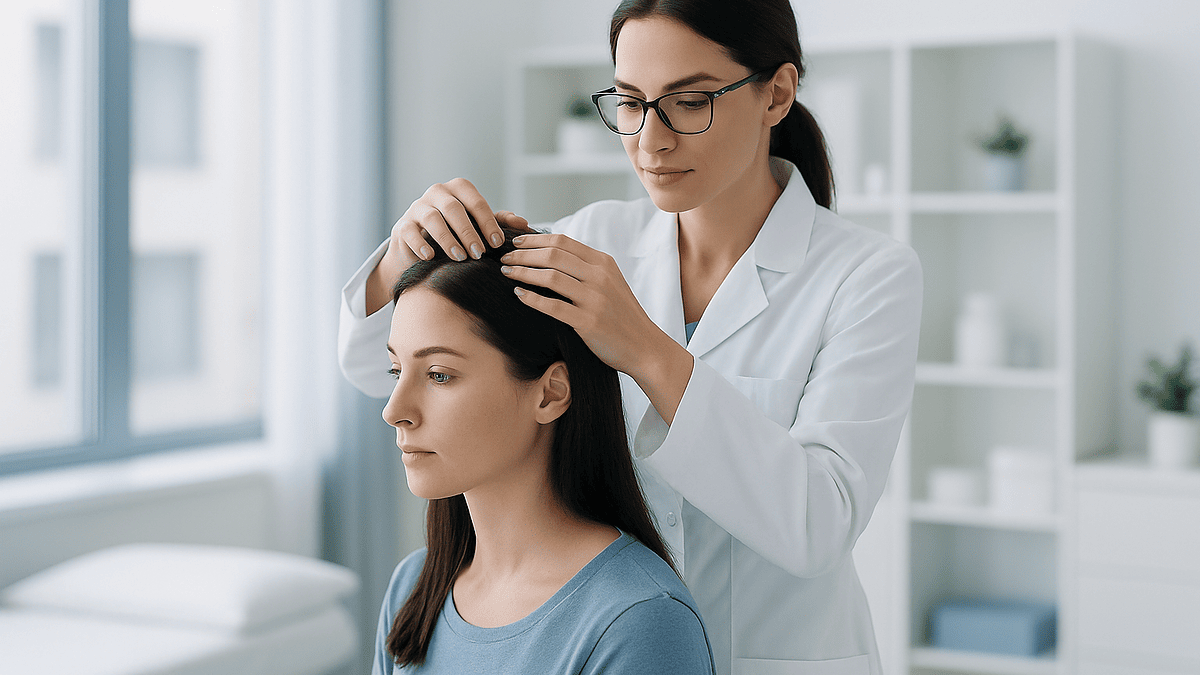
A good DHI hair transplant candidate usually has stable pattern hair loss, a healthy donor area at the back and sides of the scalp, realistic goals, and a clearly defined target such as refining a hairline or adding density to one small thinning zone. People with active or unexplained shedding, scarring or autoimmune hair loss, very early-stage loss at a young age, or limited donor hair are often asked to wait. A qualified surgeon confirms suitability in person.
The light over a bathroom mirror is unforgiving. He tilts his head, holds the phone up, takes a photo of his temples, then another of the crown, then compares them with a picture from a few years ago. The hairline has drifted back a little. It is not dramatic. It is just enough to notice every morning.
That is the moment many people start searching phrases like dhi hair transplant candidate, usually late at night, usually after reading a forum thread that made the whole thing sound either miraculous or terrifying. Neither is true. DHI is a placement technique inside a well-established procedure, and the question of whether it fits you has far more to do with the pattern and stability of your hair loss than with the pen in the surgeon’s hand.
This explainer walks through who tends to do well, who is usually asked to wait, and what the evidence actually supports, so you can arrive at a consultation asking sharper questions than the ones an advertisement wants you to ask.
How does a DHI hair transplant actually work?
Every modern hair transplant moves hair from a part of the scalp that resists balding to a part that does not. The hair at the back and sides is genetically less sensitive to the hormone that shrinks follicles at the front and crown, so when it is relocated it usually keeps behaving the way it did in its original home. The NHS describes the two mainstream ways of harvesting that hair: follicular unit transplantation (FUT), in which a strip of scalp is removed and divided under magnification, and follicular unit extraction (FUE), in which individual follicular units are removed one by one with a tiny circular punch. A follicular unit is the natural bundle of one to four hairs that grows from a single opening in the skin.
DHI, short for direct hair implantation, is a variation of FUE. Harvesting is the same: each follicular unit is extracted with a small punch. The difference is at the other end. In conventional FUE, the surgeon first makes many small incisions in the thinning area, then an assistant places grafts into those openings with forceps. In DHI, each graft is loaded into a hollow needle inside an implanter pen, sometimes called a Choi pen, and the pen creates the opening and places the graft in one motion.
Why does that detail matter? Two reasons are usually given. The graft spends less time outside the body waiting for its slot, and the operator controls angle, direction and depth at the instant of placement rather than relying on a pre-made incision. Whether those theoretical advantages translate into measurably better growth is a separate question, and it is one we will come back to honestly. The procedure itself is typically done under local anesthetic as a day case, which the NHS notes for hair transplants generally, and the session can last much of a day depending on how many grafts are planned.
Who is a good DHI hair transplant candidate?
Suitability starts with a diagnosis, not a wish list. The overwhelming majority of people who benefit from any transplant have androgenetic alopecia, the inherited, hormone-driven pattern loss that MedlinePlus estimates affects around 50 million men and 30 million women in the United States. In this condition, follicles at the front and top gradually shrink, a process called miniaturization, while the donor rim stays robust. That predictable geography is what makes relocation work.
Within that group, the people surgeons tend to describe as strong DHI candidates share a few features:
- Hair loss that has settled into a recognizable, slow-moving pattern rather than a fast, recent shift.
- A donor area with good density and reasonable hair caliber, because thicker individual hairs create more visual coverage per graft.
- A specific, limited goal: a receded temple, a soft or irregular front edge, a thinning patch behind an old scar, or a crown that needs a little more depth rather than a full rebuild.
- Willingness to accept that transplanted hair fills a gap while native hair may keep thinning around it, and an openness to discussing medical management alongside surgery.
- General health that tolerates several hours in a chair under local anesthetic, with no uncontrolled bleeding disorder or active scalp infection.
Notice what is not on that list: a particular age, a particular ethnicity, or a particular hair color. Those affect planning, not eligibility. Contrast between hair and scalp color, hair curl and hair thickness all change how much coverage a given number of grafts provides, and a careful surgeon will factor them into the design.
The honest summary is that a good DHI candidate is, first, a good hair transplant candidate. The pen is chosen afterward, when the surgeon decides which placement method best serves the plan they have drawn on your scalp.
Is a DHI hairline transplant a good fit for hairline refinement?
The hairline is where transplants are judged. A crown can hide a slightly uneven result under longer hair; the front edge sits in every photograph and every conversation. That is why hairline refinement is the setting where the implanter pen’s control over angle and direction is most often discussed.
Natural front hairlines are not straight lines. They are irregular, slightly asymmetric, and made mostly of single-hair follicular units that grow forward at a low angle, then transition a few millimeters back into denser two- and three-hair groupings. Recreating that requires placing very fine grafts in a tight zone at a consistent, shallow angle. With DHI, the surgeon decides the angle at the moment of insertion rather than pre-cutting hundreds of slits and hoping the assistant follows them faithfully. For a surgeon who has trained extensively with the pen, that can feel like drawing directly on the skin.
Refinement, though, is a modest word on purpose. The best hairline candidates are usually people who want to soften a corner, lower a line slightly, or add a natural fringe in front of an older, slightly blunt-looking transplant. They are less often people who want to bring a deep recession all the way down to where it sat in adolescence. A hairline placed too low or too dense today may look strange as the hair behind it keeps thinning over the following decades, and the donor hair spent on it cannot be recovered. Cleveland Clinic and the NHS both point out that transplanted hair is permanent in the sense that it stays, but the surrounding native hair may continue to recede.
So the question a candid surgeon asks is not “Can we lower this?” but “Where should this line sit in twenty years?” If your goal aligns with that longer view, hairline work with DHI is a reasonable option to discuss. If it does not, the conversation about expectations comes first.
Small-area density: filling thin patches without shaving everything
The second scenario in the title, small-area density, is where DHI has a practical appeal that has nothing to do with growth rates. Because the implanter pen places grafts between existing hairs without a separate incision step, some surgeons are comfortable working in an unshaven or partially shaven recipient zone. For someone whose thinning is limited to a patch on the crown, a widening part, or a spot where scar tissue has replaced hair, the ability to keep most of the surrounding hair at its normal length matters enormously to daily life and to privacy at work.
Density work is also where realistic numbers matter. A transplant cannot restore the original count of hairs per square centimeter; it redistributes a finite donor supply. The aim is the illusion of fullness, which depends on hair thickness, curl, color contrast and how the hairs are angled to overlap. Adding grafts into a zone that still has miniaturizing native hairs carries a specific hazard: the trauma of surgery can temporarily shed the weak hairs around the new grafts, a phenomenon usually called shock loss, which Cleveland Clinic lists among the recognized side effects. Most of those hairs regrow over the following months, but a few of the most miniaturized ones may not, so the surgeon weighs how much native hair is at stake before planting between it.
Good small-area candidates therefore tend to have a well-defined patch with reasonably healthy hair around its border, stable loss elsewhere, and enough donor reserve that spending some of it here will not compromise a larger procedure later if the pattern progresses. People with diffuse thinning across the whole top of the scalp, where there is no clear edge between thin and full, are trickier: there is no small area, only a large one, and the discussion shifts toward medical management or a broader plan.
Who is not suitable for hair transplant, or usually asked to wait?
A surgeon who says “not yet” is often doing you a bigger favor than one who says “yes” to everyone. Several situations reliably prompt a pause.
Hair loss that is still moving fast. If the pattern changed noticeably in the past year or two, nobody can predict where the edges will settle. Transplanting into a moving target risks an island of transplanted hair with a bald moat around it later.
Very young age with early loss. Someone in their late teens or early twenties with beginning recession is at the start of a process that can continue for decades. Many surgeons prefer to observe, and to discuss medical options with a dermatologist, before committing donor hair to a hairline that adult pattern loss may later isolate.
Unexplained or diffuse shedding. Sudden, widespread thinning can be telogen effluvium, a temporary shedding triggered by illness, surgery, childbirth, major stress or certain medicines, in which hairs shift into their resting phase together. Mayo Clinic notes this type usually reverses on its own once the trigger passes. Transplanting into it makes no sense; the hair is coming back anyway.
Scarring and autoimmune alopecias. Conditions such as lichen planopilaris or frontal fibrosing alopecia destroy follicles and replace them with scar; alopecia areata is an autoimmune attack that comes and goes. Grafts placed into active disease can be destroyed by the same process. These need a dermatologist’s diagnosis and control first, and some may never be suitable.
Insufficient donor supply. When the back and sides are also thinning, there may not be enough resistant hair to move safely.
Medical and behavioral factors. Uncontrolled diabetes, bleeding disorders, medicines that impair clotting, active scalp infection, heavy smoking that compromises healing, and unrealistic expectations or body dysmorphic concerns all warrant careful discussion before, not after, a decision.
None of these is a judgment. Each is a reason the timing, the diagnosis or the plan needs more work.
Is DHI really better than FUE? DHI vs FUE side by side
Here is where marketing and evidence part ways. DHI is FUE with a different placement tool. Harvesting is identical. Guideline-level sources such as the NHS describe FUT and FUE as the established techniques and do not single out implanter-pen placement as a separate, superior category. High-quality randomized comparisons of DHI against forceps placement in matched patients are scarce; most published support for DHI comes from case series and surgeon experience. That does not make DHI worse. It means claims that it grows more hair, heals faster or looks more natural are, at present, expert opinion rather than established fact.
| Feature | Conventional FUE | DHI (implanter pen) |
|---|---|---|
| How grafts are harvested | Individual punch extraction | Individual punch extraction (same) |
| How grafts are placed | Pre-made incisions, then forceps insertion | Pen creates opening and places graft in one motion |
| Who controls angle and depth | Surgeon sets slits; assistants place grafts | Operator at the moment of insertion |
| Time grafts spend outside the body | Generally longer between extraction and placement | Generally shorter per graft |
| Shaving of recipient area | Usually required | Often possible with less shaving |
| Pace and session size | Efficient for large sessions | Often slower per graft; suited to smaller zones |
| Evidence of better growth | Standard reference technique | No high-quality trial evidence of superiority |
Read that table as a description of trade-offs, not a scoreboard. For a large area needing thousands of grafts, many teams prefer conventional FUE for its speed. For a hairline edge or a small patch among existing hair, the pen’s precision and reduced shaving are practical advantages. The variable that dwarfs all of these is the experience of the person doing the work, and that is not something any tool can substitute for.
What are the disadvantages of DHI hair transplant?
Balanced information includes the downsides, and DHI has several worth weighing.
It is slower per graft. Loading each follicular unit into a pen and placing it individually takes longer than a two-team approach in which one person cuts sites and others insert grafts. For small zones, that is irrelevant. For extensive baldness, it can mean longer sessions or splitting the work across more than one day, which increases the total time under local anesthetic and the total number of appointments.
It depends heavily on operator skill. The pen concentrates responsibility for angle, depth and graft handling in one pair of hands, at speed. A well-trained operator can be very precise; a poorly trained one can bury grafts too deep, causing small cysts or pitting, or crush the follicle while loading it.
Working between existing hairs carries shock loss risk. Any transplant into a zone with native hair can temporarily shed the weaker neighbors. Because DHI is often chosen precisely for these mixed zones, that risk is part of the package and needs to be explained before you consent.
The general risks of surgery still apply. The NHS lists bleeding, infection, crusting, itching, swelling, temporary numbness, an unnatural appearance if design is poor, and grafts that fail to take. DHI does not remove any of these.
Donor scarring is unchanged. Harvesting is standard FUE, so the small dot scars at the back and sides are the same regardless of how the grafts are placed. Over-harvesting a limited donor area produces a moth-eaten look that is very hard to correct.
Marketing can outrun the data. The most common practical harm is not surgical; it is choosing a technique because of a label rather than because a surgeon assessed your scalp and explained why that method serves your plan.
How stable does your hair loss need to be before a transplant?
Stability is the quiet variable that decides most candidacy questions, and it deserves more attention than it usually gets in online debates about pens and punches.
Androgenetic alopecia does not stop at a convenient point. It progresses in a pattern that dermatologists grade with scales such as the Norwood classification in men and the Ludwig or Sinclair scales in women, and the pace varies enormously from person to person. Mayo Clinic describes it as gradual, typically appearing as a receding hairline and crown thinning in men and a widening part in women. A transplant is a snapshot of a plan taken against a moving background. If the background is moving quickly, today’s sensible hairline can look stranded in ten years.
How do surgeons judge stability? They look at photographs across time, ideally yours from several years back. They examine the scalp under magnification, a technique called trichoscopy, to gauge how many hairs in the border zones are miniaturizing, which predicts future loss better than the naked eye. They ask about family history on both sides, because the genetic influence, as MedlinePlus explains, comes from multiple genes and is not simply inherited from one parent. And they ask what you have already done medically, because loss that has been slowed by treatment behaves differently from loss that is untouched.
Age enters here, not as a rule but as a proxy. Someone in their mid-thirties or older whose pattern has looked similar for several years is easier to plan for than someone whose temples receded in the last eighteen months. This is why the same surgeon can say yes to a patient at forty-two and “let’s watch this for a while” to one at twenty-three, even if their photographs look alike today. The decision is about trajectory, and only your treating team, with your history in front of them, can estimate it.
Can women, and people with other causes of hair loss, be DHI candidates?
Hair transplant discussions online skew toward men, which does a disservice to a large group of women with pattern loss and to anyone whose thinning has a different cause.
Women with androgenetic alopecia can be candidates, and the small-area density model often suits them well: a widening central part or a thinning frontal zone behind a preserved hairline is exactly the kind of target that can be worked between existing hairs without shaving. The complication is that female pattern loss is more often diffuse, sometimes extending into the donor rim itself, and it is more frequently accompanied by other contributors such as thyroid disorders, iron deficiency, or hormonal changes, which Mayo Clinic lists among causes of hair loss. Those need to be evaluated and addressed before anyone talks about relocating follicles. A blood work-up and a dermatology assessment are standard first steps.
Traction alopecia, caused by years of tight styling that pulls on the hairline and temples, can be a good indication for transplantation once the traction has stopped and the area has been stable, because the donor hair is usually healthy. Scars from injury, burns or previous surgery can also accept grafts, although scar tissue has poorer blood supply and growth may be less predictable, so surgeons often test a small area first.
Where the picture differs is inflammatory and autoimmune disease. Alopecia areata, which produces smooth round patches and can relapse unpredictably, and the scarring alopecias, which destroy follicles permanently, are generally not treated with transplantation while active. The immune process that removed the original hair can remove the new hair too. Some people with long-inactive scarring disease are considered on a case-by-case basis, but that judgment belongs to a dermatologist working with the surgeon, and it is not a decision to make from a search result.
Do you need to be on hair loss medicine before or after DHI?
Medical management is not a separate topic from surgical candidacy; it is part of it. Two classes of treatment come up in almost every consultation, and understanding how they work helps you follow that conversation. Nothing here is a recommendation to start, stop or change anything; those decisions belong with your prescribing clinician.
Topical minoxidil is a medicine applied to the scalp that is thought to prolong the growth phase of the hair cycle and enlarge miniaturized follicles, although its exact mechanism is not fully understood. Mayo Clinic notes that it typically takes at least six months of use before it becomes clear whether it is helping, and that benefit is maintained only with continued use. In the transplant context, it is often discussed as a way to support the native hair around the grafted zone, particularly on the crown.
Oral finasteride belongs to a class called 5-alpha reductase inhibitors. It blocks the enzyme that converts testosterone into dihydrotestosterone (DHT), the hormone that drives follicle miniaturization in genetically susceptible scalp. Mayo Clinic describes it as an option for men with pattern loss that can slow further loss and may produce some regrowth, again over months rather than weeks, and it carries potential side effects that need to be discussed individually. It is not used in women who are or may become pregnant.
Why does this matter for candidacy? A transplant fixes the grafts in place but does nothing for the surrounding native hair. Someone who is not on any treatment and continues to lose hair around a transplanted hairline may find the result looks isolated over time. Many surgeons therefore want to know whether you are willing to have that conversation with a dermatologist, or whether you would rather plan the surgery assuming the native hair will keep going. Both are legitimate choices. What matters is that you make one deliberately.
What do the days and weeks after a DHI transplant usually look like?
The procedure day is long and mostly boring. Local anesthetic is injected into the donor and recipient areas, which most people describe as the most uncomfortable part; after that, the sensation is pressure rather than pain. You can usually go home the same day, as the NHS notes for hair transplants generally, and someone should drive you if sedation was used.
The first week is about protecting grafts. Tiny crusts form around each one. Expect some swelling of the forehead, occasionally drifting down toward the eyes for a few days, along with pinpoint scabs at the donor site. Gentle washing usually begins within the first days, following your team’s exact instructions, and the crusts typically lift over one to two weeks. Sleeping with the head elevated and avoiding anything that rubs or knocks the recipient area are the practical rules.
Then comes the part that alarms people who were not warned: the transplanted hairs fall out. The NHS describes this shedding as normal in the weeks after surgery, and Cleveland Clinic frames it the same way; the follicle stays, the hair shaft it arrived with is discarded, and the follicle enters a resting phase. It can look as if the whole procedure has vanished.
New growth begins some months later, fine and often lighter at first, then thickening. Guideline-level sources are consistent that judging the result early is a mistake: the NHS suggests it can take around six months to a year to see the full effect, and Cleveland Clinic notes that final density may continue to develop beyond a year. Photographs taken at the same angle and lighting every month are far more informative than daily mirror checks. Numbness in the donor area can persist for weeks and usually resolves. The donor dots fade to small pale marks that are typically covered by hair kept at a modest length.
What people often get wrong about DHI
Some of the most confident statements you will read about this technique are also the least supported. A few corrections, in the order they tend to appear.
“DHI grows more hair than FUE.” There is no high-quality trial evidence that grafts placed with a pen survive at a higher rate than grafts placed carefully with forceps. Both can achieve excellent survival in skilled hands; both can fail in unskilled ones. Guideline sources like the NHS do not distinguish outcomes by placement tool.
“DHI is scarless.” Harvesting is standard FUE, which leaves small dot scars in the donor area. They are usually inconspicuous, not absent. Very short haircuts can reveal them.
“You don’t need to shave for DHI.” The recipient area often needs less shaving, sometimes none. The donor area still has to be trimmed short enough for the punch to see and extract follicular units.
“Transplanted hair is permanent, so the problem is solved.” The moved follicles usually keep their resistance to DHT, but the native hair around them does not. Pattern loss continues unless it is managed, and some people need further sessions years later.
“It’s just a cosmetic procedure, so anyone can do it.” It is surgery, with the bleeding, infection and healing risks the NHS lists, performed over many hours with anesthetic. Who does it, and where, matters as much as any label attached to the technique.
“If I’m losing hair, I need a transplant.” Sudden diffuse shedding, patchy loss and inflammatory conditions are not treated with surgery. Many people who walk in asking about grafts leave with a dermatology referral instead, and that is the correct outcome.
“The DHI pen is the treatment.” The pen is an instrument. The treatment is the diagnosis, the plan, the design and the hands. Choosing a tool before a diagnosis is choosing backward.
Questions to ask your care team before agreeing to DHI
A consultation is an interview in both directions. The questions below are less about catching anyone out and more about learning whether the team has actually assessed you rather than sold you a package.
- What is my diagnosis, and how did you confirm it? Did you examine the scalp under magnification, and what did the border zones show?
- How stable do you judge my hair loss to be, and what makes you say so?
- Why are you suggesting DHI for me specifically, rather than conventional FUE or another approach? What would change your mind?
- Who will actually harvest and place the grafts, and how many procedures like mine has that person performed? Will a physician be present throughout?
- Where exactly will the hairline sit, and why there? Can you show me on my own photographs how it will relate to the hair behind it in fifteen or twenty years?
- How much of my donor area will this use, and what would remain if I needed more work later?
- What is the risk of shock loss to my existing hair in the treated zone, and how do you minimize it?
- Should I see a dermatologist about medical management before or alongside surgery? Are there blood tests you would like done first?
- What complications have you seen in your own patients, and how were they handled?
- What does aftercare involve day by day, who do I contact if something worries me, and when are follow-up reviews scheduled?
- Which of my medicines or supplements need to be discussed with my prescribing doctor before the procedure?
Write the answers down. A team that welcomes these questions, gives you time to think, and is comfortable saying “you are not a candidate right now” is demonstrating the judgment that will matter in the operating room. A team that pressures you to book on the spot is telling you something too.
When to call your doctor after a hair transplant
Most recovery from DHI is uneventful: mild soreness, some swelling, crusting that lifts over a week or two, and an alarming but expected shedding of the transplanted hairs. The following signs are different, and they warrant a prompt call to your surgical team or, if you cannot reach them, urgent medical care.
- Bleeding from the donor or recipient area that does not stop after several minutes of gentle, steady pressure with clean gauze.
- Spreading redness, warmth, increasing rather than decreasing pain, or thick yellow-green discharge from either area; these can indicate infection, which the NHS lists as a recognized complication.
- Fever, chills or feeling generally unwell in the days after the procedure.
- Swelling that closes the eyes, spreads rapidly, or is accompanied by difficulty breathing, hives, lip or tongue swelling, or feeling faint. Severe allergic reactions to anesthetic or medicines are rare but need emergency treatment.
- Pain that is severe or escalating despite the measures your team advised.
- Numbness or tingling that is worsening, or that has not begun to improve after the timeframe your team described.
- Small pus-filled bumps that keep appearing in the recipient area weeks later, which may be folliculitis or buried grafts and should be examined.
- Patches of the transplanted area or the surrounding native hair that look markedly different from what you were told to expect, especially if the skin is changing color or texture.
Before the day of surgery, make sure you have a direct contact number for out-of-hours concerns and know which emergency service to use where you live. Photograph anything that worries you in good light; it helps the team assess it remotely. And remember that separate from surgical recovery, any new hair loss that is sudden, patchy, itchy, painful or scaly at any point in life deserves a dermatology assessment rather than a transplant consultation.
DHI hair transplant candidate assessment: how the decision usually comes together
Pull the threads together and the picture is simpler than the forum debates suggest. The decision about whether you are a DHI hair transplant candidate rests on four questions, in this order.
First, what is causing the loss? Pattern hair loss, traction alopecia and stable scars are the usual indications. Diffuse shedding, autoimmune and inflammatory alopecias, and anything undiagnosed go to a dermatologist first.
Second, has it stopped moving enough to plan around? Photographs over years, magnified examination of the border zones, family history and your response to any treatment all feed into this estimate. Younger people with early loss are the group most often asked to wait.
Third, is there enough donor hair to achieve the goal and still leave a reserve? A limited target, such as refining a hairline or filling one small area, is the scenario most likely to pass this test comfortably, which is precisely why those two goals sit in the title of this article.
Only then, fourth: which placement method suits the plan? Here the implanter pen’s control of angle and its compatibility with less shaving make it a sensible option for fine hairline work and for adding density between existing hairs, while its slower pace makes conventional FUE more practical for large sessions. Neither is proven superior in high-quality studies; both depend on the operator.
If you take one opinion from this piece, take this: the technique is the last decision, not the first. A surgeon who spends most of the consultation on your diagnosis, your trajectory and your donor supply, and only a few minutes on the tool, is working in the right order. Whatever you read online, the assessment happens on your scalp, in person, and the final call always belongs with you and the treating team looking at it together.
Frequently asked questions
Is DHI really better than FUE?
Not in any way that high-quality evidence currently demonstrates. DHI uses the same FUE harvesting; only the placement tool differs. Guideline sources like the NHS do not distinguish outcomes by placement method, and comparisons favoring DHI mostly come from case series and surgeon experience. The pen offers practical advantages for fine hairline work and unshaven density sessions, while conventional FUE is often faster for large areas. Operator skill outweighs the tool.
Who is a poor candidate for hair transplant?
People whose hair loss is still changing quickly, very young people with early recession, anyone with unexplained diffuse shedding, and those with active autoimmune or scarring alopecia are generally poor candidates at that moment. Limited donor hair, uncontrolled medical conditions, active scalp infection and unrealistic expectations also count against proceeding. Many of these are reasons to wait or to see a dermatologist rather than permanent exclusions.
Who is not suitable for hair transplant even with a healthy donor area?
A good donor rim does not help if the recipient scalp cannot support grafts. Active scarring alopecias destroy follicles regardless of origin, alopecia areata can attack transplanted hair as readily as native hair, and skin with poor blood supply from radiation or extensive scarring may not sustain growth. Body dysmorphic concerns, inability to tolerate a long procedure under local anesthetic, and bleeding disorders also need addressing before surgery is considered.
What are the disadvantages of DHI hair transplant?
DHI is slower per graft than a two-team FUE approach, so large sessions take longer or need splitting. It concentrates responsibility in one operator, so results depend heavily on that person’s training. Working between existing hairs carries a risk of temporary shock loss. All the usual surgical risks the NHS lists, including bleeding, infection, swelling, numbness and graft failure, still apply, and donor scarring is identical to standard FUE.
How much does a DHI pen cost?
This article does not cover prices for instruments or procedures, and no reputable clinical source uses the cost of the pen as a measure of quality. The implanter pen is a surgical tool; what determines your result is the accuracy of your diagnosis, the stability of your hair loss, the design of the plan and the experience of the person placing each graft. Ask your care team about those before asking about equipment.
Does DHI leave scars?
Yes, in the donor area. Because DHI harvests follicular units with the same small punches used in FUE, it leaves tiny dot scars at the back and sides of the scalp. These usually fade to pale marks that are covered by hair kept at a modest length, although very short haircuts can reveal them. Over-harvesting a limited donor area can produce visible thinning there, which is difficult to correct.
Can I have a DHI hairline transplant without shaving my head?
Often the recipient area needs little or no shaving with DHI, because the pen places grafts between existing hairs without a separate incision step. The donor area still has to be trimmed short enough for the surgeon to see and extract follicular units, though some teams shave a strip that longer hair above can cover. Whether unshaven work is appropriate depends on the size of the area and your surgeon’s approach.
How long after DHI does the hair start to grow?
Expect the transplanted hairs to shed in the weeks after surgery; the NHS and Cleveland Clinic both describe this as normal. New growth begins some months later, initially fine, then thickens over time. The NHS suggests around six months to a year to see the full effect, and final density may keep improving beyond that. Judging the result early is the most common cause of unnecessary worry.
Do I have to take medication after a hair transplant?
Not necessarily, but the question deserves a real conversation. Transplanted follicles usually keep their resistance to hormone-driven loss, while native hair around them may continue to thin. Medicines such as topical minoxidil or oral 5-alpha reductase inhibitors are sometimes discussed to support surrounding hair, and Mayo Clinic notes they take months to show effect. Whether any is appropriate for you is a decision for your prescribing clinician.
Is DHI suitable for crown thinning as well as the hairline?
It can be, particularly when the thinning is confined to a defined patch with reasonably healthy hair around it, because the pen works well between existing hairs. The crown, however, is a large curved area that consumes many grafts and tends to keep expanding with pattern loss, so surgeons weigh donor supply and stability carefully before committing hair there. Some prefer conventional FUE for extensive crown work.
References
This article is for general information only and is not a substitute for professional medical advice. Please consult a qualified doctor about your individual situation.

More from the Blog
Hair Operations After 60: How Age, Scalp Laxity and Health Conditions Change the Plan
People over 60 can often have hair transplant surgery, because age alone is not the deciding factor. Surgeons weigh scalp laxity, how much stable…
Hair Transplant Cost: Turkey vs USA vs UK: the Honest Comparison Table
A hair transplant in Turkey typically costs a fraction of the same procedure in the USA or UK. Our guide range for an all-inclusive…
Which Female Hair Transplant Side Effects Are Normal? Redness, Scabbing and Swelling Explained
After a female hair transplant, a tight or achy scalp, pinkness, small scabs around each graft, mild forehead swelling and temporary shedding of the…
DHI Hair Transplant Recovery: When Scabs Lift, When Hats Are Allowed and When Sport Returns
After a DHI hair transplant, the tiny crusts around each graft usually loosen and lift over roughly one to two weeks, helped by the…
Second Hair Transplants: When a Touch-Up Makes Sense and How Many You Can Have
A second hair transplant can make sense when hair loss has progressed around a first procedure, when you want more density, or when an…
PRP for Hair Loss Myths: One Session, Instant Regrowth and Other Misconceptions Corrected
PRP for hair loss is a series of scalp injections using a concentrate of a person's own platelets, not a single-visit fix. Published protocols…