

Why Neurologists Ask for Videos of Abnormal Movements Before a Movement Disorder Evaluation

Key Takeaways
- Neurologists request home videos because tremor, tics and jerks often fade in an unfamiliar exam room, so a clip shows the true pattern rather than the clinic's snapshot.
- A tremor that appears with the hand resting in the lap points in a different diagnostic direction from one that appears when reaching for a cup, and both states should be filmed.
- Steady, horizontal phone footage in good light, showing the whole affected body part without zoom and with sound on, is the standard specialists ask for.
- For people on Parkinson's medicines, clips taken before the first dose, an hour after it and just before the next one reveal the on and off states the appointment usually misses.
- Movements during sleep can be captured with a motion-activated camera and a small night lamp, and a note on whether the person woke or remembered the event adds diagnostic value.
- Video informs the neurological examination but cannot replace it, since tone, reflexes and eye movements can only be assessed in person.
Neurologists ask for videos because many abnormal movements are intermittent, change with stress or medication timing, or quiet down in a clinic room, so a short clip filmed at home can show a pattern the exam never catches. Movement disorder evaluation videos help the specialist see the movement's rhythm, body distribution and triggers, but they supplement the in-person examination and history rather than replace them.
The tremor that shook the coffee cup every morning for six weeks did not show up. Not once, not in the waiting room, not on the exam table, not while the neurologist watched a hand held out, palm down, for what felt like a very long minute. Anyone who has lived through that appointment knows the small, sinking feeling: the body picks the one hour it is being watched to behave.
That gap between what happens at the kitchen table and what happens in a clinic is exactly why so many referral letters now carry one extra request. Before the visit, please send movement disorder evaluation videos: a few short clips of the shaking, jerking, twisting or stiffness as it actually occurs.
It is not a test of honesty, and it is not busywork. It is a piece of evidence, often the most useful one a patient can bring.
Why a 30-second clip can outrun a 45-minute visit
Most abnormal movements are not steady. Tremor, a rhythmic, involuntary shaking of a body part, tends to worsen with fatigue, caffeine, anxiety or a particular task. Tics, sudden repeated movements or sounds a person feels driven to make, often ease when someone is concentrating, which is precisely what a patient does when a stranger in a white coat asks questions. Myoclonus, a brief lightning-fast jerk, may fire only when a person is drifting toward sleep.
A neurologist working from the exam alone is looking through a keyhole. The visit may last under an hour, and much of it is history-taking and a structured neurological examination rather than passive observation. Meanwhile the movement has been present, in some cases, across dozens of hours at home, in a wide range of conditions the clinic cannot recreate: walking to the mailbox, eating soup, waking at 3 a.m., three hours after the morning tablet.
A video collapses that distance. In half a minute the specialist can see how fast the movement is, which body parts are involved, whether it stops when the limb rests or starts only when it moves, and what the person was doing at the time. The National Institute of Neurological Disorders and Stroke notes that the diagnosis of tremor rests on physical and neurological examination and a detailed history rather than a single laboratory test, so anything that sharpens the history carries real weight.
There is a second reason the request has become routine. Some movements are suppressible. A person with tics can hold them back for a stretch; a person with a functional movement disorder, where the nervous system’s signaling is disrupted without structural damage, may find the movement changes when attention shifts to it. Neither means the movement is unreal. Both mean the office is an unreliable stage for it.
What actually happens at a movement disorder evaluation
The appointment has three parts, and the video threads through all of them. First comes the history: when the movement started, whether it is constant or comes in episodes, what makes it better or worse, what medicines have been taken (including nausea and psychiatric medicines, some of which can trigger movements), and whether relatives have had anything similar. Family history matters because essential tremor, the most common tremor disorder according to the Mayo Clinic, frequently runs in families.
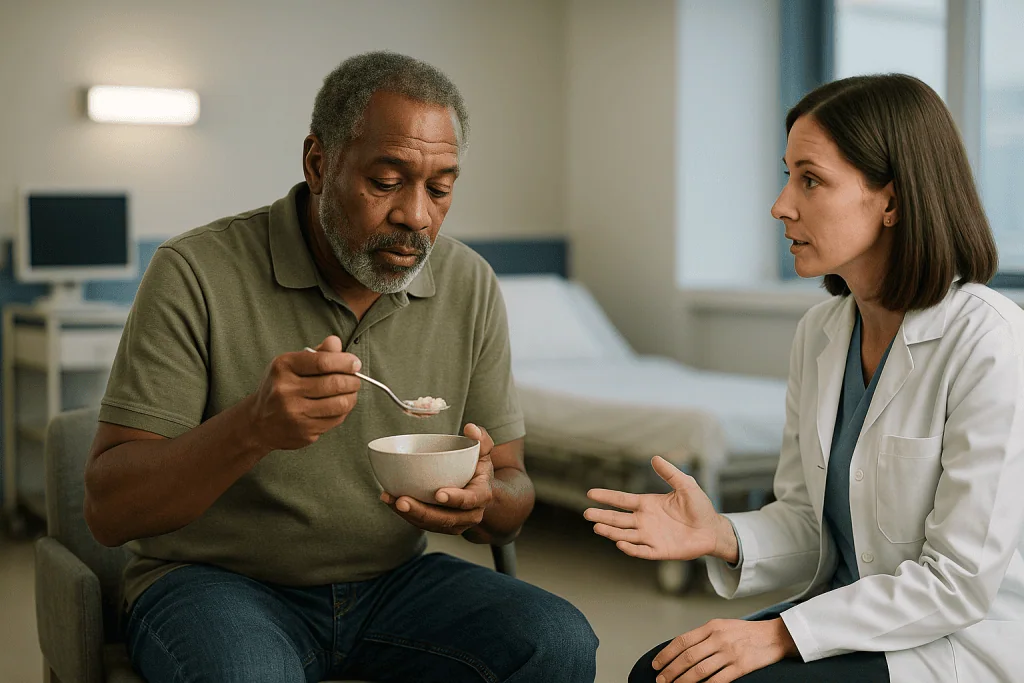
Second is the examination. The neurologist watches the patient at rest, holding the arms outstretched, pouring water or drawing a spiral, walking, turning, and rising from a chair. They check muscle tone by moving the limbs, looking for the ratchety resistance sometimes felt in Parkinson’s disease. They may tap a finger against a thumb to gauge speed and rhythm, or ask the patient to write a sentence.
Third comes reasoning. Movement disorders are largely classified by how they look and behave, a set of clinical patterns known as phenomenology (the observable features of a movement, such as speed, rhythm and distribution). The NHS describes Parkinson’s disease, for example, as a diagnosis made on symptoms and examination, since no blood test confirms it. Scans and blood work are ordered to rule out other causes rather than to make the primary call.
Where do the clips fit? Often at the very start. Many specialists review the footage before the patient walks in, then tailor the exam around what they saw: if the video showed a head tremor at the dinner table, they will look for it while the patient sits and talks. If it showed a leg buckling on stairs, they will watch gait with extra care. The video does not shorten the visit; it makes the minutes count.
What neurologists look for in movement disorder evaluation videos
Watch a specialist review footage and you will notice they rarely comment on the drama of it. They are sorting. Is the movement rhythmic or irregular? Fast or slow? Present when the limb is fully supported, or only when it reaches for something?
That last distinction separates two of the commonest referrals. A rest tremor, which appears while the hand lies still in the lap and often lessens when the hand moves, is characteristic of Parkinson’s disease. An action tremor, which shows up when holding a cup or pointing at a target, is more typical of essential tremor. The NINDS tremor fact sheet describes both patterns and notes that essential tremor is usually worst during voluntary movement. A clip of someone eating cereal can settle the question faster than a sentence of description.
Distribution is the next clue. Does the movement affect one side only, both sides equally, the head and voice, or the trunk? Dystonia, a disorder of sustained or repetitive muscle contractions that pull a body part into a twisted posture, often has a signature look: the head rotating to one side, the foot turning inward on walking. NINDS notes that dystonia can be focal (one region) or generalized, and a video showing which regions are involved helps place it.
Then there is variability. Movements that change character from one clip to the next, pause when the person is distracted, or match the rhythm of a tapping foot may point toward a functional movement disorder, which has its own recognized features and its own treatment pathways. Consistency across clips can point the other way. Neither conclusion is drawn from footage alone; the exam and history complete the picture.
Finally, context. Was the person just woken? Just startled? Halfway through a medication cycle? Good footage carries that information in the frame or in a two-line note beside it.
How to video tremor for a neurologist
The most useful tremor clips are boring to watch. They are steady, well lit and show the whole affected body part with a little space around it. Here is what specialists generally ask for.

- Hold the phone horizontally and keep it still. Prop it against a book or ask someone else to film. A shaking camera hides a shaking hand.
- Film in daylight or a bright room, with the affected part against a plain background. A hand on a dark tabletop reads far better than a hand against a patterned sofa.
- Capture three states in one clip or three short clips: the limb resting fully supported (hands in the lap, feet flat), the arms held straight out in front, and the hand doing a task such as lifting a cup, writing a sentence or drawing a spiral on paper.
- Include a wide shot of the whole body sitting or standing, then a closer view of the affected part. Avoid digital zoom, which blurs detail.
- Keep the sound on. Tremor of the voice, and any words spoken during the episode, are part of the record.
- Do not narrate over the movement or try to hold the limb still. Let the movement do what it does.
A minute of footage is usually plenty for one situation. Two or three clips across different times of day, especially a bad moment and an ordinary one, give a truer picture than a single long recording. If the tremor is triggered by something specific, whether cold, caffeine or standing for a while, film that situation rather than trying to describe it later.
Where possible, jot down the time of day and how long since any regular medicine was taken. Those two facts turn a clip from an illustration into a data point.
Filming tics, jerks and sudden movements in children and adults
Tics are the classic disappearing act. The NHS notes they are common in childhood, often first appearing around the age of five, and that many children can suppress them for a short time, which is exactly what tends to happen in a doctor’s office. Parents frequently arrive with a vivid description and a child who sits perfectly still.
Video solves this without pressure on the child. The most natural footage comes when a child is absorbed in something familiar: watching a favorite show, playing, eating a snack. Parents can set the phone on a shelf and step back. There is no need to ask the child to perform the tic, and asking usually makes it vanish.
A few points help the reviewer. Try to catch both the movement and any sounds, because vocal tics (sniffing, throat clearing, words) carry diagnostic meaning. Capture the face and shoulders in frame, since eye blinking, grimacing and shoulder shrugs are among the commonest motor tics. If the child describes an urge or feeling before the tic, mention it in the note; that premonitory sensation is a recognized feature.
For sudden jerks in any age group, the neurologist wants to see the onset. Was the person startled by a noise? Standing up? Falling asleep on the couch? A jerk that follows a loud sound differs from one that arrives out of nowhere. If the episodes cluster at a particular time, keeping the phone within reach then improves the odds of catching one.
Consent matters at every age. Talk with children about why the recording is being made and who will see it. Older children and teenagers may prefer to film themselves; many do so willingly once they understand it may spare them a room full of adults waiting for a movement that will not come.
Recording movements during sleep and on waking
Some of the most telling movements happen when no one is awake to see them. A partner may describe kicking, punching, shouting or falling out of bed; the person themselves may remember only a vivid dream or nothing at all. Neurologists take these accounts seriously because certain sleep behaviors are linked to underlying neurological conditions, and a description is hard to interpret without seeing the event.
Bedside filming is possible with a little preparation. A phone propped on a nightstand and set to record for a stretch of the night will produce a large file, so many households instead use a baby monitor or a camera with motion detection that saves only the active segments. Low light is the main obstacle; a small night lamp in the corner of the room usually gives enough for a phone camera without disrupting sleep much.
What the specialist wants to see is the whole body and the timing. Did the movement begin as the person was falling asleep, deep in the night, or on waking? Were the eyes open? Did the person respond when spoken to? Did they remember it in the morning? A brief note answering those questions, attached to the clip, is as valuable as the footage.
Movements on waking deserve attention too. Stiffness or slowness first thing in the morning, before any medicine has been taken, can differ sharply from the picture two hours later. A short clip of getting out of bed and walking to the bathroom captures a state the clinic will never observe.
None of this replaces a formal sleep study, which a neurologist may still order to record brain waves and muscle activity overnight. Home footage helps decide whether that study is needed and what it should look for.
Timing matters: medication cycles and the on-off clock
For people already taking a medicine that affects movement, the clock is part of the clinical picture. The NHS explains that levodopa, the mainstay treatment class for Parkinson’s disease, is converted in the brain to dopamine, and that over years of use its effect can become shorter and less predictable, with symptoms returning before the next dose is due. Clinicians call the period of good symptom control the “on” state and the return of symptoms the “off” state.
A video taken at the right moment shows the neurologist something the exam cannot: what the patient looks like at the trough. A person who walks smoothly into a 2 p.m. appointment because their medicine is working well may look entirely different at 6 a.m. Conversely, involuntary writhing movements that appear at the peak of a dose, known as dyskinesia, may be absent by the time of the visit.
The practical request is simple. Film a short clip at three points in the cycle: before the first medicine of the day, roughly an hour after taking it, and just before the next one is due. Write the times on a note. Some specialists provide a diary sheet; a phone’s timestamp works as well.
Two cautions belong here. First, never skip or delay a prescribed dose in order to capture a worse moment on camera. The natural ebb of a normal day provides enough contrast, and the treating team can advise if a supervised observation is needed. Second, the clips inform a conversation about adjusting treatment; they do not decide it. Any change to medicine timing or type sits with the prescribing clinician, who weighs the footage alongside the exam, the history and the person’s own account of how they feel.
Which movements to film and what to capture: a quick reference
Different movements reveal themselves in different situations. The table below summarizes what specialists most often want to see for each of the common referral patterns. It is a guide to what is worth filming, not a tool for working out what the movement is; that conclusion belongs to the examination.
| Movement described | Best moments to film | What to include in frame | Note to attach |
|---|---|---|---|
| Shaking of hands or head | Resting in lap, arms outstretched, drinking or writing | Whole upper body, then closer view of hands | Time of day, caffeine, stress, medicine timing |
| Slowness, stiffness, shuffling | Getting out of bed, walking a hallway, turning around | Full body, side and front view, feet visible | Time since last medicine, how it compares to a good day |
| Twisting postures or abnormal head position | While sitting and talking, while walking, during the trigger task | Head, neck and shoulders; feet if walking is affected | Whether touching the face or chin eases it |
| Repeated blinking, grimacing, sounds | While relaxed and absorbed, not when asked to show them | Face and shoulders, sound on | Any urge felt beforehand, how long it can be held back |
| Sudden jerks | Drifting off to sleep, after a startle, on standing | Whole body | What happened just before, whether awareness was affected |
| Night-time kicking, shouting, acting out | Overnight with motion-activated recording | Whole bed, low light source | Time of night, whether the person woke or remembered it |
| Episodes that come and go over minutes | From the first sign through recovery | Whole body, sound on | Duration, triggers, what ended it |
One habit serves every row: film the ordinary as well as the dramatic. A clip of a good moment gives the specialist a baseline, and the difference between the two is often where the diagnosis lives.
Who is usually asked to send videos, and who can skip it
The request is nearly universal for intermittent movements. If the shaking, jerking or twisting comes and goes, is tied to a time of day, a task or a state such as sleep, or has ever failed to appear at a medical visit, footage is close to essential. The same goes for movements that others have witnessed but the patient cannot describe, such as episodes during sleep or brief events the person does not remember.
Children fall squarely in this group. Tics, stereotypies (repetitive purposeful-looking movements such as hand flapping that often appear when a child is excited) and episodic jerks all tend to evaporate in an unfamiliar room. A parent’s phone is often the only reliable witness.
People already on treatment are asked for a different reason. Their movements may be well controlled at appointment time, so the trough and peak of the medication cycle, described above, need to be seen to guide any discussion about adjustments.
Who is usually told not to worry about it? Someone whose movement is continuous and unchanging, present from the moment they wake to the moment they sleep, will most likely display it in the clinic, and the exam can do its work directly. Even then, a single clip of daily activity rarely hurts. People with a long-established diagnosis attending routine follow-up may only need footage if something has changed.
There is one group who should never delay care to gather footage: anyone with a movement that appeared suddenly alongside weakness, confusion, speech trouble or a change in consciousness. That is an emergency, covered in the final section, not a filming assignment. For everyone else, a handful of clips gathered over a week or two before the appointment is a reasonable aim, and arriving with none is not a reason to cancel. The evaluation proceeds; the footage simply sharpens it.
Privacy, consent and how to share clips safely
A video of an abnormal movement is medical information, and it deserves the same protection as a scan or a blood result. Most health systems now accept clips through a secure patient portal or a dedicated upload link sent with the appointment letter. Where that exists, it is the right route. Ordinary email and text messages travel through servers the clinic does not control, and neurology teams generally prefer not to receive footage that way.
Ask the clinic how they want to receive files before recording. Some set a maximum file size, which is one more reason to keep clips short; a phone recording at a lower resolution setting still shows a tremor perfectly well. Others prefer that footage be brought to the appointment on the phone itself and viewed together in the room, which has the advantage that the patient can explain each clip as it plays.
Consent runs in both directions. If someone else appears in the frame, a partner in bed or a sibling at the dinner table, they should agree to being recorded and to the clip being shared. Children should be told, in age-appropriate terms, what the recording is for. Teenagers may reasonably ask that clips be deleted from a parent’s phone once uploaded, and that request deserves respect.
Once received, footage becomes part of the medical record under the same confidentiality rules as any other document. Patients can ask how long it is stored, who can view it and whether it might be used for teaching, which normally requires separate written permission. Public platforms are a different matter entirely: posting a clip online, even to a support group, cannot be undone, and the diagnostic value comes from the specialist seeing it, not from an audience.
What the days and weeks after the evaluation usually look like
Few movement disorder evaluations end with a single, final answer on the day. The Mayo Clinic notes that diagnosing Parkinson’s disease, for example, can take time, and that clinicians may recommend regular follow-up appointments to watch how symptoms evolve. The same is true of many other conditions in this field, where the pattern over months carries as much information as the pattern on one afternoon.
In the first days, tests ordered at the visit are scheduled. These commonly include blood work to check thyroid function and other metabolic causes of tremor, and sometimes an MRI scan of the brain to exclude structural problems. The NHS explains that such tests are used to rule out other conditions rather than to confirm Parkinson’s disease itself. Results typically come back over the following weeks, and the neurologist reviews them alongside the exam and the footage.
Patients are often asked to keep filming. A second set of clips, gathered after the visit, lets the specialist see whether the movement is stable, spreading or settling, and, if a treatment has been started, whether it is doing what was hoped. Improvement on medicine can itself be a diagnostic clue in some conditions, though never the only one.
The follow-up visit usually falls within a few months, sooner if symptoms are changing quickly or a treatment needs monitoring. At that appointment the earlier footage becomes a baseline; the new footage sits beside it. Over time this builds something no single exam can produce, a longitudinal record of how the movement behaves across seasons of a person’s life.
Throughout, decisions about starting, adjusting or stopping any treatment remain with the treating team, informed by everything in the record, including the clips filmed at the kitchen table.
What people often get wrong about movement disorder videos
“They want a video because they think I’m exaggerating.” The opposite is closer to the truth. Neurologists ask for footage because they know the clinic hides movements, and they would rather see the real thing than rely on any description, however honest.
“If the video shows it, I won’t need the exam.” Footage cannot test muscle tone, reflexes, eye movements or the subtle features a clinician feels and elicits in person. Video informs the examination; it never substitutes for it.
“I need to capture the worst episode ever.” A typical episode is more useful than a rare extreme one. Several ordinary clips across different days tell the specialist more about the pattern than a single dramatic recording.
“A functional movement disorder means the doctor thinks I’m faking.” Functional disorders are recognized neurological conditions in which the brain’s control of movement is disrupted without structural damage. Video helps identify them precisely because they have characteristic features, and identifying them opens the door to specific treatment approaches.
“I should skip my medicine so the video shows how bad it gets.” Never alter prescribed treatment for the sake of a recording. The normal rise and fall of a day provides contrast enough, and any supervised observation should be arranged with the prescribing clinician.
“Phone footage isn’t good enough; I need proper equipment.” A steady, well-lit phone clip is the standard. Detail matters more than resolution, so avoid zoom and keep the affected part fully in frame.
“Once I’ve sent the videos, the diagnosis will be clear.” Some patterns are recognizable at a glance; many are not, and the specialist may ask for tests, more footage or time. Uncertainty at the first visit is common and does not mean the evaluation has failed.
Questions to ask your care team about the movement disorder evaluation
Arriving with questions turns a passive appointment into a working session. These are the ones patients and families most often find useful, grouped by the moment they tend to arise.
Before the visit:
- Which situations do you most want to see on video for the movement I have described?
- How should I send the clips, and is there a file size or format limit?
- Should I record before and after my regular medicine, and how should I note the timing?
- If the movement happens during sleep, is home footage enough or will you want a sleep study?
During the visit:
- What did you notice in the clips, and did it match what you saw on examination today?
- Which possibilities are you considering, and what would help tell them apart?
- Are the tests you are ordering meant to confirm something or to rule other things out?
- Is there anything in my daily routine, such as caffeine, sleep or stress, that you think is affecting the movement?
After the visit:
- Should I keep filming, and what changes would you want to know about before the next appointment?
- If a treatment is being considered, how will we judge whether it is helping, and over what timeframe?
- Who do I contact if the movement changes suddenly or something new appears?
- How is my footage stored, who can see it, and can I ask for it to be deleted later?
One more question deserves a place on the list: “What would you want me to do if the clips I send do not show what I have been experiencing?” The answer is usually reassuring. Missing footage is common, and the evaluation continues regardless.
When to call your doctor
Most abnormal movements are not emergencies, and gathering footage over a week or two before a scheduled evaluation is entirely reasonable. Some presentations are different. They call for immediate medical attention, not a camera.
Call emergency services right away if an abnormal movement or weakness appears suddenly together with any of the following: drooping on one side of the face, an arm that drifts down or cannot be lifted, slurred or confused speech, sudden loss of vision, or a severe headache unlike any before. The American Heart Association’s stroke warning signs emphasize that these features, especially in combination and with abrupt onset, require emergency care within minutes.
Seek urgent same-day care if a movement is accompanied by loss of consciousness or unresponsiveness, a high fever with stiffness or confusion, difficulty swallowing or breathing, or if a new twisting or stiffening of the neck, jaw, tongue or eyes begins within hours to days of starting a new medicine, particularly an anti-nausea or antipsychotic medicine. That last pattern, an acute dystonic reaction, is uncomfortable and needs prompt assessment.
Contact your doctor or the neurology team promptly, without waiting for the scheduled appointment, if a known movement spreads to new body parts over days, if falls begin or increase, if the movement leads to injury, if there is a marked change after any medication adjustment, or if sleep behaviors become violent enough to risk harm to the person or a partner.
For everything else, the ordinary tremor at breakfast, the tics that come and go, the stiffness that eases by mid-morning, keep the phone handy, film when it happens, note the time, and bring what you have. The treating team will take it from there.
Frequently asked questions
Why do neurologists ask for videos before a movement disorder appointment?
Because many abnormal movements are intermittent or ease under observation, so the clinic may never see them. A video shows the movement’s speed, rhythm, body distribution and triggers in the setting where it actually occurs. Neurologists use the footage to focus the examination and history, not to replace them, and it often shortens the path to the right tests.
How do I video a tremor for my neurologist?
Hold the phone horizontally and steady, in good light, with the affected body part fully in frame and no zoom. Record the limb resting in the lap, the arms held out, and a task such as lifting a cup or writing. Keep the sound on, do not hold the limb still, and note the time of day and when any medicine was last taken.
What happens at a movement disorder evaluation?
The neurologist takes a detailed history, watches you at rest, walking and performing tasks, and checks muscle tone, reflexes and coordination. Any videos you have sent are reviewed and matched against the exam. Blood tests or brain imaging may be ordered to rule out other causes. A firm answer on the day is not guaranteed; follow-up visits are common.
How should I film my child's tics for the doctor?
Film when your child is relaxed and absorbed, such as watching television or playing, rather than asking them to show the tic, which usually makes it stop. Keep the face and shoulders in frame with the sound on so vocal tics are captured. Tell your child why you are recording and who will see it, and note any urge they describe beforehand.
Can a video diagnose a movement disorder on its own?
No. Footage cannot assess muscle tone, reflexes, eye movements or the way a limb feels when moved, all of which are part of the examination. Video adds context the clinic cannot provide, and some patterns are recognizable on sight, but the diagnosis rests on the full evaluation, including tests to exclude other causes, and sometimes on how symptoms change over time.
Should I skip my medication so the video shows my symptoms at their worst?
Never change or skip a prescribed medicine to make a recording. The natural rise and fall of a normal day, filmed before the first dose, an hour afterward and before the next one, gives the specialist enough contrast. If a supervised observation off medicine is needed, the prescribing clinician will arrange it safely.
What if the movement never happens while I am recording?
This is common and does not delay the evaluation. Bring whatever you have, including clips of ordinary moments, which give a useful baseline. Keep the phone within reach at the times the movement usually appears, ask a family member to help, and consider a motion-activated camera for events during sleep. The neurologist will also gather information in other ways.
How long should movement disorder evaluation videos be?
Around 30 seconds to a minute per situation is usually enough. Several short clips across different days and times of day tell the specialist more than one long recording. Check with the clinic about file size limits and the preferred secure upload route before you record, since most health systems accept footage through a patient portal rather than email.
Is it safe to send videos of my symptoms to a doctor?
Yes, when sent through the clinic’s secure patient portal or upload link, where the footage is protected like any other medical record. Avoid ordinary email or text messages, which pass through unsecured servers. Ask how long the clips are kept and who can view them, and make sure anyone else in the frame has agreed to be recorded.
What should I record if my abnormal movements happen during sleep?
Set up a phone or motion-activated camera with a view of the whole bed and a small night lamp for light. Note the time of night, whether the eyes were open, whether the person responded when spoken to and whether they remembered it in the morning. The neurologist may still order a formal sleep study; home footage helps decide whether it is needed.
References
- Tremor (NINDS, National Institutes of Health)
- Movement Disorders (MedlinePlus)
- Parkinson's disease: Diagnosis (NHS)
- Tics (NHS)
This article is for general information only and is not a substitute for professional medical advice. Please consult a qualified doctor about your individual situation.

More from the Blog

What Does Autonomic Testing Involve? Tilt Table, Sweat and Heart Rate Tests Explained
Autonomic testing is a set of noninvasive measurements, usually completed in one visit of roughly one to two hours, that records how your heart…
Caring for Someone After a Traumatic Brain Injury: What Families Can Do in the First Weeks
In the first weeks after a traumatic brain injury, families help most by keeping the environment calm and predictable, protecting sleep, speaking slowly in…

When Is It Time to See a Neurologist for Migraine? How Frequency and Disability Guide It
Consider seeing a neurologist for migraine when attacks occur on about five or more days a month, when they regularly stop you from working…
What Does the Screening Injection Before Baclofen Pump Implantation Show?
A baclofen pump screening trial shows whether a person's spasticity loosens when a small test dose of baclofen is placed directly into the spinal…

Mealtime Support for Someone With Dysphagia: Positioning, Pacing and Swallowing Safety
Mealtime support for dysphagia means helping someone eat and drink in the way their swallowing assessment recommends: sitting fully upright with the head slightly…

What Families Can Do Between Therapy Sessions to Support a Child With Cerebral Palsy
Between therapy sessions, families support a child with cerebral palsy mainly by folding the therapist's goals into daily routines: planned positioning, regular stretching, supported…