Quick answer
Color blindness is a vision disorder in which the eyes have difficulty distinguishing certain colors, most often red and green, due to inherited or acquired changes affecting the retina or optic nerve. Evaluation focuses on identifying the type and cause with eye examinations and color vision testing, and management may include supportive strategies, tinted lenses in selected cases, and treatment…
What is color blindness?
Color blindness, known medically as color vision deficiency, is a condition in which a person has difficulty telling certain colors apart. Despite the name, most people with color blindness are not blind to color entirely. Instead, they see colors differently from most people, and some pairs of colors, most often shades of red and green, or less commonly blue and yellow, look similar or identical to them. Complete color blindness, in which the world appears only in shades of gray, is rare.
To understand what is color blindness, it helps to know how the eye normally sees color. The retina, the light-sensitive layer at the back of the eye, contains special cells called cones. There are three types of cones, and each type responds most strongly to a different range of light: roughly red, green, or blue. The brain compares the signals from these three cone types to produce the full range of colors we perceive. In color blindness, one or more cone types is missing, does not work properly, or responds to a slightly shifted range of light. The result is that certain colors send similar signals to the brain and become hard to distinguish.
Color blindness is common. It affects far more men and boys than women and girls, because the most frequent forms are passed down on the X chromosome, one of the two chromosomes that determine biological sex. Males have only one X chromosome, so a single altered gene is enough to cause the condition. Inherited color blindness is usually present from birth, affects both eyes equally, and stays stable throughout life. Color vision problems can also develop later in life as a result of eye disease, certain general health conditions, some medications, or injury; these acquired forms may affect one eye more than the other and can change over time.
Symptoms of color blindness
Color blindness symptoms vary from mild to severe depending on the type and how strongly the cones are affected. Many people with a mild deficiency do not realize they see colors differently until a screening test, a school activity, or a job requirement brings it to light. Common signs include:
- Difficulty telling certain colors apart, most often reds and greens, and less commonly blues and yellows.
- Colors appearing duller or washed out compared with how other people describe them.
- Trouble judging the brightness or intensity of some colors.
- Difficulty with color-coded materials, such as maps, charts, traffic signals, ripeness of fruit, or matching clothes.
- In children, using the “wrong” colors when drawing, struggling with color-based learning games, or avoiding coloring activities.
- In rare complete color blindness (achromatopsia), seeing only in shades of gray, often together with poor sharpness of vision, sensitivity to bright light, and involuntary eye movements (nystagmus).
Symptoms differ by type. In red-green color blindness, the most common form, shades of red, orange, brown, and green can look confusingly similar; purple may look like blue because the red component is not perceived normally. Within this group, doctors distinguish deficiencies of the red-sensing cones (protan types) and the green-sensing cones (deutan types), but the everyday experience is often similar. In blue-yellow color blindness (tritan types), which is much less common, blues may be confused with greens, and yellows with pinks or light grays. In complete color blindness, color perception is absent and other vision problems are usually present as well.
It is also useful to distinguish inherited from acquired symptoms. Inherited color blindness does not get worse over time: a person’s color perception in adulthood is essentially the same as it was in childhood. By contrast, when color vision changes in an adult who previously saw colors normally, this suggests an acquired cause, such as a disease of the retina or the optic nerve (the cable that carries visual signals from the eye to the brain), a cataract (clouding of the eye’s natural lens), or a medication side effect. A new or worsening change in how you see colors deserves medical attention, because it can be an early sign of a treatable eye or general health problem.
Causes and risk factors
The most common color blindness causes are genetic. Inherited red-green color blindness is caused by changes in genes located on the X chromosome that carry the instructions for the light-sensing pigments in the cones. Because males have only one X chromosome, they are affected much more often. Females, who have two X chromosomes, are usually carriers: they can pass the gene to their children without having significant symptoms themselves, although some women do have a measurable color vision deficiency. Blue-yellow color blindness and complete color blindness follow different inheritance patterns and affect men and women more equally, but they are far less common.
Acquired color vision deficiency can result from a range of conditions and exposures, including:
- Eye diseases such as glaucoma (damage to the optic nerve often related to eye pressure), age-related macular degeneration (deterioration of the central retina), diabetic retinopathy (retinal damage from diabetes), and cataracts.
- Diseases of the optic nerve or brain, including optic neuritis (inflammation of the optic nerve, sometimes associated with multiple sclerosis), stroke, or other neurological conditions.
- General health conditions such as diabetes and, in some cases, chronic liver or kidney disease.
- Medications, since certain drugs used for heart conditions, infections, autoimmune disease, and other problems can affect color perception in some people; your doctor or pharmacist can advise whether a medication you take carries this risk.
- Exposure to certain chemicals, such as some industrial solvents, over long periods.
- Aging, because the lens of the eye gradually yellows over the decades, which can subtly alter color perception, especially for blues.
- Eye or head injury affecting the retina, optic nerve, or the parts of the brain that process color.
Risk factors therefore include being male, having a family history of color vision deficiency (particularly on the mother’s side of the family), having diabetes or other chronic conditions that can affect the eye, taking medications known to influence color vision, and increasing age. If you have any of these risk factors, mentioning them at your regular eye examination helps your eye doctor decide whether formal color vision testing is worthwhile.
Diagnosis
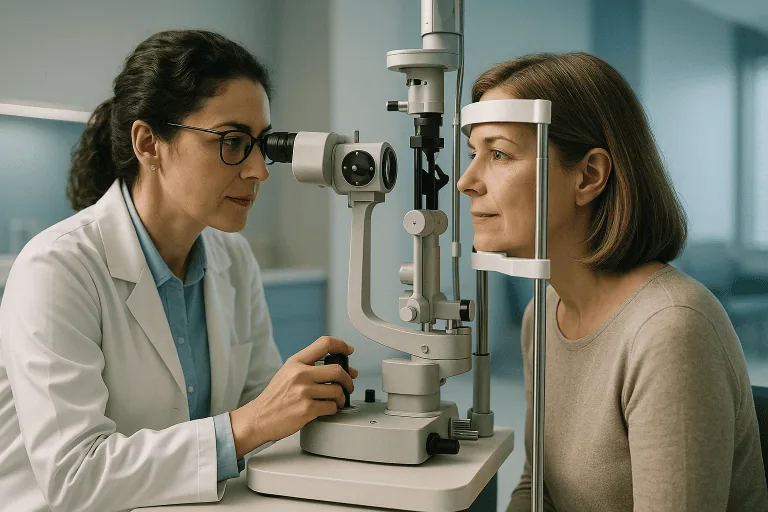
Color blindness diagnosis is straightforward, painless, and usually quick. It is typically carried out by an ophthalmologist (a medical doctor specializing in eye disease) or an optometrist (an eye care professional trained to examine vision) as part of a broader eye examination. At Acibadem, color vision assessment is handled within the ophthalmology department, where it can be combined with a full check of eye health when needed.
The most widely used screening test is the Ishihara test. You are shown a series of circular plates made up of colored dots. Within each circle, dots of a different color form a number or a wavy line. People with normal color vision see the hidden figure easily, while people with red-green color blindness see a different figure or nothing at all. The pattern of correct and incorrect answers helps identify whether a deficiency is present and, broadly, what type it is. The Ishihara test is mainly designed to detect red-green deficiencies; other plate tests exist for blue-yellow problems.
When more detail is needed, for example, to grade the severity of a deficiency or to assess suitability for certain occupations, doctors may use additional tests:
- Arrangement tests, such as the Farnsworth D-15 or the more detailed Farnsworth-Munsell 100 Hue test, in which you place colored caps in order of hue. The pattern of errors reveals the type and severity of the deficiency.
- Anomaloscope testing, considered a precise method for red-green deficiencies, in which you adjust a mixture of red and green light to match a yellow reference light. The settings you choose show how your cones respond.
- Lantern tests, sometimes required for aviation, maritime, or railway roles, which check whether you can recognize colored signal lights.
If an acquired cause is suspected, for example, because color vision has changed in adulthood, differs between the two eyes, or is accompanied by other visual symptoms: the eye doctor will look for an underlying condition. This may involve a dilated examination of the retina and optic nerve, measurement of eye pressure, imaging such as optical coherence tomography (a detailed scan of the retinal layers), visual field testing, and a review of your medications and general health. In children, color vision screening is often recommended before school age, especially when there is a family history, so that teachers and parents can adapt learning materials early.
Treatment options for color blindness
It is important to be honest about color blindness treatment: at present, there is no cure for inherited color blindness. The missing or altered cone pigments cannot currently be replaced in routine clinical practice. Research into gene therapy for certain inherited retinal conditions is ongoing, but for the common forms of red-green color blindness, no approved treatment restores normal color vision. Fortunately, inherited color blindness is not a disease of the eye in the usual sense: the eye is otherwise healthy, the condition does not progress, and it does not threaten overall sight. Management therefore focuses on adaptation rather than correction.
Approaches your doctor may discuss include:
- No treatment (watchful waiting). For most people with mild inherited deficiency, no intervention is needed. Confirming the diagnosis, understanding which color confusions to expect, and making small adjustments in daily life are often enough.
- Special tinted lenses or glasses. Certain filtered glasses and contact lenses are marketed to enhance the contrast between colors that people with red-green deficiency confuse. In many cases these can make some color differences easier to notice, but they do not restore normal color vision, results vary from person to person, and they may not help in all lighting conditions or for all types of deficiency. An eye care professional can help you set realistic expectations before purchasing such products.
- Technology and practical aids. Smartphone apps can identify the color of an object through the camera, and many operating systems, websites, and games now offer color-blind-friendly display modes. Labeling clothes, organizing items by position rather than color, and learning the fixed order of traffic lights are simple, effective strategies.
- Treating the underlying cause of acquired deficiency. When color vision loss results from another condition, treating that condition may improve or stabilize color perception. For example, cataract surgery can restore more natural color perception when a yellowed lens is the cause; controlling diabetes helps protect the retina; and adjusting or stopping a medication (only under a doctor’s supervision) may reverse a drug-related change. Whether color vision recovers depends on the cause and how much damage has occurred.
There is no medication, standard procedure, or surgery that treats inherited color blindness itself. Any product or clinic claiming to cure genetic color blindness should be viewed with caution. If you are unsure whether your color vision problem is inherited or acquired, which directly affects whether treatment of an underlying cause is possible, an evaluation in an ophthalmology unit can clarify the situation.
Living with color blindness and outlook
For most people, the outlook with inherited color blindness is very good. The condition is stable, does not cause pain or vision loss, and does not lead to blindness. The main challenges are practical, and most can be managed with awareness and simple strategies.
In daily life, people with color blindness often develop their own reliable systems: memorizing which traffic light is on top, asking a family member to help label clothing, or relying on brightness and position cues rather than color. Good lighting makes color discrimination easier for almost everyone with a deficiency. Digital tools continue to improve, and many workplaces and schools can adapt materials, for example, by adding text labels or patterns to color-coded charts.
Some careers have color vision requirements, particularly those involving colored signal lights or safety-critical color coding, such as commercial aviation, certain maritime and railway roles, some branches of the military and police, and parts of electrical work. Requirements differ by country and by the specific role, and some occupations accept milder deficiencies or offer alternative testing. Young people with color blindness benefit from learning about these requirements early so they can plan realistically, but the great majority of professions are fully open to people with color vision deficiency.
For children, early identification matters mainly for education. A child who cannot distinguish the colors used in reading schemes, maps, or science diagrams may be wrongly thought to have a learning difficulty. Informing teachers allows simple adjustments, such as labeling colors in classroom materials. For acquired color vision deficiency, the outlook depends on the underlying cause, and regular follow-up with an eye doctor is important to monitor the responsible condition.
Frequently asked questions
What is color blindness in simple terms?
Color blindness means that the light-sensing cone cells in the retina do not respond to colors in the usual way, so certain colors, most often reds and greens, look similar or identical. Most affected people still see many colors; total loss of color vision is rare. The condition is usually inherited and present from birth, though it can also develop later because of eye disease, other health problems, or medications.
Can color blindness be cured or heal on its own?
Inherited color blindness cannot currently be cured and does not resolve on its own, but it also does not get worse. Research into future therapies is ongoing, but no approved treatment restores normal color vision for the common inherited forms. Acquired color vision deficiency may improve if the underlying cause, such as a cataract or a medication side effect, is treated, although improvement is not guaranteed and depends on the cause.
How serious is color blindness?
For most people, inherited color blindness is a mild, lifelong condition rather than a serious illness. It does not damage the eye, does not cause blindness, and does not affect general health. Its impact is mainly practical, affecting tasks that rely on color coding and eligibility for a limited number of careers. Acquired color vision changes are a different matter, because they may signal an underlying eye or neurological condition that needs assessment.
What are the first color blindness symptoms parents might notice in a child?
Parents may notice a child using unusual colors in drawings, struggling to learn color names, confusing red and green objects, or losing interest in color-based games. Because children often compensate well, symptoms can be subtle, and many cases are found only through screening. If there is a family history of color vision deficiency, mentioning it at the child’s eye check is helpful so that appropriate testing can be done.
Do special glasses for color blindness really work?
Tinted glasses and lenses designed for red-green deficiency can, in many cases, make some color differences more noticeable by filtering the light entering the eye. However, they do not give the wearer normal color vision, they do not work equally well for everyone, and they typically do not allow a person to pass occupational color vision tests. Trying such glasses with guidance from an eye care professional, and with realistic expectations, is a sensible approach.
How is color blindness diagnosis done, and is testing painful?
Diagnosis is simple and completely painless. The most common method is the Ishihara plate test, in which you identify numbers hidden among colored dots. If more detail is needed, arrangement tests or an anomaloscope may be used to determine the type and severity of the deficiency. When an acquired cause is suspected, the eye doctor may also examine the retina and optic nerve and perform imaging to look for an underlying condition.
Can adults suddenly develop color blindness?
Yes. While inherited color blindness is present from birth, adults can develop color vision problems from eye diseases such as glaucoma, macular degeneration, or cataracts, from optic nerve conditions, from diabetes, or as a side effect of certain medications. A new change in how you see colors, especially if it affects one eye or comes with other visual symptoms, should always be evaluated by an eye doctor, because the underlying cause may be treatable.
When to see a doctor
Inherited color blindness itself is not an emergency, but a routine eye examination is worthwhile whenever a color vision problem is suspected, for example, if a child has trouble learning colors, if there is a strong family history, or if a job application requires documented color vision status. An ophthalmology assessment can confirm the type of deficiency and rule out other eye conditions.
Seek prompt medical attention if you notice any of the following warning signs, because they may indicate a condition that goes beyond simple color blindness:
- A sudden or recent change in color perception in someone who previously saw colors normally.
- Color vision that differs between the two eyes, or a change affecting only one eye.
- Color vision changes accompanied by blurred vision, dim vision, or loss of part of your visual field.
- Eye pain, pain with eye movement, or a red, inflamed eye together with visual changes.
- New flashes of light, a sudden shower of floaters, or a shadow or curtain across your vision, possible signs of a retinal problem that needs urgent care.
- Color vision changes after starting a new medication, which should be reported to your prescribing doctor without stopping the medication on your own.
- Headache, weakness, difficulty speaking, or other neurological symptoms occurring alongside a change in vision, which require emergency evaluation.
If you are unsure whether your symptoms are urgent, it is safer to have them checked. Many causes of acquired color vision change respond best to treatment when they are found early, and a straightforward examination can provide reassurance or a timely diagnosis.
Medically reviewed by the Acıbadem International Medical Board September 3, 2026
See our medical review board →
Update history
- PublishedJune 14, 2026
- Medical review approvedSeptember 3, 2026
- Last content updateSeptember 2, 2026