Quick answer
Dementia is a group of conditions that progressively impair memory, thinking, behavior, and daily functioning, often due to diseases affecting the brain such as Alzheimer’s disease. At Acibadem in Turkey, dementia care focuses on detailed neurological evaluation, identifying the underlying cause, and managing symptoms with personalized treatment, cognitive support, and follow-up by a multidisciplinary team.
What is dementia?
Dementia is a general term for a decline in memory, thinking, and reasoning that is severe enough to interfere with daily life. It is not a single disease. Instead, dementia describes a group of symptoms that can be caused by many different conditions affecting the brain. When doctors use the code F03.90, they are referring to unspecified dementia, meaning a dementia whose exact underlying cause has not yet been identified or classified.
To understand what is dementia in practical terms, it helps to know that the brain relies on billions of nerve cells (neurons) communicating with one another. In dementia, these cells become damaged or die, and the connections between them break down. As this damage spreads, a person gradually loses abilities such as remembering recent events, finding the right words, planning tasks, or recognizing familiar people and places.
Dementia mainly affects older adults. The risk rises steadily with age, particularly after 65, although dementia is not a normal or inevitable part of aging. Many people live into their 80s and 90s without developing it. Less commonly, dementia can begin before the age of 65; this is often called young-onset or early-onset dementia. The condition affects people of all backgrounds, and it also has a major impact on family members and caregivers, who often provide daily support as the condition progresses.
Alzheimer’s disease is the most common cause of dementia, but there are several other important types, including vascular dementia (related to reduced blood flow in the brain), Lewy body dementia, and frontotemporal dementia. Many older people have a mix of more than one type.
Symptoms of dementia
Dementia symptoms vary from person to person and depend on which parts of the brain are affected, the underlying cause, and how far the condition has progressed. In most cases, symptoms begin gradually and worsen slowly over months and years.
Common dementia symptoms include:
- Memory lossespecially forgetting recent conversations, appointments, or events, and asking the same questions repeatedly.
- Difficulty with languagestruggling to find words, losing the thread of a conversation, or having trouble following what others say.
- Problems with planning and judgmentdifficulty managing finances, following a recipe, or making decisions that used to be routine.
- Disorientationbecoming confused about the time, the date, or familiar places, and sometimes getting lost on well-known routes.
- Changes in mood and personalityincreased anxiety, irritability, apathy (loss of interest and motivation), suspicion, or depression.
- Difficulty with everyday tasksneeding more help with cooking, dressing, using appliances, or taking medications correctly.
- Poor concentrationlosing focus easily or taking much longer to complete familiar activities.
- Visual and spatial problemsmisjudging distances or having trouble recognizing objects and faces.
Symptoms often differ by stage. In the early stage, changes may be subtle and easy to attribute to normal aging or stress: mild forgetfulness, occasional word-finding trouble, or reduced initiative. In the middle stage, memory loss and confusion become more obvious, help is needed with daily tasks, and behavioral changes such as agitation, wandering, or sleep disturbance may appear. In the late stage, people usually need full-time care; communication becomes very limited, mobility declines, and problems with swallowing and continence are common.
Symptoms can also differ by type of dementia. In Alzheimer’s disease, memory loss for recent events is often the earliest and most prominent feature. In vascular dementia, thinking speed and planning may be affected first, and symptoms sometimes worsen in noticeable steps after small strokes. In Lewy body dementia, people may experience visual hallucinations (seeing things that are not there), fluctuating alertness, and movement problems similar to Parkinson’s disease. In frontotemporal dementia, early changes often involve personality, behavior, or language rather than memory.
It is important to know that occasional forgetfulness, misplacing keys or briefly forgetting a name, happens to almost everyone and does not by itself mean dementia. What matters is a persistent, progressive change from a person’s previous abilities that interferes with everyday life.
Causes and risk factors
Dementia causes vary depending on the type, but all involve damage to brain cells and the connections between them. The main underlying conditions include:
- Alzheimer’s diseasethe most common cause, associated with abnormal protein deposits in the brain (amyloid plaques and tau tangles) that gradually damage nerve cells.
- Vascular diseasereduced blood flow to the brain from strokes, small vessel disease, or long-standing high blood pressure, leading to vascular dementia.
- Lewy body diseaseabnormal protein clumps called Lewy bodies that form inside brain cells, seen in Lewy body dementia and in dementia related to Parkinson’s disease.
- Frontotemporal degenerationdamage concentrated in the front and side regions of the brain, which control behavior and language.
- Mixed dementiaa combination of causes, most often Alzheimer’s changes together with vascular damage, which is common in older adults.
Some conditions can cause dementia-like symptoms that may improve when the underlying problem is treated. Examples include vitamin B12 deficiency, an underactive thyroid gland, severe depression, side effects of certain medications, infections, normal pressure hydrocephalus (a buildup of fluid in the brain), and heavy alcohol use. This is one reason a thorough medical evaluation is so important.
Several factors are known to increase the risk of developing dementia:
- Agethe strongest risk factor; risk rises significantly after 65.
- Family history and geneticshaving close relatives with dementia can increase risk, although most cases are not directly inherited.
- Cardiovascular risk factorshigh blood pressure, diabetes, high cholesterol, obesity, and smoking all raise the risk, particularly of vascular dementia.
- Physical inactivity and an unhealthy diet.
- Heavy alcohol consumption over many years.
- Hearing loss that is left untreated.
- Head injuries, especially repeated or severe ones.
- Social isolation and low mental stimulation, which may reduce the brain’s resilience.
- Depression, particularly in later life.
Some of these factors cannot be changed, but many can. Research suggests that managing blood pressure and diabetes, staying physically and socially active, not smoking, limiting alcohol, and treating hearing loss may lower the risk of dementia or delay its onset, although no measure can guarantee prevention.
Diagnosis
There is no single test that confirms dementia. Instead, a dementia diagnosis is made by combining information from the medical history, physical and neurological examinations, cognitive testing, laboratory work, and brain imaging. The goal is both to confirm that dementia is present and to identify its likely cause, since this influences treatment and outlook.
The diagnostic process usually includes:
- Medical historythe doctor asks about the symptoms, when they started, how they have changed, current medications, and other health conditions. Because people with memory problems may not recall details, information from a family member or close friend is often essential.
- Cognitive and neuropsychological testsstructured tests of memory, language, attention, problem-solving, and orientation. Brief screening tools such as the Mini-Mental State Examination (MMSE) or the Montreal Cognitive Assessment (MoCA) are commonly used; more detailed neuropsychological testing may follow.
- Physical and neurological examinationchecking reflexes, muscle strength, balance, coordination, eye movements, and senses to look for signs pointing to a specific cause.
- Blood teststo rule out treatable conditions that can mimic dementia, such as thyroid problems, vitamin B12 deficiency, infections, or metabolic imbalances.
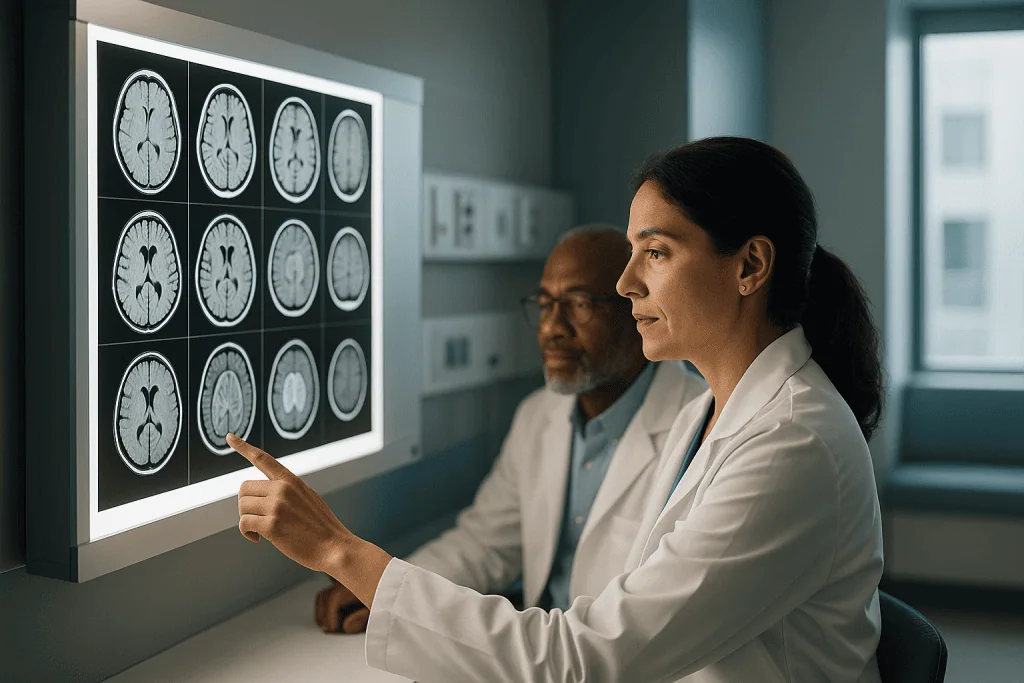
- Brain imagingcomputed tomography (CT) or magnetic resonance imaging (MRI) scans can reveal strokes, tumors, fluid buildup, bleeding, or patterns of brain shrinkage that suggest a particular type of dementia. In selected cases, specialized scans such as PET (positron emission tomography) may be used.
- Mental health assessmentbecause depression and severe anxiety can affect memory and concentration, doctors often evaluate mood as part of the workup.
Doctors also distinguish dementia from delirium, a sudden state of confusion that develops over hours or days, often due to infection, medication, or another acute illness, and from mild cognitive impairment (MCI), in which thinking changes are measurable but do not yet significantly disrupt daily life. Some people with MCI later develop dementia, while others remain stable or improve.
Diagnosis and long-term management are usually coordinated by specialists in neurology, often working together with geriatricians, psychiatrists, and neuropsychologists. In many cases, the diagnosis becomes clearer over time, as doctors observe how symptoms evolve at follow-up visits.
Treatment options
At present, most causes of dementia cannot be cured, and the brain damage that has already occurred generally cannot be reversed. However, dementia treatment can ease symptoms, slow decline in some cases, treat contributing conditions, and significantly improve quality of life for both patients and caregivers. Treatment plans are individualized based on the type of dementia, the stage, and the person’s overall health. An overview of how this condition is managed is available on the dementia treatment page.
Medications
Several medicines may be used, depending on the diagnosis:
- Cholinesterase inhibitors (such as donepezil, rivastigmine, and galantamine) increase levels of a brain chemical involved in memory and are often prescribed for Alzheimer’s disease and some other dementias. They may modestly improve or stabilize symptoms for a time, but they do not stop the underlying disease.
- Memantine works on a different brain chemical system and may be used in moderate to severe Alzheimer’s disease, sometimes together with a cholinesterase inhibitor.
- Medications for related symptomsdoctors may treat depression, anxiety, sleep problems, or, in carefully selected cases, severe agitation or hallucinations. These medicines are used cautiously, at the lowest effective dose, because some carry risks in older adults with dementia.
- Treatment of underlying conditionscontrolling blood pressure, diabetes, and cholesterol is important, especially in vascular dementia, to reduce the risk of further damage.
Non-drug approaches
Non-medication strategies are a central part of dementia care and are often tried before or alongside medicines for behavioral symptoms:
- Cognitive stimulation and occupational therapystructured activities and practical training that help people use their remaining abilities and adapt daily routines.
- Physical exerciseregular activity supports overall health, mood, sleep, and mobility.
- Environmental adjustmentssimplifying the home, using labels, calendars, and reminders, improving lighting, and removing hazards to reduce confusion and prevent falls.
- Caregiver education and supportteaching families how to communicate effectively, manage difficult behaviors, and plan for changing needs.
- Speech and language therapyfor communication difficulties and, in later stages, swallowing problems.
Watchful waiting and follow-up
In very early or uncertain cases, for example, mild cognitive impairment, doctors may recommend regular monitoring rather than immediate medication. Repeat cognitive testing over time helps clarify whether symptoms are stable or progressing, so that treatment can be adjusted appropriately.
Procedures and surgery
Surgery is not a treatment for the common degenerative dementias such as Alzheimer’s disease. However, when dementia-like symptoms are caused by a specific structural problem, for example, normal pressure hydrocephalus, a brain tumor, or a blood collection pressing on the brain: a surgical procedure to address that problem may improve symptoms. This is one of the reasons brain imaging is part of the standard workup. At facilities such as Acibadem, these evaluations and treatments are typically managed within the neurology department in coordination with neurosurgery when needed.
Living with dementia and outlook
Dementia is, in most cases, a progressive condition, meaning symptoms gradually worsen over time. The speed of progression varies widely: some people decline slowly over many years, while others change more quickly. The type of dementia, the person’s age, overall health, and access to good supportive care all influence the course. Doctors cannot predict an individual’s timeline with certainty, and honest, ongoing conversations with the care team are the best way to understand what to expect.
Many people live meaningfully for years after a dementia diagnosis, particularly in the early and middle stages. Practical steps that often help include:
- Establishing consistent daily routines and using memory aids such as calendars, pill organizers, and written notes.
- Staying physically, socially, and mentally active at a comfortable level.
- Eating a balanced diet and attending regular medical checkups to manage other health conditions.
- Making the home safer early on, before problems arise.
- Planning ahead for legal, financial, and care decisions while the person can still take part in those choices.
Caregivers play a vital role and face significant physical and emotional demands. Respite care, support groups, counseling, and community services can help families sustain their own health while caring for a loved one. In later stages, professional home care or residential care may become necessary, and palliative care approaches can help keep the person comfortable and dignified.
While current treatments cannot cure most dementias, research into new therapies is active and ongoing. Your medical team can advise whether any newer options or clinical studies may be relevant in your situation.
Frequently asked questions
What is dementia in simple terms?
Dementia is a decline in memory and thinking that becomes severe enough to affect everyday life. It is caused by damage to brain cells from conditions such as Alzheimer’s disease, strokes and blood vessel disease, or other brain disorders. It is a symptom pattern rather than one specific disease, which is why finding the underlying cause is an important part of the diagnosis.
Can dementia be cured or reversed?
In most cases, no. The common degenerative causes of dementia, such as Alzheimer’s disease, currently have no cure, and lost brain function generally cannot be restored. However, a small number of dementia-like conditions, such as thyroid problems, vitamin deficiencies, or fluid buildup in the brain, may improve when the underlying cause is treated. This is why a full medical evaluation is essential before assuming the condition is irreversible.
How serious is a diagnosis of dementia?
Dementia is a serious, usually progressive condition that eventually affects a person’s independence and, in later stages, their physical health. That said, the course varies greatly from person to person, and many people continue to enjoy meaningful activities and relationships for years, especially with good support. Early diagnosis allows time to plan, treat contributing conditions, and start therapies that may help maintain function longer.
What are the earliest dementia symptoms to watch for?
Early signs often include forgetting recent conversations or events, repeating questions, trouble finding words, difficulty managing finances or planning tasks, getting confused about dates or familiar places, and changes in mood or motivation. The key feature is a persistent change from the person’s usual abilities, noticed by the person themselves or by those around them, rather than an occasional lapse.
Is dementia the same as Alzheimer’s disease?
Not exactly. Dementia is the umbrella term for the overall pattern of cognitive decline, while Alzheimer’s disease is the most common specific cause of that decline. Other causes include vascular dementia, Lewy body dementia, and frontotemporal dementia. A person may also have more than one cause at the same time, which is known as mixed dementia.
Does dementia treatment actually help if there is no cure?
Yes, in many cases treatment makes a real difference even though it does not cure the disease. Medications may modestly improve or stabilize memory and thinking for a period of time, and treating problems such as depression, sleep disturbance, or agitation can substantially improve comfort and daily functioning. Non-drug approaches, structured activities, exercise, home adjustments, and caregiver support, are often just as important as medication.
Can dementia be prevented?
There is no guaranteed way to prevent dementia, but research suggests that certain habits may lower the risk or delay its onset. These include controlling blood pressure and diabetes, not smoking, limiting alcohol, staying physically and socially active, keeping the mind engaged, maintaining a healthy diet, and treating hearing loss. These measures also benefit heart and overall health, so they are worthwhile at any age.
When to see a doctor
Anyone who notices a persistent decline in memory, thinking, or daily functioning, in themselves or in a loved one, should arrange a medical evaluation. Early assessment matters, because some causes of cognitive decline are treatable, and early diagnosis allows better planning and care.
Seek medical attention promptly, or emergency care where appropriate, if any of the following red flags occur:
- Sudden confusion that develops over hours or days, which may indicate delirium from infection, medication, or another acute illness.
- Sudden weakness, numbness, slurred speech, facial drooping, or vision losspossible signs of a stroke, which is a medical emergency.
- Confusion or memory problems after a head injury or fall, even if it seemed minor at the time.
- Rapid worsening of memory or behavior over weeks rather than months or years.
- New hallucinations, severe agitation, or dramatic personality change.
- Getting lost in familiar places or wandering, which raises immediate safety concerns.
- Seizures, severe headache, or repeated vomiting alongside confusion.
- Signs of self-neglect, such as significant weight loss, missed medications, or unsafe living conditions.
- Difficulty swallowing, choking, or repeated chest infections in someone with advanced dementia.
If memory or thinking changes are gradual but ongoing, a routine appointment with a family doctor or a neurologist is the right first step. Bringing a family member who can describe the changes, along with a list of current medications, will help the doctor make an accurate assessment.
Medically reviewed by the Acıbadem International Medical Board September 2, 2026
See our medical review board →
Update history
- PublishedJune 14, 2026
- Medical review approvedSeptember 2, 2026
- Last content updateSeptember 2, 2026