Developmental Hip Dysplasia
Developmental Hip Dysplasia is a childhood hip condition. Learn symptoms, causes, diagnosis, treatment options and when to seek care.

Quick answer
Developmental hip dysplasia is a condition in which a baby’s hip joint does not form or fit together properly, ranging from mild looseness to partial or complete dislocation. Treatment depends on the child’s age and the severity of the problem, and may include observation, bracing or a cast, or surgery to position and stabilize the hip and support normal joint…
Developmental Hip Dysplasia is a condition in which a baby or child’s hip joint does not form or fit together normally, making the hip unstable, partially dislocated or fully dislocated. Early diagnosis and specialist treatment help guide the hip into a healthier position and support normal growth and movement.
Overview
Developmental Hip Dysplasia is a disorder of hip development in which the femoral head, the rounded top of the thigh bone, does not sit securely in the acetabulum, the socket of the pelvis. The socket may be shallow, the ligaments may be loose, or the hip may be partly or completely out of place. The condition is often shortened to DDH and may affect one hip or both hips.
The word developmental is important because the condition can be present at birth or become more apparent as the child grows. In some babies, the hip is unstable but can still move in and out of the socket. In others, the hip is dislocated and remains outside the socket. DDH ranges from mild hip immaturity to more significant dislocation.
The hip joint develops best when the ball and socket remain well aligned during early growth. If DDH is not recognized, the hip may not develop normally, which can contribute to limping, leg-length difference, pain, or early joint wear later in life. Early assessment by pediatric and orthopedic specialists helps determine whether observation, bracing, casting, or surgery is appropriate.
Symptoms
Developmental Hip Dysplasia can be difficult for parents to notice because many newborns appear comfortable and have no pain. A baby may feed, sleep and move normally even when one hip is unstable. For this reason, routine newborn and infant hip checks are an important part of child health care.
Possible signs in babies include uneven skin folds on the thighs or buttocks, one leg appearing shorter than the other, limited movement when the hip is gently opened to the side, or a difference in how the legs rest. A healthcare professional may feel a hip click, clunk, or instability during a specific physical examination, but parents should not try to test the hip themselves.
In older babies and toddlers, signs may become more visible when the child starts standing or walking. These may include delayed walking, limping, toe walking on one side, a waddling gait, or an exaggerated curve in the lower back when both hips are affected. Some children do not develop pain until adolescence or adulthood, when untreated or residual dysplasia can place extra stress on the hip joint.
- DDH is not always painful in infancy.
- A normal-looking baby can still have hip dysplasia.
- Any limp, leg-length difference, or reduced hip movement should be assessed by a doctor.
Causes & Risk Factors
Developmental Hip Dysplasia usually has more than one cause. It is linked to how the hip forms before birth, the baby’s position in the uterus, ligament looseness, and mechanical forces around the hip during late pregnancy and early infancy. The hip joint is naturally more flexible in newborns, and in some babies the socket is not deep enough to hold the femoral head securely.
Several factors are known to increase the risk of DDH. These include breech position, especially when the baby is positioned bottom-down late in pregnancy, a family history of hip dysplasia, female sex, first-born status, and conditions associated with reduced space in the uterus. DDH may also be seen more often with other musculoskeletal findings such as foot positioning problems or neck tightness, although each child needs individual assessment.
Infant positioning after birth can also influence hip development. Tight swaddling that holds the legs straight and pressed together may increase stress on the hips. Hip-healthy swaddling allows the baby’s hips and knees to bend and move outward naturally. Parents should ask a healthcare professional to demonstrate safe swaddling and carrying techniques if they are unsure.
Having a risk factor does not mean a child will definitely develop Developmental Hip Dysplasia, and some children with DDH have no clear risk factors. Screening and follow-up are therefore based on both the physical examination and the child’s individual risk profile.
Diagnosis
Diagnosis of Developmental Hip Dysplasia begins with a careful medical history and physical examination. In newborns, clinicians use gentle maneuvers to assess hip stability and range of motion. These examinations are designed to detect whether the hip is loose, reducible, or dislocated, and they should be performed by trained healthcare professionals.
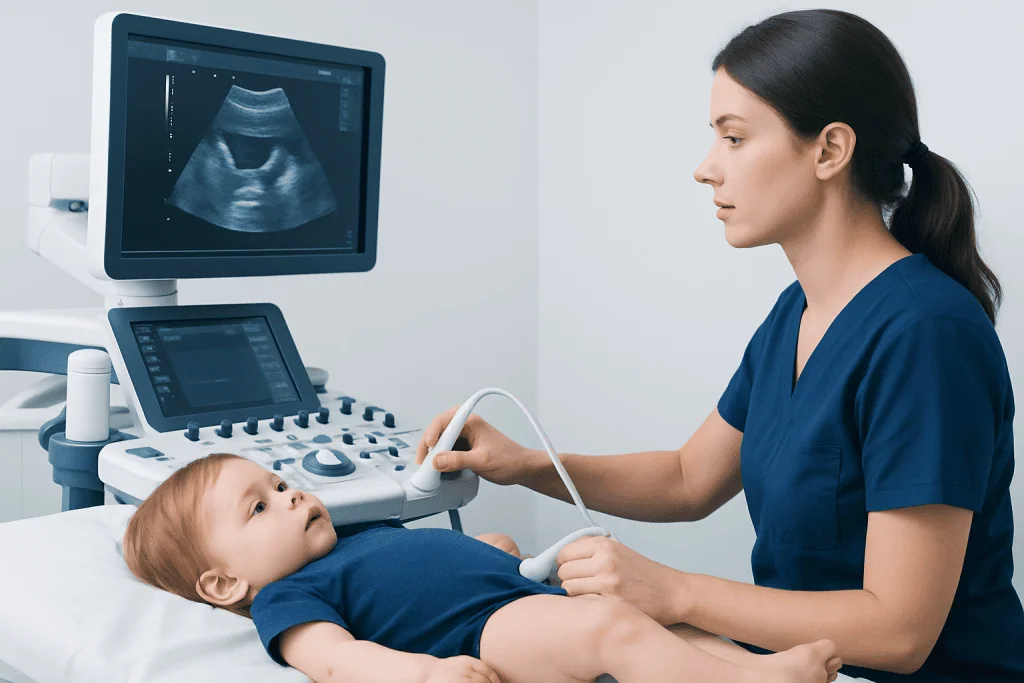
Imaging is often used to confirm the diagnosis or monitor hip development. Ultrasound is commonly used in young infants because much of the hip is still cartilage and may not be clearly visible on X-ray. Ultrasound can show the shape of the socket, the position of the femoral head, and whether the hip is stable during gentle movement.
As babies grow and the hip bones become more visible, X-rays become more useful. X-rays help orthopedic specialists assess socket development, hip alignment and response to treatment. The choice and timing of imaging depend on the child’s age, physical findings and risk factors.
Some babies with mild hip immaturity improve as they grow, while others need treatment to avoid ongoing instability. For this reason, follow-up appointments are important even when the first findings seem mild. A pediatric orthopedic specialist can explain whether observation is safe or whether active treatment is needed.
Treatment Options
Treatment for Developmental Hip Dysplasia aims to keep the femoral head well positioned in the hip socket so the socket can develop as normally as possible. The right approach depends on the child’s age, the severity of dysplasia, whether the hip is stable or dislocated, and whether previous treatment has been attempted. A specialist decides the treatment plan after examination and appropriate imaging.
In young infants, a soft positioning device such as a harness may be used to hold the hips in a flexed and outward position while allowing safe movement. This position helps the ball remain in the socket during a key period of hip development. Families are taught how to use the device, how to dress and handle the baby, and how to watch for skin irritation or fitting problems.
If a harness is not suitable or does not achieve stable hip positioning, other methods may be considered. These may include a brace, a procedure to place the hip into the socket under anesthesia, or a body cast to maintain alignment while the hip heals and develops. In older babies and children, surgery may be needed to reposition the hip, adjust tight soft tissues, or improve the shape and coverage of the hip socket.
Rehabilitation and follow-up are part of treatment. Children may need monitoring of growth, gait, hip motion and imaging over time. Physiotherapy may be recommended in selected cases, especially after casting or surgery, but exercises should be guided by the treating team rather than started independently.
Living With / Prognosis
Many children with Developmental Hip Dysplasia do well when the condition is found early and the hip is kept in a healthy position during growth. Treatment can require patience because harnesses, braces, casts or follow-up appointments may affect daily routines. Clear instructions and regular communication with the care team help families manage feeding, sleeping, bathing, clothing and carrying safely.
Parents should not remove or adjust a prescribed harness, brace or cast unless the medical team has specifically explained when and how to do so. Skin checks, proper positioning and attending scheduled visits are important because small adjustments may be needed as the baby grows. If a device seems too tight, slips, causes skin problems or the child appears unusually uncomfortable, the treating team should be contacted.
Long-term outlook depends on the severity of the dysplasia, the child’s age at diagnosis and how the hip responds to treatment. Some children need only temporary support and observation, while others require more complex care and long-term monitoring into later childhood or adolescence. The goal is to support stable, pain-free hip movement and reduce the risk of later hip problems.
For international families seeking evaluation, Acibadem International’s multidisciplinary specialists and JCI-accredited hospitals provide diagnosis and treatment for pediatric orthopedic conditions, including Developmental Hip Dysplasia. Care decisions should always be individualized after assessment by qualified pediatric orthopedic professionals.
When to See a Doctor
A doctor should assess any baby or child with possible signs of Developmental Hip Dysplasia, especially if one leg appears shorter, the hips do not move equally, the thigh or buttock folds look uneven, or a limp develops. Parents should also ask about hip screening if their baby was breech, has a family history of DDH, or had abnormal findings during a newborn examination.
Medical review is also important if a baby has been treated for DDH and a device is causing skin sores, swelling, persistent irritation, or problems with feeding, sleeping or positioning. Families should seek guidance rather than modifying treatment equipment on their own. Proper fit and follow-up are essential for safe and effective care.
Older children, teenagers or adults should see an orthopedic specialist if they have hip pain, reduced hip movement, clicking with discomfort, a limp, or a known history of childhood hip dysplasia. Even if symptoms are mild, evaluation can identify residual dysplasia or early joint stress and help guide safe activity and treatment decisions.
Frequently asked questions
What is Developmental Hip Dysplasia?
Developmental Hip Dysplasia is a condition in which a baby or child’s hip joint does not form or fit together normally. The hip may be loose, partly out of the socket, or fully dislocated. It can be present at birth or become more noticeable as the child grows.
Can Developmental Hip Dysplasia be missed at birth?
Yes. Some babies with DDH have no obvious signs in the newborn period, and the hip may look normal to parents. This is why routine hip examinations and follow-up imaging for higher-risk babies are important.
Is hip dysplasia painful for babies?
Most babies with Developmental Hip Dysplasia do not appear to have pain. They may feed, sleep and kick normally even if the hip is unstable. Pain is more likely to become an issue later if significant dysplasia remains untreated or if the joint becomes stressed over time.
How is Developmental Hip Dysplasia diagnosed?
Diagnosis usually involves a physical hip examination and imaging. Ultrasound is often used in young infants, while X-rays are more useful as the hip bones mature. A pediatric orthopedic specialist interprets the findings in relation to the child’s age and risk factors.
How is Developmental Hip Dysplasia treated?
Treatment depends on the child’s age and the severity of the hip problem. Options may include observation, a harness, bracing, casting, or surgery in selected cases. The right plan is chosen by a specialist after examination and imaging.
Can a child walk normally after treatment for DDH?
Many children walk well after timely and appropriate treatment, especially when DDH is detected early. Some children need longer follow-up, additional treatment, or monitoring as they grow. The prognosis depends on the stability and development of the hip over time.
Can swaddling affect hip development?
Swaddling that forces the legs straight and together can place stress on the hips. Hip-healthy swaddling allows the hips and knees to bend and move outward naturally. Parents can ask a healthcare professional to show safe positioning for swaddling, baby carriers and sleep routines.
References
- American Academy of Orthopaedic Surgeons
- International Hip Dysplasia Institute
- American Academy of Pediatrics
- National Institute for Health and Care Excellence
- Pediatric Orthopaedic Society of North America
This article is for general information only and is not a substitute for professional medical advice. Please consult a qualified doctor about your individual situation.