Quick answer
Entropion is a condition in which the eyelid turns inward, causing the lashes and skin to rub against the eye and leading to irritation, tearing, redness, and possible damage to the cornea. Treatment depends on the cause and severity, ranging from lubricating drops and temporary measures to eyelid surgery to restore the lid’s normal position and protect the eye.
What is entropion?
Entropion is an eye condition in which the eyelid turns inward, toward the surface of the eye. When this happens, the eyelashes and the skin of the eyelid rub against the cornea (the clear front window of the eye) and the conjunctiva (the thin, moist membrane covering the white of the eye). This constant rubbing can cause irritation, redness, watering, and, if left untreated, damage to the surface of the eye. In the medical classification system used by doctors, entropion is coded as ICD-10 H02.0.
Entropion most often affects the lower eyelid, although the upper eyelid can be involved in some situations. The condition can affect one eye or both eyes. It is most common in older adults, because the muscles and connective tissues that hold the eyelid in its normal position tend to loosen and weaken with age. In many parts of the world, entropion in older adults is one of the most frequent eyelid problems seen in eye clinics.
Although age-related entropion is the most common form, the condition can also occur in babies (a rare congenital form, meaning present from birth), after eye injuries or burns, after certain eye infections, or as a result of scarring on the inner surface of the eyelid. Understanding what is entropion and how it develops helps patients recognize the symptoms early and seek care before the eye surface is harmed.
Symptoms of entropion
The symptoms of entropion come mainly from the eyelashes and eyelid skin rubbing against the sensitive surface of the eye. Some people notice the inward-turned eyelid themselves in a mirror; others first notice the discomfort it causes. Common entropion symptoms include:
- A feeling that something is in the eyeoften described as a gritty, sandy, or foreign-body sensation.
- Redness of the eye and the surrounding eyelid.
- Excessive tearing (watery eyes), because irritation stimulates tear production.
- Irritation or pain, which may worsen with blinking or eye movement.
- Sensitivity to light (photophobia).
- Mucous discharge or crusting on the eyelid, especially on waking.
- Blurred vision, usually when the cornea becomes irritated or scratched.
- Decreased vision in advanced cases, if the cornea is scarred or infected.
Symptoms often vary by stage and by type of entropion. In the early stages, or in intermittent (spastic) entropionwhere the eyelid only turns inward from time to time, often triggered by forceful blinking or eye rubbing: a person may have episodes of irritation and watering that come and go, with periods of comfort in between. In constant entropion, where the eyelid remains turned inward all the time, symptoms are usually persistent and tend to worsen gradually.
If the rubbing continues over weeks or months, the cornea can develop small scratches (called corneal abrasions) or open sores (called corneal ulcers). At this stage, pain often becomes more intense, light sensitivity increases, and vision may become noticeably blurred. A corneal ulcer that becomes infected is a serious problem that can threaten sight, which is why persistent entropion symptoms should not be ignored.
In babies with the rare congenital form, parents may notice frequent tearing, redness, or the child rubbing the eye, although in many infants the extra fatty tissue of the lid cushions the lashes and symptoms may be mild.
Causes and risk factors
Several different processes can cause the eyelid to turn inward. Doctors usually group entropion causes into a few main categories:
- Involutional (age-related) entropion. This is by far the most common form. With age, the tendons and muscles that keep the eyelid firm against the eye stretch and weaken. The lid loses its normal tension and can rotate inward. This form usually affects the lower eyelid.
- Cicatricial (scarring) entropion. Scar tissue on the inner surface of the eyelid pulls the lid margin inward. Scarring can result from chemical burns, injuries, previous eye surgery, chronic inflammatory conditions, or certain infections. Worldwide, trachoma, a chronic bacterial eye infection more common in some low-income regions, is an important cause of scarring entropion, often of the upper eyelid.
- Spastic entropion. Strong squeezing of the eyelid muscles, often triggered by eye irritation, inflammation, or recent eye surgery, can push a lax eyelid inward. This form may be temporary and can settle when the underlying irritation resolves, although it sometimes becomes persistent in people who already have age-related lid laxity.
- Congenital entropion. Rarely, a baby is born with an eyelid that turns inward, usually because of a developmental difference in the eyelid structure. This is distinct from a more common and usually harmless condition called epiblepharon, in which an extra fold of skin pushes the lashes toward the eye but the lid margin itself remains in a normal position.
Factors that increase the risk of developing entropion include:
- Older agethe tissues supporting the eyelid naturally loosen over time.
- Previous eye infections, particularly trachoma in regions where it occurs.
- Burns or trauma to the eye or eyelid, including chemical injuries.
- Previous eyelid or eye surgery, which can occasionally alter lid position or cause scarring.
- Chronic inflammation of the eye surface or eyelids.
It is worth noting that entropion is different from ectropion, a related condition in which the eyelid turns outward, away from the eye. Both conditions become more common with age, but they cause different problems and are treated differently.
Diagnosis
Entropion diagnosis is usually straightforward for an eye doctor (ophthalmologist) and is made during a routine eye examination. In most cases, no imaging scans or laboratory tests are needed. The evaluation typically includes:
- Visual inspection of the eyelids. The doctor looks at the position of the eyelid margin and the direction of the eyelashes, both when the eyes are open at rest and during blinking.
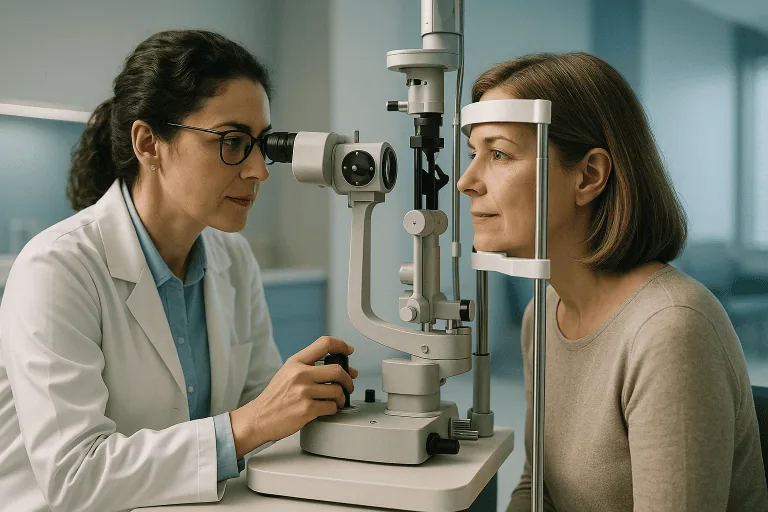
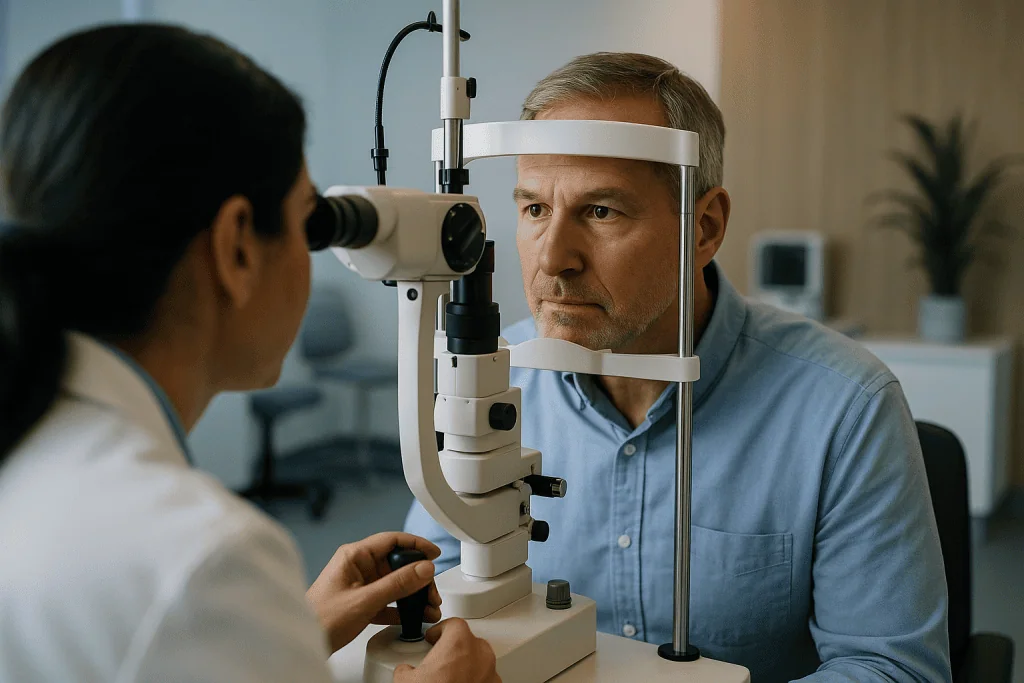
- Slit-lamp examination. A slit lamp is a special microscope with a bright light used in eye clinics. It allows the doctor to examine the eyelid, eyelashes, conjunctiva, and cornea in fine detail, and to check whether the lashes are touching the eye surface.
- Fluorescein staining. The doctor may place a drop of harmless orange-yellow dye (fluorescein) on the eye. Under blue light, the dye highlights any scratches, dry spots, or ulcers on the cornea caused by the rubbing lashes.
- Eyelid laxity tests. Simple, painless maneuvers help the doctor assess how loose the lid tissues are. In the snap-back test, the lower lid is gently pulled down and released to see how quickly it returns to its normal position. In the distraction test, the lid is pulled gently away from the eye to measure how far it stretches.
- Provocation for intermittent entropion. If the eyelid appears normal at rest but the patient describes typical symptoms, the doctor may ask the patient to squeeze the eyes shut forcefully. In spastic or intermittent entropion, this can make the lid turn inward and confirm the diagnosis.
- Examination of the inner eyelid surface. The doctor may gently turn the eyelid over to look for scarring on its inner surface, which points to a cicatricial (scarring) cause and can change the treatment plan.
The doctor will also ask about symptoms, past eye infections, injuries, surgeries, and general health, since identifying the underlying cause helps guide the choice of treatment.
Treatment options for entropion
Entropion treatment depends on the cause, the severity of symptoms, and the health of the eye surface. The goals are to relieve discomfort, protect the cornea from damage, and restore the eyelid to its normal position. Care is typically managed by an ophthalmologist; at Acibadem, for example, this condition is evaluated and treated within the ophthalmology department.
Watchful waiting and supportive measures
In very mild or intermittent cases, and in some infants with congenital forms that often improve as the face grows, doctors may recommend monitoring rather than immediate intervention. Supportive measures used while monitoring, or while waiting for surgery, may include:
- Lubricating eye drops and ointments (artificial tears) to protect the eye surface and reduce the friction from rubbing lashes.
- Soft contact lenses used as a bandage lens, which can shield the cornea from the lashes in selected cases.
- Skin tape. A small piece of medical tape applied to the lower lid can gently pull the eyelid outward and hold it in a better position. Your doctor or nurse can show you how to place the tape safely.
These measures relieve symptoms but do not correct the underlying eyelid problem, so they are usually temporary solutions.
Medication and injections
There is no eye drop or pill that cures entropion itself, but medications play a supporting role. Lubricants protect the cornea, and antibiotic drops or ointments may be prescribed if the eye surface has been scratched or is at risk of infection. In some cases of spastic entropion, or in patients who are not suitable for surgery, doctors may use botulinum toxin injections into the eyelid muscle. This temporarily weakens the muscle that pushes the lid inward. The effect typically wears off after some months, so injections may need to be repeated.
Minor procedures
Some office-based procedures can improve eyelid position temporarily. Everting sutures (sometimes called Quickert sutures) are stitches placed through the eyelid to rotate it outward. This can be done under local anesthetic and often provides relief for a period of time, though the entropion may return. Such procedures are sometimes used as a bridge for patients waiting for definitive surgery, or for those in whom a larger operation is not advisable.
Surgery
Surgery is the definitive entropion treatment in most cases and is generally effective at restoring the eyelid to its normal position. The exact operation depends on the cause:
- For age-related (involutional) entropion, the surgeon usually tightens the eyelid and its supporting tendons, and may reattach or shorten the small muscles that stabilize the lid. These procedures are typically done under local anesthesia, often as day surgery.
- For scarring (cicatricial) entropion, the surgeon may need to release the scar tissue and, in some cases, use a small graft: a piece of tissue taken from another site, such as the inside of the mouth or the other eyelid, to lengthen the inner surface of the lid.
- For congenital entropion that does not improve on its own and threatens the eye surface, corrective eyelid surgery may be recommended.
After surgery, patients commonly use antibiotic ointment for a period, and mild bruising and swelling of the eyelid are expected for a week or two. Stitches, if not dissolvable, are usually removed at a follow-up visit. As with any operation, there are risks, including bleeding, infection, scarring, over- or under-correction, and recurrence of the entropion over time. Your surgeon will discuss the expected benefits and risks in your individual case.
Living with entropion and outlook
The outlook for people with entropion is generally good, especially when the condition is recognized and treated before the cornea is damaged. Surgical correction relieves symptoms in most patients, although no procedure can be guaranteed to work permanently, and entropion can occasionally recur, particularly in age-related cases, because the tissues continue to loosen over the years, and in scarring cases if the underlying scarring process continues.
While living with entropion, or waiting for treatment, the following habits can help protect the eye:
- Use lubricating drops or ointment as recommended by your doctor to keep the eye surface moist and protected.
- Avoid rubbing the eye, as rubbing can worsen irritation and, in spastic forms, trigger the lid to turn inward.
- Keep any follow-up appointments so your doctor can monitor the cornea for early signs of damage.
- Report new or worsening pain, light sensitivity, or blurred vision promptly, as these can signal a corneal problem.
Untreated, long-standing entropion can lead to chronic irritation, corneal scarring, infection, and in severe cases permanent vision loss. Fortunately, with timely diagnosis and appropriate treatment, most people can expect lasting relief of symptoms and preservation of their vision, although individual results vary and your doctor can give you the most realistic expectations for your situation.
Frequently asked questions
What is entropion in simple terms?
Entropion is a condition in which the eyelid, most often the lower one, turns inward so that the eyelashes rub against the eye. This rubbing irritates the surface of the eye and causes redness, watering, and a gritty feeling. It is most common in older adults because the tissues that support the eyelid loosen with age, but it can also result from scarring, injury, infection, or, rarely, be present from birth.
Can entropion heal on its own?
In most adults, entropion does not go away on its own, because it is caused by structural changes in the eyelid, such as loosened tendons or scar tissue. Temporary spastic entropion triggered by eye irritation may settle once the irritation resolves, and the congenital form in babies sometimes improves as the child grows. However, persistent entropion generally needs treatment, usually surgery, to correct the eyelid position permanently.
How serious is entropion?
Entropion itself is not life-threatening, but it should be taken seriously because the constant rubbing of lashes against the cornea can scratch and, over time, scar the eye surface. If a scratch becomes infected, a corneal ulcer can develop, and severe or repeated corneal damage can permanently affect vision. Early diagnosis and treatment usually prevent these complications, which is why ongoing eye irritation deserves a professional evaluation.
What is the best treatment for entropion?
There is no single best treatment for everyone; the right approach depends on the cause and severity. Lubricating drops, eyelid taping, or a bandage contact lens can relieve symptoms temporarily. Botulinum toxin injections or everting sutures may help in selected cases. For most people with persistent entropion, surgery to tighten or reposition the eyelid offers the most reliable and long-lasting correction. An ophthalmologist can recommend the option best suited to your eyes and general health.
Is entropion surgery painful, and how long is recovery?
Entropion surgery is usually performed under local anesthesia, so the eyelid is numbed and the procedure itself is generally not painful, though patients may feel pressure. Afterward, mild soreness, bruising, and swelling of the eyelid are common and typically improve over one to two weeks. Most people can return to everyday activities fairly quickly, though your surgeon may advise avoiding heavy lifting, swimming, or eye rubbing for a period. Follow-up visits allow the doctor to check healing and remove any non-dissolving stitches.
What causes entropion in older adults?
The most common entropion cause in older adults is age-related weakening of the muscles and tendons that hold the eyelid firmly against the eye. As these tissues stretch, the lid loses its normal tension and can rotate inward, especially during blinking or squeezing of the eyes. This form is called involutional entropion and usually affects the lower eyelid of one or both eyes.
Can entropion come back after surgery?
Surgery corrects entropion successfully in most patients, but recurrence is possible. In age-related cases, the eyelid tissues continue to loosen over the years, and in scarring cases the scarring process may progress, so the lid can occasionally turn inward again months or years later. If symptoms return after surgery, a further procedure can often be performed. Attending follow-up appointments helps your doctor detect any recurrence early.
When to see a doctor
Make an appointment with an eye doctor if you notice that your eyelid or eyelashes are turning toward your eye, or if you have ongoing redness, watering, or a persistent feeling that something is in your eye. Early evaluation allows treatment before the cornea is damaged.
Seek urgent medical attention if you have entropion, or suspect it, together with any of the following red-flag warning signs:
- Increasing eye pain that does not improve or becomes severe.
- Sudden or worsening blurred vision or any noticeable loss of vision.
- Marked sensitivity to light that makes it hard to keep the eye open.
- A white or gray spot on the cornea, which may indicate a corneal ulcer.
- Thick discharge (pus) from the eye, which can signal infection.
- Rapidly worsening redness, especially around the colored part of the eye.
- An eye injury or chemical exposure in an eye already affected by entropion.
These signs can indicate corneal damage or infection, both of which need prompt treatment to protect your sight. Even without red-flag symptoms, any persistent change in how your eyelid sits or how your eye feels is a good reason to have it examined by an ophthalmologist.
Medically reviewed by the Acıbadem International Medical Board September 3, 2026
See our medical review board →
Update history
- PublishedJune 14, 2026
- Medical review approvedSeptember 3, 2026
- Last content updateSeptember 2, 2026