Knock Knees (Genu Valgum)
Knock knees (genu valgum) are common in children and usually correct on their own. Learn about symptoms, causes, diagnosis, and when treatment or surgery may be considered.
Quick answer
Knock knees (genu valgum) is a condition where the knees angle inward and touch while the ankles stay apart. It is very common and usually normal in children aged about 2 to 5, often correcting itself by age 7 or 8. Persistent, painful, one-sided, or worsening cases may need evaluation, and severe cases are sometimes treated with surgery.
What is knock knees (genu valgum)?
Knock knees, known medically as genu valgum, is a condition in which the knees angle inward and touch or nearly touch when a person stands with their feet together, while the ankles stay apart. The word genu is Latin for knee, and valgum describes a part of the body that angles outward from the midline below the joint. In simple terms, the lower legs slant outward from the knees, so the knees appear to “knock” together.
Knock knees in children are extremely common and, in most cases, are a normal part of growth. Many toddlers have bowed legs, then develop a knock-kneed stance between roughly ages 2 and 5, and their legs usually straighten on their own by around age 7 or 8. Doctors call this pattern physiologic genu valgum, meaning it is part of normal development rather than a disease.
Knock knees can also affect older children, teenagers, and adults. When the inward angle is unusually severe, appears only on one side, gets worse instead of better, or continues past the age when legs normally straighten, doctors may look for an underlying cause. This is sometimes called pathologic genu valgum. In adults, knock knees may develop later in life because of arthritis, injury, or other conditions that affect the knee joint.
Symptoms of knock knees
The most noticeable feature of knock knees is the appearance of the legs. Many people, especially young children, have no discomfort at all. When symptoms do occur, they tend to be related to the way the altered leg alignment affects walking, running, and the wear on the joints.
- Knees that touch or nearly touch when standing with the feet together, while the ankles remain apart
- A visible gap between the ankles when standing straight, often several centimeters or more
- Feet and ankles that turn outward to make room for the knees
- An unusual walking pattern, such as the knees rubbing together or the feet swinging out to the sides
- Knee pain, particularly at the front or on the outer side of the knee, more common in older children and adults
- Hip, ankle, or foot pain caused by uneven loading through the legs
- Stiffness or a feeling of the knee being unstable
- Difficulty running, or tiring more quickly than others during physical activity
- Uneven wear on the soles of shoes
How symptoms show up often depends on age and cause. In young children with physiologic genu valgum, the only sign is usually the shape of the legs; pain is uncommon. In teenagers and adults, the inward angle can shift body weight toward the outer part of the knee joint. Over time this may contribute to cartilage wear and knee pain, and in some cases to osteoarthritis, a condition in which the smooth cartilage that cushions the joint gradually breaks down. When knock knees are caused by an underlying bone disorder, a child may also have other signs, such as slower growth, bone tenderness, or knock knees that affect only one leg.
Causes and risk factors
Knock knees causes fall into two broad groups: normal growth patterns and underlying medical conditions. Understanding which group applies is one of the main goals of a medical evaluation.
Normal development. The most common cause of knock knees in children is simply the way the legs grow. As a child begins to walk, the legs often bow outward. Between about ages 2 and 5, the alignment typically swings the other way, producing knock knees. This gradually corrects itself as the child grows, and by about age 7 or 8 most children have the mild outward angle at the knee that is normal in adults.
Underlying conditions. When knock knees are severe, persistent, or affect only one side, doctors consider other causes, including:
- Rickets – softening and weakening of growing bones, usually due to a lack of vitamin D or calcium, which can bend the legs under body weight
- Growth plate injury – damage to the area of growing tissue near the end of a bone (the growth plate) from a fracture or infection, which can make one side of the bone grow unevenly
- Skeletal dysplasias – a group of inherited conditions that affect how bone and cartilage develop
- Metabolic bone disease – conditions such as kidney-related bone disease that interfere with the body’s handling of minerals
- Obesity – excess body weight places extra force on growing knees and may worsen alignment
- Arthritis – in adults, rheumatoid arthritis or osteoarthritis can wear down one side of the knee joint and tilt the leg inward
- Previous injury or surgery – a fracture that heals in a slightly bent position, or changes after knee surgery, can alter alignment
- Neuromuscular conditions – disorders that affect muscle tone and control, such as cerebral palsy, can change how the legs are loaded
Risk factors that make knock knees more likely to be a concern rather than a normal stage include a family history of bone disorders, low vitamin D intake or limited sun exposure, obesity, a history of leg fracture or bone infection, and certain chronic illnesses that affect bone health. Knock knees themselves are not contagious and are not caused by anything a parent did or did not do during a child’s early years.
Diagnosis
In most children, a doctor can recognize knock knees during a routine physical examination. Diagnosis focuses less on confirming that the knees angle inward and more on deciding whether the pattern is normal for the child’s age or whether it points to an underlying problem.
Medical history. The doctor may ask when the leg shape was first noticed, whether it is improving or worsening, whether one leg is more affected than the other, whether there is pain, and whether there is a family history of bone or joint conditions. Questions about diet, growth, and past injuries help identify possible causes.
Physical examination. The doctor observes the child or adult standing and walking, checks the alignment of the hips, knees, ankles, and feet, and looks for differences in leg length. A common measurement is the intermalleolar distance, the gap between the inner ankle bones when the knees are touching. A large or increasing gap, or a clear difference between the two legs, may prompt further tests. The doctor may also measure height and weight and plot them on growth charts, since slow growth can be a clue to a bone disorder.
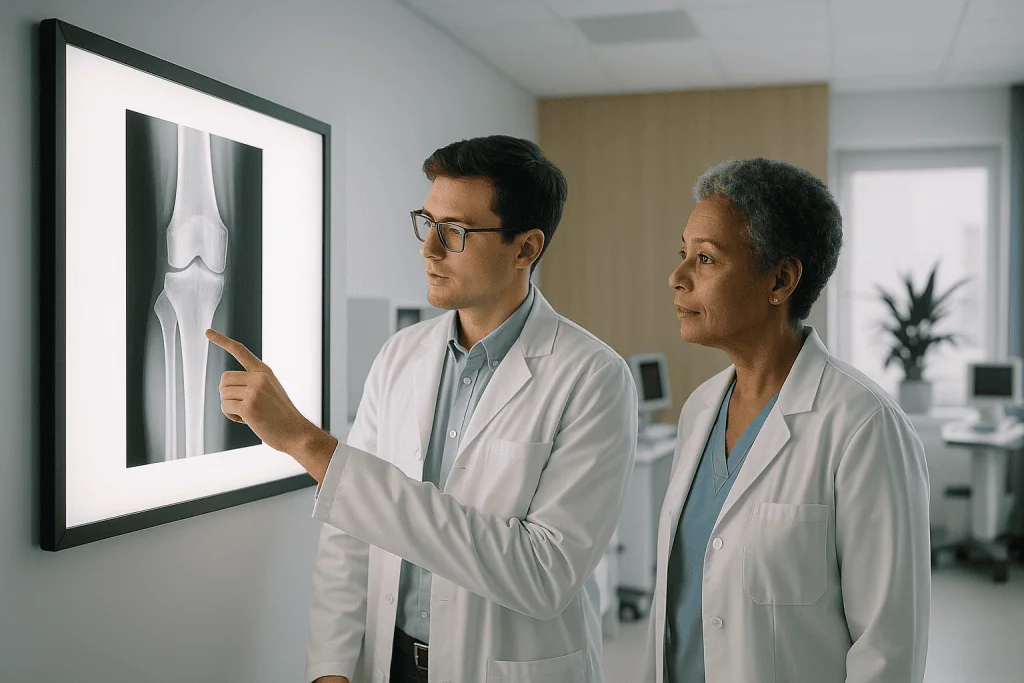
Imaging. X-rays are not needed for every child with knock knees. They are usually reserved for cases that are severe, one-sided, painful, worsening, or present in an older child or adult. A standing X-ray of the whole leg, from hip to ankle, allows the doctor to measure the precise angle at the knee and to see where the deformity comes from. Doctors often measure the mechanical axis, an imaginary line from the center of the hip to the center of the ankle; in knock knees, this line passes to the outer side of the knee. X-rays can also reveal signs of rickets, growth plate damage, or arthritis.
Blood tests. If a bone disorder is suspected, blood tests may check levels of vitamin D, calcium, phosphate, and other markers of bone metabolism. These help identify rickets or metabolic bone disease that can be treated directly.
Specialist referral. When the picture is not straightforward, a family doctor or pediatrician may refer the patient to an orthopedic specialist. At Acibadem, conditions affecting leg alignment are evaluated within the Orthopedics & Joint Center, which manages both pediatric and adult limb alignment concerns.
Treatment options for knock knees
Knock knees treatment depends on the person’s age, the severity of the angle, whether symptoms are present, and whether an underlying cause has been found. Many people need no treatment at all.
Observation. For young children with physiologic genu valgum, the standard approach is watchful waiting. The doctor may re-check the child’s legs every several months to confirm that the alignment is improving as expected. Because the legs usually straighten on their own, active treatment during this stage is generally not recommended.
Treating the underlying cause. If tests show rickets or another metabolic bone problem, treatment focuses on correcting it, for example with vitamin D and calcium supplements under medical supervision. Improving bone health may allow the legs to straighten as the child continues to grow. When obesity is a contributing factor, weight management support may be part of the plan.
Braces and shoe inserts. Special shoes, wedges, and braces were once commonly prescribed for knock knees in children, but current evidence does not show that they change the natural course of physiologic genu valgum. Doctors therefore rarely recommend them for this purpose. In some cases, shoe inserts or supportive footwear may be used to ease foot or knee discomfort rather than to correct the angle.
Physical therapy and exercise. Exercise cannot straighten the bones, but strengthening the muscles around the hips, thighs, and knees may help improve walking patterns, reduce strain on the joints, and ease pain, particularly in teenagers and adults. A physical therapist can also work on balance and flexibility.
Pain management. For adults with knee pain related to alignment, doctors may suggest over-the-counter pain relievers, activity modification, and low-impact exercise such as swimming or cycling. These measures aim to control symptoms rather than change the shape of the leg.
Knock knees surgery. Surgery is considered only for the minority of people whose deformity is severe, causes pain or functional problems, or is progressing. The type of operation depends largely on whether the person is still growing.
- Guided growth (hemiepiphysiodesis) – in children who still have open growth plates, a small metal plate or staple is placed on one side of the growth plate near the knee. This temporarily slows growth on that side so that the other side catches up and the leg gradually straightens. The implant is usually removed once the desired alignment is reached. This procedure relies on remaining growth, so timing is important.
- Osteotomy – in teenagers who have finished growing and in adults, the surgeon cuts the bone near the knee (either the lower thigh bone or the upper shin bone), repositions it to correct the angle, and holds it in place with plates and screws while it heals. This is a more involved procedure with a longer recovery.
- Knee replacement – in older adults whose knock knees are associated with advanced arthritis, joint replacement surgery may address both the worn joint and the alignment at the same time.
Rehabilitation. After any surgical procedure, a period of rehabilitation with a physical therapist is typical. This may involve protected weight-bearing with crutches, exercises to restore movement and strength, and gradual return to normal activities. The length of recovery varies with the type of surgery, the person’s age, and general health.
Living with knock knees (genu valgum) and outlook
For the great majority of children, knock knees are a temporary stage that resolves without treatment, and there are no long-term effects. Parents often find it reassuring to know that a knock-kneed stance at age 3 or 4 is expected rather than worrying.
When knock knees persist into the teenage years or adulthood, the outlook depends on the degree of the angle and whether it causes symptoms. Mild knock knees that do not cause pain often need no intervention, though some people choose to stay active with low-impact exercise and maintain a healthy weight to reduce stress on the knees. More pronounced alignment problems may increase the load on the outer part of the knee over many years, which can contribute to cartilage wear. Regular follow-up with a doctor can help catch changes early.
When surgery is performed, many people experience improved alignment and relief from symptoms, but results vary from person to person, and no procedure can guarantee a specific outcome. Guided growth procedures in children depend on continued growth and may need adjustment. Osteotomies require bone healing time and carry the usual surgical risks, such as infection, blood clots, stiffness, or incomplete correction. Your surgeon can explain what is realistic in your particular situation.
Day-to-day, people living with knock knees may find it helpful to wear well-fitting, supportive shoes, to stay physically active in ways that do not aggravate knee pain, and to keep up with any exercises recommended by a physical therapist. If an underlying condition such as vitamin D deficiency was identified, following the treatment plan for that condition is an important part of long-term care.
Frequently asked questions
Are knock knees in children normal?
In most cases, yes. Knock knees are a normal stage of leg development that typically appears between ages 2 and 5 and usually resolves by around age 7 or 8. Doctors become more attentive when the angle is severe, affects only one leg, causes pain, worsens over time, or continues well beyond the usual age of correction.
What causes knock knees in adults?
Knock knees causes in adults often include genu valgum that never fully corrected during childhood, arthritis that wears down one side of the knee joint, a previous fracture that healed in a bent position, or bone conditions that affect mineral balance. A doctor can help determine the specific cause through examination and, if needed, X-rays.
Can knock knees be corrected without surgery?
In young children, knock knees usually correct on their own without any treatment. If an underlying problem such as rickets is found, treating it may allow the legs to straighten during growth. In adults, exercise and physical therapy can help with strength and pain but do not change the shape of the bone; only surgery can alter the actual alignment in a fully grown person.
Do braces or special shoes help knock knees?
Current medical evidence does not support the use of braces, wedges, or special shoes to correct physiologic knock knees in children, and most doctors no longer recommend them for that purpose. Supportive footwear or inserts may still be suggested in some cases to ease discomfort in the feet or knees.
When is knock knees surgery recommended?
Knock knees surgery is generally reserved for severe cases that cause pain, interfere with walking, or continue to worsen. In growing children, a guided growth procedure may be used to gradually straighten the leg. In teenagers who have stopped growing and in adults, an osteotomy, which involves cutting and realigning the bone, may be considered. The decision is individual and made together with an orthopedic specialist.
Can knock knees lead to arthritis?
Persistent, moderate to severe genu valgum can shift body weight toward the outer part of the knee, and over many years this uneven loading may contribute to cartilage wear and osteoarthritis. Not everyone with knock knees develops arthritis, and mild cases often cause no long-term joint problems.
What kind of doctor treats knock knees?
Knock knees in children are usually first assessed by a pediatrician or family doctor. If the pattern seems unusual, referral to a pediatric orthopedic specialist is common. Adults with symptomatic knock knees are typically seen by an orthopedic surgeon, often working alongside physical therapists.
When to see a doctor
Most children with knock knees do not need medical treatment, but it is reasonable to have a doctor check the legs during routine visits. Certain features suggest that a more detailed evaluation is needed. Seek medical advice if you notice any of the following:
- Knock knees that affect only one leg, or one leg that is clearly more angled than the other
- Knock knees that appear before age 2 or persist beyond about age 7 or 8
- An inward angle that is getting worse over time rather than improving
- A gap between the ankles of roughly 8 centimeters (about 3 inches) or more when the knees are together
- Knee, hip, or ankle pain, or a limp
- Difficulty walking, running, or keeping up with other children
- A child who is unusually short for their age or is growing more slowly than expected
- Other signs of bone weakness, such as bowing in the arms, bone tenderness, or frequent fractures
- A history of a leg injury, bone infection, or a known bone or kidney condition
- In adults, new or worsening knee deformity, swelling, or pain that limits daily activities
Sudden severe pain, a knee that locks or gives way, redness and warmth around the joint, or fever together with joint pain are not typical of knock knees and should be assessed promptly, as they may indicate an injury or infection that needs urgent care.
Medically reviewed by the Acıbadem International Medical Board September 8, 2026
See our medical review board →
Update history
- PublishedSeptember 8, 2026
- Medical review approvedSeptember 8, 2026
- Last content updateSeptember 8, 2026