Laryngeal Cancer
Laryngeal Cancer is a throat cancer affecting the voice box. Learn symptoms, causes, diagnosis, treatment options and when to seek care.

Quick answer
Laryngeal cancer is a malignant tumor of the voice box that can affect speaking, breathing, and swallowing, often causing persistent hoarseness or throat symptoms. Treatment depends on the tumor’s location and stage and may include surgery, radiotherapy, chemotherapy, or combined approaches, with care focused on removing the cancer while preserving voice and airway function whenever possible.
What is laryngeal cancer?
Laryngeal cancer is a type of cancer that starts in the larynx, the organ most people know as the voice box. The larynx sits in the front of the neck, above the windpipe (trachea), and it has three main jobs: it helps you speak, it lets air pass into your lungs, and it protects your airway when you swallow. Cancer develops when cells in the lining of the larynx begin to grow in an abnormal, uncontrolled way and form a tumor, which is a lump of abnormal tissue.
Most laryngeal cancers are a type called squamous cell carcinoma, which means the cancer begins in the thin, flat cells that line the inside of the larynx. Doctors often describe the disease by where in the voice box it starts: the glottis (the part that contains the vocal cords), the supraglottis (the area above the vocal cords), or the subglottis (the area below the vocal cords, closer to the windpipe). The location matters because it influences the symptoms a person notices, how early the cancer tends to be found, and which laryngeal cancer treatment options doctors may recommend.
When people ask what is laryngeal cancer and who gets it, the honest answer is that it can affect adults of many ages, but it is more common in people over 55 and occurs more often in men than in women. It is strongly linked to tobacco and heavy alcohol use, which is why quitting smoking is one of the most important steps anyone can take to lower their risk. In many health systems, this condition is managed by a team that includes ear, nose, and throat (ENT) surgeons, radiation specialists, and cancer physicians in a Medical Oncology Department, which is the specialty that oversees drug-based cancer care.
Symptoms of laryngeal cancer
Laryngeal cancer symptoms depend on where the tumor starts and how far it has grown. Because the vocal cords are very sensitive to even small changes, cancers that begin on the vocal cords often cause a noticeable change in the voice at an early stage. Cancers that begin above or below the vocal cords may grow quietly for longer before they cause obvious problems.
Common symptoms include:
- Hoarseness or a change in the voice that does not improve, often lasting more than two to three weeks
- A persistent sore throat or a feeling that something is stuck in the throat
- Pain or difficulty when swallowing (doctors call painful swallowing odynophagia and difficult swallowing dysphagia)
- A lump or swelling in the neck, which may be an enlarged lymph node (a small gland that is part of the immune system)
- A long-lasting cough, sometimes with blood-streaked spit
- Ear pain, often on one side, without an obvious ear problem (referred pain from the throat)
- Noisy or difficult breathing, which can occur when a tumor narrows the airway
- Unexplained weight loss or ongoing tiredness
In early-stage disease, hoarseness may be the only sign, especially for tumors on the vocal cords. In more advanced disease, symptoms such as trouble swallowing, breathing difficulty, ear pain, and a neck lump become more likely because the tumor has grown larger or has spread to nearby lymph nodes. Supraglottic cancers (above the vocal cords) are more likely to cause swallowing problems and a neck lump before they affect the voice, while subglottic cancers (below the vocal cords) are less common and may first cause breathing changes.
It is important to remember that all of these symptoms are far more often caused by common, harmless conditions such as viral infections, acid reflux, or voice strain. However, symptoms that persist for several weeks, keep getting worse, or occur together should be checked by a doctor, particularly in people who smoke or drink alcohol regularly.
Causes and risk factors
Like most cancers, laryngeal cancer develops when the genetic material inside cells is damaged over time, causing the cells to grow abnormally. Doctors cannot always say exactly what caused an individual person’s cancer, but research has identified several well-established risk factors. Understanding laryngeal cancer causes can help people reduce their own risk where possible.
- Tobacco use: Smoking cigarettes, cigars, or pipes is the single most important risk factor. The risk rises with how much and how long a person smokes, and it falls gradually after quitting. Chewing tobacco also increases risk.
- Alcohol: Heavy, long-term alcohol use raises the risk of laryngeal cancer. Combining heavy drinking with smoking multiplies the risk far beyond either habit alone.
- Age and sex: The disease is most common in people over 55 and occurs more frequently in men, although rates in women have risen where smoking is common among women.
- Human papillomavirus (HPV): This common virus is linked to some throat cancers. Its role in laryngeal cancer specifically is smaller than in cancers of the tonsils and back of the tongue, but it is considered a possible contributing factor in some cases.
- Workplace exposures: Long-term exposure to certain substances, such as asbestos, wood dust, paint fumes, and some industrial chemicals, has been associated with a higher risk.
- Poor nutrition: Diets low in fruits and vegetables may modestly increase risk.
- Previous head and neck cancer: People who have had a cancer of the mouth, throat, or larynx before have a higher chance of developing another one.
- Chronic acid reflux: Long-standing gastroesophageal reflux disease (GERD), in which stomach acid rises into the throat, may irritate the larynx over time; its exact role in causing cancer is still being studied.
Having one or more risk factors does not mean a person will develop laryngeal cancer, and some people develop the disease without any obvious risk factor. Still, avoiding tobacco and limiting alcohol are the most effective known ways to reduce risk.
Diagnosis of laryngeal cancer
Laryngeal cancer diagnosis usually begins when a person sees a doctor about persistent hoarseness, throat symptoms, or a neck lump. The doctor will ask about symptoms, smoking and alcohol history, and general health, and will examine the mouth, throat, and neck, feeling for enlarged lymph nodes.
To see the larynx directly, doctors use a procedure called laryngoscopy. In many cases, this is done in the clinic with a thin, flexible tube containing a tiny camera (a flexible endoscope) passed gently through the nose to view the voice box while the patient is awake. If an abnormal area is seen, the next step is usually a direct laryngoscopy under general anesthesia, during which the surgeon examines the larynx closely and takes a biopsy, which means removing a small sample of tissue.
The biopsy is the key test: a specialist doctor called a pathologist examines the tissue under a microscope, and only this examination can confirm whether cancer is present and what type it is. Imaging tests do not replace a biopsy, but they show how large the tumor is and whether it has spread. Depending on the situation, doctors may order:
- CT (computed tomography) scan: a detailed X-ray-based scan of the neck and chest to map the tumor and check lymph nodes and lungs
- MRI (magnetic resonance imaging): a scan using magnetic fields that shows soft tissues in fine detail
- PET-CT (positron emission tomography): a scan that highlights areas of active cancer cells, often used to look for spread in more advanced disease
- Ultrasound of the neck, sometimes with a needle sample (fine-needle aspiration) of a suspicious lymph node
Once all results are available, doctors assign a stage, usually using the TNM system, which describes the size and extent of the tumor (T), whether lymph nodes are involved (N), and whether the cancer has spread to distant parts of the body (M). Stages range from early (stage I) to advanced (stage IV). Staging is essential because it guides which treatments are likely to work best. Doctors will also assess voice, swallowing, breathing, dental health, and nutrition before treatment begins, since these functions can be affected by both the cancer and its treatment.
Treatment options for laryngeal cancer
Laryngeal cancer treatment depends on the stage and location of the tumor, the person’s overall health, and their priorities, including how important it is to preserve the natural voice and swallowing. Treatment decisions are usually made by a multidisciplinary team, meaning a group of specialists, including ENT (head and neck) surgeons, radiation oncologists, medical oncologists, speech and swallowing therapists, and dietitians, who plan care together.
Radiation therapy
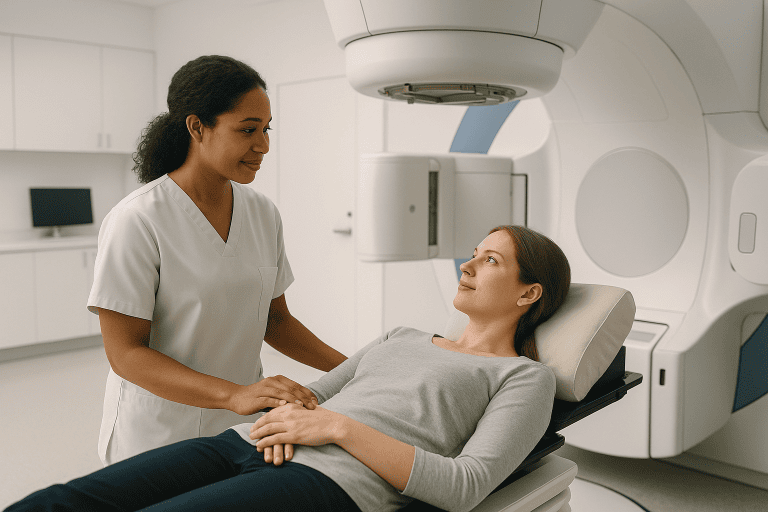
Radiation therapy uses precisely targeted high-energy beams to destroy cancer cells. For many early-stage laryngeal cancers, radiation alone can be an effective treatment and often allows the voice box to be preserved. In more advanced disease, radiation is frequently combined with chemotherapy (called chemoradiation) or used after surgery to lower the chance of the cancer returning. Side effects can include a sore throat, dry mouth, skin changes in the treated area, taste changes, tiredness, and swallowing difficulty; many of these improve over time, though some can persist.
Surgery
Surgical options range from small, minimally invasive procedures to major operations, depending on the tumor:
- Endoscopic or laser surgery: for some early tumors, the surgeon removes the cancer through the mouth using instruments or a laser, without external cuts.
- Partial laryngectomy: removal of part of the voice box, aiming to preserve speech and swallowing where possible.
- Total laryngectomy: removal of the entire voice box, usually reserved for advanced tumors or cancers that return after other treatment. After this operation, the windpipe is connected to an opening in the front of the neck called a stoma, through which the person breathes. Natural speech is no longer possible, but many people learn to speak again using a voice prosthesis (a small valve placed between the windpipe and food pipe), an electrolarynx (a handheld device that creates sound), or esophageal speech techniques.
- Neck dissection: removal of lymph nodes in the neck if the cancer has spread there or if the risk of spread is significant.
Chemotherapy and other drug treatments
Chemotherapy uses medicines that kill fast-growing cells. In laryngeal cancer it is most often given together with radiation for advanced disease, sometimes as part of an approach designed to avoid removing the voice box. Targeted therapy drugs, which act on specific molecules that help cancer cells grow, and immunotherapy drugs, which help the immune system recognize and attack cancer cells, may be options in certain advanced or recurrent cases. Drug-based treatment is planned and supervised by medical oncologists; at institutions such as Acibadem, this is coordinated through the medical oncology service working alongside surgeons and radiation specialists. Your care team can explain which drugs, if any, are appropriate for your situation and what side effects to expect.
Watchful waiting and supportive care
Active surveillance, meaning close monitoring without immediate treatment, is not a standard approach for confirmed laryngeal cancer, because the disease can progress. However, careful observation may be used for certain precancerous changes of the vocal cords, with regular check-ups and biopsies as needed. For people who cannot have, or choose not to have, curative treatment, supportive (palliative) care focuses on relieving symptoms such as pain, breathing difficulty, and swallowing problems, and on maintaining quality of life. Palliative care can be provided alongside cancer treatment at any stage; it is not only for the end of life.
Whatever the treatment plan, stopping smoking is strongly advised. Continuing to smoke during and after treatment can make treatment less effective, increase side effects, and raise the risk of the cancer returning or a new cancer developing.
Living with laryngeal cancer and outlook
The outlook for laryngeal cancer varies widely and depends mainly on the stage at diagnosis, the tumor’s location, and the person’s overall health. In general, cancers found early, particularly those limited to the vocal cords, respond well to treatment in many cases, and voice-preserving approaches are often possible. Advanced cancers are harder to treat and more likely to return, but meaningful treatment options still exist, and outcomes differ from person to person. No doctor can guarantee a specific result, and statistics describe groups of patients, not individuals; your care team is the best source of information about your own situation.
Life during and after treatment often involves adjustments. Some people experience lasting changes in voice quality, swallowing, taste, or saliva production. Speech and language therapists play a central role in helping people regain communication and safe swallowing, including after total laryngectomy. Dietitians can help when eating is difficult, and some people need temporary feeding support during treatment. Emotional effects are common and understandable; counseling, support groups, and honest conversations with the care team can help patients and families cope.
Follow-up care is an important part of living with laryngeal cancer. After treatment, doctors schedule regular examinations of the throat and neck, often frequently in the first two to three years when the risk of recurrence is highest, then less often over time. Follow-up visits also monitor thyroid function (the thyroid gland sits near the larynx and can be affected by treatment), nutrition, dental health, and voice. Reporting any new hoarseness, pain, lumps, or swallowing changes promptly gives the best chance of catching a recurrence early.
Frequently asked questions
What is laryngeal cancer in simple terms?
Laryngeal cancer is a growth of abnormal cells in the voice box, the organ in the front of the neck that produces your voice and protects your airway. Most cases start in the thin cells lining the larynx and are strongly linked to smoking and heavy alcohol use. It is confirmed only by a biopsy, in which a small tissue sample is examined under a microscope.
What are the first laryngeal cancer symptoms?
The most common early sign is persistent hoarseness or a voice change lasting more than two to three weeks, especially when the tumor starts on the vocal cords. Other possible early symptoms include a lasting sore throat, discomfort when swallowing, one-sided ear pain, or a feeling of something stuck in the throat. These symptoms usually have harmless causes, but persistent ones should always be evaluated by a doctor.
Can laryngeal cancer be cured?
In many cases, particularly when the cancer is found at an early stage, treatment with radiation therapy or surgery can remove or destroy the cancer, and many people remain free of disease afterward. Advanced cancers are more difficult to treat, though combinations of surgery, radiation, and drug therapy can still be effective for some people. No outcome can be guaranteed, and your medical team can discuss what is realistic in your specific case.
How serious is laryngeal cancer?
It is a serious condition that requires prompt specialist care, because it can affect breathing, swallowing, and speech, and it can spread to lymph nodes and other organs if untreated. At the same time, the stage at diagnosis makes a major difference: early-stage disease often responds well to treatment, while advanced disease carries a more guarded outlook. This is one reason persistent throat and voice symptoms should not be ignored.
Will I lose my voice if I have laryngeal cancer treatment?
Not necessarily. Many early cancers can be treated with radiation or limited surgery that preserves the voice box, though voice quality may change. If a total laryngectomy (removal of the entire voice box) is needed, natural speech is lost, but most people can learn to communicate again using a voice prosthesis, an electronic speaking device, or special speech techniques, with support from speech therapists.
How is laryngeal cancer diagnosed?
Doctors examine the voice box with a thin camera (laryngoscopy) and take a biopsy of any abnormal area; only the biopsy can confirm cancer. Imaging tests such as CT, MRI, or PET-CT scans are then used to determine the tumor’s size and whether it has spread, which allows the cancer to be staged and a treatment plan to be made.
What is recovery like after laryngeal cancer treatment?
Recovery varies with the treatment received. After radiation, side effects such as sore throat, dry mouth, and tiredness often improve gradually over weeks to months. After surgery, healing time depends on how much tissue was removed; swallowing and speech rehabilitation may take weeks or longer, and some people need temporary feeding support. Regular follow-up visits continue for several years to watch for recurrence and manage long-term effects.
When to see a doctor
See a doctor if you have any of the following symptoms lasting more than two to three weeks, especially if you smoke or drink alcohol regularly:
- Hoarseness or a voice change that does not go away
- A sore throat or throat discomfort that persists despite simple treatment
- Pain or difficulty when swallowing, or food sticking in the throat
- A lump or swelling in the neck
- Ear pain on one side without an obvious ear infection
- A persistent cough or coughing up blood-streaked spit
- Unexplained weight loss
Seek urgent medical attention immediately if you experience noisy, labored, or worsening difficulty breathing, are unable to swallow liquids or your own saliva, or cough up significant amounts of blood. These are emergency warning signs that need assessment without delay. For less urgent but persistent symptoms, an early evaluation matters: laryngeal cancer found at an early stage is generally easier to treat, and prompt diagnosis gives you and your doctors the widest range of options.
Medically reviewed by the Acıbadem International Medical Board September 3, 2026
See our medical review board →
Update history
- PublishedJune 8, 2026
- Medical review approvedSeptember 3, 2026
- Last content updateSeptember 2, 2026