Quick answer
Leukemia is a cancer of the blood-forming tissues in which abnormal white blood cells grow uncontrollably and interfere with normal blood cell production. At Acibadem, leukemia is evaluated with blood tests, bone marrow analysis, and imaging when needed, and treatment may include chemotherapy, targeted medicines, immunotherapy, stem cell transplantation, and supportive care depending on the type and stage.
What is leukemia?
Leukemia is a cancer of the blood and bone marrow. Bone marrow is the soft, spongy tissue inside your bones where blood cells are made. In a healthy body, the marrow produces red blood cells (which carry oxygen), platelets (which help blood clot), and white blood cells (which fight infection) in a controlled, balanced way. In leukemia, the marrow begins to produce large numbers of abnormal white blood cells that do not work properly. These abnormal cells crowd out the healthy blood cells, and over time the body struggles to carry oxygen, stop bleeding, and defend itself against infections.
When people ask what is leukemia in simple terms, a useful answer is this: it is a cancer that starts in the cells that make blood, rather than a solid lump or tumor in a single organ. Because blood circulates throughout the body, leukemia can affect many organs and systems at once.
Leukemia is usually grouped in two ways. First, by how quickly it develops: acute leukemia comes on rapidly, often over days or weeks, and generally needs prompt treatment, while chronic leukemia develops slowly, sometimes over years, and may be found by chance on a routine blood test. Second, by the type of white blood cell involved: lymphocytic (or lymphoblastic) leukemia starts in cells called lymphocytes, and myeloid (or myelogenous) leukemia starts in cells that would normally become other blood cells. Combining these gives the four main types: acute lymphoblastic leukemia (ALL), acute myeloid leukemia (AML), chronic lymphocytic leukemia (CLL), and chronic myeloid leukemia (CML).
Leukemia affects both children and adults. Acute lymphoblastic leukemia is the most common cancer in children, while chronic forms such as CLL are seen mainly in older adults. Overall, leukemia can occur at any age and in any population, and it affects both men and women.
Symptoms of leukemia
Leukemia symptoms happen because abnormal cells crowd out healthy blood cells. When there are too few red blood cells, people feel tired and short of breath. When there are too few platelets, they bruise and bleed easily. When healthy white blood cells are lacking, infections become frequent and harder to shake off.
Common leukemia symptoms include:
- Persistent tiredness or weakness that does not improve with rest
- Frequent or long-lasting infections, or infections that keep coming back
- Fever or chills without an obvious cause
- Easy bruising or bleeding, such as frequent nosebleeds, bleeding gums, or heavy menstrual periods
- Small red or purple spots on the skin (called petechiae), caused by tiny bleeds under the skin
- Pale skin due to anemia (a shortage of red blood cells)
- Unintended weight loss or loss of appetite
- Swollen lymph nodes, often felt as painless lumps in the neck, armpit, or groin
- Pain or a feeling of fullness under the ribs, caused by an enlarged spleen or liver
- Bone or joint pain, especially in children
- Night sweats that soak clothing or bedding
- Shortness of breath during everyday activities
Symptoms often differ by type. In acute leukemia, symptoms tend to appear suddenly and worsen quickly; people may feel very unwell within days or weeks, with high fevers, severe fatigue, and obvious bleeding or bruising. In chronic leukemia, symptoms may be mild or absent for a long time. Many people with chronic lymphocytic leukemia, for example, feel entirely well and only learn of the disease when a routine blood test shows an abnormal white blood cell count. As chronic leukemia progresses, tiredness, night sweats, weight loss, and swollen lymph nodes may gradually appear.
It is important to know that all of these symptoms are far more often caused by common, non-cancerous conditions such as viral infections or iron deficiency. Having one or more of them does not mean you have leukemia, but persistent or unexplained symptoms deserve medical attention.
Causes and risk factors
Leukemia causes are not fully understood. The disease begins when the DNA (the genetic instructions inside a cell) of a developing blood cell changes, or mutates. These mutations tell the cell to keep growing and dividing when a healthy cell would stop or die. Over time, the abnormal cells multiply and take over the bone marrow. In most people, doctors cannot say exactly why these mutations happened.
Certain factors are known to increase the risk of developing leukemia, although most people with these risk factors never develop the disease, and many people with leukemia have no known risk factors at all:
- Previous cancer treatment. Some chemotherapy drugs and radiation therapy used for other cancers can raise the risk of developing certain leukemias later in life.
- Exposure to high levels of radiation, such as from nuclear accidents or, historically, atomic explosions.
- Exposure to certain chemicals, most notably benzene, an industrial solvent found in some workplace settings and in tobacco smoke.
- Smoking, which is associated with an increased risk of acute myeloid leukemia.
- Certain genetic conditions, such as Down syndrome and some other inherited disorders, which are linked to a higher risk of leukemia.
- Family history. Having a close relative with certain types of leukemia, particularly chronic lymphocytic leukemia, may modestly increase risk.
- Some blood disorders, such as myelodysplastic syndromes (conditions in which the bone marrow does not make blood cells properly), which can develop into leukemia over time.
- Age. The risk of most leukemias rises with age, although acute lymphoblastic leukemia is more common in children.
Leukemia is not contagious. You cannot catch it from another person, and it is not caused by anything a patient or parent did wrong. In many cases, it develops without any identifiable cause.
Diagnosis
Leukemia diagnosis usually begins when a doctor notices unexplained symptoms, unusual findings on a physical examination, or abnormal results on a routine blood test. Confirming the diagnosis requires several steps.
Physical examination. Your doctor may look for pale skin, bruising, small skin bleeds, swollen lymph nodes, and enlargement of the spleen or liver.
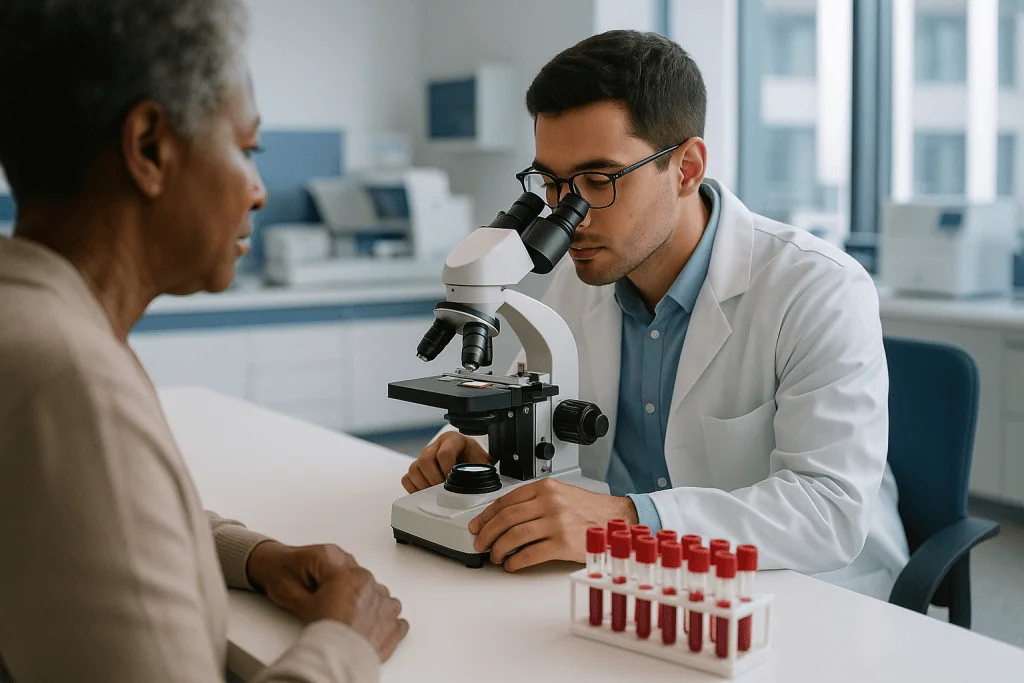
Blood tests. A complete blood count (CBC) measures the numbers of red blood cells, white blood cells, and platelets. In leukemia, the white blood cell count is often abnormal, sometimes very high, sometimes low, and red blood cells and platelets are frequently reduced. A blood smear, in which a drop of blood is examined under a microscope, may show immature or abnormal cells called blasts that do not normally circulate in the blood.
Bone marrow biopsy and aspiration. This is often the key test for confirming leukemia. Using local anesthesia (medicine to numb the area), a doctor inserts a thin needle into a bone, usually the back of the hip, and removes a small sample of liquid marrow (aspiration) and sometimes a small core of bone and marrow tissue (biopsy). Specialists then examine the cells to identify the type of leukemia and how far it has replaced healthy marrow.
Genetic and molecular tests. Laboratory tests such as cytogenetics (studying the chromosomes of the leukemia cells), flow cytometry (identifying markers on the cell surface), and molecular tests for specific gene mutations help doctors classify the leukemia precisely. These results often guide treatment choices, because some modern medicines target specific genetic changes. A well-known example is the Philadelphia chromosome, a genetic abnormality found in chronic myeloid leukemia and some cases of acute lymphoblastic leukemia.
Lumbar puncture (spinal tap). In some types of leukemia, particularly acute lymphoblastic leukemia, doctors may take a small sample of the fluid around the spinal cord to check whether leukemia cells have spread to the nervous system.
Imaging. Leukemia does not usually form a visible tumor, so imaging is not used to diagnose it directly. However, tests such as chest X-rays, ultrasound, or CT scans (detailed X-ray pictures) may be used to check for enlarged lymph nodes, spleen or liver enlargement, or infections.
Unlike many solid cancers, leukemia is generally not described using numbered stages such as stage I to IV. Instead, doctors classify it by type, subtype, and genetic features, and, for chronic lymphocytic leukemiaby specific staging systems based on blood counts and organ involvement. Your care team can explain what your particular classification means for you.
Treatment options
Leukemia treatment depends on the type and subtype of leukemia, its genetic features, your age and overall health, and in some cases how quickly the disease is progressing. Treatment plans are highly individual, and what is right for one person may not be right for another. At many centers, including the medical oncology department, a team of specialists in blood cancers plans and coordinates care. An overview of how leukemia is managed is available on the dedicated treatment page.
Watchful waiting (active surveillance). Some slow-growing leukemias, especially early chronic lymphocytic leukemia, may not need immediate treatment. In this approach, doctors monitor your blood counts and symptoms at regular visits and begin treatment only if the disease starts to progress or cause problems. Research suggests that starting treatment earlier in these situations does not necessarily lead to better outcomes, so waiting is often a safe and reasonable strategy.
Chemotherapy. Chemotherapy, medicines that kill fast-growing cells, is a mainstay of treatment for many leukemias, particularly the acute forms. It may be given as tablets, injections, or infusions into a vein, often in cycles with rest periods in between. Acute leukemias are typically treated in phases: an intensive first phase to bring the disease under control (induction), followed by further phases to eliminate remaining leukemia cells (consolidation) and, in some cases, longer-term lower-dose treatment (maintenance).
Targeted therapy. Targeted drugs attack specific abnormalities in leukemia cells while causing less harm to healthy cells. For example, medicines called tyrosine kinase inhibitors block the abnormal protein produced by the Philadelphia chromosome in chronic myeloid leukemia, and have transformed the outlook for many people with that disease. Other targeted drugs are used in chronic lymphocytic leukemia and in certain subtypes of acute leukemia. Whether a targeted drug is suitable depends on the genetic test results from your diagnosis.
Immunotherapy. These treatments help your own immune system recognize and attack leukemia cells. They include monoclonal antibodies (laboratory-made proteins that attach to leukemia cells) and, in selected patients, CAR T-cell therapy, in which a patient’s own immune cells are collected, modified in a laboratory to recognize leukemia cells, and returned to the body. Availability depends on the leukemia type and individual circumstances.
Radiation therapy. High-energy beams may occasionally be used to treat leukemia that has spread to specific areas, such as the brain, or to prepare the body before a stem cell transplant. It is not a routine treatment for most leukemias.
Stem cell (bone marrow) transplantation. A stem cell transplant replaces diseased bone marrow with healthy blood-forming stem cells, usually from a donor. Before the transplant, high doses of chemotherapy, sometimes with radiation, are given to destroy the leukemic marrow. Transplantation can offer the possibility of long-term disease control or cure in some situations, but it carries significant risks and is generally reserved for patients whose disease features, age, and general health make it appropriate.
Supportive care. Alongside treatments aimed at the leukemia itself, supportive care is essential. This may include blood and platelet transfusions, antibiotics and other medicines to prevent or treat infections, medicines to reduce nausea, and treatments to protect the kidneys and other organs during intensive therapy.
Surgery plays little role in treating leukemia itself, because the disease is spread throughout the blood and marrow rather than located in one place. Occasionally, an enlarged spleen may be removed if it causes significant problems, but this is uncommon.
Living with leukemia and outlook
The outlook for people with leukemia varies widely and depends on the type of leukemia, its genetic features, the person’s age and overall health, and how the disease responds to treatment. Some forms, such as chronic myeloid leukemia treated with modern targeted drugs, can often be controlled for many years, and many people live near-normal lives on ongoing medication. Childhood acute lymphoblastic leukemia frequently responds well to treatment, and many children are cured. Other forms, particularly some acute leukemias in older adults, can be harder to treat. No doctor can promise a particular outcome, but treatments have improved substantially over recent decades, and your care team can give you an honest picture based on your specific situation.
Living with leukemia often means adjusting to regular blood tests, clinic visits, and periods of treatment. During and after therapy, your immune system may be weakened, so practical steps such as careful hand hygiene, avoiding people with obvious infections, keeping vaccinations up to date as advised by your doctor, and reporting fevers promptly are important. Fatigue is common and may last for months after treatment; gentle, gradually increasing activity often helps, though you should follow your care team’s advice.
Emotional health matters as much as physical health. Anxiety, low mood, and worry about the future are normal reactions to a leukemia diagnosis, both for patients and for family members. Counseling, support groups, and open conversations with your care team can help. For children with leukemia, schools and treatment teams can often work together to keep education and social life going during therapy.
After treatment ends, follow-up continues for years. Regular check-ups look for signs of the leukemia returning (relapse) and monitor for late effects of treatment, such as heart, hormone, or fertility issues. Attending these appointments, even when you feel well, is an important part of long-term care.
Frequently asked questions
What is leukemia in simple terms?
Leukemia is a cancer of the blood-forming tissue, mainly the bone marrow. Instead of making healthy blood cells in the right amounts, the marrow produces large numbers of abnormal white blood cells that crowd out the normal cells. This leads to problems such as anemia, easy bleeding, and frequent infections. It differs from most cancers because it does not usually form a solid lump.
Can leukemia be cured?
In many cases, yes, particularly some acute leukemias in children and younger adults, where treatment can eliminate the disease permanently. Other forms, such as chronic lymphocytic leukemia, are often managed as long-term conditions rather than cured, with treatment controlling the disease for extended periods. Whether cure is a realistic goal depends on the type of leukemia, its genetic features, and individual factors, so this is a question best discussed with your own hematologist or oncologist.
How serious is leukemia?
Leukemia is a serious diagnosis, but seriousness varies greatly by type. Acute leukemias progress quickly and usually need urgent treatment, while some chronic leukemias develop slowly and may not need treatment for years. Modern therapies have significantly improved outcomes for many types, and many people respond well to treatment. Your care team can explain how serious your particular situation is based on your test results.
What are the first symptoms of leukemia?
Early leukemia symptoms are often vague and easy to mistake for common illnesses. They may include persistent tiredness, pale skin, frequent infections, unexplained fevers, easy bruising or bleeding, night sweats, bone pain, and painless swollen lymph nodes. In chronic leukemia there may be no symptoms at all at first, and the disease is sometimes discovered on a routine blood test. Persistent, unexplained symptoms should be checked by a doctor.
What causes leukemia, and can it be prevented?
Leukemia is caused by genetic changes in developing blood cells, but in most people the exact trigger is unknown. Known risk factors include previous chemotherapy or radiation, high radiation exposure, contact with chemicals such as benzene, smoking, certain inherited conditions, and increasing age. Because most cases have no identifiable cause, there is no reliable way to prevent leukemia, although not smoking and avoiding unnecessary chemical and radiation exposure are sensible general measures.
How is leukemia diagnosed?
Diagnosis usually starts with blood tests, including a complete blood count and a microscopic examination of the blood. If leukemia is suspected, a bone marrow biopsy, taking a small sample of marrow, usually from the hip bone, is typically needed to confirm the diagnosis and identify the exact type. Genetic and molecular tests on the leukemia cells then help doctors choose the most appropriate treatment.
How long does leukemia treatment and recovery take?
This varies widely. Intensive treatment for acute leukemia often involves weeks of hospital care followed by months of further therapy, and childhood acute lymphoblastic leukemia treatment can extend over two years or more, including maintenance phases. Some chronic leukemias are treated with daily tablets taken long term, while others are simply monitored until treatment is needed. Recovery of energy and normal routines after intensive treatment often takes months, and follow-up continues for years.
When to see a doctor
Make an appointment with a doctor if you have persistent, unexplained symptoms such as ongoing tiredness, repeated infections, night sweats, unintended weight loss, swollen lymph nodes that do not go away, or unusual bruising or bleeding. These symptoms usually have other, less serious causes, but they should be evaluated rather than ignored.
Seek urgent medical care if you or someone you care for has any of the following red-flag warning signs, especially if leukemia has already been diagnosed or is being investigated:
- A fever of 38°C (100.4°F) or higher, particularly during or after chemotherapy, when even a mild fever can signal a dangerous infection
- Bleeding that will not stop, including heavy nosebleeds, blood in urine or stool, or vomiting blood
- A sudden rash of small red or purple spots on the skin, or rapidly spreading bruising
- Severe shortness of breath, chest pain, or a racing heartbeat
- Severe headache, confusion, sudden weakness, or changes in vision or speech
- Extreme paleness with dizziness or fainting
- Signs of serious infection, such as shaking chills, drowsiness, or feeling much more unwell over a few hours
Acute leukemia can progress quickly, and complications such as severe infections or bleeding can become life-threatening without prompt care. If you are ever unsure whether a symptom is urgent, it is safer to seek medical attention than to wait.
From the Acibadem Blog

Leukemia Bruises: What It Means, What to Expect and When to See a Specialist
Leukemia bruises happen because the marrow makes too few platelets, the cell fragments that plug small leaks in blood vessels. They tend to appear…

Types of Leukemia: How Each One Works and When It Is Used
Leukemia is sorted along two axes: how fast it progresses (acute or chronic) and which blood cell line it comes from (lymphoid or myeloid).…

Leukemia Survival Rate: What the Statistics Mean, Stage by Stage, and What Changes Them
The overall five-year relative survival rate for leukemia in the United States is about 67 percent, according to NIH SEER data, but that single…

Is Leukemia Curable? What Remission Means and What Treatment Can Achieve
Some leukemias can be cured and others are controlled for many years, so the answer depends on the type, the person's age, and how…

Leukemia Rash: What It Means, What to Expect and When to See a Specialist
A leukemia rash is not usually a true rash. Most often it is a cluster of tiny red or purple dots called petechiae, or…
Medically reviewed by the Acıbadem International Medical Board September 2, 2026
See our medical review board →
Update history
- PublishedJune 14, 2026
- Medical review approvedSeptember 2, 2026
- Last content updateSeptember 2, 2026