Quick answer
Myocardial infarction, or heart attack, happens when blood flow to part of the heart muscle is suddenly blocked, causing tissue damage that requires urgent treatment. At Acibadem in Turkey, care focuses on rapid diagnosis and restoring circulation with emergency cardiac procedures, medications, and continued specialist follow-up to limit heart damage and support recovery.
What is myocardial infarction?
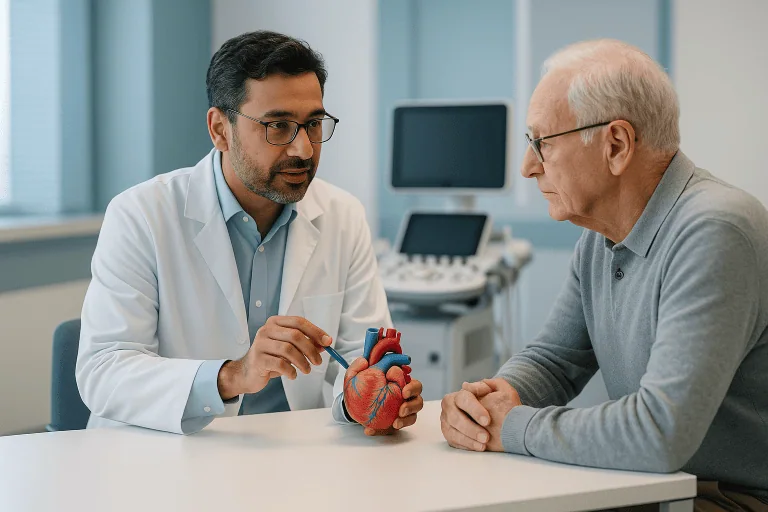
A myocardial infarction, widely known as a heart attack, happens when blood flow to part of the heart muscle is suddenly blocked or severely reduced. The heart muscle (the myocardium) needs a constant supply of oxygen-rich blood, which it receives through vessels called the coronary arteries. When one of these arteries becomes blocked, the section of heart muscle it supplies is starved of oxygen. If blood flow is not restored quickly, that area of muscle begins to be damaged and, over time, can die. The word “infarction” simply means tissue damage caused by a lack of blood supply.
Understanding what is myocardial infarction matters because it is a medical emergency. The faster treatment begins, the more heart muscle can usually be saved. Myocardial infarction is one of the most common serious heart conditions worldwide. It can affect adults of any age, although the risk rises with age. Men often develop it somewhat earlier in life, while women’s risk increases after menopause. People with conditions such as high blood pressure, diabetes, or high cholesterol, and people who smoke, are at higher risk, but a heart attack can also occur in people with no previously known heart problems.
Doctors classify myocardial infarction in several ways. Two broad types are often discussed: STEMI (ST-elevation myocardial infarction), in which a coronary artery is usually completely blocked and a specific pattern appears on the heart’s electrical tracing, and NSTEMI (non-ST-elevation myocardial infarction), in which the artery is often partially blocked. Both types damage the heart and both require urgent medical care, but the immediate treatment approach can differ.
Symptoms of myocardial infarction
Myocardial infarction symptoms can vary widely from person to person. Some people experience the classic, intense chest pain often shown in films, while others have milder, vaguer discomfort that is easy to mistake for indigestion, muscle strain, or anxiety. Recognizing the range of possible symptoms is important, because delays in seeking help can lead to more heart damage.
Common myocardial infarction symptoms include:
- Chest pain or pressure: often described as squeezing, tightness, heaviness, or a burning sensation in the center or left side of the chest. It may last more than a few minutes or come and go.
- Pain spreading to other areas: discomfort may radiate to the left arm, both arms, the shoulders, neck, jaw, back, or upper stomach.
- Shortness of breath: this can occur with or without chest discomfort, at rest or with minimal effort.
- Cold sweat: sudden sweating that is not explained by heat or exertion.
- Nausea or vomiting: sometimes mistaken for a stomach problem.
- Lightheadedness or dizziness: a feeling of faintness or actually fainting.
- Unusual fatigue: sudden, severe tiredness, sometimes appearing days before the event.
- A sense of anxiety or dread: some people describe a feeling that something is seriously wrong.
Symptoms may differ depending on the type and stage of the event. In a STEMI, symptoms often begin abruptly and are severe and persistent. In an NSTEMI, or in the unstable chest pain that can precede a heart attack (called unstable angina), discomfort may come and go, worsen with activity, or occur at rest in a pattern that is new for the person. Some people, particularly women, older adults, and people with diabetes, may have few or no chest symptoms at all. In these groups, a heart attack can present mainly as breathlessness, nausea, jaw or back pain, or overwhelming fatigue. So-called “silent” myocardial infarctions, discovered later on heart tests, can also occur without the person ever realizing a heart attack has happened.
Because symptoms are so variable, any new, unexplained chest discomfort or the combination of symptoms above should be treated as a possible emergency until proven otherwise.
Causes and risk factors
The most common cause of myocardial infarction is coronary artery disease, a condition in which fatty deposits called plaques build up inside the walls of the coronary arteries over many years. This buildup process is known as atherosclerosis. A heart attack typically occurs when one of these plaques ruptures or erodes. The body responds by forming a blood clot at the site, and this clot can block the artery partially or completely, cutting off blood flow to the heart muscle downstream.
Less common myocardial infarction causes include a sudden spasm of a coronary artery, which temporarily narrows the vessel; a spontaneous tear in the artery wall (called spontaneous coronary artery dissection, which occurs more often in younger women); a blood clot or other material traveling from elsewhere in the body; and situations in which the heart’s oxygen demand greatly exceeds supply, such as severe anemia, very fast heart rhythms, or extremely low blood pressure. Use of certain stimulant drugs, such as cocaine, can also trigger a heart attack by causing artery spasm.
Many risk factors increase the likelihood of developing coronary artery disease and, in turn, myocardial infarction. Some can be changed; others cannot.
- High blood pressure (hypertension): puts ongoing strain on artery walls and accelerates plaque buildup.
- High cholesterol: especially high levels of LDL (“bad”) cholesterol, which contributes to plaque formation.
- Smoking: damages the artery lining and makes blood more likely to clot; secondhand smoke also increases risk.
- Diabetes: high blood sugar over time injures blood vessels and often coexists with other risk factors.
- Obesity and physical inactivity: both contribute to high blood pressure, abnormal cholesterol, and diabetes.
- Unhealthy diet: diets high in saturated fat, trans fat, salt, and added sugar are associated with higher risk.
- Family history: having close relatives who developed heart disease at a relatively young age raises risk.
- Age and sex: risk increases with age; men tend to be affected earlier, and women’s risk rises after menopause.
- Chronic stress and poor sleep: both are linked with higher cardiovascular risk in many studies.
- Chronic kidney disease and some inflammatory conditions: these can accelerate atherosclerosis.
Most heart attacks result from a combination of these factors acting together over time, which is why prevention usually focuses on managing several risk factors at once rather than any single one.
Diagnosis of myocardial infarction
Myocardial infarction diagnosis is made urgently, usually in an emergency department, using a combination of the person’s symptoms, an electrical tracing of the heart, and blood tests. Because time matters, testing typically begins within minutes of arrival.
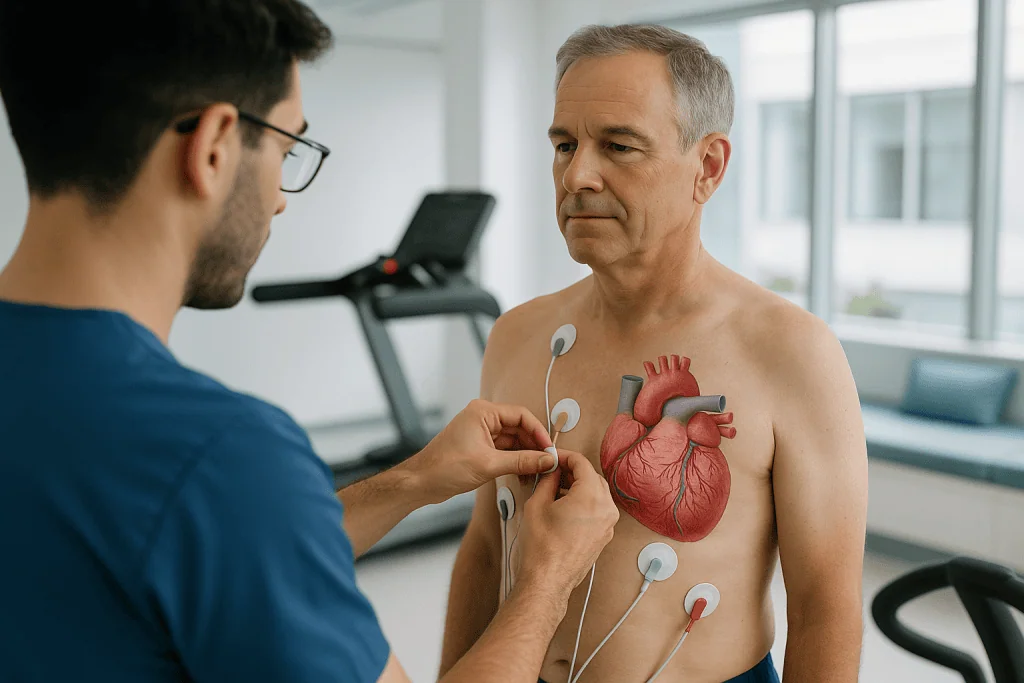
Electrocardiogram (ECG or EKG): this quick, painless test records the heart’s electrical activity through sensors placed on the chest, arms, and legs. It can show patterns that suggest a heart attack is happening and helps doctors distinguish a STEMI, which needs immediate artery-opening treatment, from an NSTEMI. The ECG is often repeated, because changes can evolve over minutes to hours.
Blood tests for cardiac troponin: troponin is a protein released into the bloodstream when heart muscle cells are damaged. Modern high-sensitivity troponin tests can detect very small amounts of injury. Doctors usually take blood samples at intervals to see whether troponin levels are rising or falling, which helps confirm that heart damage is recent and ongoing.
Coronary angiography: if a heart attack is confirmed or strongly suspected, doctors often perform an angiogram. A thin, flexible tube called a catheter is guided through a blood vessel in the wrist or groin up to the heart, and a contrast dye is injected so the coronary arteries can be seen on X-ray. This test shows exactly where an artery is narrowed or blocked and often allows treatment during the same procedure.
Other imaging tests: an echocardiogram (an ultrasound scan of the heart) can show whether part of the heart wall is moving weakly, which suggests damage, and can assess overall pumping function. A chest X-ray may be done to check the lungs and heart size and to rule out other causes of chest pain. In some cases, cardiac MRI or CT scans are used to clarify the diagnosis or assess damage.
Formally, doctors diagnose myocardial infarction when there is evidence of heart muscle injury (usually a rise and fall in troponin) together with signs that the injury is due to reduced blood flow, such as typical symptoms, ECG changes, imaging findings of new heart wall damage, or a blockage seen on angiography. Doctors also work to exclude other conditions that can mimic a heart attack, including lung clots, tears in the main body artery, inflammation of the heart lining, and severe acid reflux.
Treatment options for myocardial infarction
Myocardial infarction treatment aims to restore blood flow to the heart muscle as quickly as possible, limit damage, relieve symptoms, and reduce the risk of another event. Because a heart attack is an emergency, watchful waiting is not appropriate for the acute event itself; treatment begins immediately. The specific approach depends on the type of heart attack, how much time has passed, the person’s overall health, and the findings on angiography. In hospital settings, this condition is typically managed by cardiologists; at Acibadem, for example, care for heart attack patients is coordinated through the Cardiology Department.
Emergency and early medications
Several medicines are commonly used as soon as a heart attack is suspected. Aspirin and other antiplatelet drugs make blood platelets less sticky, helping to prevent the clot from growing. Anticoagulants (blood thinners) may be given to further limit clotting. Nitroglycerin can widen blood vessels and ease chest pain, and pain relief and oxygen are given when needed. In some situations, particularly for STEMI when rapid access to a catheterization laboratory is not possible, clot-dissolving drugs called thrombolytics may be used to break up the blockage.
Procedures to reopen the artery
The most common procedure is percutaneous coronary intervention (PCI), often called angioplasty. During the same catheter procedure used for angiography, doctors inflate a tiny balloon at the site of the blockage to open the artery and usually place a stent, a small metal mesh tube that holds the artery open. For STEMI, doctors aim to perform PCI as urgently as possible. For NSTEMI, the timing depends on how unstable the person is, but angiography and PCI are often performed within hours to days.
Surgery
Some people have blockages in several arteries, blockages in locations difficult to treat with stents, or other complicating factors. In these cases, coronary artery bypass grafting (CABG), a type of open-heart surgery, may be recommended. In bypass surgery, a surgeon uses a blood vessel taken from another part of the body to create a new route for blood around the blocked section of the coronary artery. The choice between stenting and surgery is made individually, often after discussion between cardiologists and heart surgeons.
Long-term medication and rehabilitation
After the acute phase, most people take several medicines long term to protect the heart and lower the risk of another heart attack. These often include antiplatelet drugs, statins to lower cholesterol, beta-blockers to reduce the heart’s workload, and drugs called ACE inhibitors or ARBs that help the heart and blood vessels. Your doctor may adjust these medicines over time based on your blood pressure, cholesterol, kidney function, and how well the heart is pumping. Cardiac rehabilitation, a supervised program of exercise, education, and support, is widely recommended after a heart attack and, in many cases, helps people recover strength and confidence while addressing risk factors.
Living with myocardial infarction and outlook
Surviving a heart attack is often the beginning of a longer process of recovery and prevention. The outlook after myocardial infarction varies considerably. It depends on how much heart muscle was damaged, how quickly treatment was given, whether complications such as heart failure or abnormal heart rhythms developed, and how well risk factors are controlled afterward. Many people recover well and return to work, travel, exercise, and their usual activities, though the pace of return differs from person to person and should be guided by the treating team.
Long-term self-care usually includes taking prescribed medicines consistently, attending follow-up appointments, and making sustainable lifestyle changes: stopping smoking, eating a heart-healthy diet rich in vegetables, fruits, whole grains, and lean proteins, staying physically active within limits agreed with the care team, maintaining a healthy weight, limiting alcohol, and managing blood pressure, cholesterol, and blood sugar. Emotional health matters too. Anxiety and low mood are common after a heart attack, and discussing these feelings with a doctor is worthwhile, since support and treatment are available.
It is honest to say that having had one myocardial infarction increases the risk of having another, but it is equally true that this risk can often be substantially reduced through medication and lifestyle measures. No treatment can guarantee that another event will not occur, which is why ongoing follow-up and awareness of warning symptoms remain important for life.
Frequently asked questions
What is the difference between a myocardial infarction and a heart attack?
There is no difference: myocardial infarction is the medical term for a heart attack. Both describe the same event, in which blood flow to part of the heart muscle is blocked and the muscle is damaged as a result. Doctors may add further labels, such as STEMI or NSTEMI, to describe the type and guide treatment.
How serious is a myocardial infarction?
A myocardial infarction is always a serious medical emergency, because untreated blockage can cause permanent heart damage or life-threatening heart rhythm problems. That said, outcomes vary widely. Many people who receive prompt treatment survive and recover well, especially when the affected artery is reopened quickly and long-term care is followed. Severity depends on which artery is blocked, how much muscle is affected, and how fast treatment starts.
Can the heart heal after a myocardial infarction?
Heart muscle that dies during a heart attack is generally replaced by scar tissue rather than new muscle, so that portion does not fully regenerate. However, the remaining healthy muscle can often adapt, and overall heart function may improve during recovery, particularly with medication and cardiac rehabilitation. The degree of recovery differs from person to person, and your doctor can assess your heart’s function with imaging tests over time.
What are the early warning signs of a heart attack?
Warning signs can appear suddenly or build over hours or even days. Common early signals include chest pressure or discomfort, breathlessness, unusual fatigue, discomfort in the arm, jaw, neck, or back, nausea, and cold sweats. Some people notice chest discomfort during exertion that eases with rest in the days before a heart attack. Any new or changing pattern of chest symptoms deserves urgent medical assessment.
How long does recovery after a myocardial infarction take?
Recovery time varies. Many people spend several days in the hospital and then gradually resume activities over weeks to months, depending on the extent of heart damage, the treatment received, and their overall health. Cardiac rehabilitation programs often run for several weeks and can help structure a safe return to activity. Your care team can give personalized guidance on returning to work, driving, exercise, and intimacy.
Can a myocardial infarction happen without chest pain?
Yes. Some heart attacks occur with little or no chest pain, particularly in women, older adults, and people with diabetes. In these cases, symptoms may include shortness of breath, nausea, jaw or back discomfort, dizziness, or sudden severe fatigue. Some heart attacks are entirely “silent” and are discovered later on heart tests. This is one reason unexplained new symptoms should be evaluated rather than dismissed.
Can a second heart attack be prevented?
The risk of a second myocardial infarction can often be substantially reduced, although no approach removes it completely. Prevention usually combines long-term medicines, such as antiplatelet drugs and statins, with lifestyle changes including not smoking, healthy eating, regular physical activity, and control of blood pressure, cholesterol, and diabetes. Regular follow-up allows your doctor to adjust treatment as your needs change.
When to see a doctor
A suspected heart attack is a medical emergency. Do not wait to see whether symptoms pass, and do not drive yourself to the hospital if emergency services are available. Call your local emergency number immediately if you or someone near you experiences any of the following red-flag signs:
- Chest pain, pressure, tightness, or heaviness lasting more than a few minutes, or that goes away and returns.
- Pain spreading to the arm, shoulder, neck, jaw, back, or upper stomach.
- Shortness of breath, with or without chest discomfort.
- Cold sweat, nausea, or vomiting together with chest or upper-body discomfort.
- Sudden dizziness, fainting, or a racing or irregular heartbeat.
- Sudden, severe, unexplained fatigue or weakness, especially in women, older adults, or people with diabetes.
Even if symptoms are mild or uncertain, it is safer to seek emergency evaluation than to wait. If symptoms have already resolved, or if you have ongoing concerns such as chest discomfort during exertion, new breathlessness, or a strong family history of early heart disease, arrange to see a doctor promptly. After a myocardial infarction, contact your care team without delay if you notice returning chest pain, worsening breathlessness, swelling in the legs, palpitations, or side effects from your medicines. Early attention, both in emergencies and in follow-up care, gives the heart the best possible chance.
Blood Pressure Calculator
Check your own numbers in seconds, free, instant and doctor-reviewed ranges.
From the Acibadem Blog

Elevated Troponin: Why It Does Not Always Mean a Heart Attack
An elevated troponin level means heart muscle cells have released this protein into the bloodstream, but it does not always signal a heart attack.…
Medically reviewed by the Acıbadem International Medical Board September 2, 2026
See our medical review board →
Update history
- PublishedJune 14, 2026
- Medical review approvedSeptember 2, 2026
- Last content updateSeptember 18, 2026