Neurosarcoidosis
Learn what neurosarcoidosis is, its common symptoms, possible causes, how doctors diagnose it, treatment options, and warning signs that need urgent care.
Quick answer
Neurosarcoidosis is sarcoidosis affecting the nervous system, where clusters of inflammatory cells called granulomas form in the brain, spinal cord, their covering membranes, or nerves. It can cause facial weakness, vision loss, headaches, numbness, seizures, or hormone problems. Diagnosis uses MRI, spinal fluid tests, and biopsy; treatment usually starts with corticosteroids.
What is neurosarcoidosis?
Neurosarcoidosis is a form of sarcoidosis that affects the nervous system. Sarcoidosis is an inflammatory disease in which the immune system forms small clusters of cells called granulomas in one or more organs. Most often these granulomas form in the lungs, lymph nodes, skin, or eyes. When they develop in the brain, spinal cord, the membranes that cover them (the meninges), the cranial nerves that run from the brain to the face and head, or the peripheral nerves in the limbs, doctors use the term neurosarcoidosis.
Neurosarcoidosis is uncommon. It occurs in only a minority of people who have sarcoidosis, and in many of those people the nervous system is not the first part of the body to be affected. In some cases, however, nervous-system symptoms are the first sign that sarcoidosis is present, which can make the condition harder to recognize.
Sarcoidosis in general is most often diagnosed in adults between their twenties and fifties, although it can occur at any age. It affects both men and women. It is reported more often in people of African and Northern European ancestry, although anyone can develop it. Because neurosarcoidosis can look like many other neurological conditions, it is usually managed by a neurologist working together with other specialists, such as a lung doctor, an eye doctor, or a hormone specialist. At Acibadem, this condition is evaluated within the Neurology department alongside these related teams.
Neurosarcoidosis symptoms
Neurosarcoidosis symptoms depend on which part of the nervous system is inflamed. Symptoms may appear suddenly or develop gradually over weeks or months. Some people have a single episode that settles, while others have symptoms that come and go or slowly progress. Common symptoms include:
- Facial weakness or drooping, often on one side, caused by inflammation of the facial nerve
- Vision changes, such as blurred vision, loss of vision in one eye, or double vision
- Headache, which may be persistent or unusually severe
- Hearing loss, ringing in the ears, or dizziness
- Numbness, tingling, or weakness in the arms or legs
- Seizures
- Problems with memory, concentration, or mood
- Extreme thirst and frequent urination, fatigue, sleep problems, or changes in body temperature and appetite, which can point to involvement of the pituitary gland or hypothalamus (the brain’s hormone-control centers)
- Difficulty walking, bladder or bowel problems, which may indicate spinal cord involvement
Doctors often group neurosarcoidosis by the part of the nervous system that is affected:
- Cranial nerve involvement is one of the most common patterns. The facial nerve is affected most often, causing weakness that can resemble Bell’s palsy. The optic nerve, which carries signals from the eye, is another frequent site and can threaten vision.
- Meningeal involvement means inflammation of the membranes around the brain and spinal cord. This can cause headache, neck stiffness, and sometimes a build-up of fluid in the brain called hydrocephalus, which raises pressure inside the skull.
- Brain (parenchymal) involvement can lead to seizures, cognitive changes, weakness, or hormone disturbances when granulomas form in the brain tissue itself.
- Spinal cord involvement can cause weakness or numbness in the legs, difficulty walking, and loss of bladder or bowel control.
- Peripheral nerve involvement can cause pain, burning, numbness, or weakness in the hands and feet. A pattern called small fiber neuropathy, which damages the thin nerves that carry pain and temperature signals, is increasingly recognized in people with sarcoidosis and can be very uncomfortable even when routine nerve tests appear normal.
Many people with neurosarcoidosis also have symptoms of sarcoidosis elsewhere in the body, such as cough, shortness of breath, skin rashes or lumps, red or painful eyes, joint pain, or ongoing tiredness.
Causes and risk factors
The exact neurosarcoidosis causes are not known. What is understood is that sarcoidosis involves an abnormal immune response. In people who develop the disease, the immune system appears to react to a trigger it cannot clear and responds by forming granulomas. These granulomas can interfere with the normal function of the tissue in which they form. In the nervous system, they may press on nerves, disrupt the blood-brain barrier, block the flow of cerebrospinal fluid, or damage nerve fibers directly.
Researchers believe that a combination of factors is involved:
- Genetic susceptibility. Sarcoidosis sometimes occurs in more than one member of a family, and certain immune-system genes are more common in people with the disease. Having a relative with sarcoidosis modestly increases the chance of developing it, although most people with sarcoidosis have no affected relatives.
- Environmental exposures. Various inhaled substances, including dusts, molds, and other organic or inorganic particles, have been studied as possible triggers, but no single cause has been confirmed.
- Infectious agents. Some studies have looked at bacteria and other microbes as possible triggers of the immune reaction. Sarcoidosis itself is not contagious and cannot be passed from person to person.
It is not clear why the nervous system becomes involved in some people with sarcoidosis and not in others. Recognized risk factors for sarcoidosis in general include age between about 20 and 50, a family history of the disease, and African or Northern European ancestry. Having sarcoidosis in another organ, particularly active disease, is the main risk factor for developing neurosarcoidosis. Nothing a person does or fails to do is known to cause neurosarcoidosis.
Neurosarcoidosis diagnosis
Neurosarcoidosis diagnosis can be difficult because its symptoms overlap with many other conditions, including multiple sclerosis, infections such as tuberculosis or fungal meningitis, lymphoma and other cancers, and other inflammatory diseases. There is no single test that confirms it. Instead, doctors combine the clinical picture with imaging, laboratory findings, and, wherever possible, a tissue sample.
- Neurological examination. A careful history and physical examination help identify which parts of the nervous system are affected.
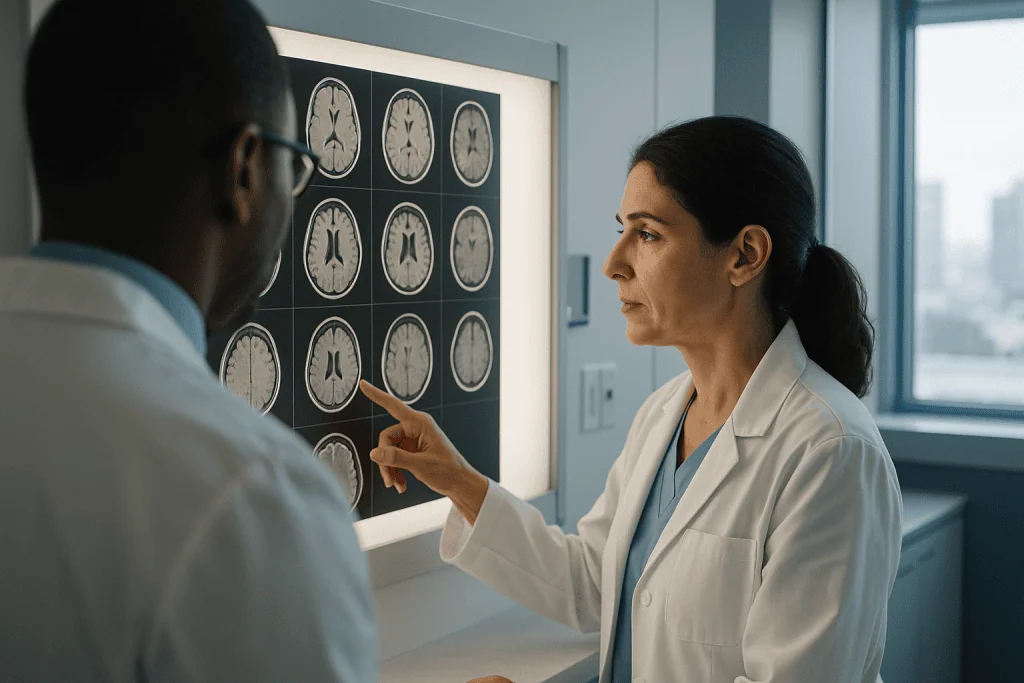
- MRI of the brain and spinal cord with contrast. Magnetic resonance imaging is the main imaging test. A contrast dye given through a vein helps show inflamed areas, thickened meninges, cranial nerve or pituitary involvement, and spinal cord lesions. MRI findings alone, however, are not specific to sarcoidosis.
- Lumbar puncture (spinal tap). A small amount of cerebrospinal fluid is taken from the lower back and analyzed. In neurosarcoidosis it may show raised protein, increased white blood cells, and sometimes low glucose. The fluid is also tested to rule out infection and cancer cells.
- Blood tests. These may include levels of angiotensin-converting enzyme (ACE), calcium, kidney and liver function, and tests for infections. ACE can be raised in sarcoidosis but is normal in many affected people and can be raised in other conditions, so it is not a reliable stand-alone test.
- Chest X-ray or CT scan of the chest. Because the lungs and chest lymph nodes are so often involved, imaging the chest can reveal sarcoidosis elsewhere and identify a safer place to take a biopsy.
- PET scan. A whole-body positron emission tomography scan can highlight active inflammation in organs throughout the body and help locate tissue suitable for biopsy.
- Biopsy. A small sample of tissue is examined under a microscope for non-caseating granulomas, the characteristic finding in sarcoidosis. Doctors usually prefer to biopsy an accessible site such as a lymph node, lung, or skin. A biopsy of brain, meninges, or nerve is sometimes needed when no other site is available, but it carries more risk and is not always possible.
- Other tests. Depending on symptoms, these may include eye examination, hearing tests, nerve conduction studies, skin biopsy for small fiber neuropathy, hormone blood tests, and an electroencephalogram (EEG) if seizures are suspected.
Specialists often classify the diagnosis by level of certainty. A diagnosis is generally called definite when nervous-system tissue shows granulomas and infection or other causes have been excluded; probable when the neurological picture and imaging fit and sarcoidosis is proven by biopsy elsewhere in the body; and possible when the picture is suggestive but tissue confirmation is lacking. This framework guides how confidently doctors can start treatment and how closely they need to keep looking for alternative explanations.
Neurosarcoidosis treatment options
Neurosarcoidosis treatment options aim to reduce inflammation, protect nervous-system function, relieve symptoms, and prevent relapses. Because the condition is uncommon, treatment is guided mainly by clinical experience, consensus among specialists, and smaller studies rather than large trials. Your care team will tailor treatment to how severe the disease is, which structures are affected, and your overall health.
- Observation. Very mild involvement, such as an isolated facial nerve palsy that is already improving, may sometimes be monitored closely without long-term medication. This is decided case by case.
- Corticosteroids. Steroid medicines such as prednisone are the usual first treatment. They are often given at a higher dose initially, sometimes through a vein for severe disease, and then slowly reduced over months. Steroids can cause side effects such as weight gain, high blood sugar, high blood pressure, bone thinning, mood changes, and sleep disturbance, so doctors try to use the lowest effective dose.
- Steroid-sparing immunosuppressants. Medicines such as methotrexate, azathioprine, or mycophenolate are often added so that the steroid dose can be lowered, or when disease returns as steroids are tapered. They take several weeks to months to work fully and require regular blood monitoring.
- Biologic therapy. Drugs that block a chemical messenger called tumor necrosis factor (TNF), such as infliximab, are increasingly used for severe or treatment-resistant neurosarcoidosis. These are given by infusion. Before starting, doctors screen for hidden infections such as tuberculosis and hepatitis because these medicines suppress the immune system.
- Other immunosuppressants. In selected severe cases, stronger medicines such as cyclophosphamide may be considered.
- Treatment of specific complications. Antiseizure medicines for seizures, hormone replacement for pituitary or hypothalamic dysfunction, pain-modulating medicines for nerve pain, and treatments for headache are used as needed.
- Procedures and surgery. Surgery does not cure neurosarcoidosis, but it may be needed for complications. A shunt, a thin tube that drains excess cerebrospinal fluid, may be placed for hydrocephalus. Rarely, a mass of granulomas that is pressing on important structures is removed.
- Rehabilitation and supportive care. Physical therapy, occupational therapy, speech therapy, and vision or hearing rehabilitation can help people recover function and adapt to lasting deficits. Support for fatigue, sleep, and mood is also an important part of care.
Treatment is usually continued for a long time, frequently a year or more, and is reduced gradually while monitoring for relapse. Follow-up MRI scans and clinical reviews help judge whether inflammation is under control. Because the medicines used can weaken the immune system, staying up to date with recommended vaccines and reporting any signs of infection promptly are part of routine care.
Living with neurosarcoidosis and outlook
The outlook for neurosarcoidosis varies widely. Some people have a single episode, respond well to treatment, and recover most or all of their function. Others have a chronic course with periods of improvement and relapse, and some develop lasting neurological problems despite treatment. Involvement of the cranial nerves, particularly the facial nerve, tends to have a more favorable course than involvement of the brain tissue, spinal cord, or hydrocephalus, although outcomes depend on many individual factors and cannot be predicted with certainty.
Living well with neurosarcoidosis often involves regular follow-up with a neurologist and other specialists, taking medicines as prescribed even when feeling well, attending monitoring blood tests, and reporting new or returning symptoms early. Fatigue is very common in sarcoidosis and can persist even when inflammation is controlled; pacing activity, protecting sleep, and addressing mood or pain can help. Some people find it useful to connect with patient organizations or support groups for sarcoidosis, and to involve family members in learning about the condition. Many people continue to work, study, and care for their families, sometimes with adjustments. Recovery and adaptation can take time, and it is reasonable to ask your care team about rehabilitation services if you notice ongoing difficulties with movement, vision, speech, memory, or daily tasks.
Frequently asked questions
What is neurosarcoidosis in simple terms?
Neurosarcoidosis is sarcoidosis that has affected the nervous system. Sarcoidosis is a condition in which the immune system forms small clumps of inflammatory cells, called granulomas, in the body’s tissues. When those granulomas develop in the brain, spinal cord, the membranes around them, or the nerves, they can disturb how those structures work, causing symptoms such as facial weakness, vision changes, headaches, numbness, or seizures.
What are the first neurosarcoidosis symptoms people notice?
There is no single first symptom. In many people the earliest sign is sudden weakness on one side of the face, blurred or lost vision in one eye, a persistent headache, or numbness and tingling in the limbs. Some people first notice unusual thirst and frequent urination, fatigue, or memory and mood changes. Because these symptoms have many possible causes, a medical assessment is needed to find out whether sarcoidosis is responsible.
What causes neurosarcoidosis, and is it hereditary?
The precise cause is unknown. Doctors believe it arises when a genetically susceptible person’s immune system overreacts to an environmental or infectious trigger that has not yet been identified. Sarcoidosis can occur in more than one family member, so genetics play a role, but it is not inherited in a simple, predictable way, and most people with the condition have no affected relatives. It is not contagious.
How is neurosarcoidosis diagnosis confirmed?
Diagnosis relies on combining the neurological picture with an MRI scan using contrast, analysis of spinal fluid from a lumbar puncture, blood tests, and imaging of the chest and sometimes the whole body. Whenever possible, a biopsy showing granulomas, usually taken from an accessible organ such as a lymph node or lung, is used to confirm sarcoidosis, while tests are done to rule out infections, cancers, and other inflammatory diseases that can look similar.
What are the main neurosarcoidosis treatment options?
Corticosteroids are usually the first treatment. Because long-term steroids have side effects, other immune-suppressing medicines such as methotrexate, azathioprine, or mycophenolate are often added, and biologic drugs that block TNF may be used for severe or resistant disease. Additional treatments address specific problems, for example antiseizure medicines, hormone replacement, or surgery to drain fluid from the brain. Rehabilitation supports recovery of function.
Can neurosarcoidosis be cured?
There is currently no cure for sarcoidosis, but in many people the inflammation can be controlled and symptoms improve or resolve with treatment. Some people experience a single episode that does not return once treatment is completed, while others need longer-term medication to keep the disease quiet. Because the course varies from person to person, doctors generally speak in terms of remission and control rather than cure.
Is neurosarcoidosis life-threatening?
Most people with neurosarcoidosis do not have a life-threatening illness, but serious complications can occur, especially when the brain tissue, spinal cord, or fluid pathways are involved or when severe infections develop during immune-suppressing treatment. Early recognition, appropriate treatment, and regular follow-up are aimed at reducing these risks. Your neurologist can discuss what your individual pattern of disease may mean for you.
When to see a doctor
If you have known sarcoidosis and develop any new neurological symptom, or if you have unexplained neurological symptoms that persist or worsen, arrange to be assessed by a doctor. Seek urgent or emergency medical care if you or someone near you experiences any of the following red-flag warning signs:
- Sudden weakness or numbness of the face, arm, or leg, especially on one side of the body
- Sudden loss of vision or double vision
- A seizure, particularly a first-ever seizure
- Severe headache that is sudden, the worst you have experienced, or accompanied by fever, neck stiffness, vomiting, or drowsiness
- New confusion, difficulty speaking, or unusual sleepiness that is hard to rouse from
- Rapidly worsening difficulty walking, or new loss of bladder or bowel control
- Fever or other signs of infection while taking steroids, immunosuppressants, or biologic medicines
These symptoms can have many causes other than neurosarcoidosis, some of which need immediate treatment, so they should never be ignored or left until a routine appointment.
Medically reviewed by the Acıbadem International Medical Board September 9, 2026
See our medical review board →
Update history
- PublishedSeptember 8, 2026
- Medical review approvedSeptember 9, 2026
- Last content updateSeptember 8, 2026