

3D Printing in Medicine: How Custom Models and Implants Are Made

3D printing in medicine uses imaging data and digital design to create customized medical tools and devices. Common medical uses include anatomical models, surgical guides, prosthetics, and selected implants.
Key Takeaways
- 3D printing in medicine uses imaging data and digital design to create customized medical tools and devices.
- Common medical uses include anatomical models, surgical guides, prosthetics, and selected implants.
- Not every patient or procedure needs 3D printing, but it can be helpful in complex or highly individualized cases.
- Safety depends on careful design, suitable materials, sterilization, and quality control.
- Patients can ask whether a printed model or guide may improve planning, precision, or understanding of their treatment.
3D printing in medicine helps turn medical scans and digital designs into physical models, surgical guides, and custom implants. It supports more personalized care by helping clinical teams plan procedures, improve fit, and better explain treatment to patients.
Overview: What 3D Printing in Medicine Means
3D printing in medicine is a way of making physical objects layer by layer from a digital design. In healthcare, those objects may include anatomical models, surgical planning tools, guides used in the operating room, prosthetic components, and in selected cases, custom implants. The process is often called additive manufacturing because material is added gradually rather than carved away from a solid block.
One of the main strengths of medical 3D printing is personalization. Doctors can use imaging such as CT or MRI scans to create a digital model of a specific patient’s anatomy. That can be especially useful when anatomy is unusual, when a condition is complex, or when a treatment must fit very precisely.
3D printing does not replace the skill of the surgeon, radiologist, dentist, or biomedical engineer. Instead, it supports decision-making and planning. A printed model can help a team study a difficult area before a procedure, while a patient-specific guide may help transfer a digital surgical plan more accurately to the operating room.
It is also important to understand that 3D printing is not needed in every case. Many conditions are treated very effectively with standard techniques and standard devices. The value of 3D printing depends on the clinical goal, the body area involved, the available materials, and whether a custom-made approach is likely to improve care.
How Custom Models and Implants Are Made
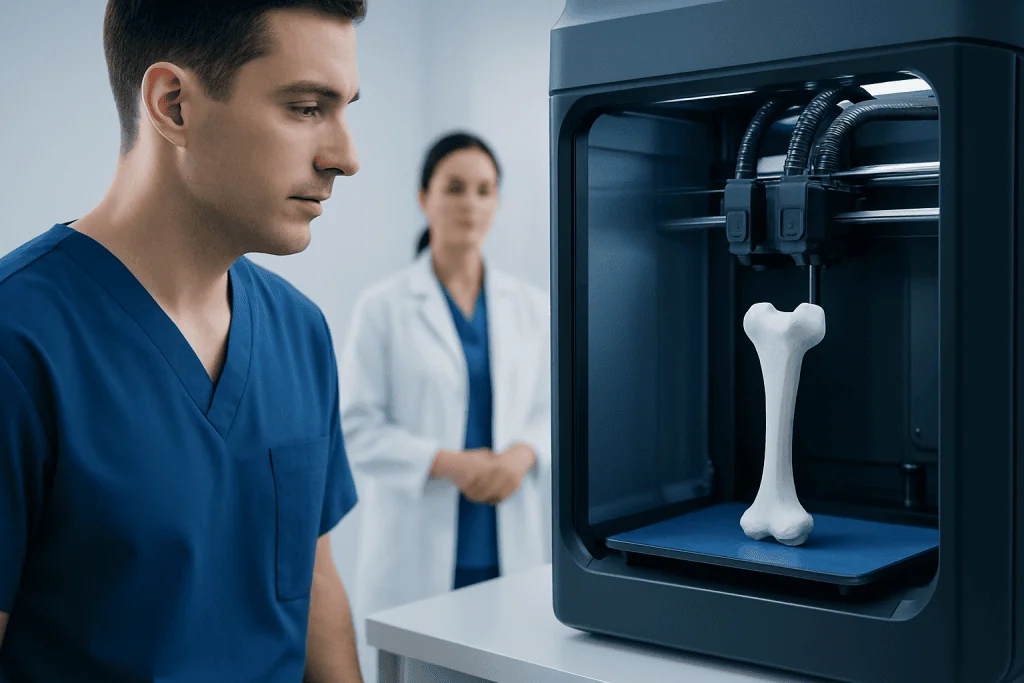
The process usually begins with medical imaging. CT scans are commonly used for bones and detailed structures, while MRI may be used for soft tissues in certain situations. The scan data are imported into specialized software, where the area of interest is segmented. Segmentation means identifying the exact anatomy that needs to be modeled, such as a jawbone, a blood vessel, part of the spine, or a joint surface.
After segmentation, a digital 3D model is created and refined. Engineers and clinicians may smooth the surface, mark critical landmarks, and design features needed for the model’s purpose. For example, a surgical guide may include openings that help direct a drill at the planned angle, while a custom implant may be shaped to match the patient’s anatomy as closely as possible.
Next comes material selection and printing. Different printers use different materials, including medical-grade plastics, resins, nylon-like polymers, and metals such as titanium for selected implant applications. The best material depends on whether the object is just for visual planning, needs to be sterilized, must be strong enough for use in surgery, or is intended to remain in the body.
Once printing is complete, post-processing is essential. This may include cleaning, curing, polishing, sterilization, and dimensional checks. For implants and surgical guides, quality assurance is particularly important. The clinical team needs confidence that the printed item matches the approved design and meets safety standards before it is used in patient care.
Common Uses in Healthcare
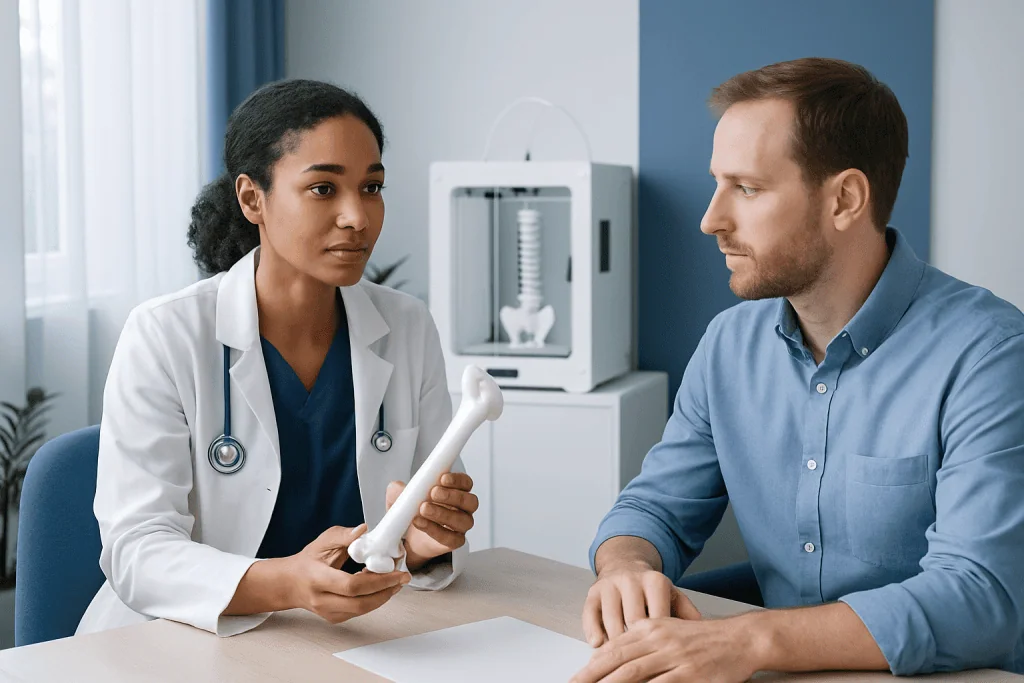
One of the most established uses of 3D printing in medicine is anatomical modeling. A patient-specific model can help surgeons prepare for complex procedures by letting them examine a real-scale version of the anatomy in advance. This can be valuable in fields such as orthopedics, maxillofacial surgery, cardiac care, neurosurgery, and selected cancer operations.
Surgical guides are another important use. These guides are designed to fit onto a patient’s anatomy in a particular position and help direct tools according to a preplanned path. In some cases, they can support more precise cutting, drilling, or placement of hardware. This approach may be used in areas related to orthopedic surgery or complex dental implant treatment, where alignment and fit are important.
Custom implants are used more selectively. These may be considered when standard implants are not a good match because of unusual anatomy, trauma, tumor-related reconstruction, or revision surgery. 3D printed implants have been used in parts of the skull, jaw, spine, and some orthopedic reconstructions, but they require careful planning, regulatory oversight, and strict manufacturing standards.
3D printing can also support education and communication. It may help patients and families understand a diagnosis and the planned treatment more clearly. For trainees and healthcare teams, printed models can be useful for simulation and practice, especially when preparing for uncommon or technically demanding cases such as scoliosis or selected forms of bone cancer.
Benefits and Limitations
The benefits of medical 3D printing depend on the case. A customized model may improve understanding of anatomy before surgery. A patient-specific guide may support precise execution of a plan. A custom implant may improve fit when standard options are limited. These advantages can contribute to more individualized care and may make some procedures easier to visualize for both clinicians and patients.
Even so, 3D printing has practical limits. It takes time to process scans, design the item, print it, and complete quality checks. This means it may not be suitable for urgent situations when there is no time for customization. Cost, equipment availability, technical expertise, and access to validated workflows can also affect whether 3D printing is a realistic option.
Another limitation is that not every printed object behaves exactly like living tissue. A plastic model may show shape very well but may not perfectly represent the softness, elasticity, or blood flow of the body. Likewise, a printed implant must be designed with great care so that strength, surface properties, and long-term performance are appropriate for the intended use.
For patients, the key message is balanced: 3D printing can be very helpful in the right setting, but it is not automatically better in every medical situation. The decision to use it should be based on the clinical problem, the evidence for that application, and the judgment of an experienced multidisciplinary team.
Safety, Regulation, and Quality Control
Because 3D printed medical products may directly influence treatment, safety is a central issue. The design must be based on accurate imaging and correct measurements. If the printed object is used during surgery or implanted into the body, the material must be suitable for medical use and compatible with sterilization or implantation requirements.
Hospitals and manufacturers also need robust quality control. This can include checking the design against the original scan, verifying the dimensions of the final object, documenting each production step, and confirming that the printed item is used for the correct patient. In implant cases, traceability of the material and manufacturing conditions is especially important.
Regulation varies by country and by the type of product being made. A teaching model used to explain anatomy has different requirements from a surgical guide or a permanent implant. Custom-made devices may still need to meet strict standards for biocompatibility, mechanical performance, and manufacturing consistency.
Patients do not need to know every technical detail, but it is reasonable to ask practical questions. For example, they may ask whether the model or implant is based on their own scans, whether it has been reviewed by the clinical team, and whether approved medical-grade materials and sterilization methods are being used.
Where Patients May Encounter 3D Printing
A patient may encounter 3D printing at several points in care. Sometimes it is used before surgery, when a team wants a detailed model to study a complex area. In other situations, it may be part of reconstructive planning after trauma or cancer surgery, or used to design a guide that helps place hardware more accurately. It can also support areas such as maxillofacial surgery and selected reconstructive procedures.
Patients may also see 3D printing in dental care, hearing-related devices, external prosthetics, or personalized rehabilitation tools. In pediatrics, where anatomy changes with growth, customization may sometimes be especially useful. In cardiology and vascular care, printed heart or vessel models can sometimes help teams prepare for unusual anatomy or congenital conditions.
Most patients will not need to request 3D printing specifically. If it is likely to add value, the care team will often raise it during planning. However, patients can ask whether there is a role for a patient-specific model, guide, or custom implant, especially when a procedure has been described as complex, reconstructive, or highly individualized.
Near the end of planning, patients may want to understand how the printed item will be used and what benefit is expected. At Acibadem International, multidisciplinary specialists in JCI-accredited hospitals evaluate and treat international patients who may benefit from advanced planning tools and personalized surgical approaches, including 3D printing where appropriate.
Questions to Ask and Future Directions
If 3D printing is being considered, patients can ask clear, practical questions. These include: What problem is the printed model or device trying to solve? Is it intended for planning, for use during surgery, or as an implant? Are there standard alternatives, and why might a customized approach be preferred in this case?
It is also helpful to ask about timing and expectations. Patients may want to know whether customization changes the surgical plan, whether it affects preparation time, and whether it introduces any additional steps in care. If a custom implant is being discussed, they can ask about the material, expected durability, and how the team confirms fit and safety.
Looking ahead, medical 3D printing is continuing to develop. Software is becoming more sophisticated, printers are gaining precision, and material science is expanding. Researchers are also exploring bioprinting and tissue engineering, although these remain more limited and specialized than the current mainstream uses of printed models, guides, and implants.
The future is promising, but current care still depends on thoughtful case selection and strong clinical oversight. For patients, the most reassuring approach is to see 3D printing as one tool among many. When used in the right context, it can support safer planning, clearer communication, and more personalized treatment.
Frequently asked questions
What is 3D printing in medicine used for?
It is used to create physical models of anatomy, surgical guides, prosthetic parts, and some custom implants. These tools can help doctors plan treatment, improve fit, and explain procedures more clearly.
Are 3D printed implants safe?
They can be safe when they are carefully designed, made from appropriate medical materials, and produced under strict quality standards. Safety also depends on choosing the right patients and making sure the implant is properly reviewed before use.
Does every surgery benefit from 3D printing?
No. Many surgeries are done very successfully without it. It is usually most helpful in complex, unusual, or highly personalized cases where anatomy or fit is especially important.
How do doctors make a patient-specific 3D model?
They usually start with imaging such as a CT or MRI scan. The anatomy is separated digitally in software, turned into a 3D design, and then printed using a suitable material for planning or clinical use.
Can 3D printing reduce surgery time?
In some cases, better preoperative planning or a well-designed surgical guide may help a procedure run more efficiently. However, this is not guaranteed, and the benefit depends on the condition, the procedure, and the team’s experience.
Will insurance or health coverage pay for medical 3D printing?
Coverage varies by country, hospital, insurer, and the reason the printed item is being used. Patients should ask their hospital and insurer whether the printed model, guide, or implant is included in the planned care.
References
- World Health Organization
- U.S. Food and Drug Administration
- Radiological Society of North America
- American College of Radiology
- International Organization for Standardization
This article is for general information only and is not a substitute for professional medical advice. Please consult a qualified doctor about your individual situation.
Explore treatments in Turkey — costs, top hospitals & a free quote
JCI-accredited · board-certified surgeons · reply within 24h
Add us as a Preferred Source to see more of our trusted health content across Google Search, AI Overviews and Discover.

More from the Health Library



Related Specialists

Dr. Lamiya Aliyeva Javit
Medical Genetics
Dt. Nehir Erdal
Oral & Dental Health
Dr. Eymen Aslan
Anesthesiology
Dr. Sedef Başgönül
Infectious Diseases & Clinical Microbiology