Allergy Testing: Skin Prick, Blood Tests, and What Results Mean

Allergy testing can help identify triggers such as pollen, dust mites, animal dander, molds, insect venom, medicines, and foods. Skin prick testing gives quick results and is often used for suspected environmental, food, or insect allergies when it is safe and appropriate.
Key Takeaways
- Allergy testing can help identify triggers such as pollen, dust mites, animal dander, molds, insect venom, medicines, and foods.
- Skin prick testing gives quick results and is often used for suspected environmental, food, or insect allergies when it is safe and appropriate.
- Allergy blood tests measure allergen-specific IgE antibodies and may be preferred when skin testing is not suitable.
- A positive test does not always mean a true allergy; it may show sensitization without symptoms.
- A negative test lowers the likelihood of an IgE-mediated allergy but may not explain every type of reaction.
- An allergy specialist can connect test results with symptoms and create a safe management plan.
Allergy testing helps identify substances that may be triggering symptoms such as sneezing, wheezing, itching, rashes, or reactions after eating certain foods. Skin prick tests and blood tests are commonly used, but results must always be interpreted together with a person’s symptoms and medical history.
Overview
Allergy testing is a set of medical tests used to help identify whether the immune system reacts to specific substances called allergens. Common allergens include pollen, house dust mites, animal dander, molds, certain foods, insect venom, and some medicines. Testing can be helpful when symptoms are persistent, recurring, unexplained, or linked to particular seasons, places, foods, or exposures.
Allergies occur when the immune system treats a usually harmless substance as a threat. In many immediate-type allergies, the body produces immunoglobulin E, or IgE, antibodies. When a person is exposed again, IgE can trigger the release of chemicals such as histamine, leading to symptoms like itching, swelling, hives, nasal congestion, wheezing, or digestive discomfort.
Two of the most common methods are the skin prick test and the allergy blood test. Skin prick testing checks for a reaction in the skin after tiny amounts of allergen are introduced to the surface. Blood testing measures allergen-specific IgE antibodies in a laboratory sample. Both methods can provide useful information, but neither test alone can diagnose every allergy with complete certainty.
The most important principle is that allergy test results must be interpreted alongside the person’s history. A doctor will consider what symptoms occur, how quickly they appear, how often they happen, what triggers are suspected, and whether other conditions could be responsible. This careful interpretation helps avoid unnecessary food restrictions, overdiagnosis, or missed causes of symptoms.
When Allergy Testing May Be Recommended
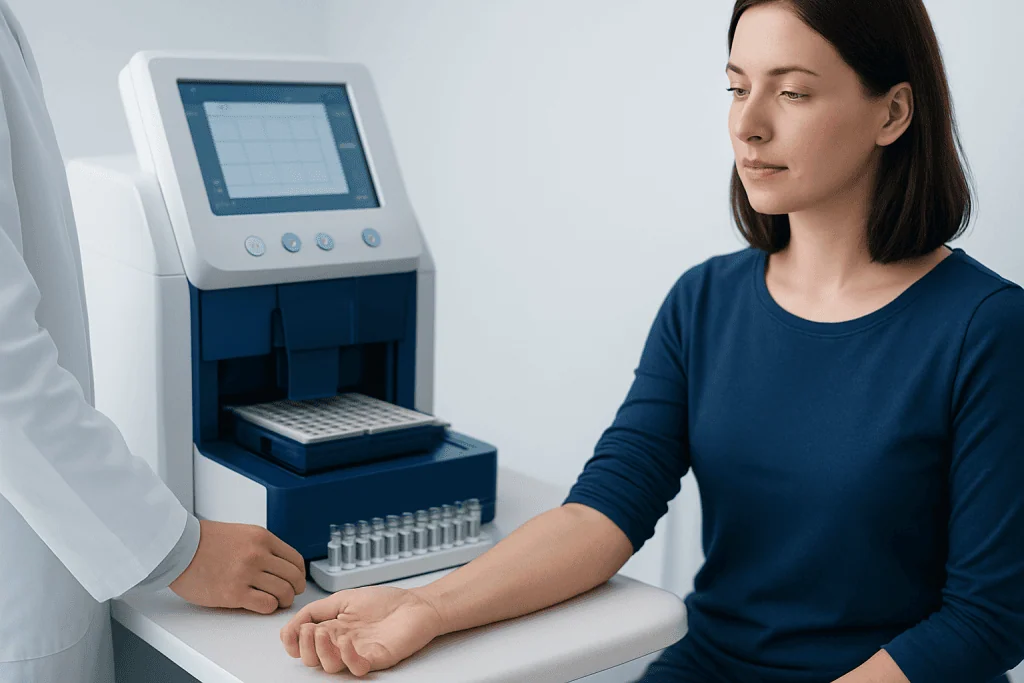
Allergy testing may be recommended when symptoms suggest an allergic pattern. These symptoms can involve the nose, eyes, lungs, skin, digestive system, or the whole body. Examples include repeated sneezing, runny or blocked nose, itchy or watery eyes, coughing or wheezing, eczema flares, hives, swelling, or symptoms that occur soon after eating a particular food.
Testing is especially useful when symptoms are moderate, frequent, difficult to control, or clearly linked to a possible exposure. For example, a person with springtime sneezing and eye itching may be tested for tree or grass pollens. Someone who develops hives and throat tightness soon after eating a specific food needs careful medical evaluation, and allergy testing may be part of that assessment.
Doctors may also consider testing for people with asthma that worsens around pets, dust, mold, or seasonal pollens. Identifying allergic triggers can help guide avoidance strategies, environmental control, and treatment decisions. In selected cases, it may also help determine whether allergen immunotherapy, often called allergy shots or tablets for certain allergens, is appropriate.
Allergy testing is not usually recommended as a broad screening tool in people without symptoms. Testing large panels without a clear clinical question can produce positive results that are not clinically meaningful. This may lead to unnecessary worry or avoidance of foods and environments that are not actually causing illness.
Skin Prick Testing: What to Expect

A skin prick test is commonly performed in an allergy clinic. Small drops of allergen extracts are placed on the skin, usually on the forearm or upper back. A tiny sterile lancet is then used to gently prick the skin surface through each drop. The test is usually only mildly uncomfortable and does not involve an injection into a vein.
The skin is observed for a reaction, usually over a short period in the clinic. If the person is sensitized to an allergen, a small raised bump called a wheal may appear, often surrounded by redness. The size of the wheal is measured and compared with control substances. A positive control confirms the skin can react, while a negative control helps detect irritation or false reactions.
Skin prick testing is often used for suspected allergic rhinitis, allergic asthma, some food allergies, and insect venom allergy evaluation. It can provide rapid results during the same visit. However, the test should be performed by trained healthcare professionals who can select appropriate allergens, recognize false positives or false negatives, and manage rare but possible systemic reactions.
Certain situations can make skin testing unsuitable or less reliable. Antihistamines and some other medicines may reduce skin reactions, so patients may be asked to stop them before testing if it is safe to do so. Skin conditions such as severe eczema on the test area, dermatographism, pregnancy considerations, or a history of severe reactions may influence whether skin testing or blood testing is preferred. Medication changes should only be made with medical guidance.
Allergy Blood Tests: How They Work
An allergy blood test measures the amount of allergen-specific IgE antibodies in a blood sample. The sample is analyzed in a laboratory for selected allergens, such as pollen, dust mites, animal dander, foods, molds, or insect venom. The result is usually reported as a level or class, depending on the laboratory method used.
Blood testing may be recommended when skin prick testing is not practical or safe. This can include people who cannot stop antihistamines, those with widespread skin disease, people with a higher risk of severe reactions, or patients who live far from an allergy clinic. Blood tests are also useful in some complex food allergy evaluations, especially when combined with a detailed history.
One advantage of blood testing is that it is not affected by antihistamines in the same way skin testing is. It also avoids placing allergens directly on the skin. However, results are not immediate, and a positive blood test still does not prove that symptoms will occur during real-life exposure. It shows that IgE antibodies are present, not necessarily that a clinically important allergy exists.
Some blood tests include more detailed testing called component-resolved diagnostics. This looks at IgE antibodies to specific allergen proteins rather than whole allergen extracts. In selected cases, it can help an allergy specialist estimate whether a reaction is more likely to be mild or potentially more significant, particularly for certain foods or insect venom. These results still require expert interpretation.
What Allergy Test Results Mean
Understanding allergy test results can be confusing because positive and negative results do not always give a simple yes-or-no answer. A positive skin prick or blood test usually means the immune system has produced IgE antibodies to that allergen. This is called sensitization. Sensitization may or may not cause symptoms when the person is exposed.
For example, a person may have a positive test to cat dander but live with cats without sneezing, wheezing, or eye symptoms. In that case, the test may not represent a clinically important allergy. On the other hand, a person with repeated hives and swelling after eating a specific food, plus a positive test to that food, is more likely to have a true IgE-mediated food allergy.
A negative result makes an immediate IgE-mediated allergy less likely, but it does not rule out every type of reaction. Some symptoms may be caused by non-IgE food reactions, intolerances, irritant effects, infections, chronic skin conditions, medication side effects, or other medical problems. This is why the timing, pattern, and reproducibility of symptoms are so important.
Doctors may use several pieces of information together: the patient’s history, physical examination, skin or blood test results, response to avoidance, and sometimes supervised challenge testing. An oral food challenge, performed under medical supervision, is considered an important tool in selected food allergy cases. It should never be attempted at home when there is a risk of a significant reaction.
Treatment and Management After Testing
Allergy testing is not the final step; it is a tool that helps guide a management plan. If a clinically relevant allergy is confirmed, the doctor may recommend practical avoidance measures, symptom-relief medicines, emergency planning for severe allergies, or allergen immunotherapy for selected triggers. The goal is to reduce symptoms while preserving normal daily life as much as possible.
For environmental allergies, management may include reducing exposure to dust mites, pollen, molds, or animal dander where possible. Medicines such as antihistamines, nasal corticosteroid sprays, eye drops, or inhalers for asthma may be recommended depending on symptoms. For some patients with allergic rhinitis or allergic asthma related to specific allergens, immunotherapy may help reduce sensitivity over time.
For food allergies, the approach depends on the food, the severity of past reactions, test results, age, and overall health. Patients may be advised to avoid the confirmed trigger, learn label-reading skills, and have a written action plan. Those at risk of anaphylaxis may be prescribed emergency medication such as an epinephrine auto-injector and taught when and how to use it.
It is important not to remove major foods from a child’s or adult’s diet based only on a test result without medical advice. Unnecessary dietary restriction can affect nutrition, quality of life, and anxiety around eating. A qualified allergy specialist or dietitian can help ensure that any avoidance plan is safe, balanced, and truly needed.
Preparing for an Allergy Appointment
Good preparation helps make allergy testing more accurate and useful. Patients should bring a clear description of symptoms, including when they began, how often they occur, how long they last, and what seems to trigger or relieve them. Photos of rashes or swelling can be helpful if symptoms are not present during the appointment.
A symptom diary may be useful, especially for suspected food allergy, chronic hives, or seasonal symptoms. It can include foods eaten, medicines taken, activities, environmental exposures, and timing of symptoms. For respiratory symptoms, noting whether symptoms occur indoors, outdoors, at work, during exercise, or around animals can help identify patterns.
Patients should also bring a list of all medicines, supplements, and previous allergy treatments. Some medicines can interfere with skin testing, particularly antihistamines, but they should not be stopped without instructions from a healthcare professional. People with asthma should tell the doctor if their breathing symptoms are not well controlled, because this may affect the timing or type of testing.
Before testing, patients can ask what allergens will be tested, how results will be explained, whether blood testing is needed, and what the next steps might be. Understanding the purpose of testing reduces uncertainty and helps patients participate in shared decision-making.
Prevention, Self-Care, and When to See a Doctor
Not all allergies can be prevented, but symptoms can often be reduced with sensible self-care. For pollen allergies, checking pollen forecasts, keeping windows closed during high-pollen periods, showering after outdoor exposure, and using recommended medicines may help. For dust mite allergy, regular cleaning, reducing indoor humidity where appropriate, and using allergen-resistant bedding covers may be recommended as part of a broader plan.
People should seek medical advice if allergy-like symptoms are persistent, worsening, affecting sleep or school/work performance, or not responding to usual over-the-counter measures. A doctor should also evaluate wheezing, shortness of breath, recurrent sinus or ear problems, frequent hives, eczema that is difficult to control, or suspected reactions to foods, medicines, or insect stings.
Urgent medical care is needed for symptoms of a severe allergic reaction, such as difficulty breathing, throat tightness, faintness, confusion, widespread hives with swelling, or repeated vomiting after a likely allergen exposure. People who have been prescribed emergency medication should follow their action plan and seek emergency care after using it.
For international patients who need coordinated evaluation, Acibadem International’s multidisciplinary specialists and JCI-accredited hospitals diagnose and treat allergic conditions as part of individualized care. Patients should consult a qualified doctor or allergy specialist to determine which tests are appropriate and how the results apply to their specific symptoms.
Frequently asked questions
Is a skin prick test painful?
A skin prick test is usually only mildly uncomfortable. The skin is gently pricked with a small lancet, and most people describe it as a quick scratch rather than a painful procedure. If a reaction occurs, the area may itch for a short time.
Which is better: a skin prick test or an allergy blood test?
Neither test is best for every situation. Skin prick testing gives quick results and is often useful for environmental and some food allergies, while blood testing may be preferred if skin testing is not suitable. The doctor chooses the test based on symptoms, medicines, skin condition, risk level, and the suspected allergen.
Does a positive allergy test always mean someone is allergic?
No. A positive test can mean the immune system is sensitized to an allergen, but sensitization does not always cause symptoms. A true allergy is diagnosed by connecting the test result with a clear and consistent history of reactions.
Can allergy testing diagnose food intolerance?
Standard allergy skin prick and IgE blood tests are designed to assess IgE-mediated allergy, not most food intolerances. Lactose intolerance, some digestive reactions, and non-allergic sensitivities may need different evaluation. A doctor can help distinguish allergy from intolerance based on the symptom pattern.
Do patients need to stop antihistamines before allergy testing?
Antihistamines can interfere with skin prick testing by reducing skin reactions. Patients may be asked to stop them for a period before the test, but this should only be done with medical guidance. Allergy blood tests are generally not affected by antihistamines in the same way.
Can children have allergy testing?
Yes, children can have allergy testing when there is a clear medical reason. The choice of skin or blood testing depends on the child’s symptoms, age, medical history, and ability to cooperate. Results should be interpreted carefully to avoid unnecessary food avoidance or anxiety.
What happens if allergy test results are unclear?
If results do not match the symptoms, the doctor may review the history again, adjust the list of suspected triggers, repeat testing later, or consider other diagnoses. In selected food allergy cases, a supervised oral food challenge may be recommended. This should only be done in a medical setting with trained staff.
References
- World Allergy Organization
- American Academy of Allergy, Asthma & Immunology
- European Academy of Allergy and Clinical Immunology
- National Institute of Allergy and Infectious Diseases
- Mayo Clinic
This article is for general information only and is not a substitute for professional medical advice. Please consult a qualified doctor about your individual situation.
Explore treatments in Turkey — costs, top hospitals & a free quote
JCI-accredited · board-certified surgeons · reply within 24h
Add us as a Preferred Source to see more of our trusted health content across Google Search, AI Overviews and Discover.