Basilar Artery: An Evidence-Based Guide for Patients

The basilar artery forms from the two vertebral arteries and supplies vital brain structures. Blockage of the basilar artery can cause a posterior circulation stroke, which is a medical emergency.
Key Takeaways
- The basilar artery forms from the two vertebral arteries and supplies vital brain structures.
- Blockage of the basilar artery can cause a posterior circulation stroke, which is a medical emergency.
- Symptoms may include dizziness, double vision, trouble speaking, weakness, imbalance, or sudden loss of consciousness.
- Doctors diagnose basilar artery problems with neurological examination and brain and blood vessel imaging.
- Treatment depends on the cause and may include emergency stroke care, medicines, and risk-factor management.
- Fast medical attention is important because early treatment can improve outcomes.
The basilar artery is a major blood vessel at the base of the brain that delivers oxygen-rich blood to the brainstem, cerebellum, and parts of the back of the brain. When it becomes narrowed, blocked, or rarely enlarged, it can lead to serious neurological symptoms and may require urgent medical evaluation.
Overview: what the basilar artery is and why it matters
The basilar artery is one of the brain’s most important blood vessels. It is formed when the two vertebral arteries join at the base of the skull, then travels along the front of the brainstem before dividing into arteries that help supply the back part of the brain. In simple terms, it is a central route that carries oxygen and nutrients to areas that control breathing, balance, swallowing, eye movements, coordination, and consciousness.
This artery is especially important because it supports the brainstem and cerebellum, two structures that help the body perform essential functions automatically. If blood flow in the basilar artery is reduced or blocked, the effects can be serious because these areas do not tolerate oxygen loss well. For that reason, symptoms related to the basilar artery should never be ignored.
Patients often encounter the term when reading about stroke, dizziness, or brain imaging reports. The basilar artery itself is a normal part of anatomy, but doctors pay close attention to it because certain conditions can affect it, including narrowing from atherosclerosis, a blood clot, dissection, or less commonly an aneurysm. Understanding what the artery does can help patients better understand why prompt evaluation is sometimes needed.
What parts of the brain does the basilar artery supply?
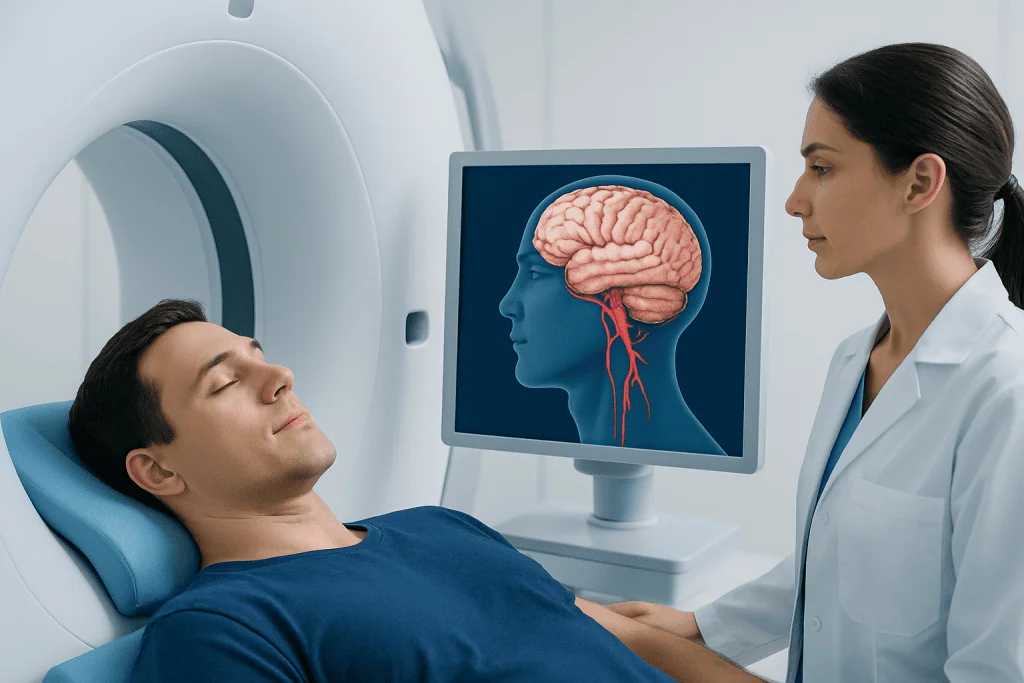
The basilar artery is part of the posterior circulation, the network of vessels that supplies the back and lower portions of the brain. Along its course, it gives off branches that supply the pons and other parts of the brainstem, the cerebellum, and nearby structures. Near its top, it divides into the posterior cerebral arteries, which help supply the occipital lobes, where vision is processed, as well as parts of the thalamus and temporal lobes.
Because of this broad reach, basilar artery problems can produce a wide range of symptoms. A person may not have the classic one-sided facial droop or arm weakness often associated with other strokes. Instead, the first signs may involve balance, vision, speech, swallowing, alertness, or coordination.
This is one reason posterior circulation strokes may be harder to recognize than strokes in other parts of the brain. The symptoms can seem vague at first, especially if they begin with vertigo, nausea, or unsteadiness. Even so, these symptoms can reflect reduced blood flow to critical brain tissue and deserve careful medical assessment.
Common basilar artery problems

The best-known basilar artery emergency is basilar artery occlusion, which means the artery is blocked by a clot or severe narrowing. This can interrupt blood flow to the brainstem and surrounding areas, causing a type of stroke known as a posterior circulation stroke. Because the brainstem controls many life-sustaining functions, this condition is treated as an emergency.
Another problem is atherosclerotic disease, in which fatty deposits and inflammation narrow the artery over time. This may reduce blood flow or create a surface where clots are more likely to form. Some patients may have repeated brief episodes of symptoms, while others develop a sudden major stroke.
Less commonly, the artery can be affected by dissection, a tear in the vessel wall, or by an aneurysm, a ballooning weakness in the artery wall. These conditions can cause headache, neurological symptoms, or in some cases bleeding. Doctors may also describe the artery as tortuous or ectatic on imaging, meaning it is widened or more elongated than usual; the importance of that finding depends on symptoms, overall anatomy, and whether nearby structures are affected.
Not every imaging variation is dangerous, but any abnormality must be interpreted in clinical context. That is why patients should review scans and reports with a qualified neurologist, neuroradiologist, or vascular specialist rather than trying to interpret anatomy terms alone.
Symptoms that may point to a basilar artery problem
Symptoms depend on how much blood flow is reduced and which brain regions are involved. Warning signs can begin suddenly or evolve over minutes to hours. They may include dizziness, vertigo, trouble walking, loss of balance, double vision, slurred speech, numbness, weakness, or difficulty swallowing.
Some people develop less familiar stroke symptoms such as sudden confusion, clumsiness, abnormal eye movements, hearing changes, or drop attacks, meaning abrupt falls without a clear explanation. In more severe cases, a basilar artery blockage can lead to profound drowsiness, loss of consciousness, or a locked-in syndrome, in which a person is awake but unable to move most of the body.
A symptom list may include:
- Sudden dizziness or severe imbalance
- Double vision or sudden vision loss
- Slurred speech or trouble understanding speech
- Weakness or numbness in the face, arm, or leg
- Trouble swallowing
- Sudden severe unsteadiness or incoordination
- Fainting, collapse, or reduced alertness
These symptoms do not always mean the basilar artery is involved, but they do require prompt attention. Time matters in stroke care, and early evaluation can help determine whether emergency treatment is possible.
Causes and risk factors
Basilar artery disease is most often linked to the same vascular risk factors that affect other arteries in the body. These include high blood pressure, diabetes, high cholesterol, smoking, obesity, and physical inactivity. Atrial fibrillation and other heart rhythm problems can also raise stroke risk because clots may form in the heart and travel to the brain.
Age is an important risk factor, but younger adults can also be affected, particularly in cases of arterial dissection or inherited clotting disorders. A recent neck injury, sudden neck movement, or connective tissue disorder may contribute to a vertebral artery dissection, which can affect blood flow into the basilar artery. Less commonly, inflammatory blood vessel disorders or unusual clotting conditions may play a role.
Doctors often look at both immediate and long-term causes. An emergency evaluation focuses on whether a clot, severe narrowing, or bleeding is present. Longer-term prevention then addresses the underlying reason the event happened, such as atherosclerosis, uncontrolled hypertension, or a heart-related source of embolism.
For many patients, risk reduction is a major part of treatment. Managing blood pressure, blood sugar, and cholesterol, stopping smoking, and taking prescribed medicines as directed can significantly lower the chance of future vascular events.
How doctors diagnose basilar artery conditions
Diagnosis starts with the history and neurological examination. Doctors ask when symptoms began, whether they came on suddenly, and whether there are stroke risk factors or recent injuries. Because symptoms of posterior circulation disease may be subtle, careful examination of eye movements, balance, speech, coordination, and strength is especially important.
Imaging is central to diagnosis. A non-contrast CT scan may be used first to look for bleeding, while CT angiography or MR angiography can show the basilar artery and detect narrowing, blockage, dissection, or aneurysm. MRI of the brain is often very helpful for identifying early ischemic injury in the brainstem, cerebellum, or occipital lobes. In selected cases, catheter angiography may be needed for more detailed evaluation and treatment planning.
Doctors may also order heart monitoring, echocardiography, and blood tests to look for underlying causes of stroke or clotting. If symptoms suggest a complex cerebrovascular problem, patients may be assessed by specialists in neurology or urgent stroke teams. The goal is not just to confirm that the basilar artery is involved, but to identify the exact mechanism so treatment can be tailored safely.
Treatment options and recovery
Treatment depends on the underlying problem and how quickly the patient reaches medical care. If a basilar artery blockage is causing an acute stroke, emergency treatment may include clot-dissolving medicine for eligible patients and, in selected cases, endovascular therapy to remove the clot. This highly specialized care may involve interventional neuroradiology techniques to restore blood flow.
When the problem is narrowing from atherosclerosis, treatment may include antiplatelet medicines, cholesterol-lowering therapy, careful blood pressure control, diabetes management, and lifestyle changes. If a dissection is present, treatment often focuses on preventing further clot formation while the vessel heals, with the exact approach based on imaging findings and the patient’s overall situation. Aneurysms may need monitoring or targeted treatment depending on their size, location, and symptoms.
Recovery after a basilar artery stroke varies widely. Some patients recover well, while others need rehabilitation for speech, swallowing, movement, vision, or balance problems. Programs in stroke rehabilitation may include physical therapy, occupational therapy, speech therapy, and support for daily activities.
Comprehensive care usually involves more than one specialist. Near the end of the care pathway, some patients may benefit from coordinated assessment by neurology, neuroradiology, rehabilitation, and vascular teams. Acibadem International’s multidisciplinary specialists and JCI-accredited hospitals diagnose and treat conditions affecting the basilar artery for international patients when advanced evaluation or stroke care is needed.
Prevention, self-care, and when to seek medical care
Prevention focuses on protecting blood vessels throughout the body. Patients can lower risk by not smoking, staying physically active, eating a heart-healthy diet, maintaining a healthy weight, limiting excess alcohol, and keeping blood pressure, cholesterol, and diabetes under good control. Taking prescribed medicines consistently is an important part of prevention after any stroke or transient ischemic attack.
Self-care also includes recognizing warning signs early. People who have had prior stroke-like symptoms, known artery disease, or heart rhythm problems should discuss a prevention plan with their doctor. Follow-up appointments and repeat imaging may be needed in some cases to monitor recovery or progression.
Medical care should be sought immediately for sudden dizziness with imbalance, double vision, slurred speech, weakness, numbness, trouble swallowing, collapse, severe confusion, or reduced consciousness. These symptoms may signal a posterior circulation stroke and should be treated as an emergency. Calling emergency services is safer than trying to drive.
Even if symptoms improve quickly, urgent evaluation is still important because a transient event can be a warning sign of a more serious stroke to come. If non-emergency questions remain about cerebrovascular risk or possible underlying artery disease, consultation in neurosurgery or vascular neurology pathways may sometimes be part of the broader assessment, depending on the imaging findings.
Frequently asked questions
What does the basilar artery do?
The basilar artery carries oxygen-rich blood to the brainstem, cerebellum, and parts of the back of the brain. These areas help control balance, coordination, eye movements, swallowing, breathing, and consciousness.
Is a basilar artery blockage a stroke?
Yes, a blockage in the basilar artery can cause a type of stroke called a posterior circulation stroke. It is a medical emergency because it can affect vital brain functions very quickly.
What are the warning signs of a basilar artery problem?
Common warning signs include sudden dizziness, difficulty walking, double vision, slurred speech, weakness, numbness, trouble swallowing, or sudden confusion. Severe cases can cause collapse, loss of consciousness, or major difficulty moving the body.
Can dizziness alone mean the basilar artery is affected?
Dizziness has many causes and is often not related to the basilar artery. However, sudden dizziness that comes with imbalance, double vision, neurological symptoms, or trouble speaking should be evaluated urgently.
How is basilar artery disease diagnosed?
Doctors use a neurological examination together with brain and blood vessel imaging such as CT, CT angiography, MRI, or MR angiography. Additional tests may look for heart rhythm problems, cholesterol disorders, diabetes, or clotting conditions.
Can a person recover after a basilar artery stroke?
Recovery is possible, but it depends on how quickly treatment begins, how much brain tissue was affected, and the person’s overall health. Rehabilitation can help improve movement, speech, balance, swallowing, and independence.
This article is for general information only and is not a substitute for professional medical advice. Please consult a qualified doctor about your individual situation.
Explore treatments in Turkey — costs, top hospitals & a free quote
JCI-accredited · board-certified surgeons · reply within 24h
Add us as a Preferred Source to see more of our trusted health content across Google Search, AI Overviews and Discover.

More from the Health Library

Eye infection eye: A Complete Medical Guide for Patients

Abdominal Aortic Aneurysm — Explained by Medical Evidence, Not Myths

Mirena IUD: What Patients Need to Know

Bruise from a scratch: Symptoms, Causes, and Treatment — Complete Patient Guide

Prebiotic Fiber: What Patients Need to Know