Best Hair Transplant in Turkey Price: What Patients Really Pay

Hair transplantation moves healthy follicles from a donor area to areas of lasting thinning or hair loss. A safe treatment plan begins with diagnosing the cause of hair loss and confirming realistic expectations.
Key Takeaways
- Hair transplantation moves healthy follicles from a donor area to areas of lasting thinning or hair loss.
- A safe treatment plan begins with diagnosing the cause of hair loss and confirming realistic expectations.
- Price estimates should be individualized and clearly explain what clinical services, medications, aftercare, and follow-up are included.
- FUE and FUT are established techniques, but their suitability depends on donor supply, hair characteristics, and the treatment goal.
- Newly transplanted hairs commonly shed before regrowth becomes visible; final results develop gradually over many months.
The best hair transplant in Turkey price cannot be safely judged from a headline figure alone. A meaningful comparison considers the surgeon’s assessment, the method used, the number and quality of grafts needed, clinical standards, anesthesia, medicines, and follow-up care.
Best Hair Transplant in Turkey Price: What Determines Value
The best hair transplant in Turkey price is not a single standard amount because each person’s hair loss pattern, donor hair supply, goals, and medical needs differ. Rather than choosing care based only on a low advertised figure, patients can ask for an individualized written plan that explains the recommended technique, expected graft range, who will perform each stage, anesthesia arrangements, medicines, laboratory testing if needed, and postoperative follow-up.
A hair transplant is a medical procedure, not simply a cosmetic service. The quality of assessment and surgical planning can influence safety, donor-area preservation, hairline design, and how natural the result appears over time. Travel-related expenses, accommodation, transfers, translation support, and the length of stay may also be separate from the clinical treatment plan, so these should be clarified in advance.
For many people, the most useful question is not which option appears cheapest, but whether the clinic can explain why a particular approach is appropriate. A transparent consultation should also discuss limits: transplantation redistributes existing follicles and does not stop ongoing hair loss in untreated areas.
How Hair Transplantation Works
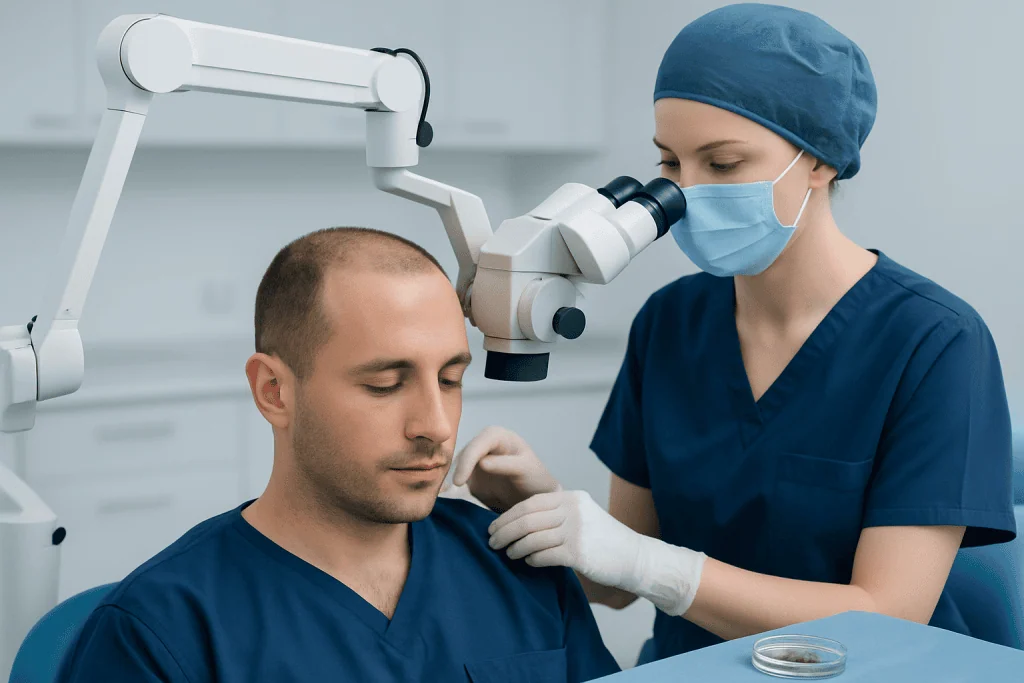
Hair transplantation involves taking follicular units, which are naturally occurring groups of one or more hairs, from a donor area and placing them into areas of thinning or baldness. The back and sides of the scalp are common donor sites because follicles in these areas may be more resistant to the hormonal effects linked with pattern hair loss. The transplanted follicles retain many of their donor-area characteristics after they are moved.
Follicular unit extraction (FUE) removes individual follicular units using a small punch instrument. Follicular unit transplantation (FUT), sometimes called strip surgery, removes a narrow strip of donor scalp that is then carefully divided into follicular units. Both methods can be appropriate in selected patients; the best choice depends on the size of the treatment area, donor density, hair texture, preferred hairstyle, prior procedures, and the clinician’s assessment.
During a hair transplant procedure, clinicians plan graft placement to follow the natural direction, angle, and density pattern of surrounding hair. The goal is generally an age-appropriate, sustainable design that preserves donor follicles for possible future needs rather than attempting to create an unrealistically dense appearance in one session.
Who May Be a Candidate

Suitable candidates usually have a stable enough donor area, a clearly evaluated cause of hair loss, and expectations that can be met with the available donor hair. Hair transplantation is most often considered for androgenetic alopecia, also called male- or female-pattern hair loss. It may also be considered in certain cases of traction-related loss, scars, or hair loss after injury, although these situations need individual specialist evaluation.
The first step is to determine why hair loss is occurring. Sudden shedding, patchy loss, scalp inflammation, breakage, nutritional concerns, thyroid disorders, medication effects, or autoimmune conditions may require medical treatment rather than, or before, surgery. A clinician may examine the scalp and hair shafts, review medical history and medicines, and recommend targeted tests when the findings suggest an underlying issue.
People with unstable hair loss, insufficient donor density, uncontrolled medical conditions, active scalp infection, or a tendency toward problematic scarring may need treatment, monitoring, or a different approach first. Those concerned about gradual patterned thinning may benefit from learning about androgenetic alopecia and discussing both medical and surgical options with a qualified doctor.
- Age alone does not determine eligibility, but long-term hair loss patterns matter.
- Smoking, some medicines, and certain health conditions can affect healing and should be disclosed.
- Previous transplants must be assessed carefully because donor hair is limited.
- People should understand that further hair loss can occur outside the transplanted area.
What Happens Before, During, and After the Procedure
Before treatment, the clinical team documents the hair loss pattern, assesses the donor area, discusses desired coverage, and plans a conservative hairline where relevant. Patients should provide a complete health history, including allergies, bleeding disorders, medications and supplements, past scalp procedures, and tobacco or nicotine use. The clinician may advise temporary changes to certain medicines or supplements, but patients should never stop prescribed medication without advice from the doctor managing it.
On the day of the procedure, the scalp is prepared and local anesthetic is typically used. In FUE, follicular units are extracted one at a time; in FUT, a donor strip is removed and the area is closed. The team then creates tiny recipient sites and places grafts according to the surgical plan. Procedure duration varies with the technique and number of grafts, and some people require more than one session to meet safely planned coverage goals.
Afterward, the patient receives instructions for scalp cleansing, sleeping position, activity restrictions, and use of prescribed medicines. Clear communication is particularly important for people traveling internationally: they should know how to contact the clinical team, what follow-up is planned, when they may travel, and how care will be coordinated after returning home.
Recovery Timeline and Expected Results
In the first days after transplantation, mild swelling, tenderness, tightness, redness, or crusting can occur. The recipient and donor areas should be handled gently, and patients should follow the team’s specific washing and activity instructions. Scratching, picking crusts, intense exercise, swimming, direct sun exposure, and pressure on the treated scalp may need to be avoided for a period recommended by the clinician.
It is common for transplanted hair shafts to shed within the first several weeks. This does not necessarily mean the follicles have been lost; the follicles typically enter a resting phase before new growth begins. Early growth may be fine and uneven, while visible improvement generally develops gradually over subsequent months. Maturation of hair texture and overall appearance can continue for many months.
Recovery varies according to the procedure, scalp healing, hair characteristics, and individual health. Existing hair may continue to thin over time, so clinicians may discuss evidence-based medical approaches for appropriate candidates. Any medication should be selected after a personal review of benefits, risks, contraindications, and reproductive considerations where relevant.
Benefits, Limitations, and Possible Risks
A successful transplant can provide growing hair in an area of permanent thinning and may improve coverage in a way that blends with existing hair. Because the follicles are the person’s own, there is no risk of rejection in the way that occurs with organ transplantation. However, results cannot be guaranteed, and visual density is limited by the amount and quality of available donor hair.
Potential complications include bleeding, infection, swelling, pain, delayed healing, numbness or altered sensation, inflammation of follicles, temporary shedding of existing hair, and visible scarring. Inadequate graft survival, an unnatural hairline, uneven density, or donor-area overharvesting can also occur, particularly when planning or surgical technique is poor. Prompt assessment can help if unusual symptoms develop.
Patients can reduce avoidable risk by choosing a properly qualified medical team, making sure a doctor evaluates them in person or through an appropriate clinical consultation, and obtaining clear information about who performs extraction, recipient-site creation, and graft placement. They should avoid clinics that promise guaranteed density, a fixed graft number without an assessment, or treatment without discussing medical history and future hair loss.
When to Seek Medical Care
People should arrange a medical assessment for sudden, rapid, patchy, painful, itchy, or inflamed hair loss, or when hair loss is accompanied by fatigue, weight changes, menstrual changes, skin rash, or other new symptoms. These features may point to an underlying condition that should be diagnosed before considering transplantation. Early assessment can also help preserve hair in some forms of loss.
After a transplant, patients should contact the treating team promptly for increasing pain, spreading redness, warmth, pus-like drainage, fever, persistent bleeding, marked swelling, or any concern about wound healing. Urgent medical care is appropriate for symptoms of a severe allergic reaction, such as trouble breathing or swelling of the face or throat.
For international patients, Acibadem International’s multidisciplinary specialists and JCI-accredited hospitals can assess hair loss and provide individualized hair transplantation care, with treatment decisions based on clinical suitability and long-term planning.
Frequently asked questions
How can patients compare the best hair transplant in Turkey price safely?
Patients should compare written, individualized treatment plans rather than headline prices. The plan should state the proposed technique, estimated graft needs, clinical team roles, anesthesia, medicines, aftercare, follow-up, and any services that are not included. A consultation should also explain why the procedure is suitable and what results are realistically achievable.
Is FUE always better than FUT?
No. FUE and FUT are both established methods of harvesting donor follicles, and each has potential advantages and trade-offs. The appropriate option depends on donor characteristics, the treatment area, hair length preferences, scarring considerations, prior procedures, and the clinician’s assessment.
How long does it take to see results after a hair transplant?
Transplanted shafts often shed in the first weeks, which is an expected part of the growth cycle. New hair usually begins to emerge gradually over the following months, with further thickening and maturation continuing over many months. The timeline differs from person to person.
Can a hair transplant stop future hair loss?
A transplant redistributes follicles to a thinning area but does not stop hormonal or other causes of hair loss from affecting non-transplanted hair. A doctor may discuss medical management and long-term follow-up to help protect existing hair where appropriate. Future treatment needs should be considered during initial planning.
Does everyone with thinning hair qualify for a transplant?
Not everyone is an ideal candidate. A person needs adequate donor hair, a diagnosed cause of loss, and a scalp condition that is appropriate for surgery. Active inflammatory scalp disease, rapidly progressing loss, or certain medical issues may need treatment or further evaluation first.
What should patients ask at a hair transplant consultation?
Patients can ask what is causing their hair loss, which technique is recommended and why, who performs each surgical step, and what donor-area limitations apply. They should also ask about expected recovery, possible complications, follow-up arrangements, and how the plan accounts for future hair loss. Clear answers support informed decision-making.
References
- American Academy of Dermatology
- International Society of Hair Restoration Surgery
- National Health Service
- Mayo Clinic
This article is for general information only and is not a substitute for professional medical advice. Please consult a qualified doctor about your individual situation.
Hair transplant in Turkey — costs, graft counts & a free assessment
JCI-accredited · board-certified surgeons · reply within 24h
Add us as a Preferred Source to see more of our trusted health content across Google Search, AI Overviews and Discover.