Breast Self Exam Procedure: An Evidence-Based Patient Guide

Breast awareness means knowing what is normal for the breasts and reporting a persistent or new change to a clinician. A breast self exam procedure can be done in front of a mirror, while lying down, or in the shower using the pads of the fingers.
Key Takeaways
- Breast awareness means knowing what is normal for the breasts and reporting a persistent or new change to a clinician.
- A breast self exam procedure can be done in front of a mirror, while lying down, or in the shower using the pads of the fingers.
- A self-exam cannot diagnose breast cancer and does not replace recommended mammograms or other screening.
- Most breast changes are not cancer, but a new lump, skin change, nipple change, or bloody discharge needs medical assessment.
- There is no single “perfect” technique; consistency and knowing when to seek care are more useful than intensive checking.
A breast self exam procedure is a simple way to become familiar with the usual look and feel of the breasts so that a new change can be reported promptly. Current evidence supports breast awareness rather than rigid monthly self-exams, because routine structured exams have not been shown to reduce breast cancer deaths and can lead to unnecessary testing.
Overview: What a Breast Self Exam Procedure Can and Cannot Do
A breast self exam procedure is a personal check of the breasts and underarm areas. Its main purpose is to help a person recognize their usual breast appearance and texture, making it easier to identify a change that deserves medical attention. It may be performed at home, with no equipment, in a few minutes.
Modern breast self exam evidence does not support requiring a formal, monthly examination for everyone. Large studies found that routine, structured self-exams did not lower the risk of dying from breast cancer and increased the number of benign biopsies. Many health organizations therefore emphasize breast awareness: noticing changes during normal activities and seeking assessment when something is new or persistent.
A self-check is not a substitute for a screening plan based on age, medical history, family history, genetic risk, and local guidance. Mammography can detect some cancers before a lump can be felt, while a clinician can decide whether examination, imaging, or other tests are needed for a new symptom.
Who May Use Breast Awareness and When to Check
Anyone with breast tissue can practice breast awareness, including women, men, transgender people, and people who have had breast surgery. The usual feel of breast tissue differs widely. It can be naturally nodular, uneven between sides, tender at certain times, or altered by pregnancy, breastfeeding, menopause, hormone treatment, weight change, or surgery.
People who menstruate may find it easier to learn their usual breast texture several days after a period begins, when cyclical swelling and tenderness often improve. However, there is no medically required date or frequency for checking. A person who chooses a more organized breast self exam procedure can use the same general timing each month.
Those at higher risk of breast cancer, such as people with a strong family history, a known inherited gene variant, previous chest radiation, or a personal history of certain breast conditions, should discuss individualized surveillance with a breast specialist. This may include earlier or additional imaging, but self-examination alone is not adequate surveillance.
What Are the 5 Steps of Breast Self-Exam?
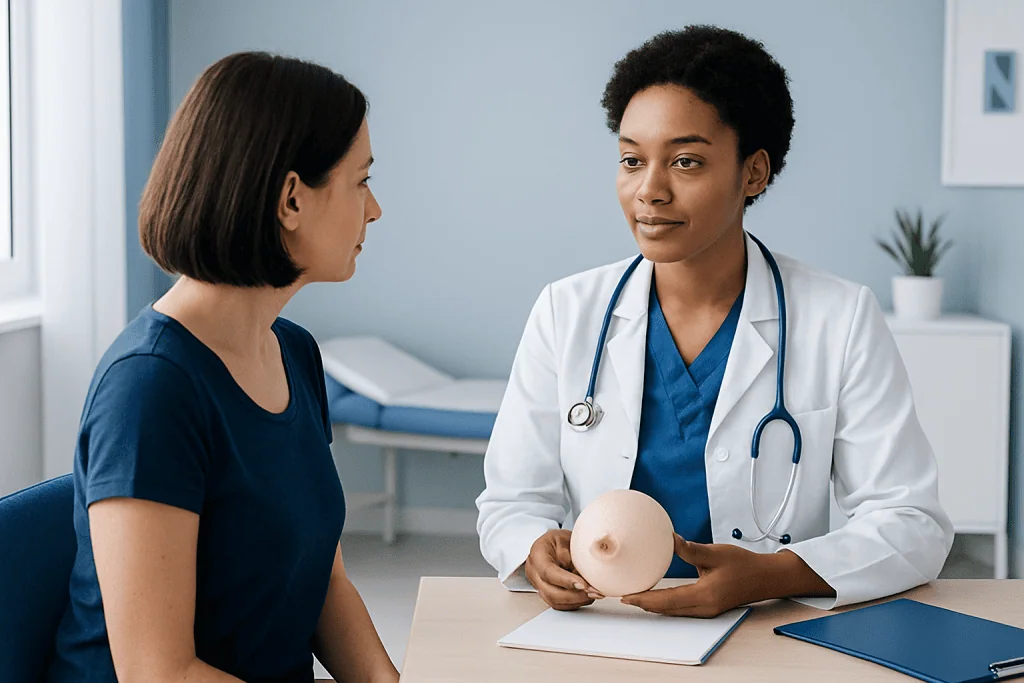
There are several valid teaching methods. The following five-step breast self exam procedure is designed to promote breast awareness rather than to create anxiety about finding every normal variation.
- 1. Look in a mirror: Stand with arms relaxed and compare both breasts for a new difference in size, shape, contour, skin color, swelling, or nipple position.
- 2. Look with the arms raised: Raise both arms overhead and look for dimpling, puckering, pulling of the skin, or a new contour change.
- 3. Check the nipples: Note a new inward turn of a nipple, rash-like scaling, or discharge. Do not repeatedly squeeze the nipples, as this can itself produce discharge or irritation.
- 4. Feel each breast: Use the flat pads of the middle three fingers and small circular movements to cover the full breast area, from the collarbone to the bra line and from the breastbone to the underarm.
- 5. Check the underarm and record changes: Feel the underarm region gently for a new, persistent lump or swelling. If a change is found, note where it is and contact a clinician rather than checking it repeatedly.
The examination may be most comfortable while lying down with a pillow beneath the shoulder on the side being checked. A person can also feel the breasts in the shower, where wet skin may make the fingers glide more easily. The important point is covering the whole area with a consistent pattern, not using force.
How Can I Teach Myself to Perform a Breast Self-Exam?
Start by learning the breasts’ baseline rather than expecting to identify a specific “normal” texture. In a private setting, use a mirror first and then feel each breast in a systematic pattern. Some people move in vertical lines up and down the breast; others use circles from the outer breast toward the nipple. Either approach is reasonable if it covers the same area each time.
Use light pressure to assess tissue just below the skin, medium pressure for the middle tissue, and firmer but comfortable pressure for tissue closer to the chest wall. Avoid pinching or digging into the breast. Many normal breasts contain lumpy or rope-like areas, particularly in the upper outer region near the underarm.
A clinician, breast nurse, or qualified educator can demonstrate an individualized technique and explain which findings require assessment. A breast self exam PDF, breast self exam instructions printable, or breast self examination patient handout can be useful as a reminder, but should come from a reliable health organization and should not replace professional advice. A person with a previous breast operation may need specific guidance about scars, implants, reconstruction, or radiation-related changes.
What Are the 7 P's of Breast Self-Examination?
The “7 P’s” are a teaching mnemonic used in some breast self-examination patient handouts. The exact wording can vary, so it is best viewed as a memory aid rather than a formal medical standard. A commonly used version is: position, perimeter, palpation, pressure, pattern, practice, and prompt reporting.
Position refers to checking in a comfortable posture, such as standing before a mirror and lying down. Perimeter means including the entire breast area, collarbone, breastbone, lower bra line, and underarm. Palpation is feeling with finger pads rather than fingertips, while pressure means using light, medium, and deeper pressure without causing pain.
Pattern encourages a repeatable route across the breast, such as vertical strips or circles. Practice helps a person recognize their own normal tissue over time. Finally, prompt reporting means arranging medical evaluation for a newly noticed or ongoing change, rather than assuming it is harmless or waiting for the next routine screening visit.
Why Are Breast Self-Exams No Longer Recommended?
Breast self-exams are not “banned,” but many health authorities no longer recommend teaching a mandatory, highly structured monthly exam to all people at average risk. The change reflects evidence showing that formal routine self-exams did not reduce breast cancer mortality compared with usual care.
In addition, frequent intensive examinations can identify normal breast variations that feel concerning, leading to extra appointments, imaging, and biopsies for conditions that are ultimately benign. This does not mean that a lump or other change should be ignored. It means the goal has shifted from searching for every possible irregularity to recognizing a meaningful new change and obtaining appropriate care.
Breast awareness, routine screening when recommended, and attention to individual risk are complementary. People should follow the screening guidance provided by their healthcare team, especially if they have increased risk or symptoms. For information about the condition that screening aims to detect, see breast cancer.
Benefits, Limitations, and What Happens After a Change Is Found
The potential benefit of a breast self exam procedure is familiarity. A person may be more likely to notice a new lump, thickening, skin dimpling, nipple change, or underarm swelling if they know their usual breasts. The procedure is free, private, and does not expose a person to radiation.
Its limitations are equally important. Self-exams may miss small or deep abnormalities, cannot determine whether a lump is benign or cancerous, and can lead to worry about normal tissue. Breast pain alone is common and is often not caused by cancer, but persistent, focal, or worsening pain still merits clinical discussion.
If a clinician identifies a concerning change, the next steps may include a clinical breast examination and diagnostic imaging such as mammography, ultrasound, or MRI, depending on age and the finding. If a sample is needed, breast biopsy can help establish a diagnosis. The “recovery” after a self-exam itself is immediate; no special aftercare is required, though it is wise to avoid repeatedly pressing on a tender area once a change has been noticed.
When to Seek Medical Care
Medical care should be arranged promptly for a new breast or underarm lump that persists, a firm area that feels different from surrounding tissue, new skin dimpling or thickening, redness that does not improve, or a change in breast shape. Also seek assessment for a newly inverted nipple, persistent crusting or scaling of the nipple, or spontaneous bloody or clear nipple discharge.
Breast symptoms are common and most do not indicate cancer. Even so, a healthcare professional should evaluate a new change rather than relying on a home check. Urgent assessment is appropriate for a breast that becomes rapidly red, hot, swollen, very painful, or is accompanied by fever, especially during breastfeeding, because infection may need treatment.
People who need a personalized assessment can consult a breast clinic or primary care clinician. Acibadem International’s multidisciplinary specialists and JCI-accredited hospitals support international patients with breast assessment, diagnostic imaging, and treatment planning when needed.
Frequently asked questions
How often should a breast self exam procedure be done?
There is no universally required schedule for formal breast self-exams. Many experts encourage ongoing breast awareness instead, meaning that a person notices new or persistent changes and reports them. Someone who prefers a routine check may choose the same point in their menstrual cycle each month.
Can a breast self-exam find breast cancer?
A breast self-exam may help a person notice a lump or visible breast change, but it cannot diagnose cancer. Some cancers cannot be felt, especially when small or deep in the breast. Recommended screening tests and timely clinical evaluation remain important.
What does a concerning breast lump feel like?
A concerning lump may be new, firm, fixed in place, or different from the surrounding breast tissue, but breast cancer can feel different from person to person. Many benign lumps also feel firm or distinct. Any new lump that remains should be assessed by a healthcare professional.
Is breast pain usually a sign of breast cancer?
Breast pain is common and is often related to hormonal changes, breast tissue sensitivity, medication, injury, or other non-cancerous causes. Cancer is less commonly the cause of pain alone. Persistent pain in one specific area, particularly with another breast change, should be discussed with a clinician.
Should people with breast implants perform breast self-exams?
People with implants can still practice breast awareness and should report new changes in the breast, skin, nipple, or underarm. Implants can change the way breast tissue feels and may require specific imaging approaches. A breast specialist can explain the best surveillance plan for the individual.
Does a normal self-exam mean a mammogram is not needed?
No. A normal self-exam does not replace mammography or other recommended screening. Imaging can detect changes before they can be felt, and the best screening plan depends on age, personal risk factors, and local clinical guidance.
References
- World Health Organization
- American Cancer Society
- U.S. Preventive Services Task Force
- National Cancer Institute
- Mayo Clinic
This article is for general information only and is not a substitute for professional medical advice. Please consult a qualified doctor about your individual situation.
Oncology care in Turkey — second opinion and treatment plan
JCI-accredited · board-certified surgeons · reply within 24h
Add us as a Preferred Source to see more of our trusted health content across Google Search, AI Overviews and Discover.