Calculate Height in Cms — Explained by Medical Evidence, Not Myths

Height in centimeters is calculated by multiplying inches by 2.54. The most accurate home measurement uses a wall, flat floor, and a level object placed on the head.
Key Takeaways
- Height in centimeters is calculated by multiplying inches by 2.54.
- The most accurate home measurement uses a wall, flat floor, and a level object placed on the head.
- Posture, shoes, hair, and time of day can slightly affect measured height.
- Children should have height tracked over time rather than judged from one measurement alone.
- Unexpected height loss or poor growth may need medical assessment.
To calculate height in cms, multiply height in inches by 2.54, or measure directly against a wall using a flat object and a metric tape. Accurate height matters because it supports growth tracking, body mass index calculations, medication planning in some settings, and general health assessment.
Overview: how to calculate height in cms
To calculate height in cms, a person can either convert from inches or measure directly in centimeters. The basic formula is simple: height in inches multiplied by 2.54 equals height in centimeters. For example, 60 inches equals 152.4 cm, and 70 inches equals 177.8 cm.
Direct measurement can be even more useful in daily life. A person stands barefoot with heels against a wall, keeps the head level, places a flat object on top of the head, marks the wall, and measures from the floor to the mark in centimeters. This method helps avoid conversion mistakes.
Although calculating height seems straightforward, accuracy matters more than many people realize. Height is used in growth monitoring, nutrition assessment, body mass index calculations, sports screening, and parts of medical evaluation. A small error may not matter in everyday conversation, but repeated errors can affect health records or create confusion over time.
Why accurate height measurement matters in health
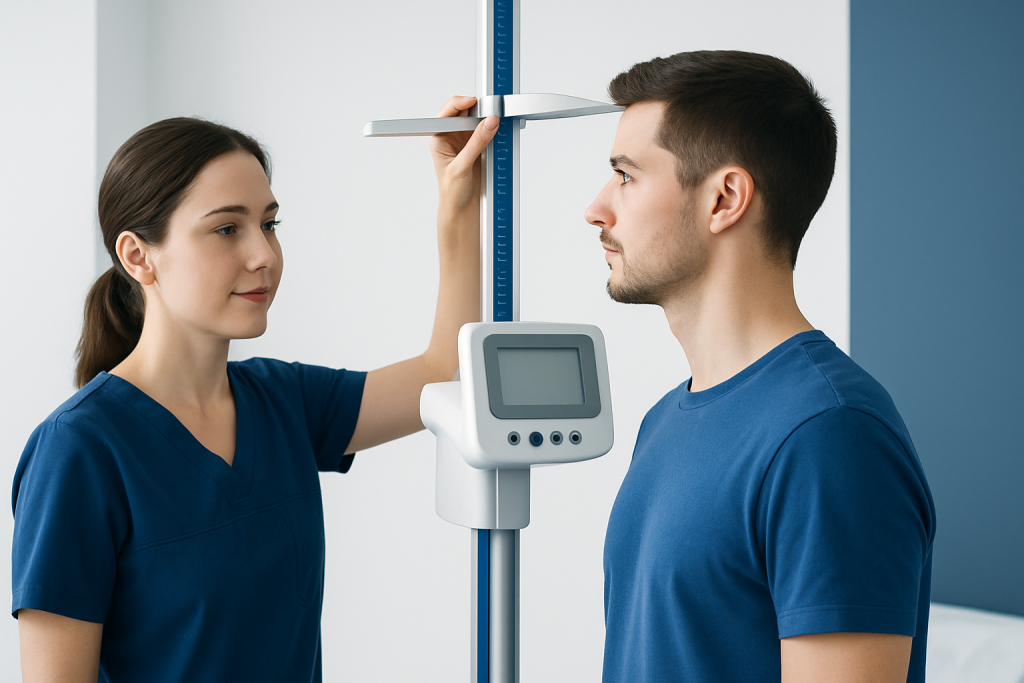
Height is a routine part of health assessment because it provides context for many other measurements. In both children and adults, clinicians often interpret weight, body mass index, and general nutritional status in relation to height. In children especially, tracking height over time can show whether growth is following an expected pattern.
Accurate height also matters when comparing current and previous records. A true change in height is different from a change caused by poor measuring technique. Adults may gradually lose height with age, while children should show continued growth according to age and puberty stage.
Height alone does not diagnose a disease. However, unexpected short stature, slowed growth, or height loss may lead a doctor to consider bone, hormonal, nutritional, or spinal causes. In some cases, doctors may look more closely for related conditions such as scoliosis or endocrine disorders if the broader clinical picture suggests it.
How to measure height correctly at home

The most reliable home method starts with the right setup. The person should remove shoes, bulky hair accessories, hats, and anything that changes head position. They should stand on a hard, flat floor with heels close to the wall, legs straight, shoulders relaxed, and eyes looking forward.
A good position keeps the back of the head, shoulder blades, buttocks, and heels as close to the wall as comfortably possible. A flat object such as a book or set square is placed firmly on the head at a right angle to the wall. The lower edge of that object is then marked, and the distance from the floor to the mark is measured in centimeters.
For the best result, height should be measured more than once and the readings compared. Small differences can happen. It often helps to:
- Measure at the same time of day when tracking changes
- Use a metal or non-stretch measuring tape
- Ask another person to assist
- Stand naturally without stretching or slouching
- Record the result to one decimal place if possible
Clinic tools such as a stadiometer are generally more precise than home methods. If height has an important medical purpose, professional measurement may be preferable.
How to convert feet and inches to centimeters
Many people know height in feet and inches rather than in metric units. To calculate height in cms from this format, the first step is to convert everything to inches. Multiply the number of feet by 12, then add the remaining inches. After that, multiply the total inches by 2.54.
For example, a height of 5 feet 6 inches is calculated as follows: 5 × 12 = 60 inches, then 60 + 6 = 66 inches. Next, 66 × 2.54 = 167.64 cm. A height of 6 feet becomes 72 inches, and 72 × 2.54 = 182.88 cm.
Rounding is common in everyday use, but medical records may keep one decimal place. A person does not need to round aggressively unless a form specifically asks for a whole number. If there is any uncertainty, it is usually better to measure directly in centimeters rather than rely on memory.
Common examples include:
- 5 ft 0 in = 152.4 cm
- 5 ft 4 in = 162.56 cm
- 5 ft 8 in = 172.72 cm
- 6 ft 0 in = 182.88 cm
What can affect measured height
Height is not always identical from one measurement to the next. Small variations can occur because of posture, spinal compression during the day, or simple technique differences. Many people are slightly taller in the morning than in the evening because the discs between the vertebrae compress with daily activity.
Hair styling, thick socks, shoes, uneven flooring, and head tilt can all create misleading results. Trying to stand excessively tall can also distort the measurement. This is why a calm, natural posture is preferred over stretching upward.
Age-related changes deserve special attention. In older adults, gradual height loss may reflect normal aging, but it can also be associated with spinal curvature, weakened bones, or vertebral compression fractures. In other people, back conditions may contribute to posture changes or discomfort; depending on symptoms, a doctor may evaluate whether a herniated disc or another musculoskeletal issue is involved.
In children and teenagers, the main concern is usually not a minor one-time difference but a pattern over time. A child who stops gaining height as expected may need professional review rather than repeated home rechecking alone.
Height, growth, and when medical evaluation is useful
For children, height is most meaningful when plotted over time on standardized growth charts. Doctors do not judge growth from a single number alone. They look at age, sex, family height patterns, puberty timing, weight, nutrition, and overall health. A child may be naturally shorter or taller than peers and still be healthy.
Medical evaluation may be considered if a child is much shorter than expected, grows very slowly, or shows a clear change in growth pattern. Possible causes can include nutritional problems, chronic illness, hormonal conditions, genetic factors, or bone disorders. Assessment may involve history, physical examination, and sometimes blood tests or imaging studies.
Adults may need evaluation if they notice unexplained height loss, back pain, stooped posture, or reduced mobility. In selected cases, physicians may request an MRI scan or an X-ray to look at the spine or bones, depending on the symptoms and examination findings. The goal is not simply to explain a number, but to understand whether there is an underlying health issue.
Common myths about height calculation and growth
One common myth is that height can be estimated accurately from shoe size, arm span, or online formulas alone. These methods may be approximate for some people, but they are not substitutes for direct measurement. Body proportions vary widely across age groups and individuals.
Another misunderstanding is that adults can significantly increase their height through exercises, stretches, or supplements. Improving posture can make someone stand straighter and appear taller, but it does not usually change true bone length after growth plates have closed. Claims of dramatic adult height gains should be viewed cautiously.
Parents also sometimes worry if a child is shorter than classmates. Shorter stature does not automatically mean illness. What matters more is whether growth is steady and whether the child is otherwise healthy. If concerns persist, consultation with a pediatrician is more useful than relying on myths or social media advice.
When height concerns are part of a broader bone or spine assessment, specialists may combine examination with imaging and rehabilitation planning. Depending on the individual case, this can include services such as physical therapy and rehabilitation to support posture, mobility, and function.
When to seek medical care
Medical advice is worth seeking if a child appears to be growing much more slowly than expected, drops across growth percentiles, or has delayed puberty, persistent fatigue, poor appetite, or chronic digestive symptoms. A pediatrician can decide whether monitoring, further testing, or referral is needed.
Adults should consider medical review if they notice unexplained height loss, ongoing back pain, a new stooped posture, or balance problems. These symptoms do not always mean a serious condition, but they should not be ignored, especially if they are getting worse or interfering with daily life.
If there is a known spinal problem, previous fracture, or significant pain, a doctor may recommend more detailed evaluation. Near the end of the care pathway, patients seeking international assessment may wish to know that Acibadem International’s multidisciplinary specialists and JCI-accredited hospitals diagnose and treat related growth, bone, and spine concerns for international patients.
Frequently asked questions
How do you calculate height in cms from inches?
Multiply the height in inches by 2.54. For example, 65 inches equals 165.1 cm. This is the standard conversion used in health and everyday measurement.
How do you convert feet and inches to centimeters?
First convert feet to inches by multiplying the number of feet by 12, then add the extra inches. Multiply the total by 2.54 to get centimeters. For instance, 5 ft 7 in equals 67 inches, which is 170.18 cm.
Is measuring height at home accurate?
Home measurement can be reasonably accurate if it is done carefully on a flat floor against a wall. Shoes, hair accessories, poor posture, and uneven surfaces can cause errors. For medical purposes, clinic measurement with a stadiometer is usually more precise.
Why can height be slightly different at different times of day?
Many people are a little taller in the morning than later in the day. This happens because the discs in the spine compress slightly with standing, walking, and daily activity. The difference is usually small but can affect repeat measurements.
Should adults worry about losing height?
A small amount of height loss can happen with aging, but noticeable or rapid loss should be discussed with a doctor. It may be related to posture, bone thinning, spinal curvature, or vertebral fractures. Evaluation is especially important if there is pain or a change in mobility.
When should parents seek medical advice about a child's height?
Parents should seek advice if a child seems to be growing much more slowly than expected, becomes much shorter than their usual growth pattern, or has other symptoms such as poor weight gain or delayed puberty. Doctors assess growth over time rather than from one measurement alone. This helps distinguish normal variation from a possible health issue.
This article is for general information only and is not a substitute for professional medical advice. Please consult a qualified doctor about your individual situation.
Explore treatments in Turkey — costs, top hospitals & a free quote
JCI-accredited · board-certified surgeons · reply within 24h
Add us as a Preferred Source to see more of our trusted health content across Google Search, AI Overviews and Discover.
Check your numbers in seconds
BMI, calories, due date, blood pressure and 30+ more clinical calculators — free, instant, doctor-reviewed ranges.

More from the Health Library

Feelings Wheel: An Evidence-Based Guide for Patients

Mycophenolate Mofetil: A Complete Medical Overview

Catarrh: A Complete Medical Overview

HPV Warts: What Patients Need to Know

Cryptogenic Stroke: An Evidence-Based Guide for Patients