Capsule Endoscopy: Benefits, Risks, and Recovery — A Complete Guide

Capsule endoscopy examines the small intestine with a pill-sized camera that is swallowed. It is commonly used to evaluate unexplained gastrointestinal bleeding, iron-deficiency anemia, suspected Crohn’s disease, and some small bowel abnormalities.
Key Takeaways
- Capsule endoscopy examines the small intestine with a pill-sized camera that is swallowed.
- It is commonly used to evaluate unexplained gastrointestinal bleeding, iron-deficiency anemia, suspected Crohn’s disease, and some small bowel abnormalities.
- The test is generally well tolerated, and most people return to normal activities the same day.
- The main uncommon risk is capsule retention, which is more likely if there is a narrowing in the bowel.
- Preparation matters because a clean digestive tract improves image quality and the test’s usefulness.
- Patients should contact a doctor promptly for severe abdominal pain, vomiting, trouble swallowing, or if the capsule may not have passed.
Capsule endoscopy is a minimally invasive test that uses a tiny camera inside a pill-sized capsule to take images of the digestive tract, especially the small intestine. It can help doctors investigate bleeding, anemia, Crohn’s disease, and other bowel concerns when standard endoscopy does not fully explain symptoms.
Overview: what capsule endoscopy is and what it shows
Capsule endoscopy is a diagnostic test in which a person swallows a small capsule containing a miniature camera, light source, battery, and transmitter. As the capsule moves naturally through the digestive tract, it takes thousands of images that are recorded on a wearable device. Doctors later review these images to look for signs of disease, especially in the small intestine, which can be difficult to evaluate with other tests.
The test is often recommended when symptoms or blood test results suggest a problem in the small bowel but routine upper endoscopy or colonoscopy has not provided a complete answer. It can be especially helpful for finding sources of hidden bleeding, inflammation, ulcers, polyps, or other changes in the intestinal lining. Unlike a standard endoscope, the capsule does not require sedation and does not involve a tube being passed through the mouth or rectum during the imaging phase.
Capsule endoscopy is best understood as a viewing test rather than a treatment. It can show suspicious areas, but it cannot take biopsies, remove polyps, or stop bleeding directly. If it identifies a problem, the next step may involve other procedures such as gastroenterology evaluation, targeted endoscopy, imaging, or medical treatment based on the findings.
Who may need capsule endoscopy
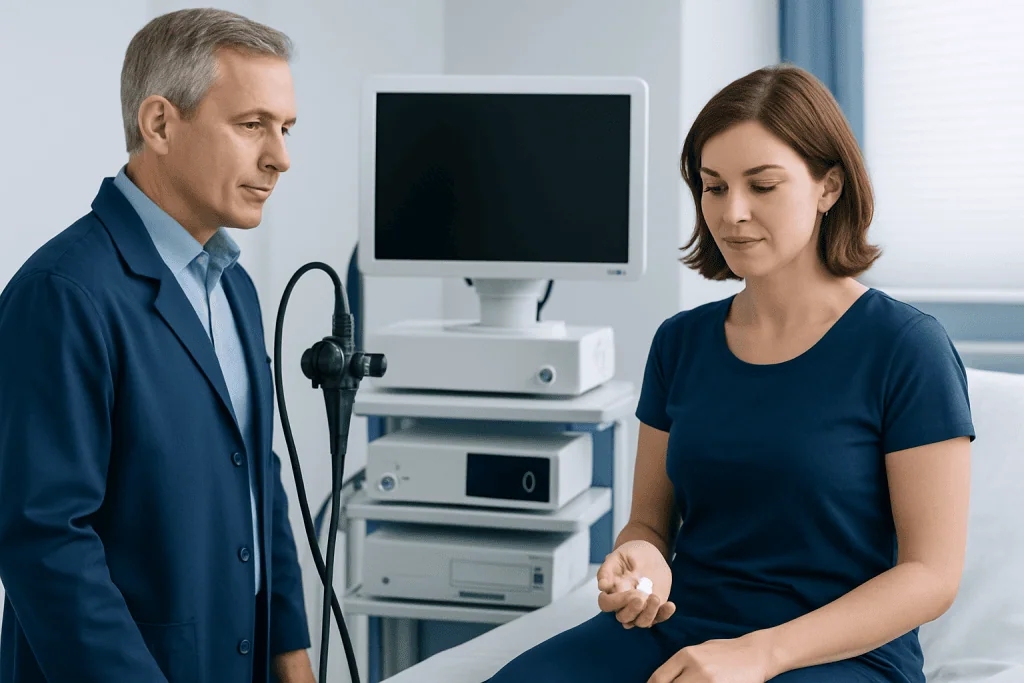
Doctors may suggest capsule endoscopy for adults or children in selected situations, most commonly when there is a concern in the small intestine. One of the most common reasons is unexplained gastrointestinal bleeding or iron-deficiency anemia, particularly when standard endoscopy and colonoscopy have not found the cause. The test may also be used when symptoms raise concern for inflammation, ulcers, or growths in the small bowel.
Capsule endoscopy can be useful in the assessment of suspected or known Crohn’s disease, especially when the goal is to look for inflammation beyond the reach of a conventional scope. It may also help evaluate chronic abdominal pain or diarrhea in carefully selected patients, screen for some inherited polyposis conditions, or monitor certain small bowel disorders. In some cases, it can help clarify whether symptoms relate to conditions such as celiac disease when other tests do not fully explain the picture.
Not everyone is an ideal candidate. People with known or suspected bowel narrowing, swallowing difficulties, certain previous abdominal surgeries, or a history suggesting obstruction may need additional evaluation before the test. Pregnancy, implanted medical devices, and age-related factors do not always rule it out, but they do require individualized medical advice.
How capsule endoscopy works: step by step

Preparation usually begins the day before the test. Patients are commonly asked to stop eating for a period of time and may be instructed to follow a clear-liquid diet or take a bowel preparation, depending on the reason for the exam and the center’s protocol. A cleaner small intestine usually leads to clearer images, which helps the doctor interpret the study more accurately.
On the day of the procedure, sensors may be placed on the abdomen and connected to a recording device worn on a belt or shoulder strap. The patient then swallows the capsule with water. In most cases, this is quick and painless. After swallowing it, the person can usually leave the clinic and continue light daily activities while the capsule passes naturally through the digestive system and sends images to the recorder.
Eating and drinking are usually resumed in stages according to the care team’s instructions. The recording period often lasts several hours. At the end of the study, the patient returns the recording equipment, and the images are reviewed by a specialist. The capsule itself is disposable and usually passes in the stool within a day or two, often without being noticed.
If there is concern that the capsule could get stuck, a doctor may first use a dissolvable “patency capsule” or order imaging to make sure the bowel is open enough. In some cases, the results of capsule endoscopy are later paired with endoscopy or colonoscopy if a suspicious area needs direct examination or tissue sampling.
Benefits and limitations of capsule endoscopy
The main benefit of capsule endoscopy is that it allows noninvasive visualization of the small intestine, an area that is harder to reach with conventional endoscopes. Many patients appreciate that it does not usually require sedation, recovery from anesthesia, or a hospital stay. It can also be more comfortable than traditional scope-based procedures because once the capsule is swallowed, imaging happens as the patient goes about the day.
Another advantage is its ability to detect subtle lesions that may cause bleeding, inflammation, or chronic symptoms. Tiny ulcers, vascular changes, or small mucosal abnormalities can sometimes be seen more clearly when the small bowel is captured frame by frame. This may help guide the next stage of diagnosis and avoid unnecessary delays in care.
At the same time, capsule endoscopy has clear limits. It does not allow the doctor to biopsy tissue, remove growths, stretch narrow areas, or deliver treatment. The quality of the study can also be reduced if bowel preparation is incomplete or if the capsule moves too quickly or too slowly through some parts of the gut.
Because of these limits, the test is often part of a larger diagnostic plan rather than a stand-alone answer. When capsule endoscopy suggests a specific abnormality, follow-up care may involve blood tests, scans, or advanced procedures such as specialized endoscopic procedures if the broader digestive workup points to a related biliary or pancreatic issue.
Risks, side effects, and possible complications
Capsule endoscopy is generally considered safe, and serious complications are uncommon. Most people feel no different after swallowing the capsule and can return to routine activities the same day. The most frequent issue is simply that the test may be incomplete if the battery runs out before the capsule reaches the colon or if image quality is limited.
The most important uncommon risk is capsule retention, meaning the capsule stays in the digestive tract instead of passing normally. This is more likely in people with Crohn’s-related narrowing, tumors, scar tissue, previous surgery, or other causes of intestinal blockage. Retention may cause no symptoms at first, but it can sometimes lead to abdominal pain, nausea, vomiting, or bloating.
Other possible problems include difficulty swallowing the capsule, aspiration into the airway in rare situations, skin irritation from the sensors, or technical problems with the recorder. If a retained capsule is confirmed, treatment depends on the cause and may include observation, medication, endoscopic retrieval, or occasionally surgery.
Before the test, patients should tell their doctor about prior bowel obstruction, swallowing disorders, implanted devices, recent abdominal surgery, or any symptoms that suggest blockage. Careful screening helps reduce the chance of complications and improves the safety of the procedure.
Recovery timeline and self-care after the test
Recovery after capsule endoscopy is usually simple because there is typically no sedation. Most patients can walk, work at a desk, and continue many normal daily activities while the test is in progress, as long as they follow the clinic’s instructions. Heavy exercise, strong electromagnetic environments, or activities that may disturb the recording device may be restricted until the equipment is removed.
Eating and drinking are usually restarted gradually, often a few hours after swallowing the capsule. The exact timing can vary, so it is important to follow the instructions provided by the medical team. After the recording period ends and the sensors are removed, most people can return fully to their regular routine.
The capsule often passes naturally in the stool within 24 to 72 hours, though the timing can vary. Patients do not usually need to retrieve it unless the care team has specifically asked them to do so. If there is uncertainty about whether it passed, a doctor may recommend an X-ray or another test, especially if symptoms develop.
Results are not usually available immediately because a specialist must review many images carefully. Patients should ask when and how they will receive results and what the next step will be if an abnormality is found. Near the end of the care journey, patients who need further evaluation may benefit from a multidisciplinary digestive health review; Acibadem International’s specialists at JCI-accredited hospitals diagnose and treat gastrointestinal conditions for international patients.
When to seek medical care
Most people complete capsule endoscopy without any urgent problems, but it is important to know when to contact a doctor. Medical advice should be sought promptly if there is severe or worsening abdominal pain, persistent nausea or vomiting, abdominal swelling, fever, chest discomfort, trouble swallowing, or difficulty breathing after swallowing the capsule.
Patients should also contact their care team if they have not noticed the capsule passing and have been told to monitor for it, or if they develop symptoms that could suggest the capsule is stuck. Anyone scheduled for an MRI should tell the imaging center if there is any chance the capsule is still inside the body, because MRI is usually delayed until capsule passage is confirmed.
In a non-urgent setting, follow-up is also important if the original symptoms continue despite a normal test. A normal capsule endoscopy can be reassuring, but it does not rule out every digestive condition. Ongoing symptoms may still need further assessment by a qualified gastroenterologist.
Frequently asked questions
Is capsule endoscopy painful?
Capsule endoscopy is usually not painful. Most people simply swallow the capsule with water and do not feel it moving through the digestive tract. There is typically no sedation and no recovery discomfort related to anesthesia.
How long does capsule endoscopy take?
The recording portion usually lasts several hours, often around a full daytime session. The patient generally wears a recorder while the capsule travels through the gut. The capsule itself often passes later in the stool, sometimes within one to three days.
Can capsule endoscopy detect Crohn’s disease?
It can help detect signs of Crohn’s disease in the small intestine, such as ulcers or inflammation. This is especially useful when standard tests have not fully explained symptoms. However, the diagnosis is based on the full clinical picture, not the capsule images alone.
What are the risks of capsule endoscopy?
The most important uncommon risk is capsule retention, where the capsule gets stuck in a narrowed part of the bowel. Other rare concerns include trouble swallowing or incomplete imaging. Doctors reduce risk by reviewing symptoms, medical history, and sometimes using additional tests beforehand.
Do patients need bowel preparation before capsule endoscopy?
Many patients do need some preparation, such as fasting and sometimes a bowel-cleansing regimen. The exact instructions vary by center and by the reason for the test. Good preparation can improve image quality and make the exam more informative.
Can a capsule endoscopy replace colonoscopy or standard endoscopy?
Not completely. Capsule endoscopy is excellent for viewing parts of the small intestine, but it cannot take biopsies or provide treatment. If the capsule finds an abnormal area, a standard endoscopic procedure may still be needed.
References
- National Institute of Diabetes and Digestive and Kidney Diseases
- American Society for Gastrointestinal Endoscopy
- National Health Service
- Mayo Clinic
This article is for general information only and is not a substitute for professional medical advice. Please consult a qualified doctor about your individual situation.
Persistent digestive symptoms? Get evaluated in Turkey
JCI-accredited · board-certified surgeons · reply within 24h
Add us as a Preferred Source to see more of our trusted health content across Google Search, AI Overviews and Discover.