Compound Exercises: An Evidence-Based Guide for Patients

Compound exercises work multiple muscle groups and joints in one movement. They can improve strength, balance, coordination, and day-to-day physical function.
Key Takeaways
- Compound exercises work multiple muscle groups and joints in one movement.
- They can improve strength, balance, coordination, and day-to-day physical function.
- Beginners often benefit from simple bodyweight or machine-based compound movements before progressing.
- Good form, gradual progression, and appropriate recovery help lower the risk of injury.
- People with pain, chronic disease, or recent surgery should ask a qualified clinician before starting a new program.
Compound exercises are movements that use more than one joint and several muscle groups at the same time, such as squats, rows, and push-ups. For many people, they are an efficient way to build strength, improve everyday function, and support long-term health when chosen carefully and performed with good technique.
What compound exercises are and why they matter
Compound exercises are strength or movement exercises that involve two or more joints and several muscle groups working together. In practical terms, this means one exercise trains a coordinated pattern rather than isolating just one muscle. Common examples include squats, lunges, push-ups, rows, deadlifts, and overhead presses.
These movements matter because daily life rarely depends on one muscle working alone. Standing up from a chair, climbing stairs, carrying groceries, lifting a child, or pushing a door all require several muscle groups to act together. Compound exercises can therefore help make training more relevant to real-world movement and physical independence.
They are also efficient. A well-designed routine that includes a few compound exercises may train the legs, hips, back, chest, shoulders, and core in less time than a program made up only of single-joint exercises. For patients who want practical, evidence-based exercise habits, that efficiency can make regular activity easier to maintain.
How compound exercises differ from isolation exercises
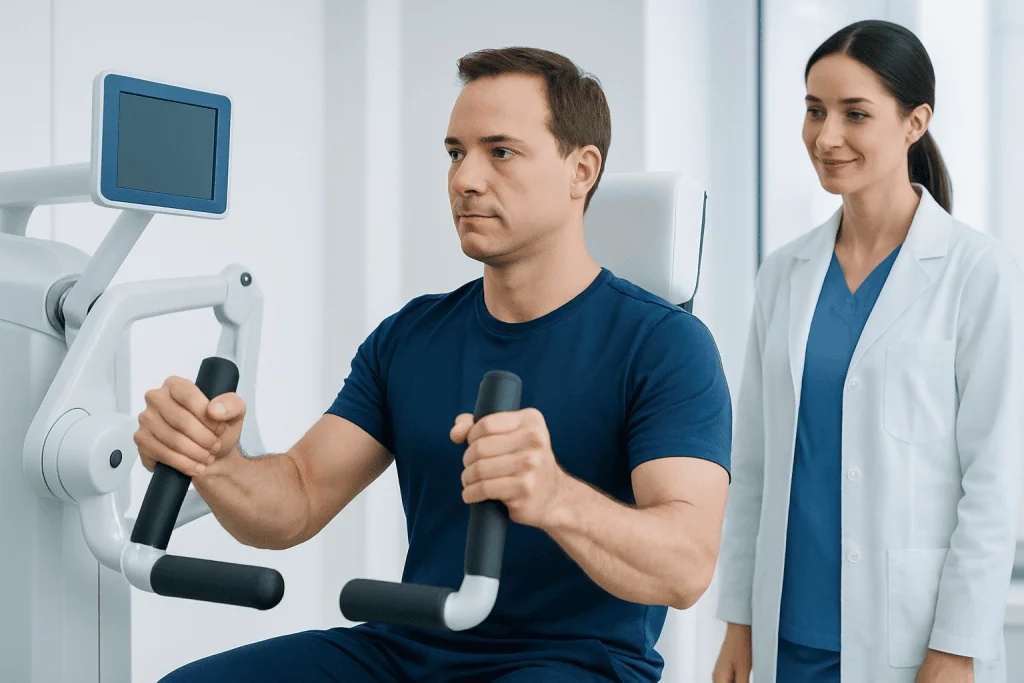
The main difference is scope. Compound exercises use multiple joints and muscle groups in one coordinated movement, while isolation exercises usually focus on one joint and one main muscle group. For example, a squat is a compound exercise because it involves the hips, knees, and ankles, while a leg extension is an isolation exercise that mainly targets the front thigh.
Neither type is inherently better in every situation. Compound exercises are often useful for general strength, fitness, movement quality, and time efficiency. Isolation exercises can still be helpful for rehabilitation, correcting muscle imbalances, or targeting a specific area after injury or surgery under professional guidance.
Many balanced exercise programs include both. A person may build a session around compound movements and then add selected isolation work if needed. For patients, the most suitable mix depends on goals, fitness level, symptoms, age, and any medical conditions affecting the joints, muscles, heart, or nervous system.
- Compound examples: squat, lunge, push-up, bench press, row, deadlift
- Isolation examples: biceps curl, leg extension, calf raise, triceps extension
Potential health benefits of compound exercises

When performed regularly and safely, compound exercises can help improve overall muscular strength and endurance. Because they train several muscle groups at once, they may also improve coordination between the upper body, lower body, and core. This can support better movement control during everyday tasks and recreational activity.
Compound exercises may help posture and joint support by strengthening the muscles around the hips, knees, shoulders, and spine. They can also contribute to healthy aging by helping preserve muscle mass and physical function. In older adults especially, maintaining the ability to stand, carry, pull, and balance is closely linked to independence.
These exercises may also support metabolic health when paired with regular aerobic activity, sleep, and appropriate nutrition. Strength training is associated with broader health benefits, including support for bone health, body composition, and glucose regulation. For people working on weight management, combining resistance training with daily movement can be useful, and some may also benefit from structured care for obesity when recommended by specialists.
It is important to note that benefits depend on proper technique, consistency, and an exercise plan matched to the individual. More weight or more complex movements do not automatically lead to better outcomes.
Examples of compound exercises for different ability levels
Beginners often do best with simple movement patterns that are easy to learn and control. Good starting options include sit-to-stand from a chair, wall push-ups, step-ups onto a low platform, resistance-band rows, and supported split squats. These movements can teach joint alignment and build confidence before more demanding variations are introduced.
For intermediate exercisers, common options include bodyweight squats, lunges, incline push-ups, dumbbell rows, glute bridges, and machine chest or leg presses. Machines can be especially helpful for some patients because they provide more external stability while still allowing multi-joint training.
Advanced compound exercises may include barbell squats, deadlifts, overhead presses, pull-ups, and kettlebell swings. These can be effective but require adequate mobility, body control, and technique. For people with back symptoms, joint disease, or previous injury, a clinician may suggest modifications or rehabilitation first, especially in the setting of spinal stenosis or other spine conditions.
- Lower body: squat, lunge, step-up, hip hinge, deadlift variation
- Upper body push: push-up, chest press, overhead press
- Upper body pull: row, lat pull-down, assisted pull-up
- Whole body: farmer carry, sit-to-stand with weight, medicine ball lift
How to start safely and make progress
A safe starting point is to learn movement quality before adding significant load. This usually means beginning with bodyweight, resistance bands, light dumbbells, or guided machines. Slow, controlled repetitions can help a person feel whether the movement is balanced, comfortable, and within a manageable range.
Progress should be gradual. Many people start with one to three sets of a small number of exercises, performed two or three times per week with rest days between sessions. As tolerance improves, a clinician or qualified exercise professional may advise increasing repetitions, resistance, or complexity one step at a time.
Technique matters more than intensity at first. General safety principles include keeping breathing steady, avoiding sudden twisting under load, stopping if pain becomes sharp or worsening, and allowing recovery between sessions. A brief warm-up with walking or mobility work may help prepare the joints and muscles for training.
People recovering from an orthopedic problem may need supervised exercise or formal physical therapy and rehabilitation to rebuild strength safely. If persistent knee pain limits squats or step-ups, clinicians may also look for underlying causes such as knee osteoarthritis.
Who should be cautious with compound exercises
Compound exercises can be adapted for many people, but some individuals should use extra caution. This includes those with recent surgery, uncontrolled blood pressure, chest pain with exertion, significant dizziness, acute back or joint injury, severe osteoporosis, or neurologic conditions that affect balance and coordination.
Patients with chronic conditions may still benefit from strength training, but their program often needs individual adjustments. For example, a person with arthritis may need shorter movement ranges and slower progression, while someone with heart disease may need a medically informed exercise plan and symptom monitoring. In some cases, structured cardiac rehabilitation may be more appropriate than starting independently.
Pregnant individuals, older adults with frailty, and people with obesity can also perform compound exercises, but exercise selection and supervision may be especially important. The safest program is one that fits the person’s medical history, movement ability, and health goals rather than copying a general fitness routine from the internet.
Common mistakes and self-care tips
A common mistake is choosing exercises that are too advanced too soon. Heavy barbell lifts, deep ranges of motion, or unstable movements may place unnecessary stress on joints if the person has not yet developed basic control. Another mistake is training through pain, especially if pain changes normal movement or worsens after exercise.
Self-care starts with realistic expectations. Strength and movement quality improve over weeks and months, not overnight. Rest, hydration, adequate protein and overall nutrition, and regular sleep all support adaptation to exercise. Alternating training days with walking, cycling, or flexibility work may help maintain activity without overloading the same tissues.
It can also help to track symptoms and progress. Noting how a movement feels during exercise and the day after can guide safer progression. Mild muscle soreness can be normal when starting a new program, but joint swelling, numbness, weakness, or persistent pain should not be ignored.
Near the end of a care journey, some international patients may seek evaluation from centers with multidisciplinary expertise. Acibadem International’s specialists and JCI-accredited hospitals diagnose and treat musculoskeletal and rehabilitation needs for international patients when further assessment is required.
When to seek medical care
Medical advice is important if exercise triggers chest pain, unusual shortness of breath, fainting, severe dizziness, or a rapid worsening of symptoms. Urgent care is also needed after a fall, sudden inability to bear weight, visible joint deformity, or signs of a significant muscle or tendon injury.
A non-urgent medical review is appropriate for pain that lasts more than a few days, repeated swelling after workouts, progressive weakness, or numbness and tingling. People with diabetes, heart disease, osteoporosis, or a recent operation should also ask their doctor what type of strength training is appropriate before beginning a new program.
If there is uncertainty about technique, a qualified physiotherapist, sports medicine physician, or rehabilitation specialist can help design a safer program. Early guidance may prevent avoidable setbacks and make compound exercises more effective and sustainable.
Frequently asked questions
Are compound exercises better than isolation exercises?
Compound exercises are not automatically better in every situation, but they are often more efficient for general strength and functional movement because they train several muscle groups at once. Isolation exercises still have value, especially in rehabilitation or when targeting a specific weak muscle.
Can beginners do compound exercises safely?
Yes, beginners can often do compound exercises safely when they start with simple variations such as chair squats, wall push-ups, or resistance-band rows. Good instruction, controlled movement, and gradual progression are more important than lifting heavy weights.
Do compound exercises help with weight loss?
Compound exercises can support weight management because they contribute to muscle strength, increase overall activity, and fit well into time-efficient workouts. However, weight loss usually depends on a broader plan that includes nutrition, sleep, daily movement, and long-term habits.
How often should someone do compound exercises?
Many adults start with strength training two or three times per week on nonconsecutive days. The ideal schedule depends on age, fitness level, recovery, symptoms, and any medical conditions, so some people need a more individualized plan.
Should compound exercises cause pain?
Mild muscle effort and temporary soreness can be normal, especially when beginning a new program. Sharp pain, increasing joint pain, swelling, numbness, or symptoms that persist after exercise should be assessed by a qualified clinician.
Are compound exercises safe for older adults?
They can be, and they may be especially useful for maintaining strength and independence in daily life. The safest approach is to choose appropriate movements, use stable support when needed, and progress gradually under professional guidance if balance, bone health, or joint pain is a concern.
References
- World Health Organization
- American College of Sports Medicine
- Centers for Disease Control and Prevention
- National Institute on Aging
- National Institute of Arthritis and Musculoskeletal and Skin Diseases
This article is for general information only and is not a substitute for professional medical advice. Please consult a qualified doctor about your individual situation.
Joint and spine care in Turkey — expert assessment & treatment
JCI-accredited · board-certified surgeons · reply within 24h
Add us as a Preferred Source to see more of our trusted health content across Google Search, AI Overviews and Discover.

More from the Health Library

Aorta — Explained by Medical Evidence, Not Myths

Synonym to Concrete: What Patients Need to Know

Cold Medicine: An Evidence-Based Guide for Patients

Fructooligosaccharides: An Evidence-Based Guide for Patients

Left Ventricular Hypertrophy: A Complete Medical Overview