Congenital Cataract: An Evidence-Based Patient Guide

Congenital cataracts can affect one or both eyes and may interfere with vision development if they obstruct the visual axis. A white pupil, unusual eye movements, poor visual attention, or an abnormal newborn eye screening result should be assessed urgently by an eye specialist.
Key Takeaways
- Congenital cataracts can affect one or both eyes and may interfere with vision development if they obstruct the visual axis.
- A white pupil, unusual eye movements, poor visual attention, or an abnormal newborn eye screening result should be assessed urgently by an eye specialist.
- A detailed congenital cataract exam helps establish the cataract’s effect on vision and identify possible associated eye or medical conditions.
- Surgery removes a visually significant cloudy lens; glasses, contact lenses, or an implanted lens may then be used to focus the eye.
- Follow-up is essential because amblyopia, glaucoma, changes in prescription, and clouding behind the lens implant can occur over time.
A congenital cataract is a cloudy area in the natural lens that is present at birth or develops during infancy. Some small cataracts only need monitoring, while cataracts that block vision may require prompt surgery and long-term visual rehabilitation to support healthy visual development.
Overview: what is a congenital cataract?
A congenital cataract is clouding of the eye’s natural lens that is present at birth or becomes apparent during the first year of life. The lens normally focuses light onto the retina at the back of the eye. When its central area is cloudy, a clear image may not reach the retina, which can disrupt the brain’s developing visual pathways.
Congenital cataracts vary widely. A small, off-centre opacity may have little or no effect on sight and can sometimes be observed. A dense or central cataract can significantly reduce the image entering the eye and needs timely specialist assessment, particularly when it affects one eye, because the brain may begin to favour the clearer eye.
Most cases are not painful and are not caused by anything a parent did during pregnancy. Early recognition and coordinated care are important because visual development is especially active in infancy and early childhood.
Signs and symptoms parents may notice
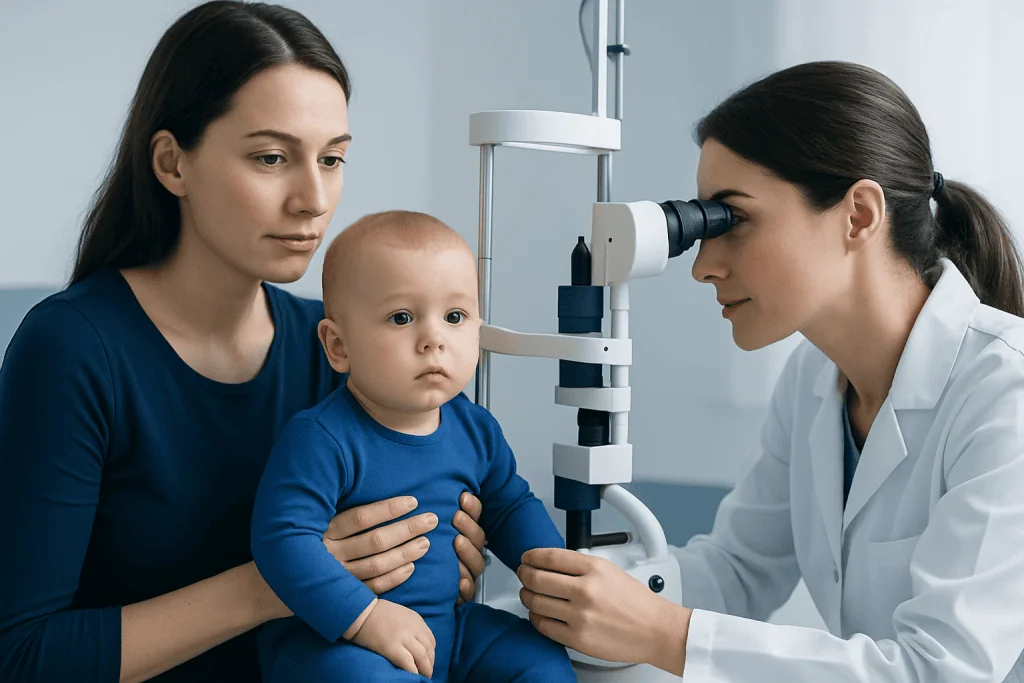
A cataract may be detected during a routine newborn red-reflex screening examination, before a family notices any changes. The red reflex is the reddish glow normally seen when light is shone into the eye. An absent, dull, uneven, or white reflex needs prompt assessment because cataract is one possible cause.
Visible signs can include a white, grey, or cloudy-looking pupil, known medically as leukocoria. Other possible clues are an eye that turns inward or outward, repetitive shaking eye movements called nystagmus, reduced interest in faces or objects, or difficulty tracking light and movement. These signs can have causes other than cataract, but they should never be ignored.
A child with a cataract in only one eye may seem to see well overall, since the unaffected eye can compensate. This is why screening and regular child health checks remain important even when no concern is obvious at home.
- White or unusually dark pupil in a photograph or in ordinary light
- Persistent eye misalignment or wandering eye
- Unusual eye movements, especially in early infancy
- Concern about visual attention or developmental visual behaviour
Causes and risk factors

Congenital cataracts may occur on their own, may run in families, or may be associated with genetic changes. They can affect one eye or both. Bilateral cataracts are more likely to have a genetic, metabolic, infectious, or systemic association, although many children still have no clearly identified cause after appropriate evaluation.
Less commonly, cataracts are linked with conditions affecting how the body processes certain substances, with eye-development differences, or with infections acquired during pregnancy. A clinician may recommend paediatric, genetic, or metabolic assessment depending on the child’s age, cataract pattern, family history, and general health. Testing is individualized rather than routine for every child.
In some people, a cataract first recognized in childhood persists into later life. The phrase congenital cataract surgery in adults may therefore refer to treatment of a cataract that was present from birth but did not initially obstruct vision, or to an adult who had childhood cataract treatment and now needs care for a related issue. Adult assessment is still individualized, with attention to longstanding amblyopia and the eye’s previous treatment history.
How a congenital cataract exam is performed
A paediatric ophthalmologist performs a congenital cataract exam to determine whether the lens opacity is affecting the visual axis and whether there are other eye concerns. The assessment includes the red reflex, pupil appearance, eye alignment, eye movements, and age-appropriate measures of visual behaviour or visual acuity. The clinician also examines the front and back of each eye.
In babies and young children, dilating eye drops are usually needed for a complete lens and retinal examination. If the cataract prevents a clear view of the back of the eye, ultrasound imaging may be used to check internal eye structures. Some children need an examination under anaesthesia to obtain precise measurements and assess the eye safely and thoroughly.
The specialist considers more than the cataract’s appearance. Decisions depend on whether it blocks central vision, its size and density, whether one or both eyes are affected, the child’s age, and signs of amblyopia. In bilateral cases or when history suggests an associated condition, the care team may discuss targeted blood tests, genetic counselling, or review by other paediatric specialists.
Families may encounter the term congenital cataract panel. This can describe a laboratory or genetic test panel selected to investigate possible causes, especially in bilateral or familial cases. It is not a single universal test, and its usefulness should be discussed with the treating clinician. A congenital cataract CPT code is an administrative billing code used by healthcare systems; it does not describe severity, predict outcome, or replace clinical assessment.
Treatment options and the role of surgery
Treatment is based on the risk to visual development. Small peripheral cataracts that do not impair the red reflex or vision may be monitored with regular examinations. Parents should attend every scheduled review because a cataract’s visual impact and the child’s focusing needs can change as the eyes grow.
When a cataract meaningfully blocks vision, surgery is commonly recommended. The goal is to create a clear pathway for light and to give the brain the best opportunity to learn to see. The clouded natural lens is removed, usually through tiny incisions. The surgeon may also remove the front portion of the lens capsule and part of the gel behind it to reduce the chance of early clouding in the visual axis.
After lens removal, the eye needs optical correction. Depending on the child’s age, eye measurements, whether one or both eyes are involved, and the surgeon’s assessment, this may involve a contact lens, glasses, or an intraocular lens implant. Cataract surgery is followed by a long-term plan for focusing correction and visual rehabilitation, not simply a one-time procedure.
Candidacy is therefore determined by a paediatric ophthalmology team, not by cataract size alone. For a visually significant cataract, the potential benefit of clearer visual input is weighed against the risks of surgery and the family’s ability to manage follow-up, eye drops, glasses or contact lenses, and amblyopia therapy.
What to expect: procedure, recovery, benefits and risks
Before surgery, the team reviews the child’s overall health, measures the eye, discusses anaesthesia, and explains the planned optical correction. During the operation, which is performed under general anaesthesia for young children, the surgeon makes small openings, removes the cloudy lens material, and performs additional capsule or vitreous steps when needed. An implanted artificial lens may be placed during the same operation in selected children; this decision is individualized.
After surgery, the child usually uses prescribed anti-inflammatory and antibiotic eye drops for a defined period. An eye shield may be needed briefly, and follow-up begins soon after the procedure. The doctor checks healing, eye pressure, the clarity of the visual axis, and the fit or prescription of glasses or contact lenses. Families should use medicines exactly as directed and contact the care team if they have concerns.
Recovery of the eye surface is often relatively quick, but vision rehabilitation takes much longer. The prescription commonly changes as the eye grows. If one eye had poorer vision, patching of the stronger eye or other amblyopia treatment may be recommended over months or years. Regular monitoring through childhood is important.
The main benefit of treatment is improved access to clear visual information during development. Possible risks include infection, inflammation, retinal complications, increased eye pressure or glaucoma, misalignment, clouding of the visual axis, and the need for further procedures. Even after technically successful surgery, final vision can be limited by the cataract’s timing and density, amblyopia, or other eye conditions.
Daily care, follow-up and long-term outlook
There is no proven home treatment that can clear a congenital cataract. The most helpful actions are keeping appointments, administering prescribed drops correctly, ensuring that glasses or contact lenses are used as advised, and following the amblyopia treatment plan. Contact lens care requires careful hygiene and direct teaching from the eye-care team.
Parents can support visual development by giving the child regular opportunities to look at faces, books, toys, and age-appropriate activities while using prescribed vision correction. However, visual play does not replace medical treatment or patching when these are required. The team can offer practical guidance for nursery, school, sports, and protective eyewear as the child grows.
Outlook depends on the cataract’s location and density, whether one or both eyes are affected, the child’s age when visual obstruction began, the presence of other eye differences, and consistency with follow-up. Many children gain useful vision with prompt, sustained care, but some require ongoing support for refractive error, amblyopia, or glaucoma into adulthood.
Acibadem International’s multidisciplinary specialists and JCI-accredited hospitals provide evaluation and treatment for international patients with childhood eye conditions, with follow-up planning tailored to the child and family.
When to seek medical care
Parents or caregivers should arrange urgent assessment by an eye specialist if they notice a white pupil, an abnormal red reflex, a new persistent eye turn, unusual eye movements, or a clear change in visual attention. A white pupil can have several causes, some of which require prompt care, so it should be assessed without waiting to see whether it resolves.
After cataract surgery, families should contact the surgical team promptly for increasing redness, marked swelling, discharge, worsening discomfort, a change in the appearance of the pupil, suspected injury, or difficulty using prescribed drops or contact lenses. Young children may not be able to describe pain or blurred vision, so behavioural changes should also be discussed.
Emergency care is appropriate for severe eye injury, sudden marked redness or swelling, or a child who appears significantly unwell. For non-urgent questions about a known cataract, scheduled review with a paediatric ophthalmologist remains the safest way to protect long-term vision.
Frequently asked questions
Can a congenital cataract go away on its own?
A true lens cataract does not usually clear on its own. Very small cataracts that do not interfere with vision may only need observation, but they still require regular specialist review. A visually significant cataract may need treatment to avoid disruption of visual development.
How urgent is congenital cataract surgery?
Urgency depends on whether the cataract blocks central vision, whether one or both eyes are affected, and the child’s age. Dense central cataracts are usually assessed promptly because vision develops rapidly in infancy. The paediatric ophthalmologist will recommend timing based on the individual examination.
Will a child need glasses after congenital cataract surgery?
Most children need some form of optical correction after the cloudy lens is removed. This may be glasses, a contact lens, an intraocular lens implant, or a combination over time. Prescriptions often change as the eye grows, so repeat visits are necessary.
What is amblyopia after a congenital cataract?
Amblyopia, often called lazy eye, occurs when the brain does not learn to use visual information from one eye normally. A cataract can cause it by blocking a clear image during early development. Cataract removal, accurate focusing correction, and patching or other therapy may all be part of treatment.
Is congenital cataract hereditary?
Some congenital cataracts are inherited, particularly when both eyes are affected or there is a family history. Others occur without a known family pattern. A doctor may recommend genetic counselling or targeted testing when the cataract pattern or medical history suggests it could be useful.
Can adults have surgery for a congenital cataract?
Yes. Some people have a childhood-onset cataract that remains stable until it becomes visually significant later, while others need care for long-term effects of childhood treatment. An adult ophthalmologist can assess current lens clouding, refractive needs, eye pressure, retinal health, and any longstanding amblyopia before recommending treatment.
References
- American Academy of Ophthalmology
- American Association for Pediatric Ophthalmology and Strabismus
- National Eye Institute
- Royal College of Ophthalmologists
This article is for general information only and is not a substitute for professional medical advice. Please consult a qualified doctor about your individual situation.
Explore treatments in Turkey — costs, top hospitals & a free quote
JCI-accredited · board-certified surgeons · reply within 24h
Add us as a Preferred Source to see more of our trusted health content across Google Search, AI Overviews and Discover.