Creeping Virginia Skin Rash Explained: Common Triggers and Red Flags

“Creeping virginia skin rash” is a descriptive term, not a specific disease name. A winding or slowly moving rash can be caused by allergy, irritation, fungal infection, scabies, or cutaneous larva migrans.
Key Takeaways
- “Creeping virginia skin rash” is a descriptive term, not a specific disease name.
- A winding or slowly moving rash can be caused by allergy, irritation, fungal infection, scabies, or cutaneous larva migrans.
- Severe itching, spreading redness, warmth, pus, fever, or facial swelling are reasons to seek medical care promptly.
- Diagnosis usually depends on the rash’s appearance, travel or exposure history, and a skin examination.
- Treatment varies by cause and may include skin-care measures, anti-itch treatment, or prescription medicines.
Creeping virginia skin rash is not a formal medical diagnosis, but people often use the phrase to describe an itchy, spreading, snake-like or winding rash on the skin. In many cases it is linked to irritation, allergy, infection, or a condition called cutaneous larva migrans, so the best next step depends on how the rash looks, how fast it is changing, and whether warning signs are present.
Overview: what “creeping virginia skin rash” usually means
Creeping virginia skin rash is a phrase people may use when they notice a rash that seems to spread, change shape, or form a thin winding line on the skin. It is not a standard medical term, so doctors first try to identify what kind of rash is actually present. The pattern, location, itch level, timing, and any recent exposures often give the most useful clues.
Sometimes this type of rash is simply an irritated or allergic skin reaction. In other situations, a “creeping” appearance can point to a condition in which something is moving within the top layer of the skin, such as cutaneous larva migrans. Less commonly, fungal infections, scabies, or inflamed scratches can mimic the same look.
Because several different problems can look similar at first, self-diagnosis is not always reliable. A careful clinical assessment helps separate common, self-limited rashes from those that need targeted treatment. If a person already lives with chronic skin conditions such as eczema or has recently had contact with a known irritant, that information can also be important.
How the rash may look and feel

The symptom pattern depends on the cause, but many people describe intense itching, redness, and a line or track that appears curved, wavy, or slowly spreading. The rash may be raised or flat, and the surrounding skin can look mildly swollen or irritated from scratching. Some people notice one line, while others have multiple spots or patches.
If the problem is due to a migrating parasite in the skin, the track often looks thin, twisting, and slightly elevated. It may seem to move a little over hours or days rather than all at once. By contrast, allergic or irritant rashes may appear more patchy, widespread, or sharply limited to areas that touched a plant, chemical, fabric, soap, or cosmetic product.
Other features can help narrow the cause:
- Marked itch at night may suggest scabies.
- Ring-shaped scaly patches can suggest a fungal rash.
- Burning, stinging, or blistering may occur with allergic contact dermatitis.
- Warmth, tenderness, or pus can point to a secondary bacterial infection.
A rash that involves the face, eyes, genitals, or large areas of the body deserves extra attention. Persistent scratching can also break the skin and make any rash worse, even if the original cause was mild.
Common triggers and possible causes
One useful way to understand creeping virginia skin rash is to think in categories rather than assume a single diagnosis. A number of skin problems can create a spreading or unusual pattern. The most common broad groups are irritation or allergy, infections, infestations, and flare-ups of underlying skin disease.
Allergic and irritant reactions are among the most frequent causes of itchy rashes. Plants, fragrances, detergents, metals, topical creams, and workplace chemicals can all trigger inflammation. In these cases, the rash often develops where the skin touched the trigger and may improve once the exposure stops.
Cutaneous larva migrans is a well-known cause of a creeping, snake-like rash. It happens when hookworm larvae from contaminated sand or soil enter the superficial skin, often on the feet, legs, buttocks, or hands after walking barefoot or sitting on contaminated ground. The rash is usually very itchy and forms a slowly advancing, winding track.
Other look-alikes include scabies, fungal infections such as ringworm, eczema, and inflamed insect bites. Doctors may also consider psoriasis or other inflammatory conditions if the rash is recurrent or does not behave like an infection. In some cases, expert skin assessment by a dermatologist is helpful, especially if the appearance is atypical or treatment has already failed.
Risk factors that help doctors identify the cause
Exposure history often matters as much as the rash itself. Travel to tropical or subtropical areas, walking barefoot outdoors, beach exposure, contact with pets, gardening, new personal-care products, recent hotel stays, or close contact with someone who has a similar rash can all be meaningful clues. Even timing can help: a rash that appears within hours of a new product is approached differently from one that develops days after outdoor exposure.
People with sensitive skin, allergies, asthma, or a personal or family history of eczema may be more prone to reactive skin rashes. Warm, humid environments can also increase the chance of fungal infections or irritation from sweat and friction. Repeated scratching can change the appearance of a rash and lead to skin breaks or infection.
Doctors also ask about immune status, pregnancy, ongoing medications, and chronic health conditions. These factors can affect which causes are more likely and which treatments are safest. If there is concern for infection or infestation, the clinician may ask whether anyone else in the household has itching or rash symptoms.
How diagnosis is made
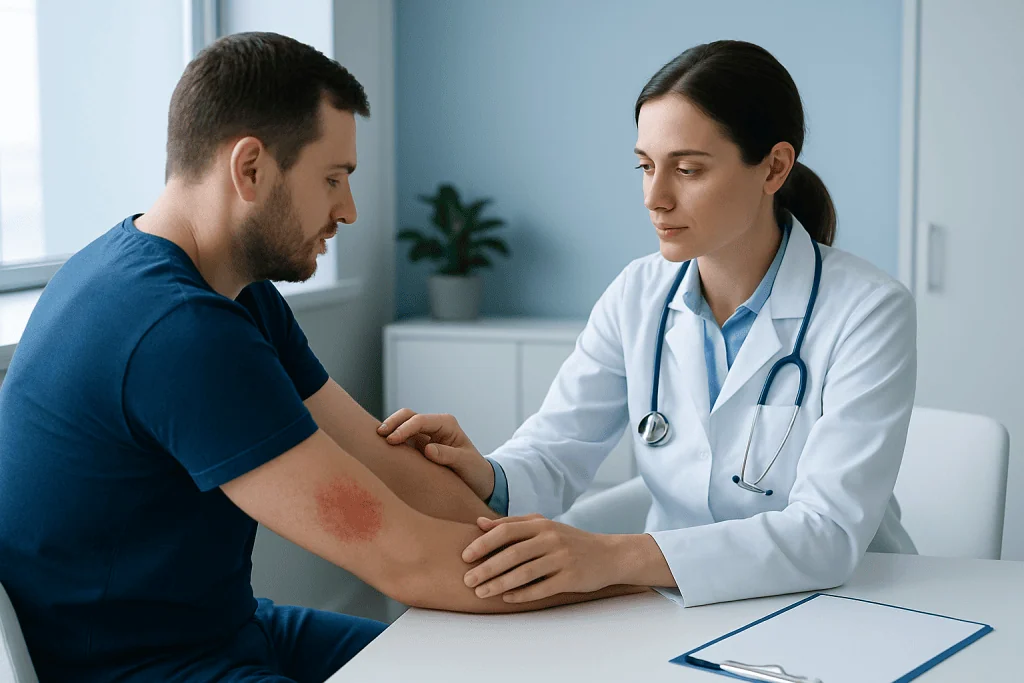
Diagnosis starts with a medical history and close skin examination. A clinician usually asks when the rash began, whether it is spreading, how severe the itch is, and what exposures happened in the days or weeks beforehand. A photo showing how the rash looked earlier can sometimes be useful, especially if the pattern changes over time.
In many cases, the rash’s appearance is enough to guide treatment. A winding, raised, intensely itchy track after barefoot beach or soil exposure strongly suggests cutaneous larva migrans. A scaly ring-shaped patch may suggest fungal infection, while burrows in finger webs or wrists can suggest scabies. Contact-pattern rashes can point toward allergy or irritation.
Some patients need additional evaluation, such as skin scraping, dermatoscopic examination, patch testing for allergies, or laboratory testing if infection is suspected. If the diagnosis remains uncertain, a specialist in dermatology evaluation and care may be recommended. Imaging is rarely needed for a simple rash, but specialist review can be important when symptoms are persistent, recurrent, or unusual.
Treatment options depend on the cause
There is no single treatment for creeping virginia skin rash because the phrase covers several possible conditions. Management is based on the cause identified during the examination. Mild irritant or allergic rashes often improve with trigger avoidance, gentle skin care, and treatments that reduce inflammation and itch. Fungal infections, scabies, and parasite-related rashes need specific prescription or over-the-counter treatment selected by a clinician.
If cutaneous larva migrans is diagnosed, treatment is usually straightforward and aimed at eliminating the larvae and relieving itch. If the rash is due to contact dermatitis, the priority is to stop the triggering exposure and calm the skin. If scratching has caused skin damage or a bacterial infection, additional treatment may be needed.
Patients should avoid applying multiple home remedies or strong medicated creams without guidance, since this can irritate the skin further or blur the diagnosis. Keeping nails short, avoiding scratching, and using bland, fragrance-free skin products can help while waiting for medical advice. If a more complex skin problem is suspected, a clinician may coordinate care with allergy testing or other targeted assessment when appropriate.
Self-care and prevention
Prevention starts with reducing common triggers. Using gentle cleansers, fragrance-free moisturizers, and protective gloves for cleaning or chemical exposure can lower the risk of irritant reactions. New creams, cosmetics, or detergents should be introduced one at a time so any trigger is easier to identify.
To reduce the risk of cutaneous larva migrans, it helps to avoid walking barefoot or lying directly on sand or soil in areas where animal feces may contaminate the ground. Wearing sandals or shoes outdoors and using a towel or barrier on the beach can be sensible precautions. Good pet care and deworming advice from a veterinarian may also reduce exposure in some settings.
General rash self-care includes cool compresses, loose clothing, and avoiding hot showers that can worsen itching. A person should not share towels, bedding, or clothing if scabies or infection is a possibility. If symptoms keep returning, medical review is useful because repeated “rash episodes” may reflect an untreated underlying condition rather than a simple one-time irritation.
When to seek medical care
A person should seek medical care if a creeping virginia skin rash is spreading quickly, becoming painful, developing drainage or pus, or is associated with fever, chills, or feeling unwell. Prompt assessment is also sensible if the rash involves the eyes, mouth, face, or genital area, or if there is swelling of the lips or trouble breathing. These features raise concern for infection, a significant allergic reaction, or another condition needing urgent treatment.
Medical advice is also recommended when the rash is intensely itchy, lasts more than a few days without improving, keeps coming back, or appears after recent travel, barefoot beach exposure, or contact with someone who has a similar rash. Children, older adults, pregnant patients, and people with weakened immune systems should be assessed sooner because skin problems can behave differently in these groups.
Near the end of the care pathway, some patients may benefit from specialist input if the diagnosis is unclear or the rash does not respond as expected. Acibadem International’s multidisciplinary specialists and JCI-accredited hospitals diagnose and treat skin conditions for international patients, including access to specialist dermatology care when needed.
Frequently asked questions
Is creeping virginia skin rash a real medical diagnosis?
It is not a formal medical diagnosis. It is a descriptive phrase people may use for an itchy, spreading, winding, or “creeping” rash. A doctor usually needs to identify the specific cause before treatment can be chosen correctly.
Can a creeping rash be caused by a parasite?
Yes, one possible cause is cutaneous larva migrans, in which hookworm larvae move within the superficial skin. This often causes a very itchy, twisting track, especially after barefoot exposure to contaminated sand or soil. However, not every creeping-looking rash is parasitic.
How can someone tell the difference between an allergy and an infection?
Allergic or irritant rashes often appear where the skin touched a trigger and may itch or burn without causing fever. Infections may be more likely if the area becomes warm, painful, increasingly red, swollen, or starts draining pus. Because the signs can overlap, a clinician may still need to examine the skin.
Is it safe to treat this kind of rash at home?
Basic skin care, avoiding suspected triggers, and not scratching may be reasonable for a mild rash. But it is best not to use many medicated products at once, because this can irritate the skin or hide the true cause. Medical advice is important if the rash is spreading, severe, or not improving.
Can stress cause a creeping virginia skin rash?
Stress does not usually cause a parasite-related creeping rash by itself, but it can worsen itching and trigger flare-ups of some inflammatory skin conditions. It may also make a person more aware of skin sensations. Persistent or unusual rashes should still be assessed medically rather than blamed on stress alone.
When should a person see a doctor urgently?
Urgent care is important if the rash comes with facial swelling, breathing trouble, severe pain, fever, rapidly spreading redness, or signs of infection such as pus. Rash around the eyes or mouth also deserves prompt attention. These features need quicker evaluation than a simple itchy patch.
References
- American Academy of Dermatology
- Centers for Disease Control and Prevention
- National Health Service
- Mayo Clinic
- Merck Manual Consumer Version
This article is for general information only and is not a substitute for professional medical advice. Please consult a qualified doctor about your individual situation.
Explore treatments in Turkey — costs, top hospitals & a free quote
JCI-accredited · board-certified surgeons · reply within 24h
Add us as a Preferred Source to see more of our trusted health content across Google Search, AI Overviews and Discover.