Developmental Hip Dysplasia: Newborn Screening and Treatment With a Harness

Developmental hip dysplasia may be present at birth or become apparent during infancy as the hip grows. Newborn screening includes a physical hip examination and, for some babies, an ultrasound.
Key Takeaways
- Developmental hip dysplasia may be present at birth or become apparent during infancy as the hip grows.
- Newborn screening includes a physical hip examination and, for some babies, an ultrasound.
- A Pavlik harness keeps the baby’s hips in a safe flexed and outward position to support healthy joint development.
- Parents should not adjust or remove the harness unless instructed by the treating doctor.
- Follow-up appointments are essential to check hip position, growth, skin comfort, and harness fit.
- Early assessment by a pediatrician or pediatric orthopedic specialist improves the chance of simpler treatment.
Developmental hip dysplasia is a condition in which a baby’s hip joint is not formed or positioned as securely as expected. Early newborn screening and timely harness treatment can often guide the hip to develop more normally.
Overview
Developmental hip dysplasia, often shortened to DDH, describes a range of conditions in which a baby’s hip joint is not as stable, deep, or well aligned as it should be. The hip is a ball-and-socket joint: the rounded top of the thigh bone fits into a cup-shaped socket in the pelvis. In DDH, the socket may be shallow, the ball may move too much, or the hip may be partially or completely out of place.
DDH can be present at birth, but it can also become more noticeable as a baby grows. Some babies have a mild form that improves with monitoring, while others need treatment to guide the hip into a stable position. Because babies are still developing, early treatment can make use of natural growth to help the hip joint form more normally.
Newborn hip screening is designed to identify babies who may need closer assessment. When DDH is found early, a soft positioning device called a Pavlik harness is commonly used. The harness does not “force” the hip into place; it holds the hips in a position that encourages the ball and socket to develop together under specialist supervision.
Symptoms and Signs Parents May Notice
Many babies with developmental hip dysplasia look comfortable and do not show obvious pain. This is one reason routine newborn screening is important. A baby may feed, sleep, kick, and move normally even if the hip joint is not fully stable. In the earliest weeks, the signs are often detected by a trained clinician during a physical examination.
As a baby grows, parents or caregivers may notice subtle differences. These can include one leg seeming shorter than the other, uneven skin folds on the thighs or buttocks, or one hip appearing less flexible during diaper changes. A baby may also have reduced ability to spread one thigh outward compared with the other side.
In older infants or toddlers, untreated DDH may be noticed when a child begins to crawl, stand, or walk. Signs can include limping, walking on toes on one side, a waddling gait if both hips are affected, or a difference in leg length. These signs do not always mean DDH is present, but they should prompt medical evaluation.
Causes and Risk Factors
Developmental hip dysplasia usually results from a combination of factors rather than a single cause. Some babies are born with looser ligaments around the hip, and some have less space in the uterus during late pregnancy. The position of the baby before birth can also influence how the hip sits in the socket.
Known risk factors include breech position, a family history of DDH, and being a first-born baby. DDH is also diagnosed more often in girls, likely related to differences in ligament looseness during newborn development. Conditions that reduce space in the womb, such as low amniotic fluid, may also increase risk.
Hip positioning after birth can matter as well. Tight swaddling with the legs straight and pressed together may place stress on the developing hips. Hip-healthy swaddling allows the baby’s legs to bend up and out at the hips, with enough room for natural movement.
- Breech presentation in the final weeks of pregnancy
- Parent or sibling with a history of DDH
- Limited hip movement or asymmetry on examination
- Associated foot or neck positioning conditions in some babies
- Tight leg swaddling that restricts hip movement
Newborn Screening and Diagnosis
Newborn screening for developmental hip dysplasia begins with a physical examination. A pediatrician or trained clinician gently moves the baby’s hips to assess stability, range of motion, and symmetry. Two common examination maneuvers are known as the Barlow and Ortolani tests. These are performed carefully and are intended to detect whether the hip can slip out of place or return into the socket.
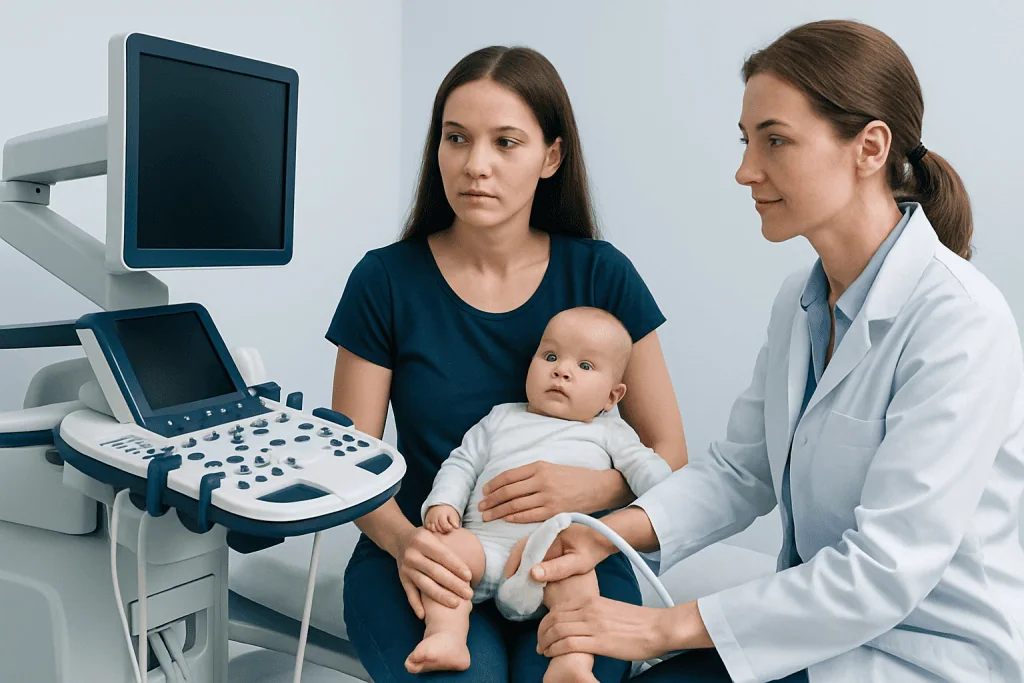
Not every baby needs imaging, but hip ultrasound is often recommended when there are risk factors, an abnormal examination, or uncertainty on physical assessment. Ultrasound is useful in young infants because much of the hip joint is still cartilage and does not show clearly on X-ray. It allows the doctor to assess both the shape of the socket and the position of the femoral head.
As babies get older and the bones become more visible, X-rays may be used instead of ultrasound. The timing and type of imaging depend on the baby’s age, examination findings, and local screening protocols. Diagnosis is made by combining the clinical examination with imaging results, rather than relying on one finding alone.
Treatment With a Pavlik Harness
The Pavlik harness is one of the most common early treatments for developmental hip dysplasia in young infants. It is a soft fabric brace with straps that hold the baby’s hips flexed and gently turned outward. This position helps keep the ball of the hip joint centered in the socket while allowing the baby to move the legs within a safe range.
Treatment is usually managed by a pediatric orthopedic specialist or a clinician experienced in infant hip conditions. The harness is fitted to the baby’s size and hip position, then checked regularly. Parents are taught how the harness should look, how to handle clothing and diapers, and what signs should lead them to call the care team.
The harness may be worn most of the day and night for a period determined by the specialist, often followed by a gradual reduction in wear time if the hips are improving. Parents should not loosen, tighten, or remove the harness unless instructed, because small changes in strap position can affect treatment. Follow-up ultrasound or X-ray is used to confirm that the hip is developing as expected.
Most babies adapt well to the harness after a short settling-in period. They can usually be fed, held, cuddled, and placed on their back for sleep while wearing it. The goal is to support normal development with the least invasive treatment appropriate for the baby’s age and hip findings.
Daily Care, Safety, and Follow-up
Daily care with a Pavlik harness is centered on comfort, skin protection, and keeping the device in the prescribed position. Diapers are usually worn under the harness and changed without removing the straps. Clothing should be loose enough to fit over the harness without pulling the legs inward.
Parents should check the skin as advised by the healthcare team, especially around the shoulders, chest, knees, and groin where straps may rub. Redness that fades quickly can be common, but persistent redness, blisters, swelling, or unusual discomfort should be reported. The baby’s feet should remain warm and normally colored, and the baby should continue moving the legs within the allowed range.
Safe sleep guidance remains important. Babies should be placed on their backs to sleep on a firm, flat surface, unless a doctor gives a specific alternative instruction. Car seats, strollers, and baby carriers may need to accommodate the wider hip position; the care team can advise families on safe positioning.
- Do not adjust harness straps unless trained to do so.
- Keep follow-up appointments even if the baby seems comfortable.
- Use loose clothing that does not press the knees together.
- Avoid tight swaddling around the legs.
- Call the care team if the baby stops kicking one leg or seems unusually distressed.
When to See a Doctor
Parents should attend all routine newborn and infant checkups, because hip screening is part of early child health care. A doctor should also evaluate any baby with risk factors such as breech birth or a close family history of developmental hip dysplasia, even if the hips appear normal to caregivers.
Medical advice is also recommended if parents notice limited movement of one hip, uneven thigh folds, a leg length difference, clicking or clunking sensations in the hip, or later walking changes. Hip clicks can sometimes be harmless tendon movement, but a healthcare professional should determine whether assessment or imaging is needed.
Families should contact the treating team promptly if a baby in a harness has skin breakdown, swelling, a change in foot color, fever with poor feeding, or stops moving a leg as usual. These symptoms do not always mean a serious problem, but timely review helps keep treatment safe and comfortable.
For international patients, Acibadem International’s multidisciplinary pediatric and orthopedic teams in JCI-accredited hospitals can evaluate and treat developmental hip dysplasia, including imaging follow-up and harness-based care when appropriate. Families should always follow the individualized plan provided by their child’s qualified doctor.
Frequently asked questions
Is developmental hip dysplasia painful for newborns?
Most newborns with developmental hip dysplasia do not appear to be in pain. The condition is often found during routine examination rather than because the baby seems uncomfortable. Treatment is still important because the hip joint is developing rapidly in infancy.
Does every baby need a hip ultrasound?
Not every baby requires ultrasound imaging. Doctors usually recommend ultrasound when the physical examination is abnormal, when the baby has risk factors such as breech position or family history, or when the examination is unclear. Screening recommendations may vary by country and clinical protocol.
How does a Pavlik harness help the hip?
A Pavlik harness holds the baby’s hips in a flexed and outward position that helps the ball of the hip sit well in the socket. This encourages the socket and femoral head to develop together. The harness must be fitted and monitored by an experienced clinician.
Can parents remove the harness for bathing?
Parents should only remove the harness if the treating doctor has specifically said it is safe to do so. In some treatment phases, the harness may need to stay on continuously. The care team can provide practical instructions for hygiene and skin care.
What happens if the harness does not correct the hip position?
If the hip does not improve with harness treatment, the specialist may recommend a different brace, a closed reduction procedure, or surgery depending on the baby’s age and hip findings. This decision is individualized and based on imaging, examination, and response to treatment.
Can developmental hip dysplasia be prevented?
Not all cases can be prevented because many risk factors relate to pregnancy position, family history, and early development. However, hip-healthy swaddling and avoiding tight positioning of the legs may reduce stress on the hips. Regular newborn checkups remain the best way to detect DDH early.
References
- American Academy of Pediatrics
- International Hip Dysplasia Institute
- American Academy of Orthopaedic Surgeons
- National Institute for Health and Care Excellence
- European Paediatric Orthopaedic Society
This article is for general information only and is not a substitute for professional medical advice. Please consult a qualified doctor about your individual situation.
Joint and spine care in Turkey — expert assessment & treatment
JCI-accredited · board-certified surgeons · reply within 24h
Add us as a Preferred Source to see more of our trusted health content across Google Search, AI Overviews and Discover.

Pediatrics
Complete healthcare for infants, children and adolescents across all sub-specialties.
232 specialists in this unit