Digital Biopsy in Cancer Care: What It Is and What It Cannot Replace
Digital biopsy uses software and AI to analyze medical images for cancer-related patterns. It may help estimate tumor features, treatment response, and prognosis without an invasive procedure.
Key Takeaways
- Digital biopsy uses software and AI to analyze medical images for cancer-related patterns.
- It may help estimate tumor features, treatment response, and prognosis without an invasive procedure.
- Traditional tissue biopsy is still usually needed to confirm a diagnosis and perform key laboratory tests.
- Digital biopsy is best understood as a complementary tool, not a complete substitute for standard cancer diagnostics.
- Its accuracy depends on image quality, the cancer type, and how well the AI tool has been validated.
Digital biopsy in cancer care refers to the use of artificial intelligence and advanced image analysis to extract clinically useful information from scans or pathology images. It can support earlier insights and more personalized decisions, but it does not fully replace traditional tissue biopsy in most situations.
Overview: what digital biopsy means
Digital biopsy in cancer care is a broad term for technologies that analyze medical data—most often radiology scans such as CT, MRI, or PET, and sometimes digitized pathology slides—to identify patterns linked to cancer. Using advanced computer analysis, including artificial intelligence (AI) and machine learning, these tools aim to estimate tumor characteristics without removing additional tissue each time a question arises.
In practice, a digital biopsy does not mean a doctor is taking a physical sample through a screen. Instead, it means software is extracting information from images that may reflect how a tumor behaves, how aggressive it may be, or how it is responding to treatment. This image-based analysis is often discussed alongside related ideas such as radiomics, computational pathology, and AI-assisted cancer diagnostics.
These methods are promising because they may provide a fuller picture of the whole tumor and even multiple tumors across the body. A tissue biopsy samples only a small area, while imaging can show the larger landscape. Even so, digital tools have important limits, and in most patients they are used to support—not replace—established diagnostic methods.
How digital biopsy works in cancer care
Digital biopsy typically begins with high-quality imaging. A patient may have a CT, MRI, PET-CT, mammogram, or another imaging study as part of cancer evaluation. Specialized software then examines features that may not be visible to the human eye alone, such as subtle differences in shape, texture, density, metabolism, or changes over time.
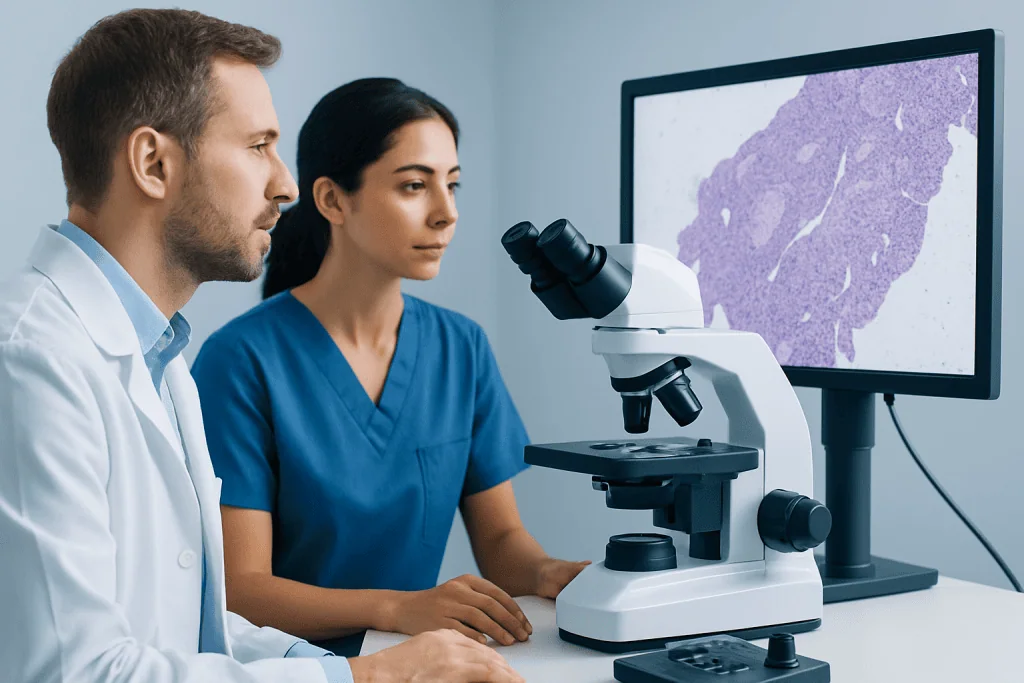
AI systems are trained on large sets of images paired with known diagnoses or outcomes. Over time, the program learns patterns associated with certain tumor types, gene mutations, likelihood of spread, or response to treatment. In pathology, a related approach can analyze digital microscope slides to help identify cancer cells, grade tumors, or highlight areas that need closer review by a specialist.
The information produced by digital biopsy is usually probabilistic rather than absolute. It may suggest that a lesion is more or less likely to be malignant, or that a tumor has features linked with a certain subtype. Doctors combine these insights with the patient’s symptoms, examination findings, blood tests, imaging reports, and, when needed, traditional biopsy results.
Because these tools depend on data quality, standardization matters. Differences in scanners, imaging protocols, timing of contrast, or slide preparation can affect the results. This is one reason why digital biopsy performs best when it is used within experienced centers and interpreted in the context of multidisciplinary cancer care.
Potential benefits and where it may help most

One of the main attractions of digital biopsy is that it can be noninvasive or minimally invasive. For some patients, obtaining tissue can be difficult because a tumor is in a hard-to-reach area, the procedure carries risk, or repeated sampling would be burdensome. In those situations, image-based analysis may offer useful additional information while reducing the need for extra procedures.
Digital biopsy may also help monitor cancer over time. Repeated scans can show how a tumor changes during treatment, potentially allowing doctors to identify response or resistance earlier. This can be especially relevant in patients receiving immunotherapy or chemotherapy, where treatment decisions often depend on careful follow-up.
Another possible advantage is that imaging can assess the whole tumor and multiple metastatic sites rather than a single sampled area. Cancers are often heterogeneous, meaning different parts of the same tumor can behave differently. A digital approach may capture some of this complexity in a way that a small tissue sample cannot.
Researchers are also exploring whether digital biopsy can predict molecular or genetic features from scans. If validated, that could help guide additional testing and prioritize the most informative next steps. It may be particularly useful in conditions such as lung cancer or breast cancer, where treatment planning increasingly depends on detailed tumor profiling.
What digital biopsy cannot replace
Despite its promise, digital biopsy cannot fully replace a tissue biopsy in most cancer cases. A traditional biopsy provides actual cells or tissue that can be examined under a microscope. This remains the standard way to confirm whether cancer is present, determine the exact type, and assess features such as grade, invasion, and certain markers that directly affect treatment choices.
Tissue samples are also essential for many laboratory tests that imaging alone cannot reliably provide. These may include immunohistochemistry, molecular profiling, receptor testing, and other genomic analyses. For example, treatment planning may depend on specific biomarkers that still require direct analysis of tumor material, sometimes alongside targeted therapy planning.
Digital biopsy may be less reliable when scans are unclear, tumors are very small, inflammation mimics cancer, or a model has not been well validated for a specific cancer type or patient population. AI systems can also be influenced by hidden biases in the data used to train them, which means performance may vary between hospitals or demographic groups.
For these reasons, digital biopsy should not be viewed as a shortcut around careful diagnosis. In most situations, it is best seen as a decision-support tool that helps clinicians ask better questions, select the most suitable tests, and follow disease more intelligently. It adds value, but it does not remove the need for pathology, clinical judgment, or patient-centered discussion.
How doctors use it alongside standard diagnosis
When a suspicious lesion is found, doctors usually begin with the established steps of cancer evaluation: medical history, physical examination, imaging, laboratory tests, and often tissue sampling. Digital biopsy can be added to this process to refine risk estimates or to help determine whether a lesion deserves urgent biopsy, short-interval follow-up, or broader staging.
In some patients, digital tools may help identify the most active or informative part of a tumor to sample. This can improve the efficiency of a conventional biopsy rather than replace it. In others, it may support treatment planning by estimating tumor burden, highlighting likely areas of spread, or tracking how lesions respond across time.
Multidisciplinary review is especially important. Radiologists, pathologists, oncologists, surgeons, and data specialists may all contribute to interpreting the findings. A digital result that suggests one possibility may be reconsidered if pathology or the clinical picture points in another direction. This combined approach helps reduce overreliance on any one test.
For patients receiving complex care such as radiotherapy, surgery, or systemic treatment, digital biopsy may become one part of ongoing assessment. The goal is not to let software make decisions on its own, but to provide clinicians with another layer of meaningful information.
Current limitations, safety, and patient questions
Patients often ask whether digital biopsy is accurate enough to avoid a needle or surgical biopsy. The honest answer is that it depends on the clinical situation, but usually not completely. Accuracy can be high in some settings, yet a suspected cancer often still needs tissue confirmation before major treatment begins.
Another common question is whether digital biopsy is safer. Because it relies mainly on existing scans or digitized slides, it may reduce the need for some additional procedures, which can be helpful. However, it does not remove the safety considerations linked to imaging itself, such as contrast use in selected tests or radiation exposure from certain scans.
Privacy and data use are also important issues. AI systems are trained and improved using large amounts of patient data, so health systems must handle that information carefully. Reputable centers use governance, anonymization, and quality controls to protect patients while maintaining clinical standards.
Patients may also wonder whether a digital result is final. It is not usually final on its own. If there is any uncertainty, doctors often recommend standard biopsy, repeat imaging, or additional pathology review. Reassurance comes from combining tools thoughtfully rather than expecting one technology to answer every question.
Looking ahead and when to seek specialist advice
Digital biopsy is likely to become more useful as imaging quality, computational methods, and validation studies improve. In the future, it may help personalize screening, guide biopsy targets more precisely, estimate prognosis, and monitor treatment response in a more dynamic way. Some applications are already entering clinical workflows, while others remain largely in research or early adoption phases.
Anyone told that a scan shows a suspicious lesion should discuss what the finding means, what tests are needed next, and whether a tissue biopsy is still recommended. It is reasonable to ask whether AI-assisted imaging analysis is being used, what it can add, and what its limitations are in that specific case. Decisions are best made with a cancer specialist who can explain the full picture clearly.
Medical attention should not be delayed if there are persistent warning signs such as unexplained weight loss, a new lump, bleeding, ongoing pain, or worsening fatigue. Even if digital tools suggest low risk, symptoms and clinical judgment still matter. A timely evaluation helps ensure that serious conditions are not missed.
For international patients seeking coordinated cancer assessment, Acibadem International’s multidisciplinary specialists and JCI-accredited hospitals diagnose and treat cancer using established standards together with advanced imaging and digital technologies where appropriate.
Frequently asked questions
Is digital biopsy the same as a liquid biopsy?
No. Digital biopsy usually refers to AI-based analysis of medical images or digital pathology slides, while liquid biopsy analyzes tumor-related material in blood or other body fluids. Both can provide useful information, but they work in very different ways and answer different clinical questions.
Can digital biopsy diagnose cancer by itself?
Usually not by itself. It may strongly suggest that a lesion is cancerous or help estimate tumor features, but most patients still need a standard tissue biopsy to confirm the diagnosis and guide treatment. Doctors interpret digital findings together with imaging, symptoms, and laboratory results.
Why is a tissue biopsy still important if imaging is very advanced?
A tissue biopsy provides real cells and tissue for microscopic examination and biomarker testing. This is often necessary to identify the exact cancer type and select the most suitable treatment. Imaging can support decisions, but it cannot yet replace all of the information a pathology lab can provide.
Does digital biopsy help avoid invasive procedures?
In some situations, it may reduce the need for additional procedures or help doctors decide when biopsy can be delayed safely. It can also help choose the best area to sample if a biopsy is needed. However, it does not eliminate invasive procedures in most confirmed or strongly suspected cancers.
Which cancers may benefit most from digital biopsy approaches?
Research is especially active in cancers commonly evaluated with detailed imaging, such as lung, breast, brain, prostate, and liver cancers. The usefulness varies by cancer type, stage, and the quality of available imaging data. A specialist can explain whether it is relevant in an individual case.
Are AI-based cancer tools always reliable?
No medical tool is perfect, including AI. Performance can vary depending on image quality, the patient population, and how the software was developed and validated. That is why AI results should be reviewed by qualified clinicians rather than used in isolation.
References
- World Health Organization
- National Cancer Institute
- American Cancer Society
- European Society for Medical Oncology
- Radiological Society of North America
This article is for general information only and is not a substitute for professional medical advice. Please consult a qualified doctor about your individual situation.
Oncology care in Turkey — second opinion and treatment plan
JCI-accredited · board-certified surgeons · reply within 24h
Add us as a Preferred Source to see more of our trusted health content across Google Search, AI Overviews and Discover.

More from the Health Library



Related Specialists

Dr. Tuğba Emüroğlu
Internal Medicine
Dr. Ferhat Erenler
Anesthesiology
Assoc. Prof. Dr. Hakan Yardımcı
General Surgery
Assoc. Prof. Dr. Sevgi Topal
Pediatric Intensive Care Unit