Esophageal Manometry: A Complete Medical Overview

Esophageal manometry checks how well the esophagus squeezes and relaxes during swallowing. It is most often used to evaluate trouble swallowing, chest pain not caused by the heart, and suspected esophageal motility disorders.
Key Takeaways
- Esophageal manometry checks how well the esophagus squeezes and relaxes during swallowing.
- It is most often used to evaluate trouble swallowing, chest pain not caused by the heart, and suspected esophageal motility disorders.
- The test does not treat a condition by itself, but it helps guide the most appropriate treatment plan.
- The procedure is usually brief, done without surgery, and causes temporary discomfort rather than lasting pain.
- Results can help identify conditions such as achalasia, esophageal spasm, and muscle weakness of the esophagus.
Esophageal manometry is a test that measures the pressure and coordination of muscles in the esophagus, including the valve between the esophagus and stomach. It is commonly used to investigate swallowing problems, unexplained chest discomfort, and suspected motility disorders when routine tests do not fully explain symptoms.
Overview: what esophageal manometry shows
Esophageal manometry is a diagnostic test that measures how the muscles of the esophagus work during swallowing. The esophagus is the tube that carries food and liquids from the mouth to the stomach. The test records pressure patterns along this tube and at the lower esophageal sphincter, the muscle valve that opens to let food pass into the stomach and then closes again.
This information is useful because swallowing depends on carefully timed muscle contractions. If those contractions are too weak, too strong, poorly coordinated, or if the valve does not relax normally, a person may develop symptoms such as food sticking, chest discomfort, regurgitation, or difficulty swallowing. Esophageal manometry helps doctors understand whether symptoms are related to an esophageal motility problem rather than a structural issue alone.
Unlike an endoscopy, which looks directly at the lining of the esophagus, manometry evaluates function. It does not show ulcers, inflammation, or tumors by itself. Instead, it provides a detailed map of pressure and movement, especially when performed with high-resolution technology, which uses multiple closely spaced sensors to give a clearer picture of swallowing mechanics.
Why this test may be recommended
A doctor may recommend esophageal manometry when a person has symptoms that suggest the esophagus is not moving food normally. Common reasons include difficulty swallowing, the sensation that food gets stuck after swallowing, repeated regurgitation, or chest pain that has not been explained by heart-related testing. It may also be used when reflux symptoms continue despite treatment or before certain procedures involving the esophagus.
The test is particularly helpful when other investigations have already looked for structural causes. For example, an endoscopy may show that the esophagus looks normal, while symptoms still suggest a functional problem. In that situation, manometry can reveal whether the muscle contractions are weak, absent, or uncoordinated.
It is also often used before anti-reflux surgery to understand esophageal function and help plan treatment safely. In some people, the test helps confirm disorders such as achalasia or clarify whether symptoms might be linked to a broader gastroesophageal reflux disease picture, especially when reflux and motility issues overlap.
Symptoms and conditions linked to abnormal results

Esophageal manometry does not diagnose symptoms in isolation; it helps connect symptoms to specific patterns of muscle function. People who undergo the test often report trouble swallowing solids or liquids, a feeling of pressure in the chest after meals, repeated belching or regurgitation, or pain that seems to come from the esophagus rather than the heart. Some also feel that swallowing requires unusual effort.
Several conditions can be identified or supported by the test results. These include achalasia, in which the lower esophageal sphincter does not relax properly and the esophageal body loses normal movement; distal esophageal spasm, in which contractions can be premature or uncoordinated; hypercontractile esophagus, where contractions are excessively strong; and ineffective esophageal motility, where the esophagus contracts too weakly to move food efficiently.
Abnormal findings can also appear in people with connective tissue diseases, long-standing reflux, or after prior foregut surgery. However, a manometry result must always be interpreted together with symptoms, endoscopy findings, imaging, and sometimes pH testing. A pressure pattern alone does not always explain how severe a person’s symptoms are or which treatment is best.
How to prepare and what happens during the test
Preparation instructions can vary slightly by center, but patients are usually asked not to eat or drink for several hours before the test. A doctor may also advise stopping certain medications that affect esophageal movement, depending on the reason for testing. Because instructions differ, it is important to follow the specific guidance given by the testing team.
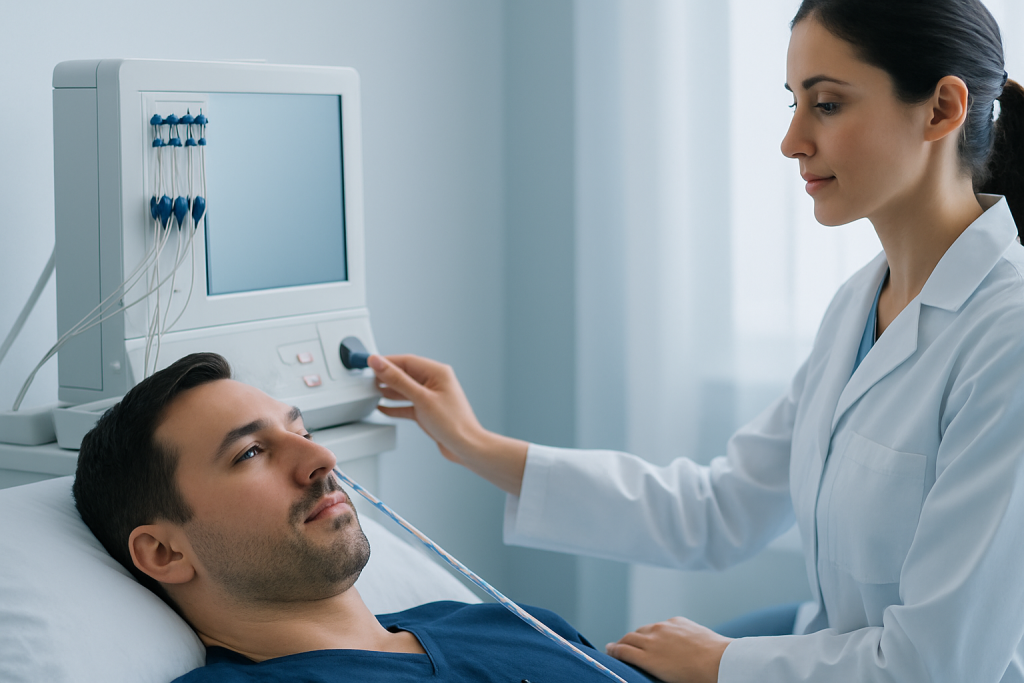
During esophageal manometry, a thin flexible tube with pressure sensors is gently passed through the nose and into the esophagus. This can feel uncomfortable, but it is generally brief and does not require surgery. Once the tube is in place, the patient is usually asked to lie down or remain in a specific position and swallow small amounts of water several times while the device records pressure changes.
The test typically takes a short time, and most people can go home soon afterward. The main sensations are temporary gagging, watery eyes, nasal irritation, or throat discomfort. Sedation is usually avoided because it can affect esophageal muscle function and change the accuracy of the results.
In some cases, doctors may combine functional assessment with other tests to build a more complete picture. Depending on symptoms, this could be alongside endoscopy or reflux testing, especially if the goal is to distinguish a motility disorder from inflammation or acid-related symptoms.
Understanding the results
After the test, the recorded pressure tracings are analyzed by a specialist. The report looks at how effectively the esophagus generates waves of contraction after each swallow, whether those waves move in an organized way from top to bottom, and whether the lower esophageal sphincter relaxes at the right time. High-resolution manometry allows these patterns to be classified using widely accepted medical criteria.
A normal result means that pressure and coordination appear appropriate for swallowing. An abnormal result may show weak contractions, absent contractions, delayed or impaired relaxation of the lower esophageal sphincter, or contractions that are too forceful or premature. Each pattern points toward different possible motility disorders and can help explain why symptoms are occurring.
The results are not interpreted in isolation. Doctors usually combine them with the patient’s symptoms and findings from other studies such as barium swallow, endoscopy, or reflux monitoring. This step is important because treatment decisions depend not only on the pressure pattern but also on whether symptoms are frequent, severe, and clearly related to the abnormality found.
Treatment options after esophageal manometry
Esophageal manometry itself is not a treatment, but it helps direct treatment more accurately. The next step depends on what the test shows. If a person has ineffective or weak esophageal motility, management may focus on treating contributing conditions, adjusting eating habits, and reviewing medications. If reflux is part of the problem, treatment may include dietary measures and therapies aimed at reducing acid exposure.
When the test supports a diagnosis such as achalasia, treatment may aim to improve the opening of the lower esophageal sphincter. Depending on the individual case, options can include endoscopic therapy, surgery, or other specialized interventions. For selected patients with clearly defined motility disorders, doctors may discuss peroral endoscopic myotomy or esophagus surgery when appropriate.
For chest pain related to esophageal spasm or hypercontractile patterns, treatment may involve medications, reflux management, and careful evaluation of symptom triggers. In people with swallowing difficulties, tailored eating advice and coordinated follow-up are often important. A personalized plan is especially valuable because the same symptom can have different causes in different patients.
Near the end of the diagnostic process, some patients benefit from a multidisciplinary review that includes gastroenterology, surgery, and radiology expertise. Acibadem International’s multidisciplinary specialists in JCI-accredited hospitals diagnose and treat esophageal motility disorders for international patients when advanced evaluation is needed.
Self-care, practical tips, and limits of the test
After the test, most people can return to normal activities quickly. Mild throat or nasal irritation may occur for a short time, and sipping water later in the day may help if allowed by the medical team. If symptoms such as swallowing difficulty are ongoing, it may help to eat slowly, take small bites, chew thoroughly, and avoid lying down immediately after meals until the doctor provides a more specific plan.
It is also useful to keep track of symptoms before and after testing. Noting whether problems happen with solids, liquids, both, or only occasionally can help the doctor interpret results more accurately. Triggers such as very hot or cold drinks, large meals, or stress may also provide clues, although they do not replace medical testing.
Esophageal manometry has important strengths, but it also has limits. It does not directly detect ulcers, narrowing, cancer, or inflammation, and it does not measure acid reflux on its own. That is why it is often one part of a broader workup rather than a stand-alone answer.
When to seek medical care
Medical evaluation is important if swallowing becomes difficult, painful, or progressively worse. A person should also seek care for repeated food sticking, ongoing regurgitation, unexplained chest discomfort, or symptoms that interfere with eating and hydration. These problems are often treatable, but they need proper assessment to identify the cause.
Urgent care is needed if someone cannot swallow saliva, has sudden severe chest pain, vomits blood, passes black stools, or develops signs of dehydration. Immediate medical attention is also appropriate when chest pain could possibly be heart-related, especially if it occurs with shortness of breath, faintness, sweating, or pain radiating to the arm or jaw.
If symptoms are persistent but not urgent, a gastroenterologist may recommend further evaluation with manometry and related tests. Early assessment can help distinguish between reflux, muscle dysfunction, structural narrowing, and other digestive causes, leading to more targeted treatment and reassurance.
Frequently asked questions
What is esophageal manometry used for?
Esophageal manometry is used to measure how the muscles of the esophagus work during swallowing. It helps doctors investigate symptoms such as difficulty swallowing, unexplained chest pain, regurgitation, and suspected motility disorders.
Is esophageal manometry painful?
Most people find esophageal manometry uncomfortable rather than painful. The tube passing through the nose can cause gagging, watery eyes, or brief throat and nasal irritation, but these sensations usually settle soon after the test.
How long does esophageal manometry take?
The procedure itself is usually relatively short, often completed within about 30 minutes, although preparation and positioning may add extra time. Exact timing can vary depending on the testing center and the type of manometry used.
Do patients need sedation for esophageal manometry?
Sedation is usually not used because it can affect the normal movement of the esophagus and make results less reliable. The test is generally performed while the patient is awake so swallowing function can be measured accurately.
What conditions can esophageal manometry diagnose?
The test can help diagnose or support the diagnosis of conditions such as achalasia, distal esophageal spasm, hypercontractile esophagus, and ineffective esophageal motility. It may also help doctors assess esophageal function before anti-reflux surgery.
Can I eat after esophageal manometry?
Many people can return to eating and drinking soon after the test, depending on their doctor’s instructions. If the throat feels irritated, starting with small sips and soft foods may feel more comfortable.
References
- National Institute of Diabetes and Digestive and Kidney Diseases
- American College of Gastroenterology
- American Gastroenterological Association
- National Library of Medicine
- European Society of Gastrointestinal Endoscopy
This article is for general information only and is not a substitute for professional medical advice. Please consult a qualified doctor about your individual situation.
Persistent digestive symptoms? Get evaluated in Turkey
JCI-accredited · board-certified surgeons · reply within 24h
Add us as a Preferred Source to see more of our trusted health content across Google Search, AI Overviews and Discover.

More from the Health Library

Bed Iodine: What Patients Need to Know

Acv with Cinnamon: What Patients Need to Know

Sultanas: A Complete Medical Overview

Lump at Clavicle — Explained by Medical Evidence, Not Myths

Brachycephaly: What Patients Need to Know