Fibrosarcoma: Diagnosis, Outlook, and Modern Treatment Approaches

Fibrosarcoma is a rare cancer of fibrous soft tissue diagnosed by expert pathology and imaging; treatment usually centers on surgery, often with radiation or…
Key Takeaways
- Fibrosarcoma is an uncommon type of soft tissue sarcoma that may develop in deep tissues of the limbs, trunk, head and neck, or other sites.
- A biopsy reviewed by an experienced sarcoma pathologist is central to confirming the diagnosis and identifying the tumor subtype.
- Surgery to remove the tumor completely is the main treatment when fibrosarcoma is localized; radiation and systemic therapy may be used in selected situations.
- Modern molecular testing is particularly important in infantile fibrosarcoma, which often has gene changes that can guide treatment.
- Outlook varies widely and is influenced by tumor stage, grade, size, location, surgical margins, and response to treatment.
- A new, enlarging, deep, or persistent lump should be assessed by a qualified clinician rather than monitored indefinitely at home.
Fibrosarcoma is a rare malignant tumor arising from fibroblasts, cells that help form connective and fibrous tissue. Accurate diagnosis by a specialist sarcoma team is essential because several other tumors can look similar, and treatment and outlook depend on the subtype, location, size, grade, and spread of disease.
Fibrosarcoma at a glance
Fibrosarcoma is a rare cancer that develops in fibrous connective tissue. It belongs to the broader group of cancers called soft tissue sarcomas. Although it can occur in different parts of the body, it often develops in deep tissue around the arms, legs, or trunk. It may also involve bone in uncommon cases.
The term fibrosarcoma is used more carefully today than in the past. Improvements in pathology and genetic testing have shown that some tumors once labeled fibrosarcoma are actually other sarcoma types. For this reason, confirmation by a pathologist with experience in sarcoma is particularly important before treatment decisions are made.
There are important differences between adult-type fibrosarcoma and infantile fibrosarcoma. Adult-type disease is very uncommon and is usually managed according to soft tissue sarcoma principles. Infantile fibrosarcoma occurs in babies and young children, often affects an arm or leg, and commonly has a characteristic genetic alteration that may open the door to targeted treatment.
Symptoms and signs of fibrosarcoma
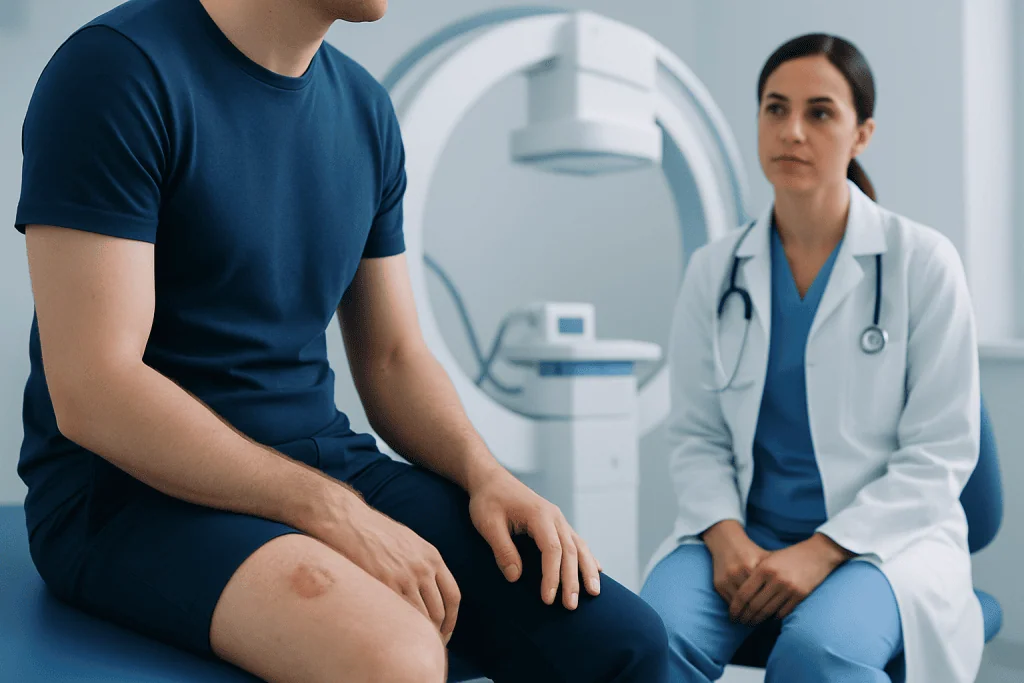
The most common sign is a lump or swelling that gradually increases in size. A fibrosarcoma is often located deep beneath the skin, so it may not be noticed until it becomes larger. Some lumps are painless, especially early on, while others cause aching, tenderness, or pressure as they grow.
Symptoms depend greatly on the tumor’s location. A tumor in a limb may cause reduced movement, weakness, numbness, or tingling if it presses on muscles, nerves, or blood vessels. Tumors in the chest, abdomen, pelvis, or head and neck may produce symptoms related to nearby organs or structures, although these presentations are less common.
These symptoms do not usually mean that a person has cancer. Benign conditions such as cysts, lipomas, muscle injuries, and other noncancerous growths are much more common. Still, a lump that is enlarging, firm, deep, painful, or larger than a golf ball merits medical assessment.
- A growing lump or area of swelling
- Persistent pain or pressure near a mass
- Reduced movement or function in a nearby joint or limb
- Numbness, tingling, weakness, or circulation changes in an affected limb
Causes and risk factors

In most people, the exact cause of fibrosarcoma is not known. It is not contagious, and there is usually nothing a person did or did not do that clearly caused it. Like other cancers, it develops when cells acquire changes that allow them to grow and divide abnormally.
Most fibrosarcomas occur without an inherited cause. Previous radiation treatment is a recognized risk factor for some types of sarcoma, although the absolute risk remains low and radiation therapy continues to be an important treatment for many cancers. Certain long-standing tissue changes and rare inherited cancer predisposition syndromes can also increase the likelihood of developing a sarcoma, but these factors account for only a small proportion of cases.
Infantile fibrosarcoma is biologically distinct from most adult sarcomas. It frequently carries an NTRK gene fusion, commonly involving ETV6 and NTRK3. This genetic change occurs within the tumor and is generally not inherited from a parent, but identifying it can be highly relevant to treatment planning.
How fibrosarcoma is diagnosed and staged
Assessment usually begins with a medical history and physical examination, followed by imaging. Magnetic resonance imaging (MRI) is often useful for tumors in an arm, leg, or trunk because it shows the relationship between a mass and nearby muscles, nerves, blood vessels, and bones. Computed tomography (CT), ultrasound, or other imaging may be used depending on the site and clinical question.
A biopsy is needed to establish the diagnosis. Whenever possible, the biopsy should be planned by the team that would perform definitive surgery, since the biopsy pathway may need to be removed during the operation. A core needle biopsy is commonly used and often provides enough tissue for microscopic examination, immunohistochemistry, and molecular testing.
Pathologists evaluate the tumor’s appearance, cell features, and growth pattern, while specialized laboratory tests help exclude other sarcomas that can resemble fibrosarcoma. Genetic testing is especially important in children and may be useful in adults when the diagnosis is uncertain or when targeted therapies are being considered.
After diagnosis, staging evaluates whether the cancer is localized or has spread. This commonly includes chest imaging because some soft tissue sarcomas can spread to the lungs. The multidisciplinary team also considers tumor size, depth, grade, location, and whether complete surgical removal appears feasible.
Modern treatment approaches
Treatment is individualized at a specialist sarcoma center. For localized fibrosarcoma, surgery is generally the main treatment. The goal is to remove the tumor in one piece with a margin of normal tissue when possible, while preserving function. Modern limb-sparing operations often make it possible to avoid amputation, though the safest approach depends on the tumor’s position and involvement of important structures.
Radiation therapy may be recommended before or after surgery for selected tumors, particularly when the tumor is large, deep, higher grade, or close to critical tissues. It can lower the risk of cancer returning in the same area. The timing and expected benefits are discussed carefully because radiation can also affect wound healing and surrounding healthy tissue.
Chemotherapy is not necessary for every person with fibrosarcoma. It may be considered when disease is advanced, has spread, cannot be fully removed, or has features associated with a higher risk of recurrence. Drug selection depends on the precise pathology, the person’s overall health, prior treatments, and treatment goals.
For infantile fibrosarcoma with an NTRK fusion, targeted TRK inhibitor medicines may be an option, particularly when surgery would cause major functional loss or when the tumor cannot be removed safely. These treatments illustrate why molecular diagnosis matters. Clinical trials may also be appropriate for some people with recurrent or advanced sarcoma.
Outlook, follow-up, and daily life
The outlook for fibrosarcoma varies considerably, so it is best discussed using the individual’s pathology report and imaging results rather than a single statistic. In general, localized tumors that can be completely removed tend to have a more favorable outlook than tumors that have spread. Tumor size, grade, depth, location, surgical margins, and tumor subtype all influence the likelihood of recurrence.
Follow-up is an important part of care because sarcomas can recur locally or, less commonly, spread to other areas. Visits commonly include a physical examination of the treated area and imaging tailored to the original tumor site and risk profile. Follow-up schedules are more frequent in the first years after treatment and may become less frequent over time.
Rehabilitation can help restore strength, movement, and confidence after surgery or radiation. Depending on the treatment area, care may involve physiotherapy, occupational therapy, pain management, nutrition support, and emotional support. Patients should report a new lump, persistent pain, breathing symptoms, or a change at the surgical site between scheduled appointments.
Acibadem International’s multidisciplinary specialists and JCI-accredited hospitals support international patients with sarcoma diagnosis, treatment planning, surgery, systemic therapy, radiation therapy, and rehabilitation when appropriate.
When to seek medical care
A person should arrange a medical evaluation for any lump that is growing, persists for several weeks, feels firm or fixed, is deep under the skin, or causes ongoing discomfort. Assessment is also advisable if a lump is associated with weakness, numbness, reduced limb function, or unexplained swelling.
More prompt medical attention is appropriate for rapidly enlarging swelling, severe or worsening pain, sudden loss of function, marked color or temperature changes in a limb, or symptoms that interfere with breathing or swallowing. These signs can have many causes, but they should not be ignored.
People with a suspected soft tissue sarcoma benefit from referral to a team experienced in sarcoma care before an unplanned excision is performed. Careful imaging and biopsy planning can improve diagnostic accuracy and help the surgical team plan treatment that addresses both cancer control and long-term function.
Frequently asked questions
Is fibrosarcoma the same as soft tissue sarcoma?
Fibrosarcoma is one specific type of soft tissue sarcoma, a group of rare cancers that arise in supporting tissues such as muscle, fat, blood vessels, nerves, and fibrous tissue. Its diagnosis requires careful pathology because several other sarcoma types can have overlapping features. The precise subtype helps guide treatment and follow-up.
Can fibrosarcoma be cured?
Some localized fibrosarcomas can be treated successfully, particularly when they can be completely removed with appropriate surgery and, when indicated, radiation therapy. However, the chance of long-term control varies by tumor subtype, grade, size, site, and whether it has spread. The treating sarcoma team can explain the outlook based on individual findings.
Does fibrosarcoma spread?
Fibrosarcoma can spread, but the risk differs from person to person. When soft tissue sarcomas spread, the lungs are a common site, which is why chest imaging is often included in staging and follow-up. Regular surveillance helps clinicians identify any recurrence or spread as early as possible.
What does a fibrosarcoma lump feel like?
It may feel like a firm, deep lump that slowly enlarges, but there is no single sensation that confirms fibrosarcoma. It can be painless or painful, and it may affect movement or nerves depending on its location. Because benign lumps are common, imaging and biopsy are needed for a reliable diagnosis.
Why is a specialist review important before fibrosarcoma surgery?
The route used for a biopsy and the extent of the first operation can affect future treatment options. Sarcoma specialists can coordinate imaging, pathology review, biopsy planning, surgery, radiation, and rehabilitation. This approach helps ensure that treatment is based on the most accurate diagnosis and is planned around both cancer control and function.
Is infantile fibrosarcoma inherited?
Infantile fibrosarcoma usually results from a genetic change that occurs in the tumor itself and is not typically inherited. Many cases have an NTRK-related gene fusion, which can be detected through molecular testing. This information may help the care team consider targeted therapy when appropriate.
This article is for general information only and is not a substitute for professional medical advice. Please consult a qualified doctor about your individual situation.
Oncology care in Turkey — second opinion and treatment plan
JCI-accredited · board-certified surgeons · reply within 24h
Add us as a Preferred Source to see more of our trusted health content across Google Search, AI Overviews and Discover.

More from the Health Library

Replacement for Tramadol: Procedure, Recovery and Results

Retinitis Pigmentosa: Diagnosis, Outlook, and Modern Treatment Approaches
Bicep Tendonitis: Diagnosis, Outlook, and Modern Treatment Approaches

Wallenberg Syndrome: Symptoms, Causes, and Treatment Options

Plantar Warts Disease: Symptoms, Causes, and Treatment Options