Finger Splint: An Evidence-Based Guide for Patients

A finger splint helps stabilize a finger and limit movement while tissues heal. Different finger injuries need different splints, so self-treatment is not always enough.
Key Takeaways
- A finger splint helps stabilize a finger and limit movement while tissues heal.
- Different finger injuries need different splints, so self-treatment is not always enough.
- Pain, swelling, bruising, deformity, numbness, or inability to straighten or bend the finger may need medical evaluation.
- A splint should feel supportive, not painfully tight, and the skin should be checked regularly.
- Some conditions can be managed with buddy taping, while others need custom splinting or surgery.
A finger splint is a device used to protect, support, and limit movement in an injured or irritated finger. It can help with healing after a sprain, tendon injury, fracture, or joint irritation, but the right type and fit matter.
Overview: what a finger splint does
A finger splint is a supportive device that holds one finger in a safer position after injury or during recovery. In simple terms, it helps reduce movement, protect the joint or tendon, and give irritated tissues time to heal. Depending on the problem, a finger splint may be used for a short period after a minor injury or for several weeks under medical supervision.
Finger splints are not all the same. Some are soft and adjustable, while others are rigid and keep the finger almost completely still. A splint may support the fingertip, the middle joint, the base of the finger, or the whole finger. Because different structures can be injured, the best splint depends on whether the problem involves a ligament, tendon, joint, or bone.
For many people, the main goals are pain relief, protection, and improved healing. A splint can also help prevent an injury from getting worse during everyday activities. However, wearing the wrong splint, wearing it incorrectly, or using one for too long can lead to stiffness, skin irritation, or delayed treatment of a more serious injury.
Common reasons a finger splint may be used
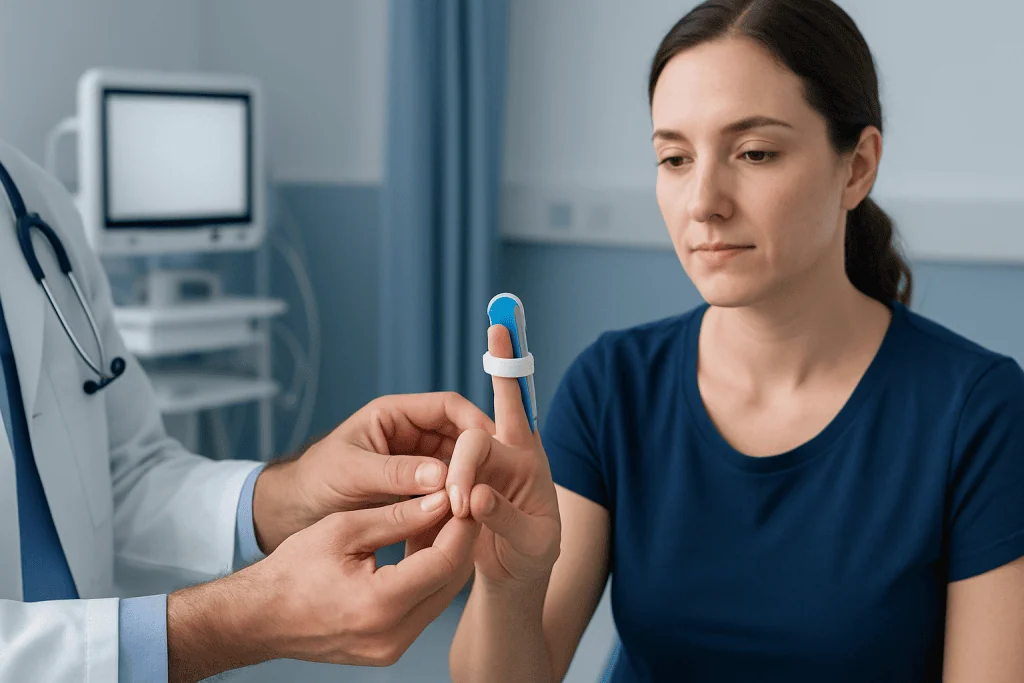
A finger splint may be recommended after a jammed finger, sports injury, fall, work accident, or repetitive strain. It is often used for sprains, tendon injuries, dislocations after reduction, fractures, and flare-ups of joint pain. Some people also use a splint temporarily after procedures or surgery, based on their clinician’s advice.
One well-known example is mallet finger, where the fingertip droops because the tendon that straightens the end joint has been injured. In this situation, keeping the fingertip in the correct position continuously is especially important. Other injuries may involve collateral ligament sprains, volar plate injuries, or irritation from overuse.
A finger splint can also be part of treatment for a broken finger or a severe sprain. In some mild cases, simple buddy taping to a neighboring finger may be enough, but this depends on the exact injury. If a finger looks crooked, catches, locks, or loses normal motion, professional assessment is usually safer than choosing a splint without guidance.
- Sprained finger joints
- Tendon injuries such as mallet finger
- Stable fractures or post-reduction support
- Dislocations after medical treatment
- Arthritis flare-ups or overuse irritation
Symptoms that may mean a splint is needed

People often consider a finger splint when a finger becomes painful, swollen, bruised, or difficult to move after an injury. The finger may feel weak, unstable, stiff, or tender when touched. Sometimes the main sign is that the fingertip or middle joint will not straighten or bend normally.
Not every sore finger needs a splint, but certain signs suggest that support may help while the person is being evaluated. These include pain with gripping, visible swelling around a joint, or a finger that feels unstable during movement. A splint may also be useful if motion clearly worsens pain or if the finger is at risk of being bumped during daily tasks.
Some symptoms point to a more significant injury that should not be managed with a store-bought splint alone. These include major deformity, severe swelling, open wounds, persistent numbness, pale or bluish skin, or inability to move the finger at all. If the finger remains very painful after a blow or twist, an examination and imaging may be needed to rule out a fracture or tendon rupture.
Types of finger splints and how they differ
There are several kinds of finger splints, and each is designed for a different purpose. A stack or mallet splint supports the tip of the finger and is commonly used when the end joint needs to stay straight. Aluminum foam splints are commonly shaped around the finger to limit movement. Thermoplastic custom splints may be made by a hand therapist or clinician for a more precise fit.
Buddy taping is another simple approach, where the injured finger is taped to the finger next to it. This can help guide motion and add mild stability in selected sprains or stable injuries. However, buddy taping is not suitable for every problem, especially if there is deformity, suspected fracture, skin injury, or a need to keep a specific joint completely still.
The best finger splint is the one that matches the diagnosis and fits comfortably. A proper splint should stabilize the needed joint without excessive pressure on the skin. If a person has ongoing symptoms, repeated injuries, or a complicated fracture, the care plan may involve hand surgery consultation or supervised rehabilitation rather than splinting alone.
Diagnosis: why the exact injury matters
A clinician usually begins with a history of how the injury happened and a physical examination of the finger, hand, and nearby joints. They may look for swelling, bruising, tenderness, range of motion, joint stability, circulation, and sensation. Comparing the injured finger with the other hand often helps identify subtle deformity or loss of function.
X-rays are commonly used when a fracture or dislocation is suspected. In some cases, imaging can also show whether a tendon injury has pulled off a small piece of bone. If the problem is more complex, a specialist may recommend further assessment through a hand clinic or orthopedic team. This is especially relevant when the finger does not line up properly, movement is severely limited, or symptoms do not improve as expected.
An accurate diagnosis matters because different injuries heal best in different positions. For example, a mallet injury may need strict continuous splinting of the fingertip, while other problems may improve faster with controlled movement. If there is concern about damage beyond the finger itself, evaluation by orthopedics and traumatology specialists can help guide treatment safely.
Treatment options, fit, and day-to-day care
Treatment depends on the cause and severity of the problem. Minor sprains may improve with rest, ice, elevation, and a short period of support such as buddy taping or splinting. Tendon injuries, fractures, and unstable joints often need a more specific splinting plan and closer follow-up. In some cases, reduction of a dislocation, formal therapy, or surgery may be necessary.
A finger splint should feel snug but not tight. The finger should not become numb, cold, blue, or increasingly swollen while wearing it. Skin care is important because moisture and pressure can cause irritation, especially if the splint is worn continuously. People should follow their clinician’s instructions about when the splint can be removed, if at all, for hygiene or exercises.
Recovery often includes gradual return to motion once healing is underway. Hand exercises may be introduced to reduce stiffness and restore function, but these should only begin when advised. Persistent pain, locking, or reduced motion may benefit from physical therapy and rehabilitation, especially after prolonged immobilization or a more complex injury.
- Keep the splint clean and dry unless told otherwise
- Check the skin daily for redness, sores, or pressure marks
- Do not adjust the position if the doctor has prescribed a specific angle
- Remove rings early if swelling is present
- Attend follow-up visits to confirm healing and alignment
Prevention and self-care after finger injury
Not every finger injury can be prevented, but a few practical steps can lower risk. During sports or manual work, good technique, protective gloves when appropriate, and attention to hand placement can help. Early rest after a jammed or twisted finger may prevent repeated strain that turns a mild injury into a more persistent one.
At home, self-care should focus on protecting the finger without ignoring warning signs. Rest, ice wrapped in cloth, elevation, and temporary support may ease symptoms in the first day or two. Rings should be removed promptly if swelling develops. Over-the-counter pain relief may help some people, but it should not replace evaluation when symptoms are severe or unusual.
Once pain and swelling improve, it is still wise to avoid forceful gripping or sport too soon. Returning to activity before healing is complete can re-injure the finger or prolong stiffness. If symptoms continue, a clinician may assess whether the issue is a tendon injury, hidden fracture, or another hand condition that needs a different approach.
When to seek medical care
Medical care is important if a finger looks deformed, cannot be straightened or bent, has severe swelling, or remains very painful after an injury. Evaluation is also needed if there is numbness, tingling, a cut over the joint, bleeding under the nail with significant pain, or any sign that circulation is affected. These features may point to a fracture, tendon injury, dislocation, or nerve involvement.
People should also seek care if a finger splint seems to make symptoms worse. Increasing pain, skin breakdown, color change, or swelling beyond the splint can mean the fit is wrong or the injury needs closer attention. If a finger is not improving over several days, or if function is not returning as expected, reassessment is sensible.
Near the end of the care pathway, some patients may benefit from specialist review for diagnosis, splinting guidance, imaging, rehabilitation, or procedural treatment. Acibadem International’s multidisciplinary specialists and JCI-accredited hospitals evaluate and treat hand and finger conditions for international patients when further care is needed.
Frequently asked questions
How long should a finger splint be worn?
The time varies depending on the injury. A mild sprain may need only short-term support, while tendon injuries such as mallet finger may require continuous splinting for several weeks. A doctor or hand specialist should decide the timing because too little or too much immobilization can both cause problems.
Can a finger splint heal a broken finger?
A finger splint can be part of treatment for some stable finger fractures, but not all broken fingers are treated the same way. Some need reduction, closer monitoring, or surgery to restore alignment and function. An X-ray is often needed to choose the safest treatment.
Is buddy taping the same as using a finger splint?
No. Buddy taping supports an injured finger by attaching it to a neighboring finger, while a finger splint usually provides more direct positioning or immobilization. Buddy taping can be helpful for some mild injuries, but it is not appropriate for every fracture, tendon injury, or dislocation.
Should a finger splint be worn at night?
Some finger injuries require the splint to stay on day and night, especially when keeping a joint in one exact position is important. In other cases, a clinician may allow removal for exercises or hygiene. The safest approach is to follow the specific instructions given for that injury.
What are signs that a finger splint is too tight?
A splint may be too tight if the finger becomes numb, tingles, turns pale or bluish, feels cold, or swells more after it is applied. Throbbing pain or pressure marks on the skin can also be warning signs. If these happen, medical advice should be sought promptly.
Can a finger become stiff from wearing a splint?
Yes, stiffness can happen, especially if the finger is immobilized longer than necessary. That is one reason why the right diagnosis and follow-up matter. Once it is safe, guided movement or hand therapy may help restore motion and function.
References
- American Academy of Orthopaedic Surgeons
- American Society for Surgery of the Hand
- National Institute of Arthritis and Musculoskeletal and Skin Diseases
- MedlinePlus
- NHS
This article is for general information only and is not a substitute for professional medical advice. Please consult a qualified doctor about your individual situation.
Joint and spine care in Turkey — expert assessment & treatment
JCI-accredited · board-certified surgeons · reply within 24h
Add us as a Preferred Source to see more of our trusted health content across Google Search, AI Overviews and Discover.

More from the Health Library

Patch of Pimples: A Complete Medical Overview

Low Grade Fever — Explained by Medical Evidence, Not Myths

Cardiac Muscle Tissue: What Patients Need to Know

Foul Taste in the Mouth: A Complete Medical Overview

Acute Renal Failure: What Patients Need to Know