Front Squat vs Back Squat: Key Differences and How Doctors Tell Them Apart
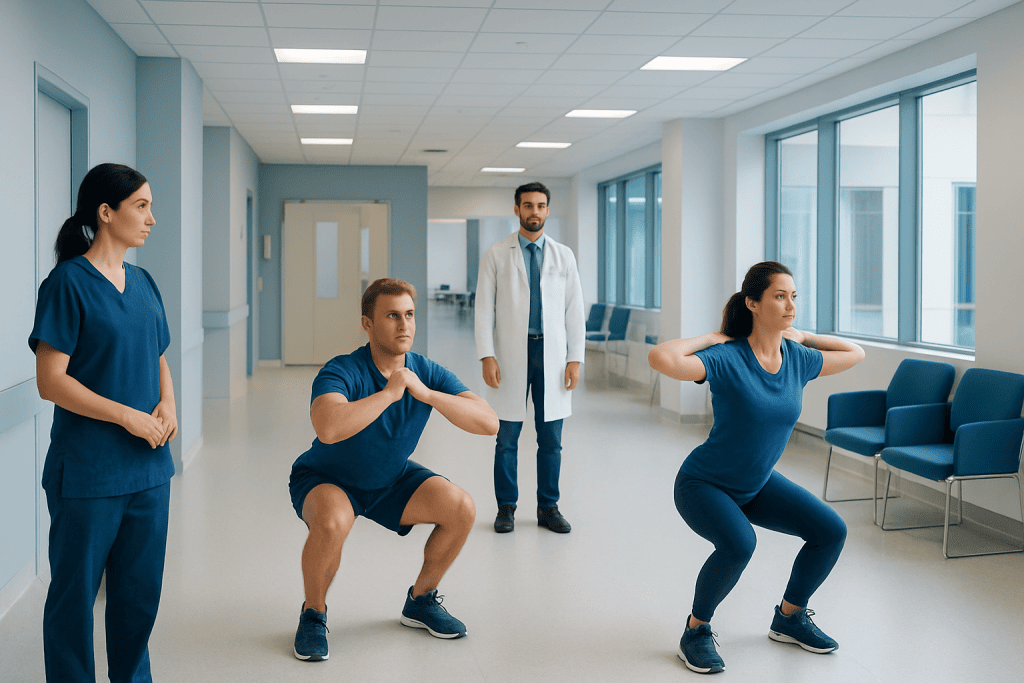
Front squats generally place greater demands on ankle, wrist, shoulder and upper-back mobility, while back squats may require more hip and trunk control. Both exercises train the quadriceps, gluteal muscles and core, but their bar positions change posture and how forces are distributed through the body.
Key Takeaways
- Front squats generally place greater demands on ankle, wrist, shoulder and upper-back mobility, while back squats may require more hip and trunk control.
- Both exercises train the quadriceps, gluteal muscles and core, but their bar positions change posture and how forces are distributed through the body.
- Clinicians assess pain location, movement quality, range of motion, strength, training history and possible injury rather than diagnosing a problem from squat style alone.
- Pain that is sharp, persistent, associated with swelling, weakness, numbness or inability to bear weight should be medically assessed.
- Reducing load, improving technique and progressing gradually can help many people return to squatting safely when no significant injury is present.
Front squats hold the bar across the front of the shoulders and usually require a more upright torso, while back squats place the bar on the upper back and may allow greater hip involvement and heavier loading. Neither variation is universally better; the appropriate choice depends on mobility, training goals, technique, symptoms and any underlying musculoskeletal condition.
Front Squat vs Back Squat at a Glance
In a front squat, the barbell rests on the front of the shoulders, supported by the hands and upper chest. In a back squat, the bar rests across the upper back, usually over the trapezius muscles. This difference changes the lifter’s center of mass: front squats commonly encourage a more upright trunk, whereas back squats often involve a greater forward lean from the hips.
| Feature | Front squat | Back squat |
|---|---|---|
| Bar position | Across the front of the shoulders | Across the upper back |
| Typical torso position | More upright | More forward lean, depending on anatomy and bar placement |
| Mobility demands | Often higher at the ankles, wrists, shoulders and upper back | Often higher demand for hip control and trunk stability |
| Muscles emphasized | Quadriceps and trunk muscles, alongside gluteal muscles | Gluteal muscles, quadriceps, trunk and hip muscles |
| Common limiting factor | Difficulty maintaining the front-rack position or an upright chest | Difficulty controlling pelvic, knee or trunk position under load |
Both movements are compound strength exercises. They can support lower-body strength, bone health and function when matched to the individual’s capacity. However, a person who experiences discomfort in one variation should not assume that the other is automatically safe; the cause of symptoms and the quality of movement matter more than the name of the exercise.
How the Two Squats Feel and Move
During a well-controlled front squat, the elbows are usually held forward so that the bar remains balanced over the middle of the foot. The knees may travel forward as the hips and knees bend together. This is a normal part of many front-squat patterns, provided the feet stay stable and the knees track comfortably in line with the toes.
In a back squat, the athlete may use a high-bar position, where the bar sits higher on the upper back, or a lower position farther down the back. These variations can change torso angle and hip involvement. A back squat does not need to look identical for every person: limb length, ankle flexibility, hip structure and stance width all influence the movement.
Front squats may feel uncomfortable at the wrists, shoulders or collarbone region if the front-rack position is limited. Back squats may feel challenging through the hips, lower back or shoulders if the bar position cannot be maintained comfortably. Muscle effort and temporary fatigue are expected during training, but joint pain, catching, instability or symptoms that worsen with each repetition deserve attention.
How a Clinician Tells the Difference Between Technique Limits and Injury

A doctor, physiotherapist or sports medicine clinician does not usually decide that front squats or back squats are inherently harmful. Instead, they ask what happens during the movement: where symptoms occur, whether pain starts during descent or ascent, what load is used, whether there was a sudden injury, and whether symptoms affect walking, sleep or daily activities.
The assessment commonly includes observation of a bodyweight squat or the relevant barbell pattern, when appropriate and safe. The clinician may look at foot stability, ankle motion, knee alignment, hip control, pelvic position, spinal control and the ability to keep the bar path balanced. They also examine the painful area, assess strength and range of motion, and compare both sides of the body.
For example, front-rack discomfort may relate to restricted wrist extension, shoulder movement or upper-back mobility. Pain at the front of the knee may be associated with training volume, patellar tendon irritation, poor load tolerance or another knee condition. Back pain can reflect many factors, including technique, rapid load progression, muscle strain or a condition requiring a more detailed assessment. Imaging is not routinely needed for every squat-related symptom, but may be considered after significant trauma, persistent symptoms or concerning examination findings.
A clinician also considers the broader training picture. A recent increase in weight, repetitions, frequency, depth or other activity may explain overload symptoms even when technique appears reasonable. Sleep, nutrition, recovery, previous injury and medical conditions can affect how well tissues tolerate exercise.
What to Do if Front Squats Cause Symptoms
If front squats cause mild discomfort without swelling, weakness or loss of function, a short period of load reduction may be helpful. This can mean using less weight, fewer repetitions, a shallower range of motion or a variation that permits comfortable control. Symptoms should not be pushed through if they become sharp, change movement mechanics or continue to increase.
When the limiting issue is the front-rack position, a qualified professional may suggest gradual mobility work for the wrists, shoulders, thoracic spine and ankles. Some people use crossed-arm, strap-assisted or specialty-bar variations, but these should be selected carefully because they alter bar control and may not suit every person. Improving the squat does not require forcing painful wrist or shoulder positions.
For pain around the knee, hip or lower back, the priority is usually identifying the aggravating factor and restoring tolerable loading. Exercises such as split squats, step-ups, leg presses or goblet squats may sometimes be used as temporary alternatives, depending on the individual’s symptoms and assessment. A structured physical therapy program can help address movement control, strength and a safe return to training when needed.
What to Do if Back Squats Cause Symptoms
Back-squat discomfort may improve when training load is reduced and the person reviews stance, bar placement, footwear and depth with a qualified coach or clinician. The aim is not to force a single “perfect” posture. It is to find a repeatable position that keeps the feet stable, allows controlled hip and knee motion, and does not provoke significant symptoms.
Shoulder discomfort can arise from the arm and hand position used to secure the bar. Adjusting grip width, hand placement or bar position may reduce strain for some people, while others may need to use a different exercise temporarily. People with a recent shoulder injury, marked loss of shoulder motion or pain during everyday reaching should seek individualized advice before continuing heavy barbell training.
Lower-back symptoms deserve particular care. A temporary muscular ache after unfamiliar exercise can occur, but pain that shoots into the buttock or leg, causes numbness or weakness, or is accompanied by changes in bladder or bowel control needs prompt medical assessment. Persistent mechanical back pain may benefit from evaluation and individualized rehabilitation rather than repeated attempts to train through it.
When symptoms arise after a clear twist, fall, failed lift or sudden painful event, stopping the activity is sensible. A clinician can determine whether the issue is likely a strain, tendon or joint irritation, or a more significant injury. This may include assessment for conditions such as a herniated disc when the history and neurological symptoms suggest it.
Prevention and Safer Squat Training
The safest squat variation is generally the one a person can perform with stable, comfortable technique and a load appropriate to their current conditioning. Beginning with bodyweight, goblet or lightly loaded versions can help establish control before heavier barbell work. Progression should be gradual, especially after time away from exercise or a recent illness or injury.
A warm-up can include a few minutes of general activity followed by lighter practice sets of the planned movement. Adequate recovery between demanding sessions, sufficient nutrition and attention to sleep can support adaptation. Training through severe fatigue may make it harder to maintain consistent control, particularly with complex free-weight exercises.
Footwear and environment also matter. Flat, stable shoes or weightlifting shoes may help some lifters maintain balance, while unstable surfaces are not appropriate for loaded squats. A spotter, safety arms or a rack with appropriate safety settings can reduce risk when lifting heavier weights. Instruction from a qualified strength professional is especially valuable for beginners and for people returning after injury.
People with known osteoporosis, inflammatory joint disease, prior spine surgery, significant arthritis, neurological conditions or pregnancy-related concerns should ask their treating clinician which exercise modifications are suitable. The goal is to maintain activity safely, not to avoid strength training unnecessarily.
When to Seek Medical Care
Medical assessment is advisable for pain that persists despite reducing activity, repeatedly returns with squatting, or limits normal walking, stairs, work or sleep. It is also appropriate when a person notices joint swelling, bruising, locking, giving way, reduced range of motion or a clear decline in strength.
Urgent medical care is needed after major trauma, an obvious deformity, inability to bear weight, rapidly increasing swelling, fever with a painful swollen joint, or new numbness and weakness. New loss of bladder or bowel control, numbness around the groin or buttocks, or severe back pain with progressive leg weakness requires emergency evaluation.
A sports medicine, orthopedic or rehabilitation professional can help distinguish temporary training-related soreness from a condition that needs treatment. Acibadem International’s multidisciplinary specialists and JCI-accredited hospitals evaluate musculoskeletal symptoms and support international patients with diagnosis and individualized care plans.
Frequently asked questions
Is a front squat safer than a back squat?
Neither exercise is automatically safer for every person. Safety depends on technique, current strength, mobility, training load, equipment and any existing injury or health condition. A variation that causes pain or cannot be performed with controlled balance may need to be modified or paused.
Which muscles do front squats and back squats work?
Both exercises work the quadriceps, gluteal muscles, hip muscles and trunk stabilizers. Front squats often create a greater demand for maintaining an upright torso and may feel more quadriceps-focused. Back squats may allow greater hip involvement, although muscle use varies with bar position, depth and individual technique.
Why do my wrists hurt during front squats?
Wrist discomfort may occur when the front-rack position requires more wrist extension than a person can comfortably achieve. Limited shoulder or upper-back mobility can also shift strain into the wrists. Persistent pain should be assessed rather than forced, particularly if it is associated with swelling, weakness or numbness.
Why does my lower back hurt during back squats?
Lower-back pain can result from excessive training load, fatigue, reduced trunk control, a rapid increase in exercise volume or a muscle strain. It may also reflect an unrelated spinal condition. Pain that travels down the leg, causes numbness or weakness, or does not improve after modifying activity should be medically evaluated.
Can someone with knee pain still squat?
Some people with knee pain can continue a modified form of squatting, but the right approach depends on the cause and severity of symptoms. Reducing load, changing depth or choosing another lower-body exercise may be appropriate. A clinician can advise when pain is persistent, swollen, unstable or follows an injury.
Should beginners start with front squats or back squats?
Beginners often benefit from learning a comfortable bodyweight or goblet squat before using a barbell. Either front or back squat may be introduced later with appropriate instruction and gradual loading. The choice should reflect the person’s mobility, confidence, goals and ability to maintain a stable, pain-free position.
This article is for general information only and is not a substitute for professional medical advice. Please consult a qualified doctor about your individual situation.
Joint and spine care in Turkey — expert assessment & treatment
JCI-accredited · board-certified surgeons · reply within 24h
Add us as a Preferred Source to see more of our trusted health content across Google Search, AI Overviews and Discover.

More from the Health Library

What Is a Bruising? Causes, Explanations, and Next Steps

How to Build Muscle? Here Is What the Evidence Says

Can You Take Cialis and Viagra Together? A Doctor-Reviewed Answer

How Long Does It Take to Get Braces on? A Doctor-Reviewed Answer

Nerve Pain: Possible Causes and When to Seek Care