FUE vs DHI Hair Transplant: Differences, Results, and Which Is Right for You

FUE usually describes the extraction of follicular units from the donor area. DHI usually describes implantation with a pen-like device that can place grafts directly.
Key Takeaways
- FUE usually describes the extraction of follicular units from the donor area.
- DHI usually describes implantation with a pen-like device that can place grafts directly.
- Both methods can produce natural-looking results when planned and performed well.
- The best choice depends on the scalp, donor supply, hairline goals, and surgical team experience.
- A medical assessment is important to confirm the cause of hair loss before treatment.
FUE vs DHI is not simply a question of “better” or “worse.” In most cases, FUE refers to how follicles are removed, while DHI refers to how they are implanted, so the right option depends on hair loss pattern, hair characteristics, desired density, and the surgeon’s technique.
Overview: FUE vs DHI at a Glance
For people comparing fue vs dhi, the short answer is that both are modern hair transplant techniques that move healthy hair follicles from a donor area, usually the back or sides of the scalp, to areas of thinning or baldness. The key difference is that FUE most often describes how grafts are collected, while DHI highlights a specific way those grafts are implanted using a specialized implanter device.
This means the comparison can be confusing at first. In practice, many procedures use follicular unit extraction to harvest grafts, and then use either traditional channel-opening methods or DHI-style direct implantation to place them. Rather than asking which method is universally best, it is more useful to ask which approach fits the person’s pattern of hair loss, donor hair quality, styling goals, and scalp condition.
Hair transplantation is usually considered for stable hair loss, especially male pattern baldness and selected cases of female pattern hair loss or scar-related loss. A thorough consultation helps confirm whether hair loss is suitable for surgery or whether medical treatment, observation, or a combined plan would be more appropriate.
How FUE and DHI Differ
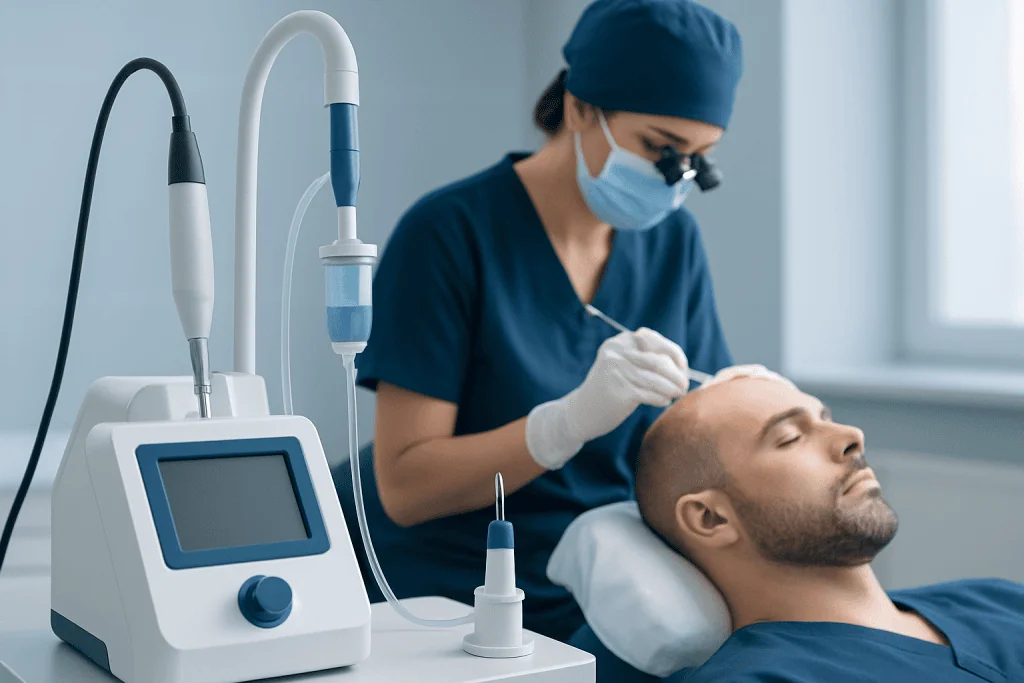
In a standard FUE-based procedure, individual follicular units are removed one by one from the donor area with a small punch tool. After extraction, the surgical team prepares the recipient area, often by creating tiny channels or incisions, and then places the grafts into those sites. The goal is to follow the natural direction, angle, and density of existing hair so the result looks balanced.
In DHI, follicular units are also commonly obtained by FUE extraction, but the implantation step is different. The graft is loaded into a pen-like implanter, and the clinician places it directly into the scalp. This can allow careful control over depth, direction, and angle during placement. Because of this, DHI is often discussed as a more placement-focused variation rather than a completely separate transplant category.
Neither method automatically guarantees a better outcome. Naturalness depends on surgical planning, the quality of graft handling, donor management, and realistic design. For readers exploring procedure details, a general hair transplant evaluation typically covers donor assessment, graft estimates, and discussion of whether a shaving or non-shaving approach is feasible.
- FUE: emphasizes individual follicle extraction
- DHI: emphasizes direct implantation with an implanter pen
- Shared goal: safe graft survival and natural-looking growth
- Main deciding factors: scalp characteristics, density goals, and surgeon preference
Results, Density, and What to Expect

When performed well, both FUE and DHI can create soft hairlines and good cosmetic coverage. Final appearance is influenced less by the label of the method and more by the number of healthy grafts available, the quality of the donor area, the caliber and curl of the hair, and how conservatively the hairline is designed. People with a strong donor area and realistic expectations often achieve the most satisfying outcomes.
DHI is sometimes chosen when precise implantation is especially important, such as refining the hairline or working between existing hairs in an area that is thinning but not completely bald. FUE with channel opening may be preferred in cases that require broad coverage over larger areas. However, these are not strict rules, and treatment plans can vary from one patient to another.
Hair transplant results also take time. Newly transplanted hairs often shed in the first weeks, then re-enter a growth cycle over months. Full maturation usually develops gradually, not immediately. People comparing timelines may also find it helpful to review related questions such as hair transplant recovery timeline and how coverage planning relates to how many grafts are needed for a hair transplant.
It is also important to understand that transplantation redistributes existing hair; it does not stop future native hair loss. For that reason, some people benefit from combining surgery with medical treatment for ongoing thinning, depending on the cause of hair loss and the doctor’s advice.
Who May Be a Good Candidate
Good candidates are usually people with pattern hair loss that has become relatively stable, along with enough healthy donor hair to move. Age alone does not determine suitability. What matters more is whether the pattern of loss is established, whether expectations are realistic, and whether the scalp and general health support a safe procedure.
Doctors also consider the hair characteristics themselves. Thick or wavy hair can create the appearance of fuller coverage with fewer grafts, while very fine or straight hair may need different planning. The color contrast between hair and scalp, the size of the thinning area, and previous procedures all play a role in choosing between implantation techniques.
Not every person with shedding is a transplant candidate. Some types of hair loss are temporary, inflammatory, diffuse, or autoimmune and may need medical treatment first. That is why scalp examination is essential before any procedure. In some cases, surgery may be delayed, modified, or avoided to protect long-term results.
Evaluation Before Choosing a Method
A proper consultation usually begins with a medical history and scalp examination. The clinician will look at the pattern of hair loss, donor density, miniaturization of existing hairs, scalp health, and any signs of conditions that could affect healing or graft survival. Photographs may be used to support planning and track change over time.
Patients are often asked about family history, medications, smoking, and previous scalp procedures. If the diagnosis is not straightforward, the doctor may recommend tests or dermatology assessment before discussing surgery. This is especially important when shedding is sudden, patchy, painful, inflamed, or associated with other symptoms.
The consultation should also cover goals in practical terms: hairline shape, expected density, whether one or more sessions may be needed, and how future hair loss could affect appearance. For people with more advanced hair loss patterns, the discussion may naturally include long-term planning frameworks such as the Norwood scale.
Treatment Planning, Recovery, and Self-care
Choosing between FUE and DHI is part of a larger treatment plan rather than a stand-alone decision. The plan may include surgical design, donor preservation, supportive medical therapy, and aftercare. People with active thinning often benefit from discussing whether treatments such as PRP treatment or medical therapy may help support the surrounding non-transplanted hair, depending on the doctor’s assessment.
Recovery after either method usually involves mild tenderness, redness, and tiny scabs in the treated areas for a short period. Patients are advised to follow washing instructions carefully, avoid scratching the scalp, protect it from sun exposure, and avoid strenuous activity for the recommended time. The transplanted area should be handled gently while the grafts settle.
It is normal to be concerned if newly transplanted hairs shed after the procedure. This early shedding phase does not usually mean the transplant has failed. The follicles remain under the skin and typically begin new growth later. Because individual healing and growth vary, regular follow-up helps the team monitor progress and advise on next steps.
Near the end of the treatment journey, some patients may also discuss appearance goals beyond scalp coverage, such as refinement of beard or eyebrow areas, but those are planned separately and depend on anatomy, donor supply, and specialist advice.
When to Seek Medical Care
Medical assessment is important before surgery if hair loss is sudden, rapidly worsening, patchy, painful, itchy, or associated with redness, scaling, or scarring. These features can suggest a condition that may need medical treatment rather than immediate transplantation. A doctor should also assess hair loss linked with recent illness, major stress, hormonal changes, or medication use.
After a transplant, patients should contact their treating team if they develop increasing pain, worsening swelling, persistent bleeding, fever, pus, or signs of infection. Advice is also important if there is significant trauma to the grafted area or concern that postoperative instructions were not followed.
People who are unsure whether FUE or DHI is suitable should seek evaluation from qualified specialists experienced in hair restoration and scalp disorders. Acibadem International’s multidisciplinary specialists and JCI-accredited hospitals diagnose and treat hair loss and provide individualized transplant planning for international patients.
Frequently asked questions
Is DHI better than FUE?
Not necessarily. DHI may offer very controlled graft placement, while FUE is the standard way many grafts are extracted. The best approach depends on the scalp, donor hair, area being treated, and the experience of the surgical team.
Do FUE and DHI give different-looking results?
Both can produce natural-looking results when the hairline design, graft handling, and placement are done well. The final look depends more on planning and surgical execution than on the method name alone. Hair characteristics such as thickness, curl, and color contrast also influence the outcome.
Is one method more painful than the other?
Both are usually performed with local anesthesia, so pain during the procedure is generally limited. Mild soreness or tightness afterward can happen with either method. Recovery experiences vary from person to person.
Which method is better for the hairline?
DHI is sometimes selected for detailed hairline work because of the control offered by the implanter device. However, a natural hairline can also be achieved with FUE-based implantation using other placement methods. Hairline success depends on artistry, angle, direction, and conservative design.
Can women have FUE or DHI hair transplant?
Yes, some women are candidates, but the cause of hair loss must be evaluated carefully first. Diffuse thinning, hormonal factors, or inflammatory scalp conditions may affect whether surgery is appropriate. A specialist can help decide whether transplant or medical treatment is the better first step.
How long does it take to see final results?
Hair growth after transplant is gradual. Early shedding is common, and visible regrowth usually develops over several months, with maturation continuing afterward. Doctors typically explain that patience is needed before judging the final cosmetic result.
References
- American Academy of Dermatology
- British Association of Dermatologists
- International Society of Hair Restoration Surgery
- National Health Service
- Mayo Clinic
This article is for general information only and is not a substitute for professional medical advice. Please consult a qualified doctor about your individual situation.
DHI Hair Transplant in Turkey — costs, top hospitals & a free quote
JCI-accredited · board-certified surgeons · reply within 24h
Add us as a Preferred Source to see more of our trusted health content across Google Search, AI Overviews and Discover.

Hair Transplant
Modern FUE and DHI hair restoration with natural, lasting results.
More from the Health Library



Related Specialists
Dr. Veysel Doğan
Emergency Service
Prof. Dr. Emel Özcan
Physical Medicine & Rehabilitation
Assoc. Prof. Dr. Mehmet Barburoğlu
Interventional Neuroradiology
Dr. Tolga Hüner
General Surgery